audiobriefs
8:31in productionCh. 1 · Born in '67, reborn with a band/ 8:31 · ceiling 15 min
Mixing & mastering · Studio & recording

API 550

It doesn’t bend to your taste—it bends frequencies with surgical repetition.

The API 550b is a four-band analog EQ re-issuing the 1967 API 550 with an added band. It offers seven switchable frequency centres per band, ±12 dB boost/cut, shelf/peak switching on bands 1 and 4, Proportional Q, reciprocal and repeatable filtering, and a +30 dBu clipping level. It uses API’s 2520 op amp and is built to original blueprints.

Chapters & takeaways4
  1. 0:53
    Born in '67, reborn with a band

    A faithful expansion of a 1967 design—not a reinterpretation.

  2. 1:52
    Switches, not sliders

    Seven fixed frequencies per band. ±12 dB. No faders—only switches.

  3. 2:53
    Where it shapes—and where it locks

    Shelf/peak only on bands 1 and 4. Proportional Q tightens at extremes.

  4. 4:16
    Repeatable. Unclipping.

    Reciprocal filtering means cut and boost mirror each other. +30 dBu headroom prevents clipping.

Worth your time?

Yes. Use the whole thing.

4.5/ 5
What works
  • delivers consistent, repeatable equalisation across multiple units
  • Proportional Q gives tighter control at extreme settings
  • +30 dBu clipping level handles hot signals without distortion
What does not
  • offer continuous frequency selection
  • allow independent Q control
  • provide notch or band-pass modes
  • extend shelf/peak switching beyond bands 1 and 4
Use it if
  • engineers tracking and mixing in analog or hybrid studios
  • those who value channel-to-channel consistency and high-headroom EQ
Skip it if
  • producers relying on real-time parameter automation
  • those needing granular frequency control
The written brief1 min read

What it is and what it was built for

A re-issue of the 1967 API 550 EQ, expanded to four bands. Built for studio mixing and mastering where precise, reliable tonal shaping is required.

How it works, in terms a player would use

Four bands. Each has seven fixed frequency centres. Each gives ±12 dB boost or cut. Bands 1 and 4 switch between shelf and peak. Proportional Q narrows the filter at extreme settings. Filtering is reciprocal and repeatable.

What it does better than anything else

It delivers consistent, repeatable equalisation across multiple units. Its Proportional Q gives tighter control at extremes. Its +30 dBu clipping level handles hot signals without distortion.

What it does badly

It does not offer continuous frequency selection. It does not allow independent Q control. It does not provide notch or band-pass modes. Shelf/peak switching is limited to bands 1 and 4.

What people made with it

The sources do not state what people made with it.

Who should use it, and who should not

Engineers who track and mix in analog or hybrid studios. Those who value channel-to-channel consistency and high-headroom EQ. Not for producers relying on real-time parameter automation or granular frequency control.

Is it worth your time

Yes—if you need aggressive, surgical EQ with high headroom and consistent behaviour across channels. No—if you need smooth sweeps, variable Q, or more than four bands.
Same bench · Mixing & mastering4 of 6
10:23
1176 Peak LimiterUREIThe UREI 1176 Peak Limiter is a fast, characterful, all-solid-state audio compressor introduced in 1968. It uses a field-effect transistor in feedback configuration for gain reduction. Compression is soft-knee with a fixed threshold controlled by input level. Four ratios — 4:1, 8:1, 12:1, 20:1 — each raise the threshold. Attack and release are program-dependent. Stereo linking is supported. The 'all-button mode' adds harmonic distortion and alters compression behaviour. It marked the transition from vacuum tube to solid-state technology in studio dynamics processing.
8:48
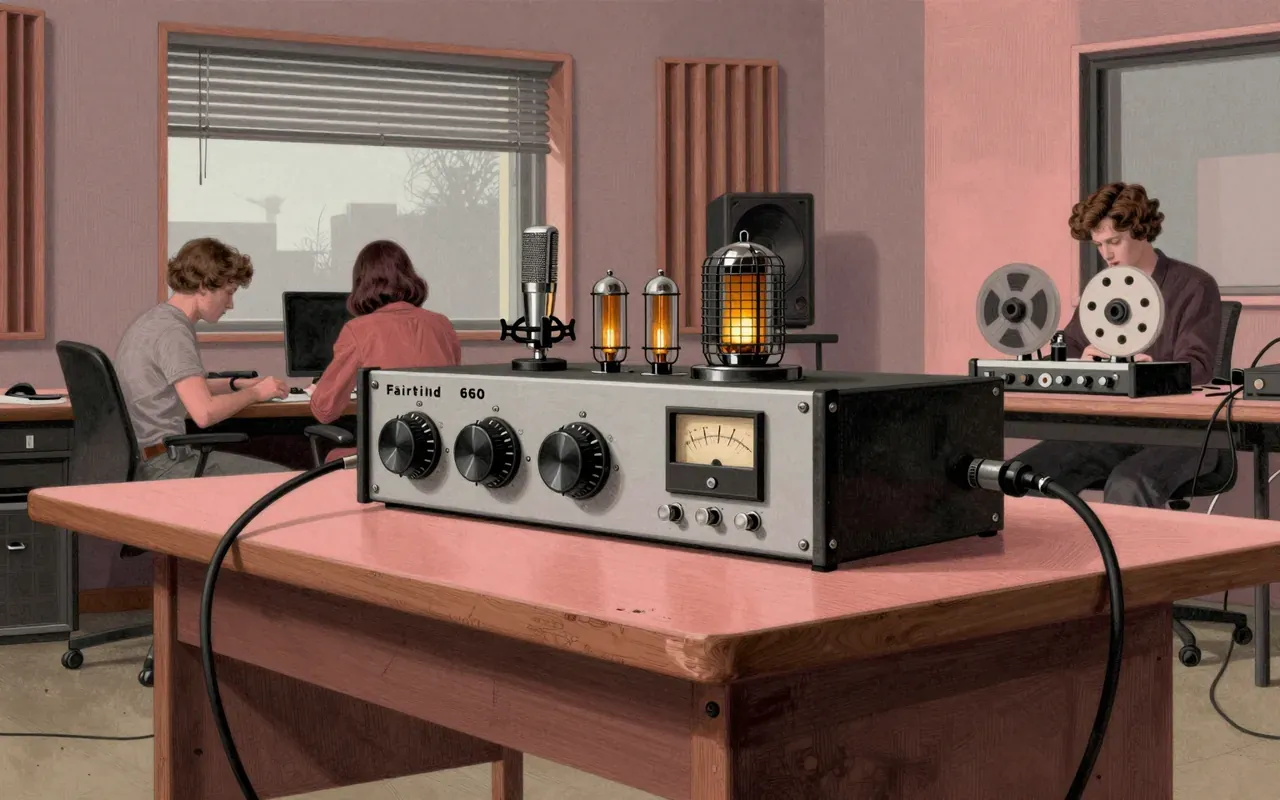
Fairchild 660FairchildThe Fairchild 660 is a mono tube compressor introduced in 1959. It was the first intelligent automatic volume control limiter. Designed by Rein Narma, the first ten units were built by him. The first unit went to Rudy Van Gelder, who used it to cut lacquer masters for Blue Note Records and Vox Records. It functions as a compressor (2:1, threshold 5 dB below normal) or peak limiter (30:1, threshold 10 dB above normal), with fixed 1/10,000-second attack and variable release. Its push-pull amplification and high control voltage yield low distortion, low noise, and no audible thumps.
9:00
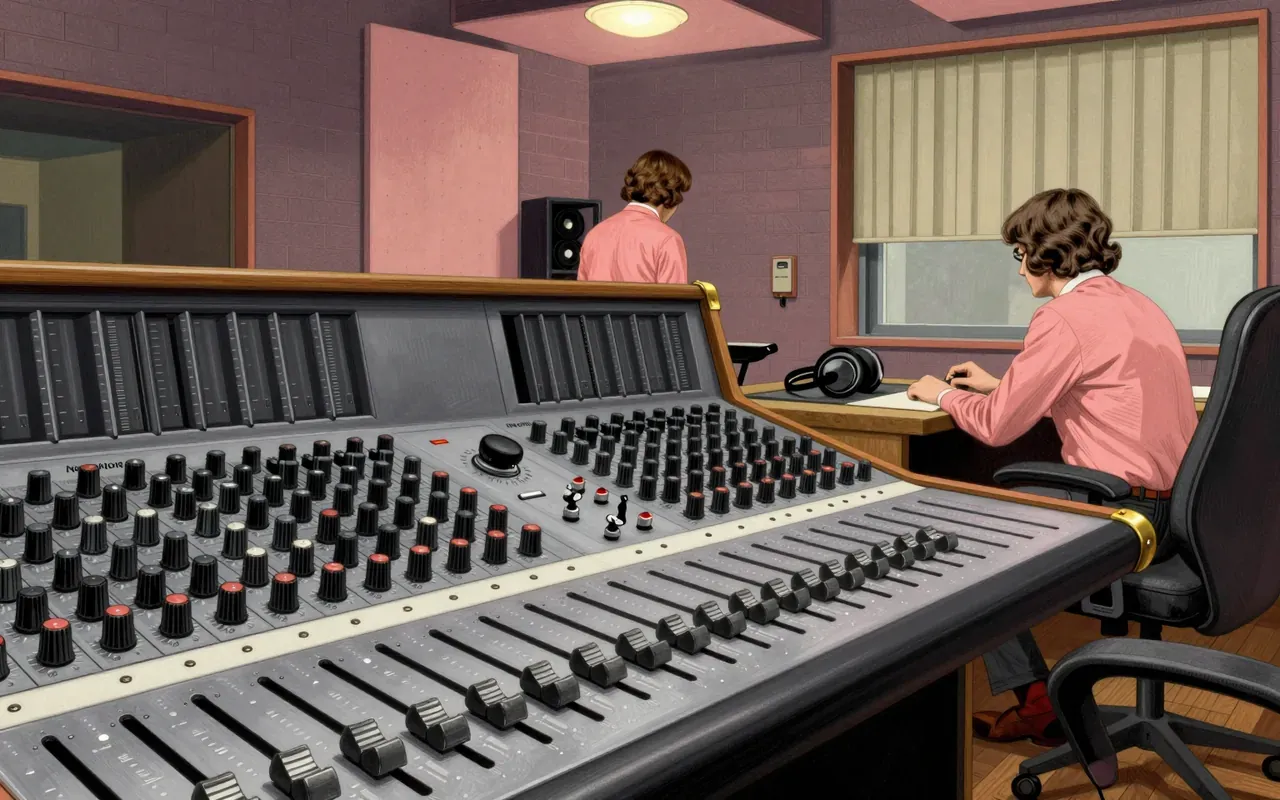
Neve 80 SeriesNeveThe Neve 80 Series is a hand-wired analogue mixing console built from 1968 to 1979. It uses custom preamps, line amps, and compressor/limiters wired point-to-point by hand. The 8048 model features the 1081 preamp and 4-band EQ across 24 or 32 channels. In 1976, Neve launched the in-line-monitor 8058 and 8068. Late-’70s units offered NECAM, the world’s first successful moving-fader automation system. Production was limited; manufacturing ceased in 1979.
9:46
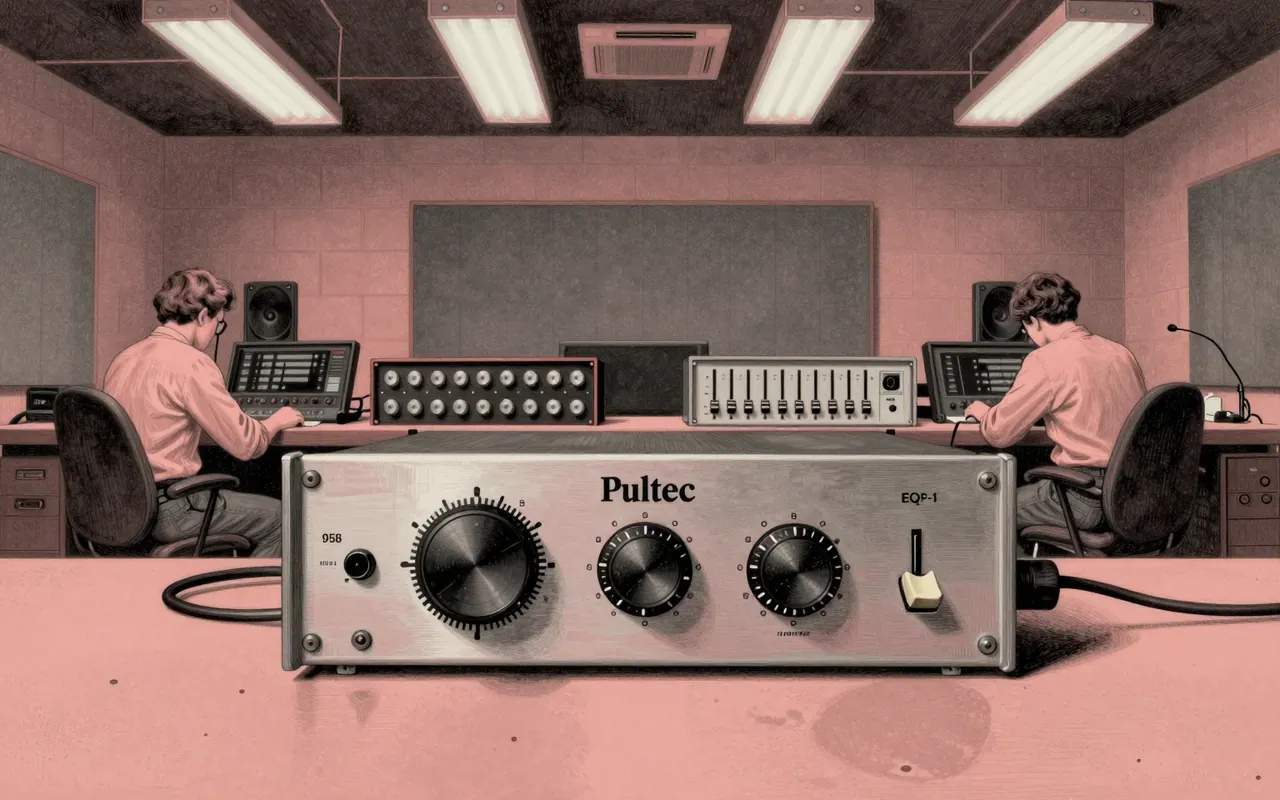
Pultec EQP-1PultecThe Pultec EQP-1 is a passive, tube-amplified equalizer introduced in 1956 in a 3U 19-inch rack chassis, designed specifically for professional recording studios to overcome noise issues in existing film-industry equalizers. It features a low-frequency shelving filter with three bands (30, 60, 100 Hz) and a parametric high-frequency section with boost frequencies at 3, 5, 8, 10, and 12 kHz plus adjustable bandwidth. Its design enabled simultaneous boost and attenuation of adjacent low frequencies — a technique later adopted despite being discouraged in the original manual.
Up next in Audio

Mutable Instruments Braids

Mutable Instruments · 8:19

One knob for brightness, one for chaos—45 synthesis methods in 16 HP, with no way to tweak what’s inside.

8:19