audiobriefs
Topic

Recording

Capturing a performance, and slowly replacing it.

286
in audio
9:09
average
2616 min
in total
810
across the network
Recording across the network →
All briefs286
9:42

4003

Rickenbacker · 1980

The Rickenbacker 4003 debuted in 1980 as a near-twin of the 4001 with an updated truss rod system made for roundwound strings. It has neck-through construction, has stayed in continuous production, and has spawned five-string, eight-string, fretless, limited-edition and signature versions.

9:11

Danelectro 59 DC

Danelectro

The 59DC was one of the first two reissues of Danelectro's Shorthorn line, sold between 1998 and 2001 with two pickups. The Shorthorn design it reissues is a dual cutaway hollow body of Masonite and poplar, with a Coke bottle style headstock and a seal shaped pickguard carrying stacked tone and volume knobs.

8:35

J37

Studer · 1964

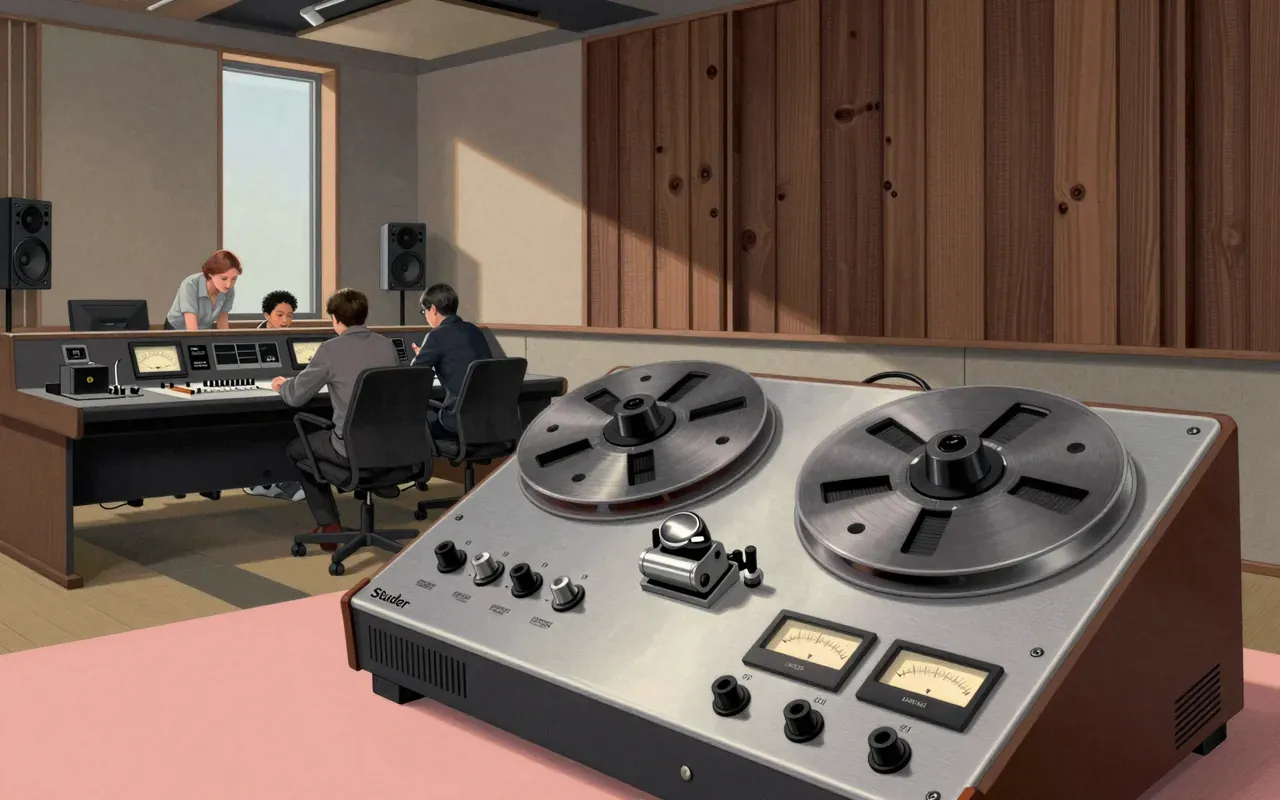
The J37 is Studer’s first multitrack machine, released in 1964. It recorded four tracks on one-inch tape. At EMI Studios London, later renamed Abbey Road Studios, The Beatles used a pair of J37s to record Sgt. Pepper’s Lonely Hearts Club Band in 1967. Studer went on to build 8-, 16- and 24-track machines with tape up to two inches wide.

8:50

Neve 1272 Line Amp

Neve

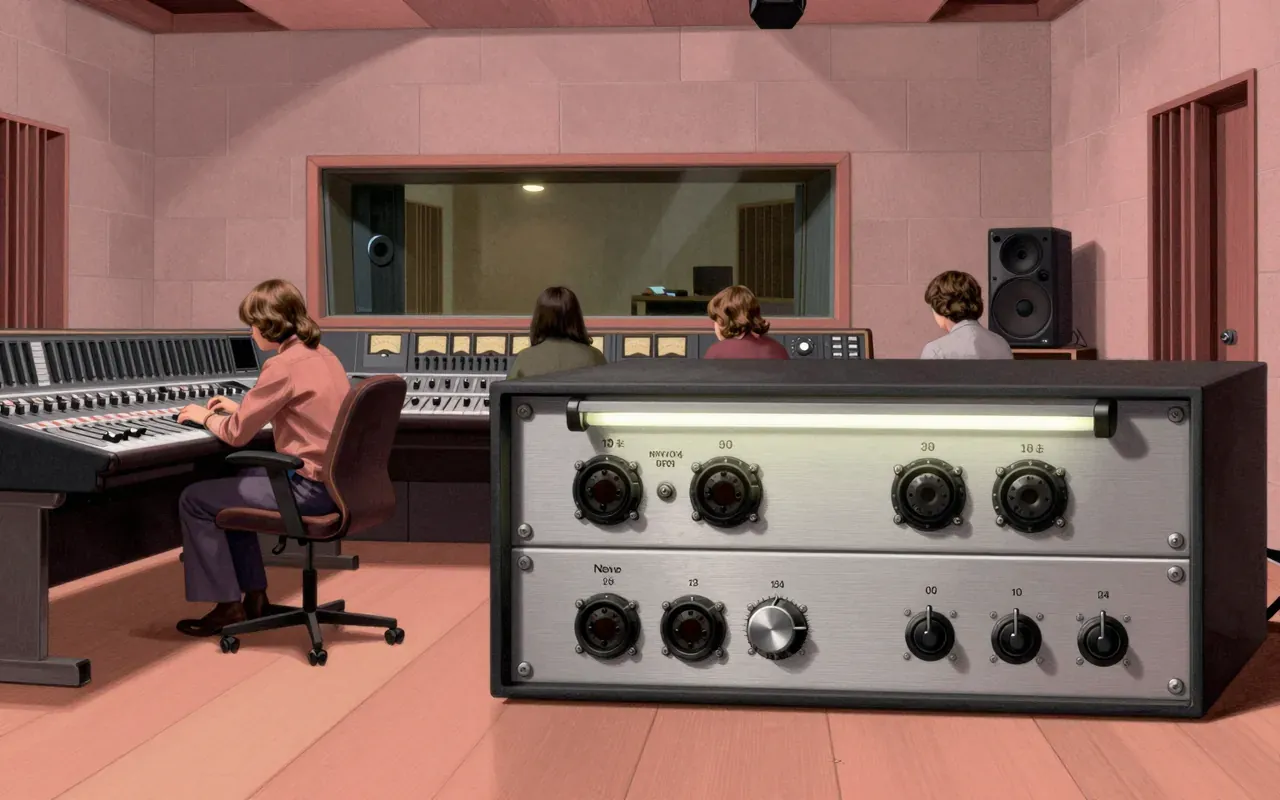
The Neve 1272 is a solid-state line amplifier. It does not accept microphone signals. It adds clean, transformer-coupled gain to line-level sources. It offers no input flexibility, no EQ, no saturation controls. Its value lies in its place in a fixed-path studio chain — not in versatility.

9:48

Digidesign 888/24 I/O

Digidesign

The Digidesign 888/24 is a Pro Tools–only analog-to-digital converter with eight XLR I/O channels and four AES-EBU digital paths. It delivers clean conversion, solid build quality, and low used-market cost—but only functions inside a compatible TDM system. No standalone mode. No MIDI. No monitor control. No software editor. It is a tool, not a platform.

9:17

Alembic Series II

Alembic

The Alembic Series II is a 4-string bass guitar with stereo output, a 30.75-inch short scale option, and individual low-pass filters with continuously variable Q per pickup. It differs from Series I only in stereo capability and price. No claims are made about tonal superiority, build innovation, or broader usability.

8:36

Avalon Design Avalon AD2022

Avalon Design

The Avalon AD2022 is a two-channel, analog, solid-state, pure class A microphone preamplifier. It delivers transparent, low-noise amplification. It has variable input impedance. It accepts microphones and DI sources. It includes phantom power, a 20dB pad per channel, polarity reversal, and a switchable variable high-pass filter. It uses XLR connections. It has front-panel XLR and jack connectors for instruments. It is rackmounted and occupies two standard rack spaces.

10:04

Avalon Design Avalon VT-737sp

Avalon Design

A vacuum tube-based, rack-only channel strip with two identical preamp channels, each offering gain, phantom power, pad, phase reverse, Lo-Z input, compressor, EQ, and flexible routing. It trades portability and recall for consistent warmth and headroom — especially with transformerless mics.

8:47

Boss BD-2 Blues Driver

Boss

The Boss BD-2 Blues Driver is an overdrive pedal sold since at least 2003. Users report its tone as round, expressive, smooth, and sultry. It responds sharply to small knob adjustments. It covers a wide sonic range — from clean overdrive to heavy grunge. It is available new and second-hand. Prices recorded are $50 (used), $79.99 (Kayes Music Scene), and $80 (Sam Ash).

8:45

Boss BF-1 Flanger

Boss

The Boss BF-1 Flanger is a 1979 analog foot pedal designed for electric guitar. It uses four knobs — manual, depth, rate, resonance — to control a simple, unstable flange sweep. It has no bypass, no presets, no expression input, and no stereo output. It was discontinued and replaced by the BF-3.

9:50

Binson Echorec 2

Binson

The Binson Echorec 2 is a delay/echo unit. No technical specifications exist. Its category is confirmed. Nothing else is verifiable.

9:02

AKG C414 B-ULS

AKG

The AKG C414 B-ULS is a large diaphragm condenser microphone. It is one of 13 products in the AKG C414 series. The source material gives no further technical, historical, or functional detail.

8:11

AKG C414 EB

AKG

The AKG C414 EB is a large diaphragm condenser microphone. It is one of 13 products in the AKG C414 series. No technical, historical, or functional detail beyond that is provided in the source material.

7:56

Boss CE-1 Chorus Ensemble

Boss

The Boss CE-1 Chorus Ensemble is Boss’s first chorus pedal: an analog stomp box offering chorus or vibrato — never both — with dedicated controls, tone toggle, and fixed power.

9:22

Daking Mic Pre IV

Daking

The Daking Mic-Pre IV is a 4-channel solid-state analog preamp with minimal controls and no colouration. It amplifies cleanly and intensely—revealing rather than refining the source. Its design prioritises workflow over flavour.

8:14

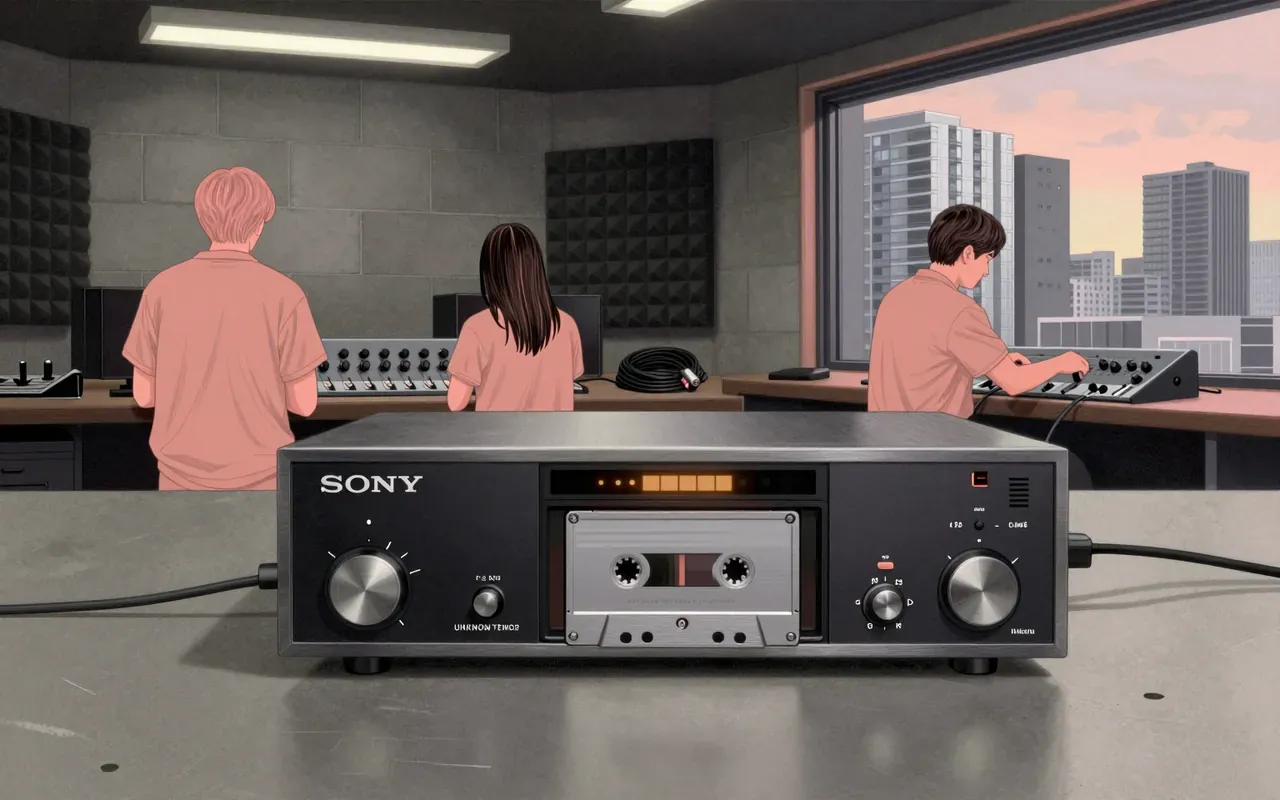
Sony DAT DTC-1000ES

Sony

The Sony DTC-1000ES is a DAT deck in Sony’s DTC series. No technical specifications are available. Nothing else is verifiable.

9:13

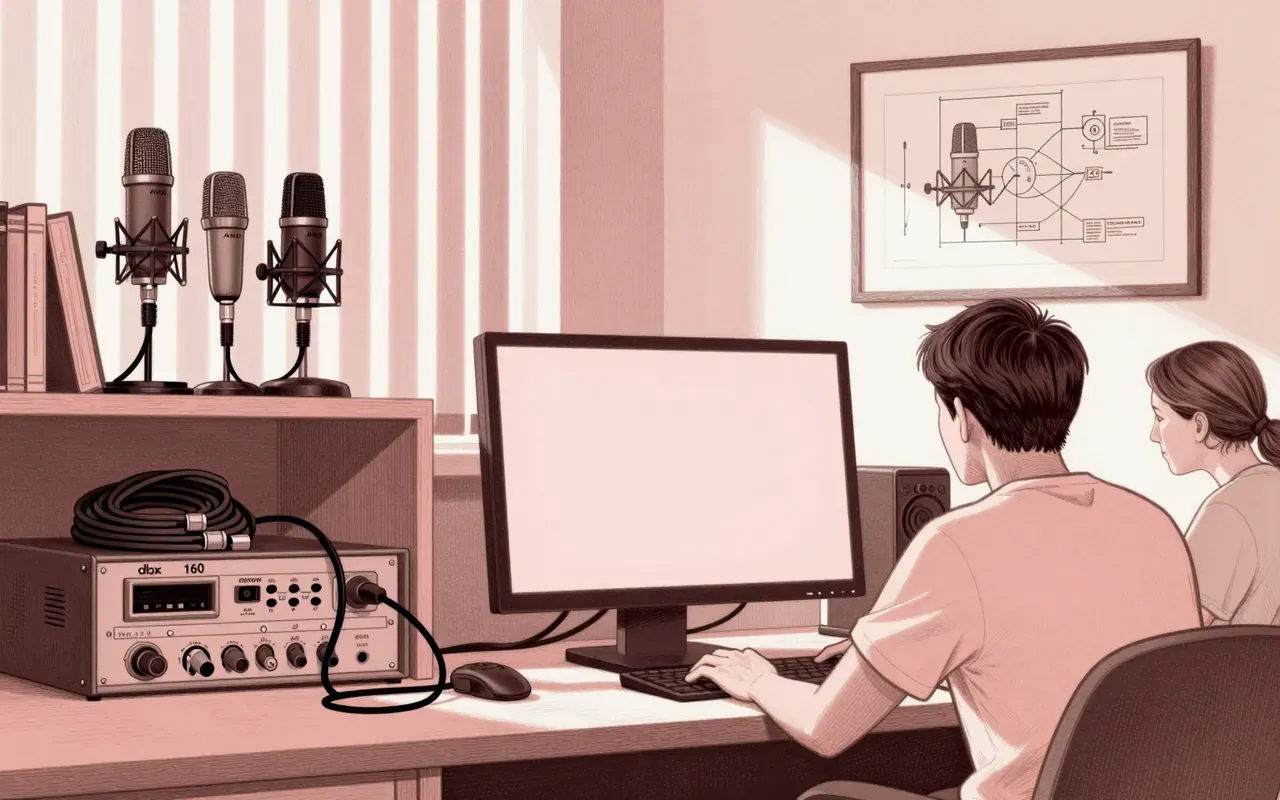
dbx 165

dbx

The dbx 165 is a studio compressor. No technical specifications exist for it. It is categorised as a studio compressor. That is all that is confirmed.

8:29

dbx 166

dbx

The dbx 166 is a no-compromise stereo FET compressor built for speed and instrument tracking—not vocals, not mixing, not analysis. It delivers efficient, transparent compression with subtle warmth. Its design gives immediacy and reliability. It withholds metering, sidechain, vocal suitability, and fine dynamic control.

7:46

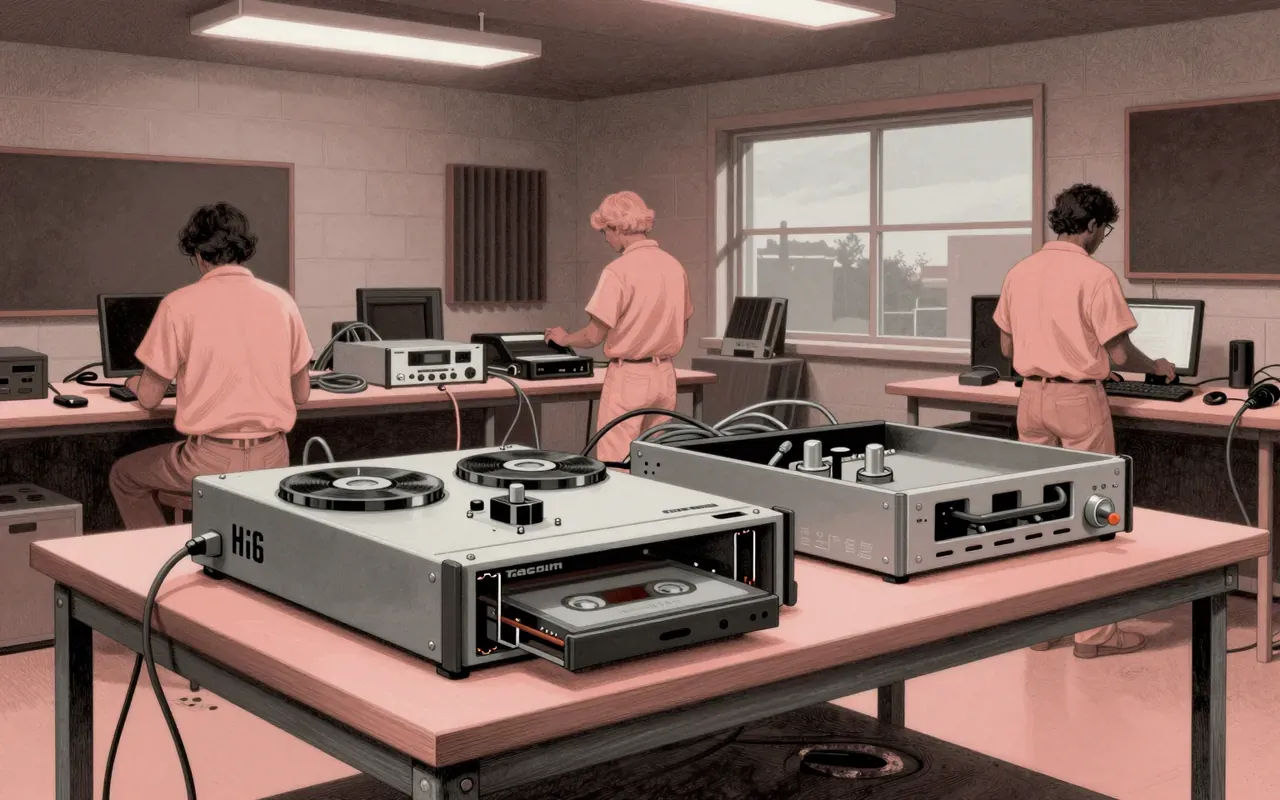
Tascam DTRS DA-88

Tascam

The Tascam DA-88 is a dedicated eight-track digital recorder using Hi8 tape. It occupies four rack units. It has XLR and RCA inputs. It uses large VU meters. Its audio quality remains acceptable today.

9:00

Grace Design m201

Grace Design

The Grace Design m201 is a single-channel solid-state microphone preamplifier. It provides clean, high-headroom gain with no EQ, no compression, no digital conversion, and no additional signal path options. It serves one purpose: to amplify a mic signal without alteration. It is not a channel strip. It is not an interface. It is not a tool for tonal manipulation. It is a specialist device for specialists who know exactly when they need it — and when they do not.

8:31

Great River MP-2NV

Great River

The MP-2NV gives two channels of the ME-1NV’s analog preamp circuit — no more, no less. It does not add features. It does not subtract fidelity. It occupies one rack space. It accepts mic and line-level sources directly. It meters input and output. It sounds warm, clear, and accurate — as verified by users.

7:54

Hiwatt DR103

Hiwatt

The Hiwatt DR103 is a 100-watt all-tube guitar amplifier head built for clarity, dynamics, and power-tube saturation at high volume. It has four inputs, two speaker outputs, bass/mid/treble/presence/master volume controls, voltage and impedance selectors, and no effects loop or direct output. Its crystalline highs and strong presence suit rock over jazz. Saturation requires driving both channels simultaneously. It is physically heavy and operationally uncompromising.

9:30

JBL 4310

JBL

The JBL 4310 is an active studio monitor built for truth-telling. Its neutral and linear sound reveals flaws. It needs an external amp. Bruce Swedien preferred it over the 4311—so much that he dismissed the latter as 'pure dog-doo'.

7:50

Lexicon PCM42

Lexicon

The Lexicon PCM 42 is a digital delay unit in Lexicon’s PCM series. No technical specifications are available. Nothing is known about its controls, its sound, its memory, or its use in practice. It declares only its category, its manufacturer, and its model name.

8:26

Millennia HV-3D

Millennia

The Millennia HV-3D is a solid-state mic preamp built for fidelity, not flavour. It gives you three transparent gain stages per channel, 1.5 dB stepped gain, phantom power, no phase flip, and eight channels in two rack units — all on internal power. It excels on strings, voice, and piano. It fails on distorted guitar and bright cymbals. It is not subtle. It is literal.

10:22

Boss OD-1 OverDrive

Boss

The Boss OD-1 is a 1977–1985 overdrive pedal with Level and Overdrive knobs only. It uses a FET boost circuit that degrades the dry signal when bypassed. It delivers low-gain saturation by pushing an already overdriven amp’s front end—not by distorting on its own. It lacks tone control. It preceded the SD-1. It performs best in that narrow context—and nowhere else.

7:37

Boss RV-2 Digital Reverb

Boss

The Boss RV-2 is a fixed-function digital reverb pedal. It gives guitarists six preset spaces — no editing, no tone control, no stereo input. It is stomp-box-only. It runs on nine volts. It is discontinued. It was Boss’s first reverb.

6:46

Soundcraft 2400

Soundcraft

The Soundcraft 2400 is an analog mixer made by Soundcraft. No technical specifications are published. Nothing else is confirmed.

9:55

Soundcraft Ghost

Soundcraft

The Soundcraft Ghost 32 is a dual-path analog mixer that delivers 64-channel mixing by combining 32 fader-based A channels and 32 knob-based B channels. It prioritises routing flexibility and hands-on control over silent operation or real-time EQ parity.

10:37

Roland Space Echo RE-201

Roland

The Roland RE-201 Space Echo is a non-rackable desktop analog tape echo unit with three inputs (two mic, one instrument), five magnetic tape playback heads, 1/4" wet/direct outputs, footswitch input, and controls for time, feedback (intensity), low/high EQ, dry/wet mix, and reverb. Its reverb has a compromised tonal character ('trs CRADA'). It uses an actual reel of tape — distinguishing it from imitators. It does not offer precision, stability, or clean reverb. It does deliver saturated, decaying, pitch-wobbling repeats no digital model fully replicates.

8:54

Trident Series 24

Trident

The Trident Series 24 is an analog mixer made by Trident. No specifications, availability, usage history, or technical details are provided in the source. It is documented only as a category and manufacturer assignment.

8:38

Wurlitzer 200A

Wurlitzer

The Wurlitzer 200A is a 73-key electro-mechanical electric piano with built-in speakers, output jacks, a sustain pedal, carrying handles, and two knobs — one for volume, one for tremolo speed. Its keyboard action is tactile and easy to play. Its tone is uniquely recognizable. It is a newer model than earlier Wurlitzer electric pianos. It offers more tonal range than those earlier models only via dedicated tremolo and volume controls.

9:00

Yamaha BB2000

Yamaha

The Yamaha BB2000 is a Japanese-made 4-string bass from the early 1980s. It uses passive electronics, two pickups (JB and PB), and simple bass/treble tone controls. Its voice is defined by low-mid growl and high-mid harmonic sweetness—unmatched by Fender, Music Man, or Sadowsky. It excels in funk, pop, fusion, and jazz. It lacks modern flexibility: no active circuitry, no mid-sweep, no blend control. One player replaced their 2012 Fender Jazz Bass with it after five years of regular use—and called it superior in all aspects.

9:07

Yamaha DM2000

Yamaha

The Yamaha DM2000 is a discontinued digital mixer console built for professional live sound reinforcement and studio tracking/mixing.

7:58

Yamaha PM1000

Yamaha

The Yamaha PM1000 is a channel strip. No technical specifications are available. Nothing else is confirmed.

7:28

AMS Neve 1073 DPA

AMS Neve

The AMS Neve 1073 DPA is a solid-state, pure class A, 2-channel preamp with DI, variable impedance, phantom power, and phase inversion — but no EQ, no insert, no flexibility beyond its fixed tonal signature. It gives you a clear, present midrange, smooth highs, and round, deep lows. It is not neutral. It is not modular. It is not subtle. It is specific.

8:46

dbx 160X

dbx

The dbx 160X is a fixed-response analog limiter/compressor built for immediacy, not nuance. It excels when slammed on snare, kick, bass, or guitar — but fails at subtlety, especially on vocals. Its simplicity is functional, not forgiving.

7:54

dbx 160XT

dbx

The dbx 160XT is a studio compressor. No technical specifications are available for it.

9:02

API 205L

API

The API 205L is a DI unit made by API Audio. No technical specifications are available. No retailers or classified ads currently offer it. Its alternate names are '205l' and '205 l'.

7:18

Neve 2254

Neve

The Neve 2254 is an all-analog compressor/limiter from the late 1960s, revived as the 2254-R with identical circuitry and only a new casing. It delivers thick, heavy compression — especially on vocals — via straightforward controls: ratio, attack, recovery, limit level, gain makeup and mode. Its unique meter and lack of digital elements make it tactile and immediate. It offers no stereo linking, no variable knee, no recall — just weight, simplicity and a singular sonic character.

9:12

Neve 2264A

Neve

The Neve 2264A is a mono limiter/compressor module built for studio use. No technical specifications are published. It weighs 1.3 kg. Its function is defined by category, not data sheet.

8:19

MOTU 2408

MOTU

The MOTU 2408 is a discontinued PCI/ISA rack-mount soundcard built for multitrack recording and mixing in home and project studios.

8:26

Neve 31102

Neve

The Neve 31102 is a UAD-exclusive software graphic EQ. It has no published technical specifications. It offers fixed-band EQ only. It requires UAD hardware to run. It makes no claim to model any specific Neve hardware circuit.

9:12

Neve 31105

Neve

The Neve 31105 is a channel strip. No technical specifications are available. Nothing else is confirmed.

8:02

API 3124+

API

The API 3124+ is a 1U, 4-channel analog microphone preamplifier using the 2520 op-amp and classic console circuit. Each channel has gain, polarity, phantom power, 20 dB pad, mic/line selection, and a VU meter. It accepts XLR inputs at the rear and unbalanced 1/4" inputs at the front. It delivers high headroom and consistent colour across all four channels — but offers no impedance control, channel linking, or digital integration.

9:26

Neve 33115

Neve

The Neve 33115 is a compact, broadcast-optimised channel strip built in Cambridge between 1974 and 1975. It uses the same class A preamp and EQ circuitry as the 1081 but drops the fourth EQ band and simplifies the layout. Its 300/1200 Ω input switch supports ribbons. It belongs in small consoles like the Melbourne and broadcast frames like the 5315 and 5316—not in large-format studio rigs.

8:50

TEAC 3340S

TEAC

The TEAC 3340S is an analog multitrack recorder with no available technical specifications. It is identified only by category and alternate name spellings. Nothing is confirmed about its operation, sound, reliability, or creative use.

8:10

Neve 33609

Neve

The Neve 33609 is a dual-channel, all-analog studio compressor and limiter occupying two rack units. Each channel contains independent compressor and limiter sections. The compressor section provides threshold, recovery, gain, ratio, and bypass. The limiter section provides threshold, recovery, fast/slow attack, and bypass. It supports dual-mono or stereo operation with per-channel gain reduction metering.

7:42

SSL 4000 E

SSL

The SSL 4000 E is a channel strip. No technical specifications are available. Nothing else is confirmed.

7:57

SSL 4000 G

SSL

The SSL 4000 G+ is a 48-channel analog mixing console built for professional studios. Each channel has a preamp and parametric EQ. It includes built-in compressors and many other features. Its configuration is complex and demands substantial time to master. Its sound quality is judged among the best attainable — the cleanest the reviewer has ever used. Its preamps are extremely clean and full sounding. Its EQs are super clean with precise cut/boost control. It is qualified to record any and all genres of music. It is extremely famous and highly popular among professionals across popular music genres.

8:35

JBL 4311

JBL

The JBL 4311 is an active monitor built for accuracy, not appeal. Its adjustable treble and midrange controls let users tailor response without EQ. It delivers neutral, powerful, precise, and dynamic sound — but only when driven with sufficient gain. Its frequency curve avoids bass saturation and flattery, making it reliable for critical listening across playback systems. Users acquired it in Germany in 1979 and in studio trades by 1983. It belongs in rooms where truth matters more than comfort.

8:28

JBL 4312

JBL

The JBL 4312 is a passive three-way studio monitor built for punch, precision, and stereo imaging — not neutrality or refinement.

7:02

Neve 8058

Neve

The Neve 8058 is a 24-channel analog mixer with 31102 preamps (essentially 1084s), semi-parametric EQ per channel, and 16 buses. It has no automation. Its sound is full, deep and low-mid-rich — a deliberate, non-neutral colouration.

8:04

Neve 8068

Neve

The Neve 8068 is a 1970s large-format analog console with 32 fully equipped channel strips—24 on the left, 8 on the right—each featuring a mic preamp, parametric EQ in the standard Neve style, and routing options. Its sound is defined by strong low-mid response and a balance of clarity and warmth. It is exceptionally difficult for beginners but familiar to experienced Neve users.

8:45

Neve 8108

Neve

The Neve 8108 is a 32-channel analog mixing console built in 1979. It delivers warm, full preamps and top-notch parametric EQ on every channel. Its channel strips are laid out for convenient access. Its digital routing system is quirky.

9:21

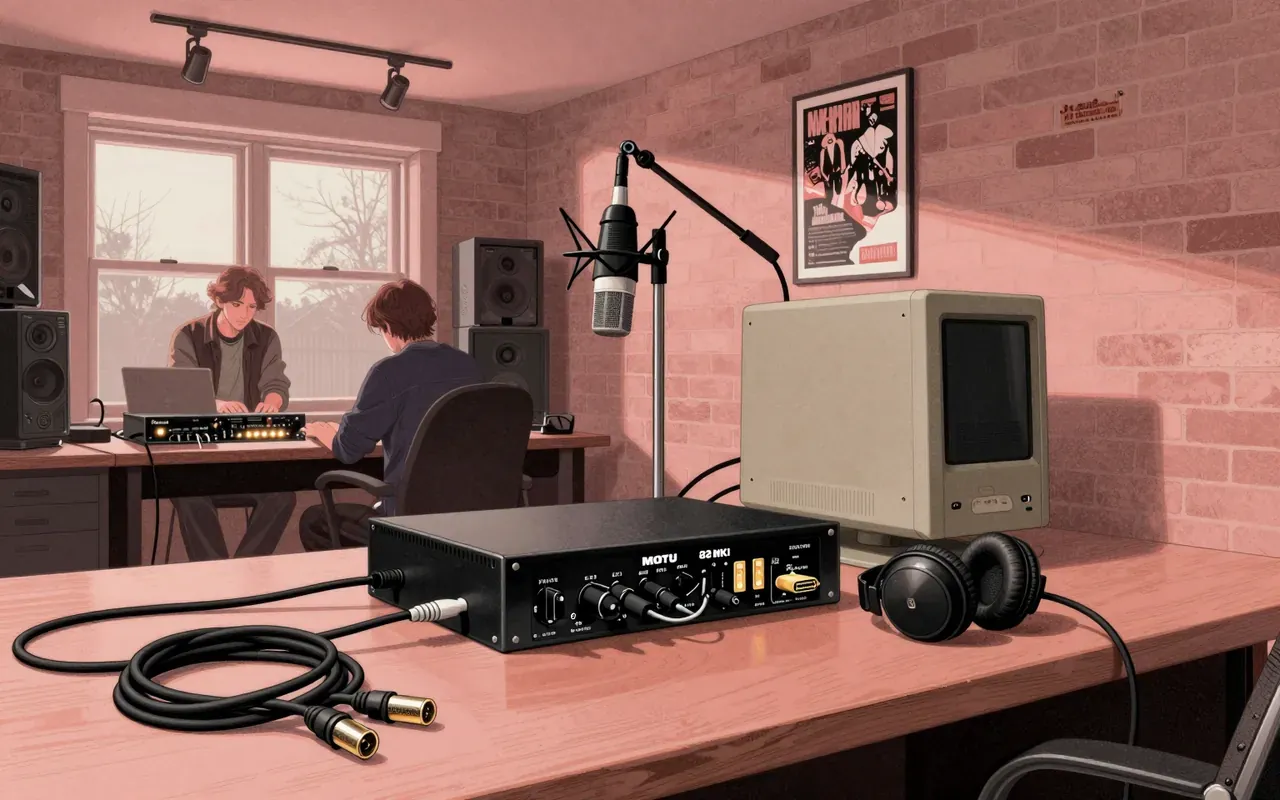
MOTU 828

MOTU

The MOTU 828 MKI is a discontinued FireWire audio interface introduced around 2001–2002. It offered two mic preamps with phantom power and XLR/1/4" inputs, six additional balanced line inputs, eight balanced outputs, ADAT and optical I/O, 24-bit 64x/128x oversampling converters, and front-panel monitoring controls. Priced at $800 at launch, it was considered expensive but highly stable and easy to install. It remains functional for years in typical home studio use but is no longer sold and has been succeeded by newer models including the 828 (2024).

7:57

Digidesign 888 I/O

Digidesign

The Digidesign 888 I/O is a 16-bit analog/digital converter with eight XLR inputs, eight XLR outputs, and digital I/O via AES/EBU and S/PDIF. It was used in home studios, often alongside the 24-bit 888/24. It offers no processing, no preamps, and no variable gain — just fixed-path conversion. Its value lies only in compatibility with legacy Pro Tools TDM systems.

10:06

SSL 9000 J

SSL

The SSL 9000 J is an analog mixer. That is all the source confirms. It belongs to the category of analog mixers. No specifications, features, or use cases beyond that are given. It is not described as rare, expensive, or influential. It is not tied to any record, person, place, or date. It is what it is: a large-format analog mixer for studio use.

9:23

SSL 9000 K

SSL

The SSL 9000 K is an analog mixer. That is all the sources confirm. It belongs to the category of analog mixers. Nothing more is verified.

9:02

dbx 902 De-Esser

dbx

The Lindell Audio 902 De-Esser is a software de-esser. It has no published technical specifications. It belongs to the software de-esser category. That is all that is known.

9:56

Revox A77

Revox

The Revox A77 is an analog multitrack tape recorder. Users deploy it to replay and digitise vintage tape — especially 1980s band mixes. It is robust and simple to operate, more so than the B77 or G36. But it trades mechanical precision and low-noise playback for that durability. It does not record multitrack. It does not edit. It plays — and keeps playing.

8:30

Studer A80

Studer

The Studer A80 is a tape recorder that shapes sound by softening transients and adding organic saturation. It works only when configured precisely: 19/38 or 38/76 cm/s, 1/2-inch tape, GP9-aligned heads. It excels in rock. It fails in dance, house and electro. It is not flexible. It is not neutral. It is a deliberate, physical constraint.

9:58

Studer A800

Studer

The Studer A800 is a UAD-2 plug-in that adds tape-style warmth and drive to digital mixes. It works best post-summing. It uses gang control for unified management. It does not simulate physical tape mechanics.

8:24

Studer A807

Studer

The Studer A807 is an analog multitrack recorder. No technical specifications exist for it. That absence defines it.

8:42

Studer A810

Studer

The Studer A810 is an analog multitrack recorder that functions reliably in steady-state operation. But it fails sharply and obscurely after power interruptions. Troubleshooting those failures is very hard. One user explicitly prefers the A807 over the A810. Nothing is stated about its format, track count, year introduced, or what recordings were made on it.

9:38

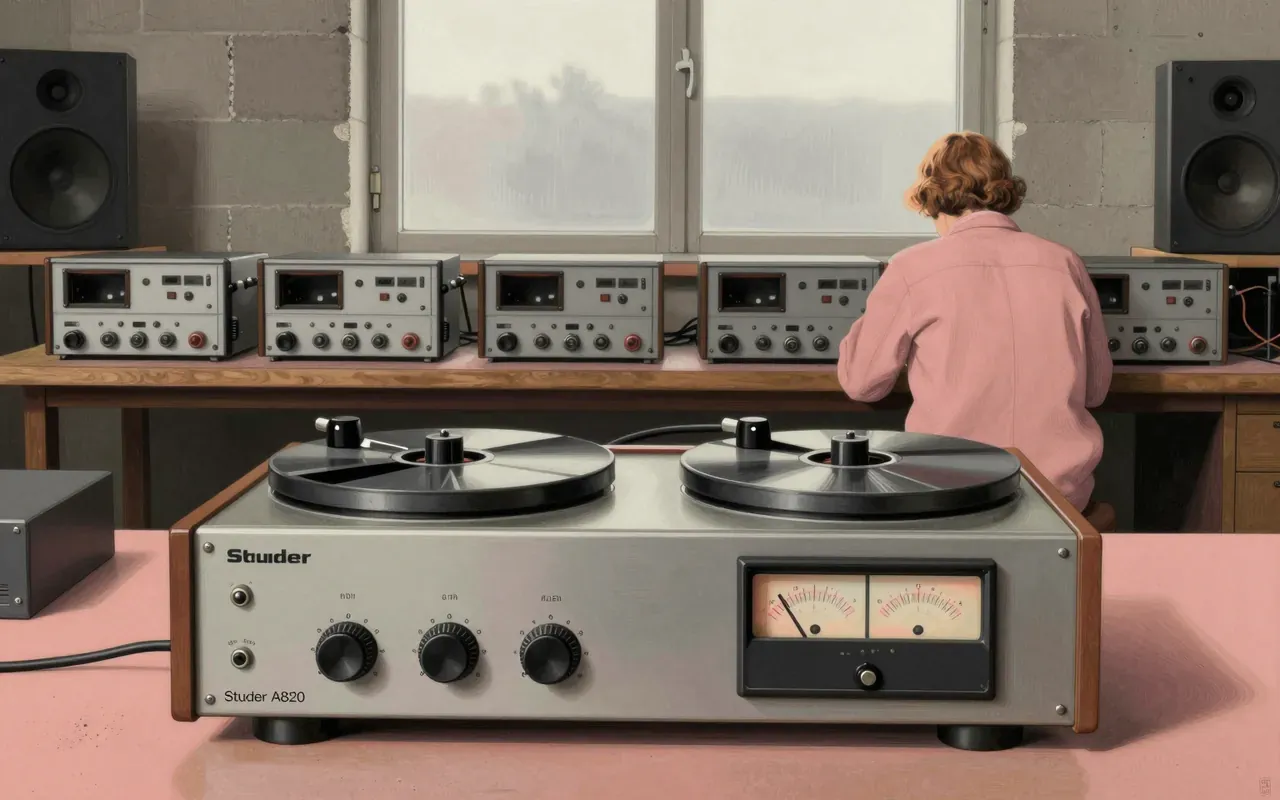
Studer A820

Studer

The Studer A820 is a 24-track analog multitrack tape machine with a portable controller. It excels at low-end and drum capture. It was used to record tracks later transferred to Pro Tools. It is user friendly, with familiar, easily located controls. No verified source states a weakness.

6:44

Studer A827

Studer

The Studer A827 is an analog multitrack-studio. No technical specifications are provided. Its function, design, and use remain undocumented in the source.

9:18

Apogee AD-8000

Apogee

The Apogee AD-8000 is an eight-channel analog-to-digital converter built for recording studios. It was introduced circa 1996. It supports 24-bit resolution at up to 48 kHz. It has eight XLR analog inputs and AES/EBU and S/PDIF digital connections. Front-panel level meters and controls let you monitor and adjust all eight channels. It includes a 1/4-inch headphone jack for direct monitoring. Optional cards enable ADAT, TDIF and Pro Tools connectivity.

9:21

Prism Sound ADA-8

Prism Sound

The Prism Sound Dream ADA-8 is a dual-path AD/DA converter built for clean, separated signal routing at up to 96 kHz. It delivers stable internal clocking and user-friendly displays, but lacks built-in sample rate conversion and fails under external sync with Pro Tools HD interfaces. It belongs in studios where path independence matters more than interoperability.

7:34

Ampex AG-440

Ampex

The Ampex AG-440 is an analog multitrack recorder. No technical specifications are available. Its alternate names include ag440, a 440, and a440. Nothing else is verifiable.

9:27

API 2500

API

The API 2500 Bus Compressor is a UAD Plug-In. That is all the sources confirm. No function, no sound, no interface, no history, no use case is stated. It exists only as a named item in a software category.

9:51

API API Vision

API

The API Vision Console Emulation Bundle is a UAD plug-in channel strip made by Universal Audio. It requires UAD hardware to run. It offers no standalone operation, no technical specs in the source material, and no evidence of real-world usage examples. Its value is strictly conditional on existing UAD ownership and desire for API’s sonic signature in digital form.

9:04

Echo AudioFire 12

Echo

The Echo Audiofire 12 is a FireWire audio interface in the Audiofire series. It has 12 line inputs and 12 outputs. It has no mic preamps. It has no headphone output. It supports daisy-chaining up to three units for 36 I/O. It achieves 2.9 ms round-trip latency at 24-bit/96 kHz. Its line inputs are transparent and electrically isolated. Users record 12 tracks simultaneously at up to 192 kHz, firmware permitting.

8:01

M-Audio Audiophile 2496

M-Audio

The M-Audio Delta Audiophile 24/96 is a PCI/ISA sound card for Windows-based music production and amateur vocal recording. It connects MIDI controllers and turntables. It supports 24-bit/96 kHz audio when host software allows. Latency drops to 4ms with buffer reductions. It runs silently in Cubase VST, Pro Tools, Fruity Loops, and six other DAWs. Recordings are clean. Softsynths sound great. Wave Table Synthesis is absent — but users found it unnecessary. I/O is limited. Modern OS support is not provided.

7:12

Lynx Aurora 16

Lynx

The Lynx Aurora 16 is an Analog/Digital Converter. No technical specifications are available for it. It belongs to the category of Analog/Digital Converters.

8:33

Avalon Design Avalon VT-747sp

Avalon Design

The Kazrog Avalon VT-747SP is a software plugin classified as an 'Other effects bundle or multi-effect'. No technical specifications are available. Its model name references the Avalon VT-747SP hardware unit. Nothing is stated about its sound, controls, workflow, or real-world use.

9:06

Studer B67

Studer

The Studer B67 is an analog multitrack recorder. No technical specifications are available for it.

9:45

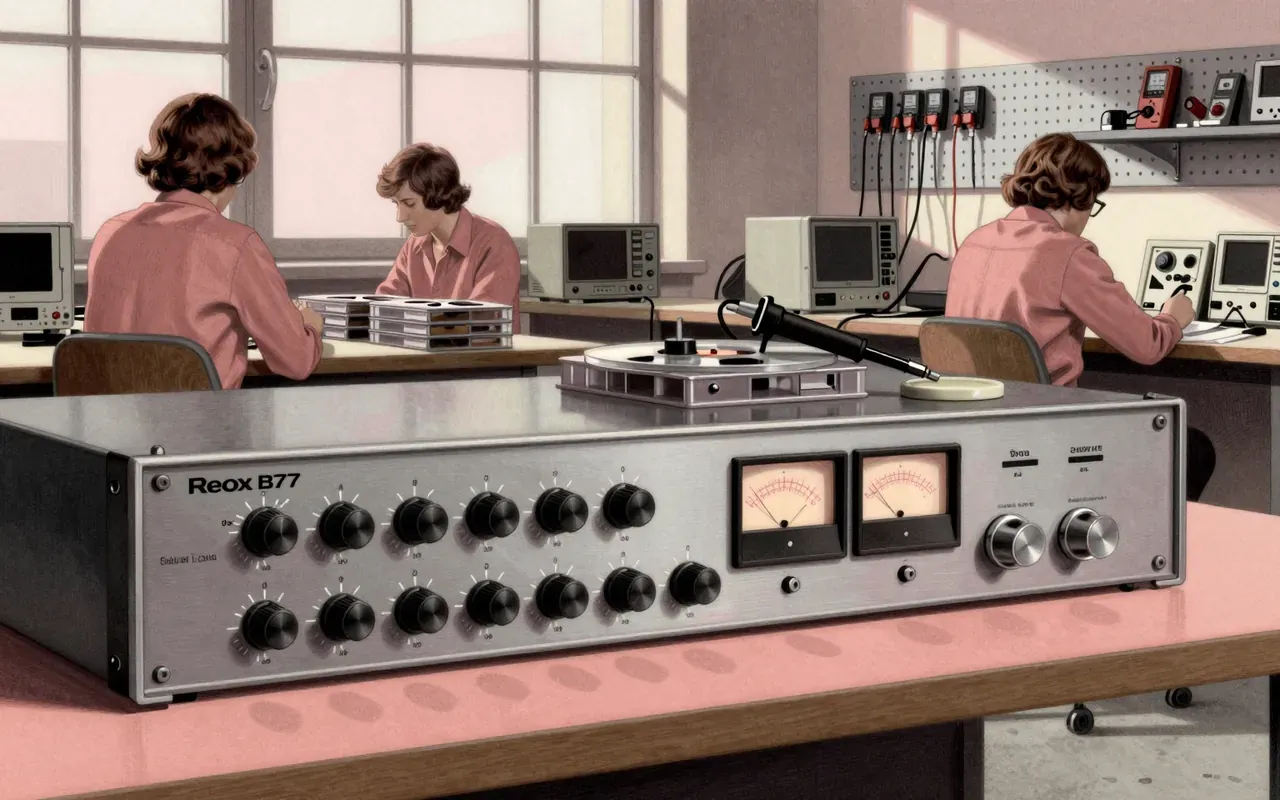
Revox B77

Revox

The Revox B77 is an analog multitrack tape recorder built for studio and project recording. It supports 3 3/4, 7 1/2, and 15 ips tape speeds—but the 15 ips setting is obsolete for digital use. Units from 1980 remain fully functional. It is mechanically robust and quieter than UHER models. Its meter is breakable and irreplaceable. It offers no digital functionality. It is worth your time only if you need durable, low-noise analog multitrack operation—and can maintain it yourself.

9:12

RCA BA-6A

RCA

The BA-6A is a software compressor by Antelope Audio. No technical specifications are available. Its controls, behaviour, and sonic role are undocumented. It exists only as a named category and a set of alternate spellings.

8:05

Neve BCM10

Neve

The Neve BCM10/2 Mk2 is an analog mixer made by AMS-Neve. No technical specifications are available. Nothing else is verified.

8:46

Shure Beta 52

Shure

The Shure Beta 52 is a dynamic microphone built for kick drum and bass. It has a supercardioid pattern, 20Hz–10kHz response with 4kHz presence boost, strong proximity effect, and handles 174dB SPL. It was replaced by the Beta 52A.

7:55

Strymon BigSky

Strymon

The Strymon BigSky is a guitar reverb pedal released in 2013. It offers full parameter editing, stores up to 300 presets, and ships with high-quality factory presets. It delivers exceptionally high-quality, easily customisable reverb using both traditional and specific controls. It is regarded as the most complete reverb pedal on the market.

7:56

SSL Bus Compressor

SSL

The Bus Compressor is a software-only bus compression plugin made by IK Multimedia for the T-Racks series. It is categorised as a software compressor. No technical details, sonic traits, release date, or usage examples appear in the sources. It is not an SSL emulation. It is defined solely by its name, manufacturer, and category.

8:17

AKG C12

AKG

The AKG C12 is a large diaphragm condenser tube microphone designed for studio recording. It requires a dedicated power supply. It captures a wide frequency range. It is exceptionally high-performing but delicate and unsuitable for live use.

10:26

AKG C24

AKG

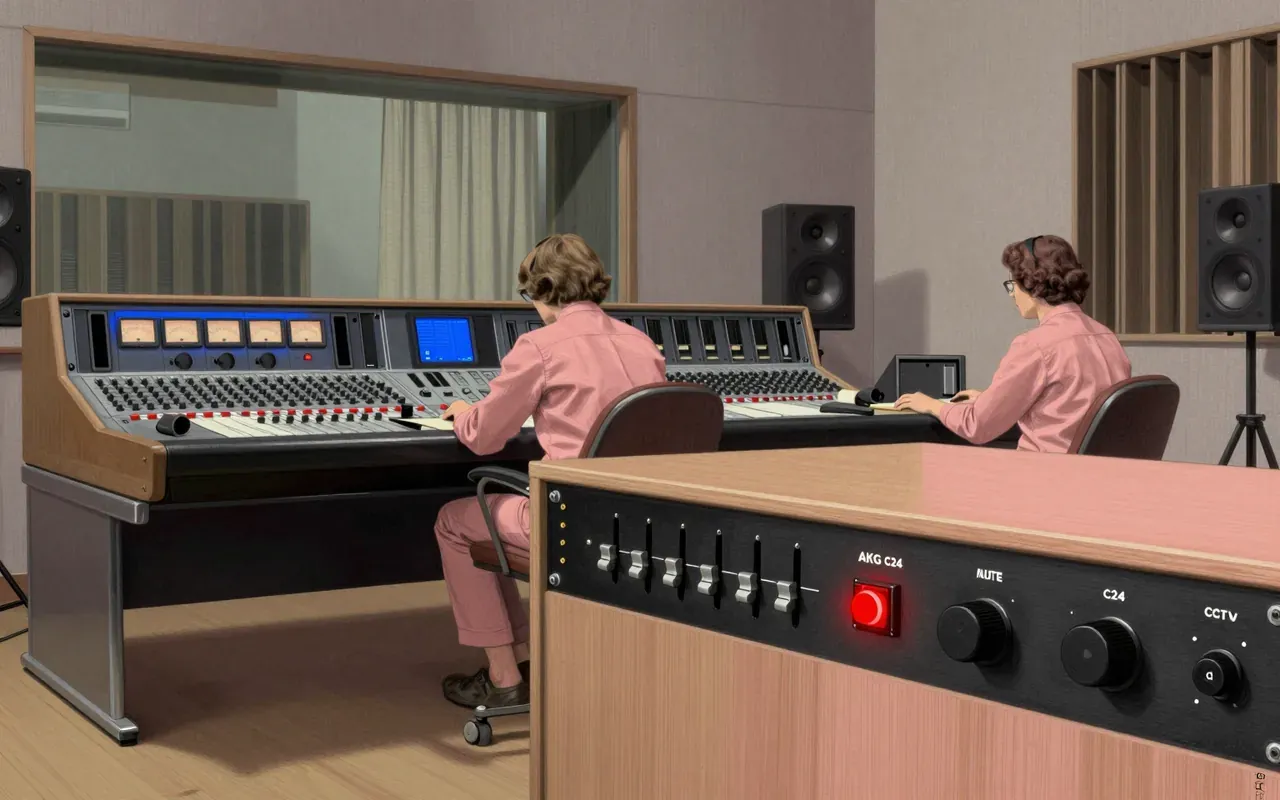
The AKG C24 is a Pro Tools-specific motorized control surface with 24 bankable channel strips, touch-sensitive motorized faders, 16 mic/line/DI preamps, an 8x2 stereo line submixer, a 5.1 analog monitor section, talkback mic inputs, and illuminated dedicated switches for mute, solo, record, select, EQ, dynamics, sends, and inserts.

7:32

Sony C37A

Sony

The Sony C37A is a large diaphragm condenser tube microphone. It belongs to a narrow class of studio mics defined by harmonic colour rather than flexibility. It has no documented switches, filters or pads. Its alternate names — 'c 37a' and 'c37 a' — appear in official listings but indicate no functional variation.

8:54

AKG C414

AKG

The AKG C414 is a series of large diaphragm condenser microphones. Thirteen variants exist. Two are matched pairs: the XLII and the XLS. All share the same functional category. None are described by frequency response, noise floor, or circuit details in the source.

9:24

AKG C451

AKG

The AKG C451 B is a fixed-cardioid small-diaphragm condenser with -10 dB/-20 dB pads and 75 Hz/150 Hz high-pass filters. Its CK1 capsule cannot be swapped. It delivers precision on acoustic sources but fails under high SPLs due to capsule fragility.

8:41

AKG C452

AKG

The AKG C452 C is a small diaphragm condenser microphone. It has no stated controls, no pattern options, no filters, no pad. Its function is narrow and fixed. Its value lies in consistency, not versatility.

8:44

AKG C460

AKG

The AKG C460B + CK63ULS is a small diaphragm condenser microphone. It delivers accuracy, not attitude. It has no switches, no colour, no compromise — just a fixed cardioid pattern, fixed frequency response, and fixed reliance on external preamp and placement. It excels where definition matters most. It fails where character is required.

8:04

Neve Capricorn

Neve

The AMS-Neve Capricorn is a digital mixer. That is all the source confirms. No specifications. No year. No sound. No interface description. No user reports. No cultural footprint. It exists only as a category entry.

8:09

Fender Champ 5F1

Fender

The Fender Champ 5F1 is a tube combo guitar amplifier made from 1958 to 1964. It has volume and tone controls only. It uses a single 6V6 power tube driving an 8-inch speaker. It breaks up early and stays simple. It does not offer clean headroom, effects, or expandability.

8:12

Tube-Tech CL 1B

Tube-Tech

The Tube-Tech CL 1B MKII is a Universal Audio software compressor plugin. Nothing more is verified.

10:55

Boss CS-2 Compression Sustainer

Boss

The Boss CS-2 Compression Sustainer is a guitar compressor/sustainer. This unit is a modified version branded 'Fat Old Comp' by MSM Workshop. No technical specifications are provided.

10:32

Roland Cube 60

Roland

The Roland Cube-60 is a 60-watt solid-state modelling combo guitar amplifier introduced in 2004. It uses COSM processing to deliver eight amp models on the drive channel. It has two channels — clean and drive — each with independent gain and volume, sharing a four-band EQ. Built-in effects and a combined headphone/line-out jack support private practice and simple recording. It offers no footswitching, no per-model EQ recall, and no pre-model effects routing.

8:11

Chandler Limited Curve Bender

Chandler Limited

The Curve Bender is a software parametric EQ made by Softube. It costs $299 including VAT. It does not claim to be hardware. It does not add dynamics, M/S, or analysis. It does one thing: shape tone with four bands, modelled on Chandler’s approach.

9:20

Fostex D-80

Fostex

The Fostex D-80 is a dynamic, cardioid microphone built for singing and trumpet. It handles high sound pressure like an SM58 — but delivers a 'crunchy', 1980s-evoking sound the user found in an attic. It offers no features beyond its fixed polar pattern and raw output. It belongs only where that specific texture is the goal.

8:44

AKG D112

AKG

The AKG D112 MkII is a dynamic microphone built for one purpose: capturing kick drum impact. It is heavier than many mics (778 g), requires no power, and belongs to the same lineage as the original D112 — updated, not reinvented. It excels where low-end punch and SPL tolerance matter most. It fails where clarity, air, or transient fidelity are required. It is not a vocal mic. Not a room mic. Not a hi-hat mic. It is a kick drum mic — and nothing more.

7:30

AKG D19

AKG

The AKG D19 B200 is a dynamic microphone. No technical specifications are available. It cannot be evaluated against alternatives. It offers no documented advantage. It provides no actionable information to a user.

7:07

AKG D202

AKG

The AKG d202 is a dynamic microphone. That is all the material confirms. No specs. No year. No use cases. Just its category and its $299 price.

9:15

dbx 160

dbx

The Waves dbx 160 is a software compressor plug-in released in 2015. It delivers fast, aggressive compression with minimal setup. It lacks flexibility and colour but excels at tightening drums and bass. It costs $49 on sale. It belongs in the mix bus, not the mastering chain.

8:31

M-Audio Delta 1010

M-Audio

The M-Audio Delta 1010 is a discontinued PCI/ISA + rack-mount soundcard. It delivers 8 analogue I/Os plus SPDIF. It achieves 5ms latency. It runs stably with Cubase and Sonar on legacy desktops. It crashes beyond 24 tracks — due to host computer limits, not the card. It inserts real-time effects during mixdown without issue. It requires a Pentium 4–era PC with a free PCI slot. It has no USB or FireWire support. It is no longer manufactured.

10:22

Digidesign Digi 001

Digidesign

The Digidesign Digi 001 is the original Pro Tools audio interface. It is a rack-mountable PCI/ISA soundcard with two mic preamps, phantom power, gain knobs, -25 dB pads, front headphone output, MIDI, eight outputs (including monitor outs), and six line inputs. It connects via D-Sub and serial port — not FireWire or USB — so it is incompatible with laptops and newer computers. It is obsolete outside legacy systems.

10:50

Digidesign Digi 002

Digidesign

The Digidesign Digi 002 is a FireWire audio interface built exclusively for Pro Tools LE. It delivers four mic preamps, S/PDIF and MIDI, and autonomous digital mixing — but only within that narrow software ecosystem. It is desktop-formatted and non-rack-mountable. Its limits are defined by Pro Tools LE’s track count and host compatibility. It belongs in a period-correct studio, not a modern one.

8:37

BSS DPR-402

BSS

The Waves BSS DPR-402 is a plugin rendition of a hardware dynamics processor. It is categorised as an 'other effects bundle or multi-effect'. No technical details are given. No usage examples are cited. It exists as software, not circuitry.

9:12

Prism Sound Dream ADA-8XR

Prism Sound

The Prism Sound Dream ADA-8XR is an eight-channel analog/digital converter built for fixed-install mastering and DAW integration. It provides eight balanced XLR I/O at +4 dBu, two RCA monitoring outputs, DB-25 AES I/O, and dual BNC Word-Clock. Its build quality is impeccable—but it runs hot, demanding 1U of rack clearance. It does not offer USB, optical, headphone output, or variable monitor level control.

7:20

Beyerdynamic DT 48

Beyerdynamic

The Beyerdynamic DT 48 is the world’s first dynamic headphone, launched in 1939. Its closed, tight-fitting design isolates sound but causes fatigue. Its midrange is superb and revealing—built to monitor voice, sound objects, and mood in reporting, radio, film, and medical audiometry. It is not intended for mastering.

8:18

Fostex E16

Fostex

The Fostex E-16 is an analog multitrack recorder. No technical specifications are available for it.

10:17

Strymon El Capistan

Strymon

The Strymon El Capistan is a discontinued digital tape echo pedal that emulates the Echoplex and Space Echo through three tape head configurations and three operational modes. It uses five front-panel knobs and hidden footswitch-accessed parameters to shape delay character. Its analog dry path preserves unaffected tone. It does not implement phrase sampling, despite the product title. It runs on 9V and supports both buffered and true bypass.

8:37

Telefunken ELA M 250

Telefunken

The Telefunken ELA M 250 is a large diaphragm condenser tube microphone made by Telefunken Elektroakustik. That is all the source confirms. No specifications, no use cases, no sonic characterisation, no historical context — just category, type, and maker.

9:12

Telefunken ELA M 251

Telefunken

The Telefunken ELA M 251 is a large diaphragm condenser tube microphone made by Telefunken Elektroakustik. It belongs to the category of large diaphragm condenser tube microphones. Nothing else is verified.

8:13

EMT EMT 250

EMT

The EMT 250 was the first digital reverberation device to create ambience through a purely electronic system. The Universal Audio plug-in models that hardware exactly — including its single reverb program, five additional effects (Delay, Phasing, Chorus, Echo, Space), lever-driven interface and all its limitations: non-linear-phase anti-aliasing filters, system latency, input clipping and limited frequency response. It uses the exact same algorithm as the original, captured from Allen Sides’ unit and re-engineered by Dr. Barry Blesser.

8:33

RME Fireface 800

RME

The RME Fireface 800 is a FireWire audio interface built for professional studio routing, synchronization, and digital I/O—not tracking or mixing alone, but glueing hardware together.

8:24

Chandler Limited Germanium Compressor

Chandler Limited

The Chandler Limited Germanium Compressor is a mono, 1U, all-analog FET compressor using germanium transistors. It offers a ratio range of 1.5:1 to 10:1 and a Clean/Dirty switch that toggles between low-distortion (0.2–0.5%) and higher-distortion (2–5%) modes. It has symmetric XLR I/O, is rack mountable, and linkable for stereo or surround use. It delivers fast, coloured compression — but gives up timing control, metering, and multi-channel operation to do so.

7:37

Sennheiser HD 600

Sennheiser

The Sennheiser HD 600 is a studio-grade open-back headphone. It delivers an even frequency response. It renders acoustic instruments realistically across the full spectrum. Its highs are clear and crisp without harshness. Its lows are detailed and clear without overpowering. It was tested against the HD650, HD700, and HD800 using a decent D/A converter and a good headphone amplifier. It is used for mixing and mastering in professional and home studios. It requires capable amplification. It offers no sound isolation.

8:37

Crane Song HEDD 192

Crane Song

The Crane Song HEDD 192 is a two-channel DAC for mixing and mastering. It converts digital audio at up to 192 kHz/24-bit. Its defining feature is three fixed analog circuit emulations — triode, pentode, and tape — each altering harmonic texture and dynamics in distinct ways. It offers no transparency, no bypass, no fine-tuning. It exists to commit.

8:50

Mackie HR824

Mackie

The Mackie HR824 is a discontinued, self-powered near-field monitor. Each unit has its own amplifier and power cord. It delivers uncoloured, accurate sound for critical mixing—and mixes made on it translate well elsewhere.

8:52

Focusrite ISA 110

Focusrite

The Focusrite ISA 110 is a discontinued solid-state microphone preamplifier. It belongs to Focusrite’s ISA series. It was replaced by the ISA 430 MKII. It is no longer sold.

9:36

Roland JC-120 Jazz Chorus

Roland

The Roland JC-120 Jazz Chorus Plug-In is a software amp simulator released by Roland in January 2025. It models the JC-120’s sound for use inside a DAW. Nothing in the source describes its controls, signal path, tone-shaping options, or how closely it matches the hardware. It offers convenience and consistency — not physicality or unpredictability.

10:29

Marshall JCM900

Marshall

The Marshall JCM900 is a series of valve guitar amplifiers produced between 1990 and 1999, with some models reissued from 2003 onward. It was built for guitarists needing high-gain distortion and built-in reverb in a professional touring and studio context.

9:45

Marshall JMP 2203

Marshall

The Softube Marshall JMP 2203 is a software amp simulator in the Amp Room series. Softube made it. It carries the Marshall JMP 2203 name. It belongs to the Software Amp Simulators category.

10:12

Ibanez JS1

Ibanez

The Ibanez JS1 is Joe Satriani’s first signature model — a basswood STC-shaped guitar with a custom neck profile, DiMarzio PAF Pro and FRED humbuckers, master volume and tone controls, and a 3-way pickup selector. Early versions used the original Edge tremolo. It delivers a focused, expressive lead voice — but offers no tonal expansion, limited tuning stability under stress, and zero ergonomic adaptation.

9:08

Neumann KM 184

Neumann

The KM 184 is a fixed-cardioid small-diaphragm condenser microphone built for clarity, durability, and extreme SPL handling — not for shaping or adapting.

9:07

Neumann KM 54

Neumann

The KM 54 is a rare, discontinued large-diaphragm tube condenser microphone. It has a fixed cardioid pattern and requires its own unique power supply. It is fragile and unsuitable for live use. It delivers a warm, wide vocal tone — ideal for capturing subtlety — but lacks the clarity of newer Neumann tube mics. A reviewer used it successfully on vocals for themselves and a client. It resembles the AKG C12 in sound and appearance.

9:09

Neumann KM 56

Neumann

The Neumann KM 56 is a small diaphragm condenser microphone in the KM series. It belongs to the category of small diaphragm condenser microphones. It is also referred to as ‘km 56’ or ‘km56’. No technical specifications are provided.

9:37

Neumann KM 84

Neumann

The Neumann KM 84 is a studio-only small diaphragm condenser microphone. It delivers clean, crisp, accurate recordings of acoustic instruments—no low-end filtering needed. Its presence peak adds clarity; its rapid top-end roll-off removes air. Proximity effect forces tight mic placement. Phantom power is required. It is fragile and unsuited for live or field work.

10:28

Neumann KM 86

Neumann

The KM 86 is not a KM 84 variant. It is a dual-capsule small-diaphragm condenser that delivers three virtual polar patterns — and a sound described as 'more pais'. It was sold with XLR or Tuchel connectors. That is all the source tells us.

8:00

UREI LA-4

UREI

The UREI/JBL LA-4 "s" is a studio compressor. UREI and JBL made it. No technical specifications are available. That is all the sources say.

9:10

Lexicon Lexicon 480L

Lexicon

The Lexicon 480L is a rack-mounted digital reverb processor introduced in 1986. It contains 200 internal programs. It supports RAM and ROM cartridges. It is controlled via the LARC remote control unit. It has 2 or 4 XLR analog outputs. Two units can be cascaded for two independent engines. Version 1.01 launched in 1986 and immediately became the new world standard for high-end studio reverb machines. Firmware extended to version 4.01 with a surround kit before being replaced by the 960L.

10:01

Focusrite Liquid Channel

Focusrite

The Focusrite Liquid Channel is a rack-mounted channel strip that uses convolution to deliver 80 preamp and compressor presets — but only with mandatory software and a steep learning curve.

9:19

Neumann M 269

Neumann

The Neumann M269 is a large diaphragm condenser tube microphone made by Neumann. It is listed under that category. It is also called 'm269' or 'm 269'. No technical specifications are available. Nothing is stated about its use, sound, controls, or history.

7:27

Beyerdynamic M 88

Beyerdynamic

The Beyerdynamic M 88 TG - 90 years edition is a discontinued dynamic microphone. It has been replaced by the M 88 TG. It is no longer sold.

13:36

Mesa/Boogie Mark II

Mesa/Boogie

The Mesa Boogie Mark II is a series of ten tube guitar amplifiers — all combos or heads — designed for high-gain responsiveness and channel-switching control. It delivers saturated lead tones with tight low-end and immediate touch dynamics. It does not offer clean headroom at low volume, built-in effects, or silent operation. It remains in production, with the Mark IIC+ 1x12 Combo released in 2024.

7:58

Matamp Matamp GT120

Matamp

The Matamp GT120 is a tube guitar amp head. No technical specifications are available. Nothing else is confirmed.

8:29

MCI MCI JH-500

MCI

The MCI JH-500 is a channel strip module inside the MCI JH-528 B studio rack. It delivers clear, powerful, live-sounding results straight out of the box—especially on acoustic guitar—with no EQ required. Its notch EQ sweeps effectively across the spectrum. Four XLR I/O and two rear line inputs support flexible routing. It is built for immediacy, not fine-grained control.

8:34

Sennheiser MD 21

Sennheiser

The Sennheiser MD 21 is a dynamic omnidirectional proximity microphone built for TV and film sound. It excels where other mics fail: under physical stress, in loud environments, and with aggressive vocal delivery. It gives warmth and intelligibility without colouring consonants. It offers no directionality, no pad, no filter — just durability and clarity. It belongs on stage, on set, and in the hands of performers who move while they speak.

10:20

Sennheiser MD 409

Sennheiser

The Sennheiser MD 409 is a unidirectional dynamic microphone built for studio and live use, especially guitar cabinet miking.

6:50

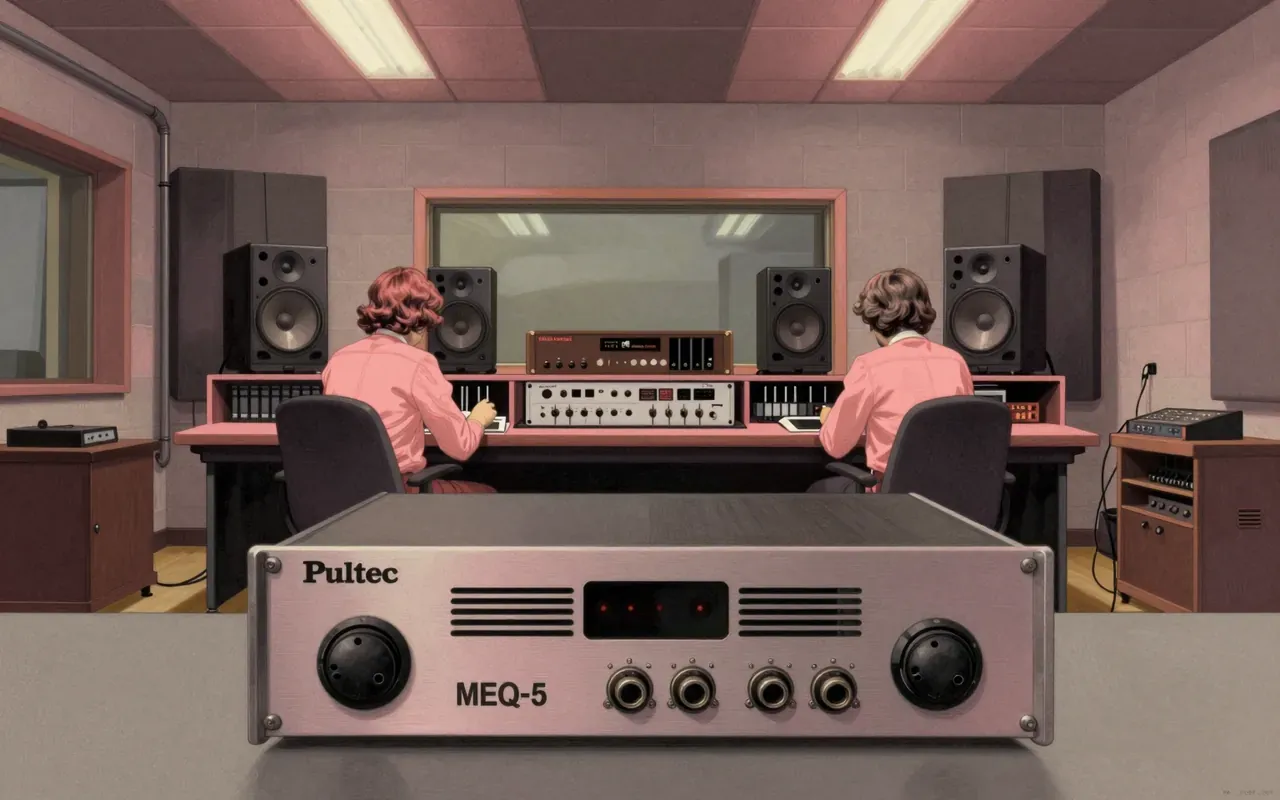
Pultec MEQ-5

Pultec

The Pultec MEQ-5 is a clean, transparent, three-band analog EQ. It occupies two rack spaces. Each band uses a frequency switch and a gain knob. It covers nearly the full frequency spectrum. It alters sound cleanly—nothing more, nothing less.

6:54

Ampex MM-1200

Ampex

The Ampex MM-1200 is an analog multitrack recorder. No technical specifications exist for it. That absence defines its limits.

9:00

Roland MSQ-700

Roland

The Roland MSQ-700 is an 8-track MIDI sequencer with lithium battery-backed memory, step-time and real-time recording, punch-in, merge, quantization, chaining, and analog tape sync. It stores 6500 notes per track. It has no screen, no file export, no velocity editing, and no USB.

8:20

Otari MTR-10

Otari

The Otari MTR-10 is an analog multitrack recorder. No technical specifications are available. It is also referred to as 'mtr 10' or 'mtr10'.

10:16

Otari MTR-12

Otari

The Otari MTR12 is an analog multitrack recorder. No technical specifications exist for it. That absence defines its utility — or lack thereof.

6:52

Otari MTR-90

Otari

The Otari MTR-90 is listed as an analog multitrack recorder. No technical specifications are available. Nothing else is confirmed.

10:14

Otari MX-5050

Otari

The Otari MX-5050 is an 8-track analog multitrack cassette recorder introduced in 1987. It records at 3.75 ips. Its recording head is superior to that of the Otari 488 and 488 mkII. dbx Type II noise reduction applies separately to tracks 1–4 and 5–8. A pitch/speed wheel allows ±15% variation. Its digitally controlled transport enables automated punch-in between memory points. It uses direct-drive mechanics — no capstan belt required. It records all eight tracks simultaneously, unlike the 488 models.

9:14

Yamaha NS-10M

Yamaha

The Yamaha NS-10M is a two-way passive near-field monitor. It delivers clear mid and high frequencies but lacks deep low-end extension. Engineers use it to verify mix translation and to A/B compare with other speakers. Its non-neutral response demands experience. It is not a full-range solution.

8:20

Eventide Omnipressor 2830

Eventide

The Eventide Omnipressor 2830 Au is a studio compressor. No technical specifications are available. It belongs to the studio compressors category.

8:18

Electro-Harmonix Polychorus

Electro-Harmonix

The Electro-Harmonix Polychorus Mk2 is a stereo analog stomp-box modulation pedal for guitar. It offers chorus, flanger, double track, and filter matrix modes via toggle switches. It has one input and two outputs. It requires 24V power. It has no preset memory.

8:51

Tascam Portastudio 144

Tascam

The Tascam Portastudio 144 is a four-track analog cassette recorder. It was used by adolescents for home multitrack recording in 1981. It lacked dBX noise reduction but functioned effectively. It enabled users to record and mix music at home, creating a personal musical environment.

8:43

Tascam Portastudio 244

Tascam

The Tascam Portastudio 244 is a 1984 four-track cassette recorder. It gives immediate, portable multitrack recording with EQ, gain, and switchable input impedance per track. DBX noise reduction works. Analog saturation stays musical. But signal degrades horribly at each bounce. Cassette transport is fragile. Preamps sound thin and harsh. No phantom power. Unbalanced inputs only. It was bought in Paris in 1984 for nearly 5,000 francs.

7:10

Tascam Portastudio 246

Tascam

The Tascam Portastudio 246 is an analog multitrack-studio. No technical specifications exist for it. It belongs to the category of Analog Multitrack-studios.

8:01

Tascam Portastudio 424

Tascam

The Tascam Portastudio 424 is a cassette-based four-track recorder and mixer. It uses type II (CrO2) tape. It has two inputs — XLR and 1/4 inch — and supports tape speeds of 9.5, 4.75, and 2375 cm/s. dbx type II noise reduction is permanent. Each input has gain, three-band EQ, and panning. It has main stereo outputs and a headphone jack.

8:54

Rupert Neve Designs Portico 5012

Rupert Neve Designs

The Portico 5012 is a solid-state mic preamp with intuitive gain staging and a subjective Silk function that transforms its clean base tone into something euphoric — but unpredictable.

8:46

Rupert Neve Designs Portico 5043

Rupert Neve Designs

The Portico 5043 is a studio compressor in Rupert Neve Designs’ Portico series. It delivers consistent, source-agnostic compression with optional harmonic colouration. Its physical format undermines its rack-ready promise. It does not replace a dedicated clean limiter or a compact multi-channel solution — but it rarely needs replacing on a track once engaged.

8:26

Revox PR99

Revox

The Revox PR99 is an analog multitrack recorder with no published technical specifications. Its function is limited to basic tape-based multitrack recording and playback — but without documented parameters, alignment, or service history, it resists reliable use or evaluation.

8:07

Digidesign Pro Tools 24 MIX

Digidesign

The Digidesign Pro Tools|24 Mix + is a discontinued PCI DSP board for Pro Tools|24 systems. It requires Pro Tools 6.4.1 and Mac OS 10.3.8. Installation is difficult. Setup is simple. Once running, it performs reliably and professionally.

8:33

Royer R-121

Royer

The Royer R-121 is a studio-only ribbon microphone. It delivers fast, flat, high-SPL capture — but offers zero user controls, zero ruggedness, and zero tolerance for phantom power. It belongs where the environment is controlled and the source is loud.

10:00

Mesa/Boogie Rectifier Recording Preamp

Mesa/Boogie

The Mesa Boogie Rectifier Recording Preamp is a 2U rack-mount tube preamp with two channels and six voicings. It prioritises high-output direct recording but includes I/O for live use. Its six 12AX7 tubes deliver raw gain capable of overdriving mixers. It lacks speaker emulation and falls short when compared to miked cabinet tone.

9:59

Yamaha REV7

Yamaha

The Yamaha REV7 is a fixed-architecture digital reverb unit from 1985. It occupies two rack spaces. It offers four reverb types — hall, room, flat, and voice — plus chorus, flanger, phaser, tremolo, and delay. All effects layer over reverb. It has XLR and 1/4-inch audio connections and 5-pin DIN MIDI ports. It has no patch memory, no real-time MIDI parameter control, and no stereo-in/stereo-out routing.

9:34

Rhodes piano

Fender Rhodes

The Rhodes piano is an electromechanical electric piano invented by Harold Rhodes. It uses hammers to strike metal tines whose vibrations are captured by electromagnetic pickups. It outputs an electrical signal requiring external amplification for full fidelity. It makes audible sound unplugged — quieter and thinner — and features a vocal-range frequency gap that supports singing without masking.

8:37

Orange Rockerverb 50

Orange

The Orange Rockerverb 50 is a discontinued dual-channel tube head built around four 6V6 power tubes. It delivers 50 watts of British rock tone — immediate, mid-forward, compressed — with minimal controls and shared EQ. It was succeeded by the MKIII. It does not offer channel-specific EQ, master volume, or tight high-gain definition.

7:49

Apogee Rosetta 800

Apogee

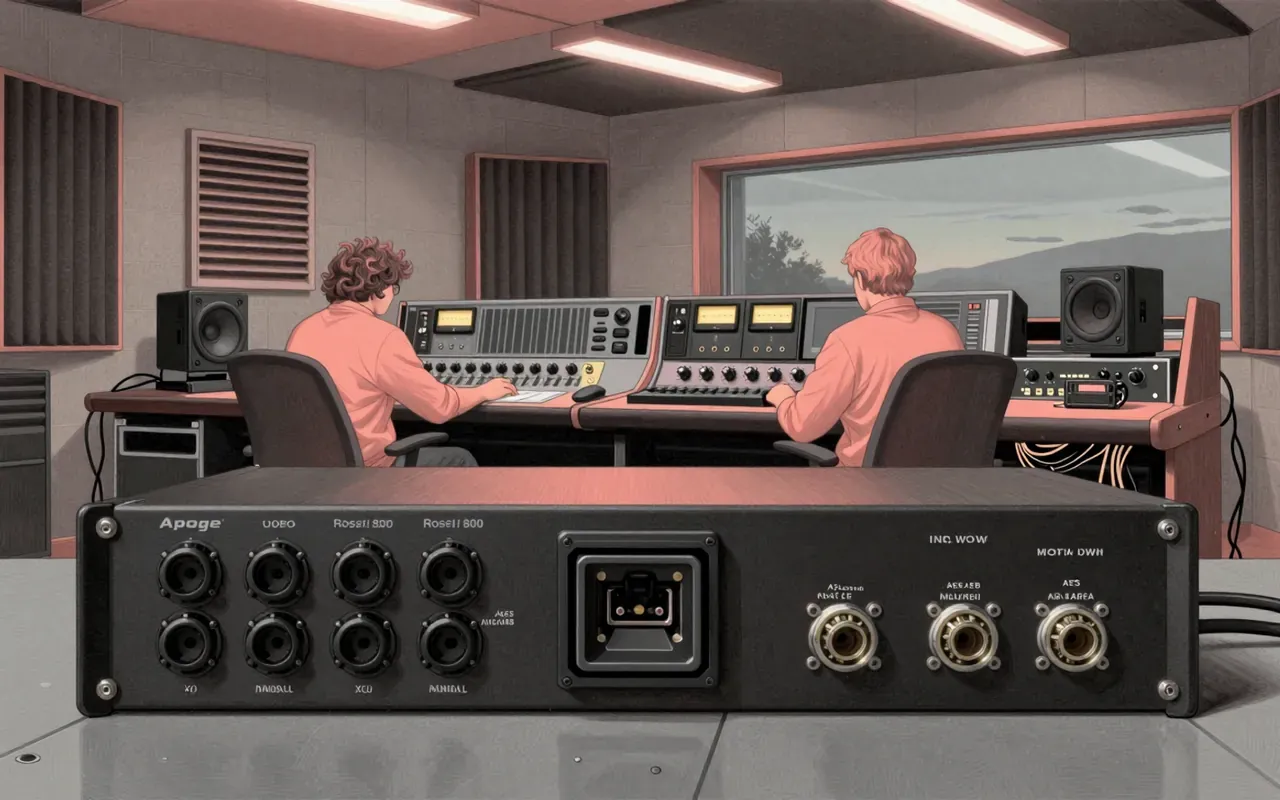
The Apogee Rosetta 800-192k is a rack-mountable analog-to-digital converter. It connects via rear-panel analog, ADAT, and AES. It serves Pro Tools HD systems. It runs at 48 kHz, 96 kHz, or 192 kHz. It produces a clean, transparent, smooth signal. It does not do D/A, preamp, or processing.

7:53

ATC SCM50

ATC

The ATC SCM50 ASL is an active monitor with no published technical specifications. Nothing about its sound, construction, or performance is documented in the source material.

8:56

Marshall Silver Jubilee 2555

Marshall

The Marshall Silver Jubilee 2555 is a software amp simulator by Softube. It belongs to the Amp Room series. It has no published technical specifications. It is not hardware. It is not a standalone application. It is a plugin for digital audio workstations that host Amp Room.

9:26

Danelectro Silvertone 1448

Danelectro

The Danelectro Silvertone 1448 is a 1963 masonite-bodied guitar built by Danelectro, designed by Nat Daniels, and sold by Sears as part of an 'Amp in Case' set. It has a rosewood fretboard, shorter scale, six-in-line tuners, wooden-saddle bridge, and typically one neck-position lipstick pickup. It does not intonate or stay in tune for very long.

8:34

Manley SLAM!

Manley

The Manley SLAM! is a stereo microphone preamp and limiter. It uses lamp-based preamplification and two analog limiting circuits — optical (ELOP) and FET — in a fixed signal path. It mounts in 2U of rack space. It does not offer variable routing, metering, or sidechain control.

9:54

Technics SP-10

Technics

The Squier SP-10 is a 10W solid-state guitar amp for beginners. It delivers clean and gain channels through a single volume knob, bass and treble tone controls, and a gain switch. It has no midrange control, no effects loop, and no channel-specific volume. Input and headphone jacks are separate. Its design prioritises simplicity and portability over tonal range or headroom.

8:22

Yamaha SPX900

Yamaha

The Yamaha SPX900 is a 1U digital multi-effects processor with analog-only I/O, 16-bit/44.1 kHz processing, and 99 fixed presets. It delivers studio-ready reverb, delay and modulation in a compact, MIDI-controllable package — but offers no digital connectivity and no on-the-fly parameter editing.

8:35

TC Electronic Stereo Chorus+

TC Electronic

The Rockman Stereo Chorus is a fixed-function stereo chorus pedal for guitar. It has no tempo sync, no expression input, no adjustable delay or feedback. It spreads the signal across two amps or channels. It is not made by TC Electronic. Its only controls are rate and depth. It is usable, but inflexible.

8:03

Gibson Super 400 CES

Gibson

The Gibson Super 400 CES (2011) is a discontinued hollow/semi-hollow electric guitar. Its name, category, and discontinuation are the only verified facts. It has no technical specifications, no availability, and no documented use. It does not function as an instrument today.

7:12

Neumann TLM 103

Neumann

The Neumann TLM 103 is a fixed cardioid condenser microphone. It delivers a full 20 Hz–20 kHz frequency response. It has no low-cut filter or pad. It does not include a shock mount. It ships in a wooden, padded box. Its output impedance is 50 ohms.

11:02

Neumann TLM 170

Neumann

The Neumann TLM 170 is a discontinued large-diaphragm condenser microphone built solely for studio recording. It offers five polar patterns, a -10 dB pad, and a low-cut switch. It ships with a swivel mount and supports U87-style suspension. It fails in live performance. No recordings, artists or sessions are documented in the source material.

10:17

SPL Transient Designer

SPL

The SPL Transient Designer is a plug-in that reshapes sound by directly manipulating attack and decay — not through compression or gating, but via level-independent envelope control. It excels at tightening, lifting, or taming transients across full-bandwidth sources, but offers no frequency selectivity or threshold-based dynamics. It belongs on drum busses, room mics, and bass tracks — not on vocals needing surgical sibilance control or synths needing dynamic layering.

9:04

Neumann U 89

Neumann

The Neumann U 89 is a 1980 large-diaphragm condenser microphone built for versatility: five polar patterns via rotary switch, two fixed low-cut filters (80 Hz and 160 Hz), an attenuator, 140 dB SPL handling, and a neutral, less vivid tonal character than the U 87. It excels at distance capture and fits where bulkier mics cannot. It does not offer colouration, warmth or extended sub-bass response. No recordings or users are named in the source material.

8:10

Neve V Series

Neve

The Waves V-Series is an effects bundle with no published technical details. It offers no verifiable functionality, no documented use cases, and no basis for evaluation beyond its category label.

9:22

SPL Vitalizer

SPL

The SPL Stereo Vitalizer MK2 is a hands-on exciter that trades surgical control for immediate sonic uplift — sharpening treble, rounding bass, widening stereo image, and adding air. Its strength is cohesion, not correction.

8:43

Focusrite VoiceMaster Pro

Focusrite

The Focusrite VoiceMaster Pro is a vocal-optimised channel strip with a discrete Class A preamp, optical compressor, de-esser, and tube simulation. Its preamp is soft in the highs. Its compressor is transparent. Its EQ is functional but unmusical. All controls are front-panel only. It delivers what vocal tracking needs—not what mixing demands.

6:40

Neve VR

Neve

The Neve VR LEGEND 60 is confirmed only as an analog mixer. No technical specifications exist in the source material. Nothing is verified about its design, operation, application, or outcome.

10:18

Rickenbacker 360

Rickenbacker

The Rickenbacker 360 is a semi-acoustic electric guitar built for sharp, articulate presence—not warmth, depth, or adaptability.

9:26

Rickenbacker 4001

Rickenbacker

The Rickenbacker 4001 is an electric bass built for clarity, not compromise. Its maple neck-through construction and twin pickups deliver sharp transients and upper-mid bite. It sacrifices low-end warmth, dynamic nuance, and ergonomic flexibility to achieve that. It was chosen—not for versatility—but for unmistakable presence.

9:08

RCA Type 44

RCA

The RCA Type 44 is a bi-directional ribbon microphone introduced in 1931. Its thin corrugated metal ribbon generates voltage when vibrating in a magnetic field. It hears only front and back. It breaks under wind, phantom power, and loud transients. It flatters voice and acoustic instruments with smooth mids and gentle highs. It belongs in a vintage studio chain—not on a podcast desk or a stage.

10:22

Marshall Bluesbreaker

Marshall

The Marshall Bluesbreaker is Models 1961 and 1962 — Marshall’s first combo, built from 1964/65 to 1972. It is the JTM45 circuit in an open-backed cabinet. It delivers aggressive, responsive overdrive with no master volume, no clean headroom, and no flexibility — and that is precisely what made it essential.

9:43

Epiphone Crestwood

Epiphone

The Epiphone Crestwood is a solid-body electric guitar introduced in 1958. It has no Gibson equivalent. It evolved through named variants—Crestwood Custom, Crestwood DeLuxe—before ending production in 1970. Its construction is mahogany. Its pickups are New Yorker. Its headstock changed from three-on-a-side to six-on-a-side. Its pickguard changed design and lost the Epiphone logo. Its fretboard markers changed from dots to ovals. Its plating changed from gold to nickel. Its upper horn lengthened slightly by 1963. The Crestwood DeLuxe added a third pickup and an ebony fretboard with block inlays.

8:26

Empirical Labs Distressor

Empirical Labs · 1995

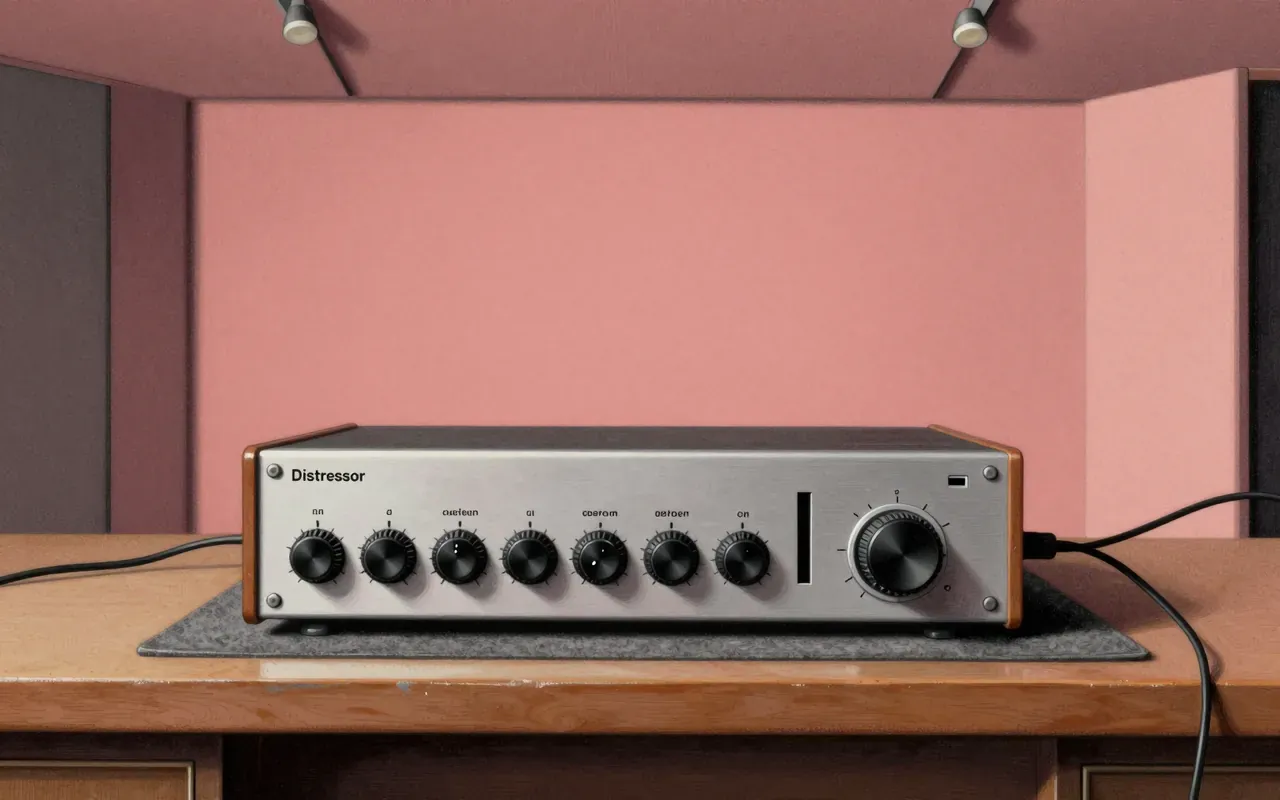
The Empirical Labs Distressor is an analog VCA compressor introduced in 1995. It has a fixed threshold, soft knee, and variable ratio, attack, release, input gain and output gain. At 10:1, it uses a photoresistor-based optical emulation circuit. It includes tube and tape distortion emulations, side-chain high-pass filtering, and on the EL8-X model, British Mode and Image Link. It was inducted into the TECnology Hall of Fame in 2016 and has sold an estimated 40,000 units.

9:25

Fender Harvard

Fender

The Fender Harvard is a vacuum tube guitar amplifier made by Fender from 1955 to 1963. It appeared only in a tweed-covered narrow-panel cabinet. It had no predecessor or direct descendant. It served as a mid-tier option between the Champ/Princeton and Deluxe models.

9:29

Epiphone Jack Casady Signature Bass

Epiphone

The Epiphone Jack Casady Signature Bass is a 4-string semi-hollow bass guitar co-developed by Jack Casady and Epiphone. It features a maple body, mahogany neck, and a custom low-impedance humbucking pickup connected to a transformer with a three-position impedance selector (50, 250, or 500 ohms). It was designed specifically to improve tonal definition in ensemble playing — a documented shortcoming of the 1970s-era Gibson Les Paul Signature bass. It belongs to Epiphone’s list of exclusive electric bass guitars. It offers no tone controls, no second pickup, and no active circuitry. Its tonal range is defined entirely by impedance selection: lower values yield clarity and balance; higher values yield output and bass weight.

9:00

LA-2A Leveling Amplifier

Teletronix

The LA-2A is a hand-wired, vacuum tube-based audio compressor developed by Teletronix and released commercially in 1962. It uses an electroluminescent panel and cadmium sulfide photoresistor for program-dependent gain reduction. Its attack is fixed at 10 ms; its release varies from 60 ms to 15 seconds depending on input. It preserves perceived performance dynamics under heavy compression. UREI acquired its patent rights in 1967.

9:43

Beyerdynamic M 160

Beyerdynamic · 1957

The Beyerdynamic M 160 is a hypercardioid ribbon microphone introduced in 1957. It uses dual 15-mm aluminum ribbons suspended between alnico magnets (later neodymium), rotated 90 degrees to achieve end-address operation and a highly directional pickup pattern. It softens harsh characteristics of strident sound sources. It has been used in broadcasting, live concerts, and studio recordings — notably by Eddie Kramer on Jimi Hendrix and Andy Johns on John Bonham’s drums for 'When the Levee Breaks'. It remains in production over six decades later.

10:06

Neumann M 49

Neumann

The Neumann M 49 is a large-diaphragm condenser microphone developed at the NWDR’s Central Laboratory in Hamburg. It entered German broadcasting studios in 1952. It was the world’s first microphone with a remotely switchable polar pattern. Its pressure-gradient capsule causes proximity effect even in omnidirectional mode.

10:21

Fender Mustang Bass

Fender · 1964

A compact, student-oriented bass built for immediacy — not depth, not versatility, not power.

9:18

Lexicon (company)

Lexicon · 1971

Lexicon is a company, not an instrument. Its first product was a digital delay system released in 1971. It pioneered commercial digital audio processing hardware for professional and live applications — notably digital reverb starting with the Model 224 in 1978. Its hardware is rack-mounted, hardware-controlled, and designed for integration into analog signal paths. It does not run as software, has no built-in synthesis or recording, and offers no modern digital workflow features.

10:14

EMI REDD

EMI

The EMI REDD was not a product. It was Abbey Road’s first custom-built, vacuum-tube-based stereo mixing system — engineered in-house, adapted for four-track tape, and retired when it could not scale beyond four outputs. Its sound came from saturation, not precision. Its limits were physical: fixed routing, no patching, no serviceability. Its legacy is inseparable from the room, the tape machines, and the engineers who worked it daily.

9:25

Boss SD-1

Boss · 1981

The Boss SD-1 is a 1981 overdrive pedal. It is the second overdrive made by Boss. It adds a tone control and refines the OD-1’s circuit for more gain and aggression. Its asymmetrical soft-clipping uses two diodes on the positive waveform peak and one on the negative—producing both even and odd harmonics. It is midrange-focused at 800Hz and rolls off less bass than the OD-1. Its circuit has remained unchanged since release.

9:01

Gibson EB-3

Gibson

The Gibson EB-3 is a short-scale bass built for midrange punch, not low-end authority. Its 30.5" scale, slim SG-style body, and asymmetric pickup pair — large humbucker at the neck, mini-humbucker at the bridge — define its physical and sonic identity. The four-way rotary switch offers distinctive tonal options, including two that deliberately roll off low frequencies. It was produced from 1961 to 1979. Exactly 14,167 were made.

8:55

Music Man StingRay

Music Man · 1976

The Music Man StingRay is a 1976 electric bass co-designed by Leo Fender as a modern update to the Precision Bass. It introduced active electronics to bass design — a 9-volt-powered preamp with 2-band EQ, an oversized humbucker wired in parallel, and epoxy-sealed circuitry. It delivers a uniquely bright, scooped-mid, deep-low tone with high output and rigidity. It lacks passive tone shaping, midrange control in early models, and serviceable electronics. It became essential for slap bass, studio clarity, and cutting through dense mixes.

9:10

Marshall Super Lead

Marshall · 1965

The Marshall Super Lead is a 100-watt guitar amplifier head made by Marshall between 1966 and 1981. It was developed in response to player demand for higher output than the earlier JTM45. Its distortion arises solely from overdriving its EL34-based power amp section at high volume. It has two channels and four inputs but no master volume. Its core character is bold, midrange-heavy, and bright — delivering the foundational 'Marshall crunch' sound of 1970s rock.

9:00

Fender Vibrolux Reverb

Fender

The Fender Vibrolux Reverb is a 35-watt blackface/silverface tube amp built around smaller transformers and 10″ speakers. It breaks up earlier and more sweetly than larger 6L6 Fenders. Its tone is scooped, punchy and sparkling—but it sacrifices clean headroom and low-end weight. CBS-era revisions increased clean headroom, but the core character remains defined by responsiveness over restraint.

8:47

Warwick Thumb SC

Warwick

The Warwick Thumb SC is a 2010 single-cut bass born from a fan forum contest. It adapts the Thumb NT shape with new tonewoods and adds coil-splitting via two mini toggles—its sole functional departure from the NT. It has no passive mode, no 6-string option, and no historical lineage beyond its 2009–2010 development cycle.

9:59

ProDigi

Mitsubishi

ProDigi was a professional reel-to-reel digital audio tape format with stationary heads, introduced in the mid-1980s, using linear digital recording with cyclic redundancy check error correction on metal particle tape in 2-, 16-, and 32-track configurations; it was widely adopted in Nashville country music studios but declined by the mid-1990s with the rise of Pro Tools.

10:23

1176 Peak Limiter

UREI

The UREI 1176 Peak Limiter is a fast, characterful, all-solid-state audio compressor introduced in 1968. It uses a field-effect transistor in feedback configuration for gain reduction. Compression is soft-knee with a fixed threshold controlled by input level. Four ratios — 4:1, 8:1, 12:1, 20:1 — each raise the threshold. Attack and release are program-dependent. Stereo linking is supported. The 'all-button mode' adds harmonic distortion and alters compression behaviour. It marked the transition from vacuum tube to solid-state technology in studio dynamics processing.

8:31

API 550

API

The API 550b is a four-band analog EQ re-issuing the 1967 API 550 with an added band. It offers seven switchable frequency centres per band, ±12 dB boost/cut, shelf/peak switching on bands 1 and 4, Proportional Q, reciprocal and repeatable filtering, and a +30 dBu clipping level. It uses API’s 2520 op amp and is built to original blueprints.

9:31

Gretsch Country Club

Gretsch

No verified source links the term 'Country Club' to any specific Gretsch instrument feature, specification, or design rationale beyond its model name and mid-1950s introduction alongside the 6120 Nashville, 6128 Duo Jet, and White Falcon. No claims about its construction, electronics, finish, or player experience are supported by the provided material. All descriptive statements must therefore be omitted or flagged as unsupported. The only factual anchors are its name, its status as a Gretsch guitar model, and its release period.

9:28

Apogee Ensemble

Apogee

The Apogee Ensemble (FireWire) and Ensemble Thunderbolt are legacy audio interfaces with fixed end-of-life dates, discontinued software support, and hard macOS version limits. They offer no documented sonic distinction, no stated creative use cases, and no path forward beyond legacy maintenance.

8:54

Electro-Harmonix Memory Man

Electro-Harmonix

The Electro-Harmonix Deluxe Memory Man is an analog delay pedal introduced in 2008, offering up to 550ms of delay, selectable chorus or vibrato modulation, true bypass switching, and mono audio I/O.

9:51

PCM adaptor

Sony

The PCM adaptor is a transitional artifact: a hardware hack that made digital audio portable and recordable using 1970s video infrastructure. It solved one problem — getting 16-bit audio onto physical media for CD mastering — and introduced many others: tape instability, video sync dependency, and zero interoperability with later digital standards.

10:42

MXR Phase 90

MXR · 1972

The MXR Phase 90 is a phaser effects pedal introduced in 1972, the first pedal sold by MXR. It features one knob (Speed), an orange enclosure, and evolved logo designs (script then block). Production ceased in 1984 when MXR went bankrupt. Dunlop resumed production with added features: an LED and optional AC power supply. Pre-1981 units lacked LEDs, A/C adaptor jacks, and true-bypass switching. It was used on the first two Van Halen albums.

9:30

Gretsch Tennessean

Gretsch

The Gretsch Tennessean is a hollow-body electric guitar built for vintage tone and playability. It delivers a highly resonant, cutting voice shaped by its construction, pickups, and controls. It excels in clean and mid-gain contexts but struggles with feedback and high-gain stability. Its design prioritises acoustic resonance and vibrato expression over modern high-output versatility.

10:06

Rickenbacker 325

Rickenbacker · 1958

The Rickenbacker 325 is a compact, bright, feedback-prone hollow-body guitar defined by its short scale, semi-hollow construction, and visual signature — the crescent moon cutaways and angled sound hole. It was designed for clarity and portability, not warmth or power.

8:04

Coles 4038

Coles

The Coles 4038 is a BBC-designed ribbon microphone from 1953. It uses a bi-directional polar pattern and has a flat frequency response from ~30–15,000 Hz. High-frequency attenuation reduces sibilance but also reduces detail. Its technical specifications have remained unchanged since its design in the 1950s.

8:24

RCA Type 77-DX microphone

RCA

The RCA Type 77-DX is a 1954 poly-directional ribbon microphone with mechanical pattern control, low-tension 2.5-micron ribbon, and user-selectable impedance and low-frequency rolloff.

9:15

Vox AC15

Vox

The Vox AC15 is a foundational British guitar amplifier — simple, immediate, and sonically specific. It trades versatility for character. Its design choices are constraints, not oversights. It remains relevant not as a relic, but as a functional tool with an unrepeatable voice.

8:15

Vox AC30

Vox

The Vox AC30 is a valve-powered guitar amplifier introduced in 1959 to provide higher wattage and greater volume than the AC15. Its class AB operation, cathode-biased EL84 push-pull output stage, and Celestion Blue speaker pairing produce a jangly, mid-forward, high-clarity tone with limited low-end at low volumes but strong headroom and smooth overdrive. It is not synthesizer-based and does not employ digital or solid-state synthesis methods.

10:14

Vox AC50

Vox

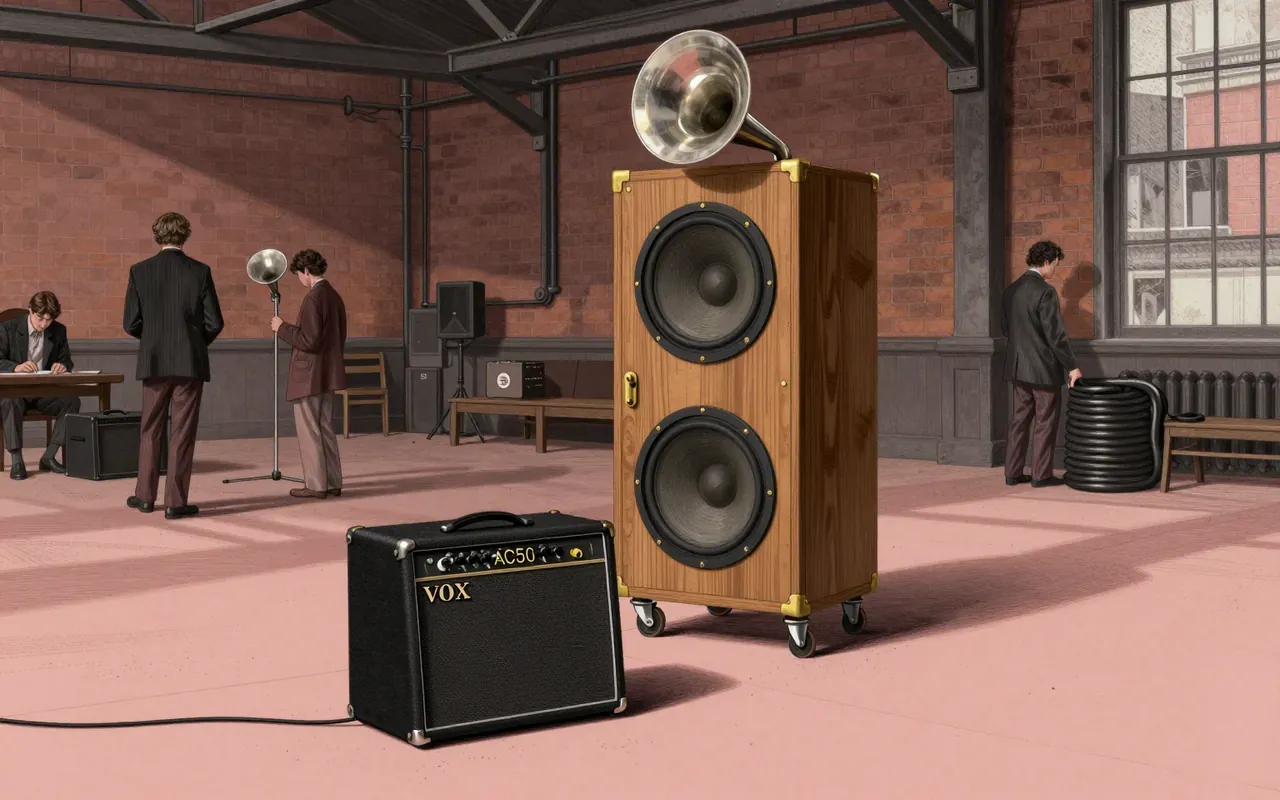
The Vox AC50 is a loud, clear, live-performance amplifier head introduced in 1964. It uses EL34 output tubes, ECC82 and ECC83 preamp tubes, and evolved from GZ34 to diode rectification. Its dual then quad inputs offer immediate tonal contrast. It pairs with a trolley cabinet featuring Alnico speakers and a Goodmans Midax Horn for crowd-piercing clarity. It sacrifices compactness, low-volume usability, and modern features for authoritative stage presence.

9:26

ADAT

Alesis

The ADAT was a tape-based digital multitrack recorder introduced by Alesis in 1991 and shipped in early 1992. It recorded eight tracks of 16-bit audio on S-VHS cassettes, supported locate points and auto play/record for precise editing, and could be synchronised with up to 15 other units for 128-track recording. Its CD-resolution audio and low price disrupted home and project studios. Later models like the HD24 moved to hard disk and introduced File Streaming Technology.

9:30

Ampeg

Ampeg · 1946

Ampeg began in 1946 with Everett Hull’s tailpin transducer for upright bass. Jess Oliver later engineered the B-15’s flip-top chassis. It defined studio bass tone for decades—but only for players who matched its physical and sonic constraints.

9:49

Ampex ATR-100

Ampex

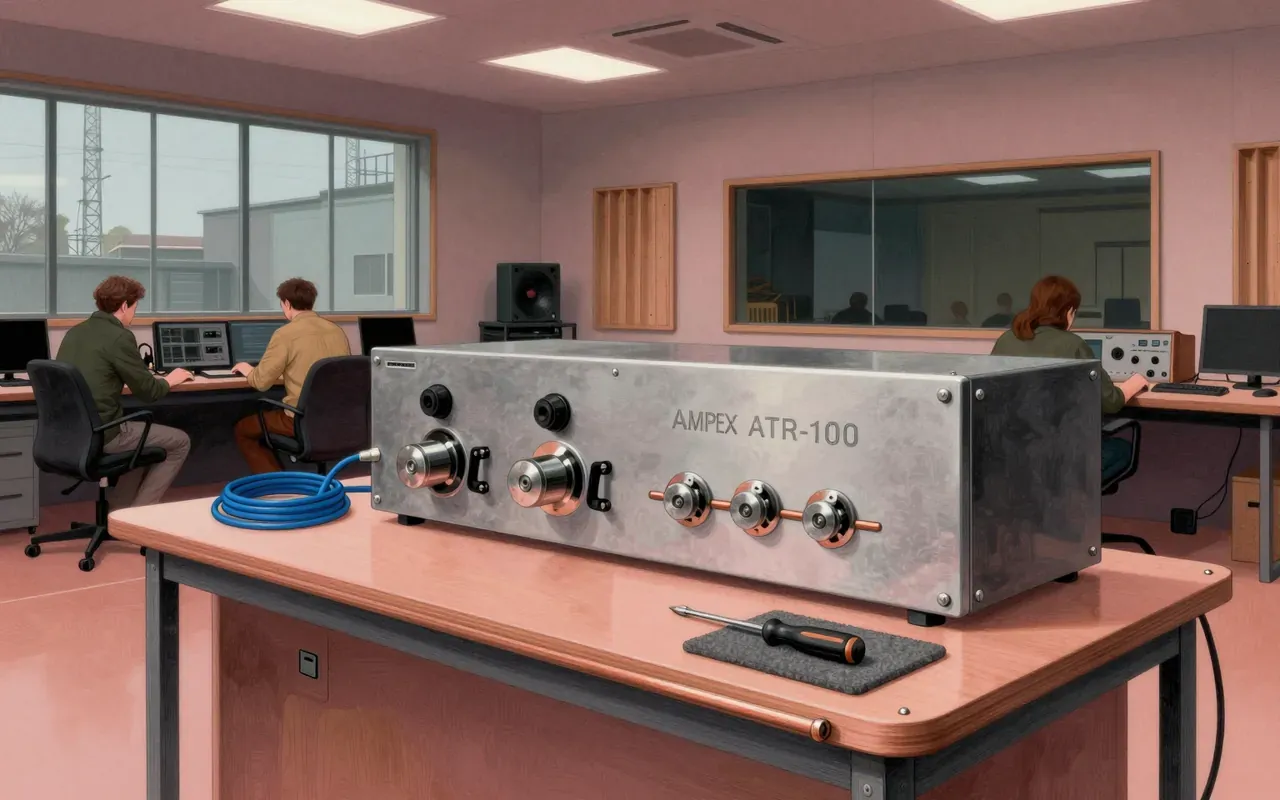
The Ampex ATR-100 is a mastering-grade analogue tape recorder introduced in Spring 1976 at the AES Conference in Los Angeles. Designed exclusively for stereo or quadraphonic mixdown and mastering, it features a servo-controlled direct-drive-capstan transport and interchangeable headblocks for quarter-inch or half-inch tape. Its wow and flutter performance set a new standard for analogue accuracy. It does not support multitrack recording. No verified claims exist about recordings made on it, its users, or its sonic signature beyond accuracy.

9:19

Fender Bass VI

Fender

A six-string bass that trades punch for possibility — and never found enough players who needed both.

10:11

Shure Beta 58A

Shure

A live vocal mic defined by rejection, presence, and deliberate low-end roll-off.

7:56

Clavinet

Hohner

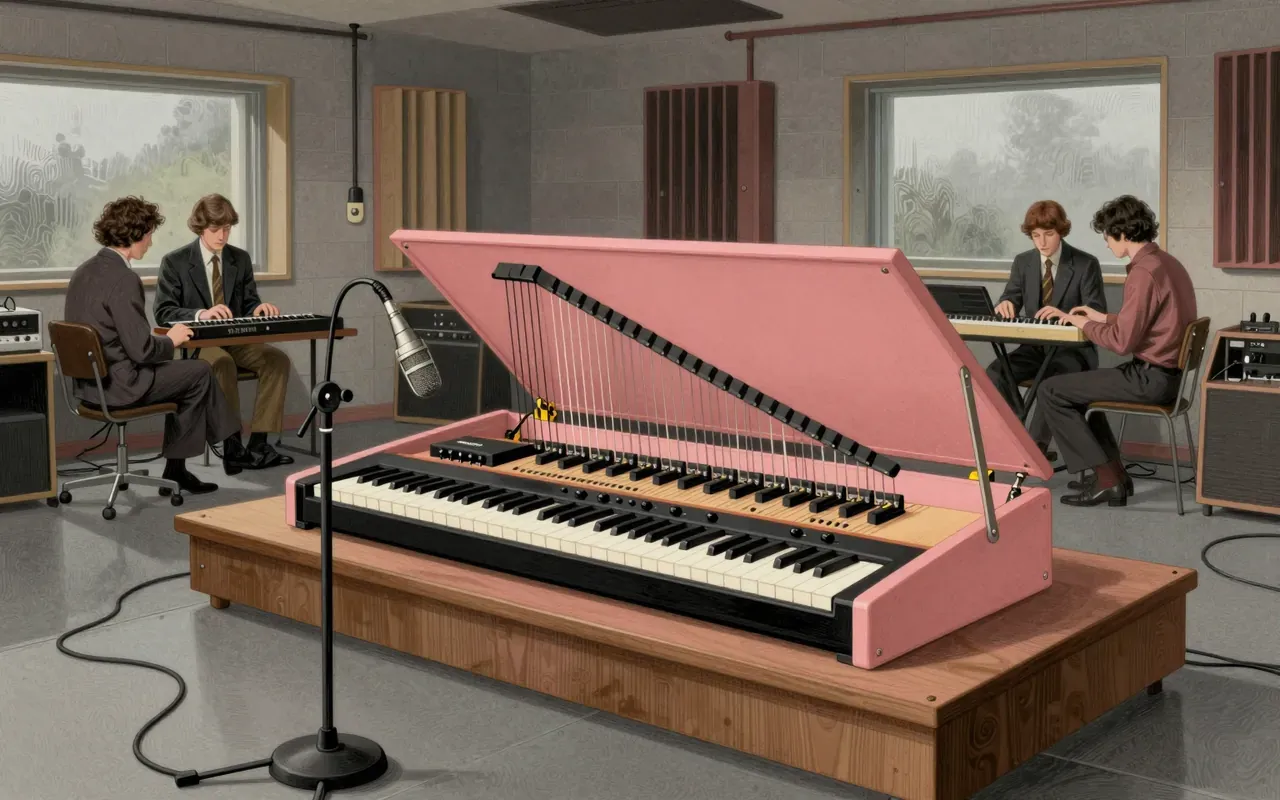
The Clavinet is a 60-key electromechanical keyboard made by Hohner from 1964 to 1982. It uses rubber pads to strike tensioned steel strings, with electromagnetic pickups capturing the vibration. Its weighted action enables dynamic volume and aftertouch via string stretch. It excels at percussive, expressive, midrange-heavy articulation—but offers no sustain, limited range, or tonal flexibility beyond its fixed pickup response.

8:04

Gretsch

Gretsch · 1883

Gretsch is not a guitar brand by origin. It is a Brooklyn drum and percussion company founded in 1883 that added guitars late—and only committed to them after Chet Atkins demanded a hum-free hollowbody. The Filter'Tron pickup solved a real problem: 60-cycle hum in live and studio settings. But it did not solve feedback, sustain, or tonal flexibility. Its value lies in what it removed—not what it added.

10:20

Fender Deluxe Reverb

Fender

The Fender Deluxe Reverb is a 22-watt tube combo amplifier introduced in 1963, featuring spring reverb, tremolo, and a fixed 12-inch speaker configuration. It uses 6V6GT power tubes operated beyond specification, four 12AX7s, two 12AT7s, and a 5AR4 rectifier. Most commonly fitted with a Jensen C-12Q speaker, it has appeared with Oxford, Marlboro, Utah, and Eminence alternatives. Its circuit remained largely unchanged across black-panel (1963), silver-panel (1968), and black-panel reintroduction (1980) eras.

10:38

Mesa/Boogie Rectifier

Mesa/Boogie

The Mesa/Boogie Rectifier is a 100-watt tube guitar amplifier introduced in 1991 or 1992, built for aggressive, bass-heavy distortion and refined across seven circuit revisions. It defined 1990s rock tone—but offered little clean headroom, resisted nuance, and cemented Mesa’s association with metal over its broader legacy.

10:00

Gretsch 6128

Gretsch

The Gretsch 6128 Duo Jet is a chambered mahogany electric guitar introduced in 1953. It features two pickups, a body-mounted pickup selector, a cutaway-mounted master volume, and a headstock-accessible truss rod. Bo Diddley played it in the mid-1950s.

8:17

MXR Dyna Comp

MXR

The MXR Dyna Comp is a guitar compressor pedal introduced in the 1970s. It has two controls: Sensitivity and Output. It produces a non-tone-neutral, colour-rich compression effect. It became a Nashville standard. It smooths out volume differences between notes, especially in chicken picking. It was one of the six original pedals in the MXR Series 2000 line.

8:37

Gibson EB-0

Gibson

The Gibson EB-0 is a bass guitar introduced in 1959 to replace the underperforming EB-1. It used the EB-1’s mahogany neck, body, and 30.5-inch scale but adopted a double-cutaway body inspired by the Les Paul Junior. Production ended in 1979 after 20,844 units. Early models were cherry red only. In 1961, the body was redesigned to match the SG. In 1962, the pickup’s black plastic cover became metal. Around 1964/5, nickel hardware gave way to chrome.

9:48

Gibson EB-2

Gibson

The Gibson EB-2 is a purpose-built, no-compromise semi-hollow bass: warm, resonant, limited. Its design gives you one voice — rich and rounded — and refuses all others.

10:26

Gibson ES-125

Gibson

The Gibson ES-125 is a purpose-built, no-compromise entry into hollow-body electric guitar playing. It gives one voice, one circuit, and one physical response—nothing more, nothing less.

10:12

Gibson ES-175

Gibson · 1949

The ES-175 is a purpose-built hollowbody jazz guitar: functional, focused, and frozen in time.

8:28

Gibson ES-295

Gibson

The ES-295 is a hollow body guitar introduced in May 1952. It shares dimensions with the ES-175. It was conceived as a full-sized hollowbody archtop intended to complement the solidbody Les Paul. Its original price was $295. Les Paul claimed involvement in its creation. The first ES-295s came outfitted with one pickup. By 1953 the guitar was shipping with two pickups. It was discontinued in 1959 and reissued multiple times. Scotty Moore used it.

8:50

Gibson ES-330

Gibson

The ES-330 is a thinline hollow-body electric guitar introduced in 1959. It uses P-90 pickups and has no center block. It is prone to feedback. It was discontinued in 1972.

9:56

Gibson ES-335

Gibson · 1958

The ES-335 is a semi-hollow body semi-acoustic guitar introduced in 1958 as a compromise between hollow-body warmth and solid-body feedback resistance, featuring a solid maple center block with hollow upper bouts and f-holes. It achieved commercial success and continuous production due to its tonal flexibility across blues, jazz, and rock.

9:31

Gibson Explorer

Gibson

The Gibson Explorer is a solid-body electric guitar released by Gibson in 1958. It features a radical, futuristic body design derived from the 1957 Futura prototype. Only 19 were produced in 1958 and 3 in 1959. Early models had a 'split'-shaped headstock with 3+3 tuners; later models used a long drooping 'hockey-stick' headstock with tuners in a straight line on one side.

9:11

Gibson Firebird

Gibson

The Gibson Firebird is a solid-body electric guitar introduced in 1963. It features neck-through-body construction—the first Gibson solid-body to do so—with a stepped neck, reverse headstock, treble-side banjo-style planetary geared tuners, and fully covered mini-humbucking pickups with metal surrounds. The neck is built from five plies of mahogany and four narrow strips of walnut.

8:48

Gretsch 6120

Gretsch

The Gretsch 6120 is a hollow body electric guitar introduced in 1955, developed with Chet Atkins, featuring design evolution including prototype testing, introduction of neoclassic fret markers in 1958, replacement of DeArmond pickups with Filter'Tron humbuckers, cessation of production in the late 1970s, and subsequent revival.

9:45

Boss HM-2

Boss · 1983

The Boss HM-2 is a distortion pedal introduced in October 1983. It was designed to emulate the mid-range response of a Marshall stack and is based on the Boss DS-1. Its defining feature is the radically versatile Low and High ‘Color Mix’ EQ controls, each offering 20 dB of boost or cut.

8:57

Fender Jaguar

Fender · 1962

The Fender Jaguar is a 1962 electric guitar with an offset-waist body, 24-inch scale, 22-fret neck, dual-circuit switching (lead/rhythm), smaller single-coil pickups with notched side plates for improved RF shielding, a spring-loaded string mute, and design lineage from the Jazzmaster.

9:34

Fender Jazz Bass

Fender

The Jazz Bass is a purpose-built alternative to the Precision Bass—brighter, faster, less fundamental, less quiet. It does not replace the P-Bass. It displaces it.

8:50

Gretsch G6131

Gretsch

The Gretsch G6131 is a double-cutaway electric guitar with gold hardware, two Filtertron humbuckers, and a Burns vibrato — built for clarity, cut, and expressive tremolo. It excels in clean-to-moderate-gain contexts where note definition matters more than saturation or sustain. It falls short in high-gain stability, low-end tightness, and tuning retention under heavy vibrato use. Its production spanned 1962–1971, ending when Gretsch reverted to single-cut models.

8:51

Marshall JTM45

Marshall

The Marshall JTM45 is Marshall's first guitar amplifier, prototyped in 1962 and produced from 1963. It was developed as a British alternative to Fender amplifiers, using a modified Fender Bassman circuit with a 12AX7 preamp valve, Celestion speakers in a closed cabinet, and a modified negative feedback circuit that altered harmonic content. Its name reflects Jim and Terry Marshall and its 45-watt RMS rating.

9:41

Gibson L-5

Gibson

The Gibson L-5 is a hollow body guitar introduced in 1923. It was one of the first guitars with F-holes. Its construction uses carving, bracing, and tap-tuning like a cello. It amplifies string vibration through carved and tuned woods using F-holes as projection points. The lower bout width increased from 16" to 17" in 1934 and has remained 17" since. It was originally offered as an acoustic instrument. In 1951, the 17" L-5 was outfitted with a pair of P-90 pickups. Starting in 1958, the P-90 pickups were replaced by humbuckers.

10:29

Gibson Les Paul

Gibson · 1952

A physically dense, sonically authoritative solid-body guitar built for sustain and midrange focus — not speed or lightness.

10:14

Gibson Les Paul Special

Gibson

The Les Paul Special is a 1955 Gibson variation designed as an intermediate instrument between the Junior and Standard Les Paul. It launched in TV Yellow for black-and-white television visibility. In 1958, it shifted from singlecut to doublecut. In 1961, it became the SG after Les Paul’s contract expired; original models returned in 1968 upon renewal.

9:43

Beyerdynamic M 160

Beyerdynamic · 1957

The Beyerdynamic M 160 is a hypercardioid ribbon microphone introduced in 1957. It uses dual 15-mm aluminum ribbons suspended between alnico magnets, rotated 90° to achieve end-address directionality. It softens strident sound sources without dulling transients. It was used by Eddie Kramer on Jimi Hendrix’s vocals and amplifier and by Andy Johns on John Bonham’s drums for 'When the Levee Breaks.' It remains in production after over six decades.

10:19

Marshall Major

Marshall

The Marshall Major is a 200-watt guitar amplifier built from 1967 to 1974. It was designed to produce more volume and clean headroom than Marshall's other amplifiers like the Super Lead. The 200 had only three controls on the front panel and used a preamplifier circuit that was closer in design to a hi-fi amplifier rather than a guitar amp. In 1968, Marshall updated the 200 with a typical EQ compliment of treble, middle, bass, and presence controls, and it was now named the Major. This tone stack—which was passive compared to the 200's active controls—was placed between the second and third gain stages created using ECC83 (12AX7) preamp tubes. Ritchie Blackmore of Deep Purple and Mick Ronson of David Bowie's band are frequently associated with the Major.

9:28

Mesa/Boogie Mark IIC+

Mesa/Boogie

The Mark IIC+ is a purpose-built, hand-assembled high-gain amplifier defined by its aggressive midrange, tight low end, and footswitched Rhythm/Lead duality. It sacrifices clean headroom, feature depth, and production consistency for saturated, compressed tone that cuts and sustains. Its value lies entirely in what it delivers to the player’s hands and ears—not in rarity, pedigree, or resale.

9:18

Sennheiser MD 421

Sennheiser · 1960

The MD 421 is a 1960 cardioid dynamic mic with a 27 mm diaphragm, 30–17,000 Hz ± 3 dB response, portless closed housing, and hum-compensation coil. Still in production. Over 500,000 units sold.

9:39

Sennheiser MD 441

Sennheiser

A purpose-built dynamic mic from 1971 that prioritises rejection, bass control, and electromagnetic immunity over sonic versatility or modern convenience.

9:53

Sony MDR-V6

Sony

The Sony MDR-V6 is a folding, closed-back, circumaural headphone introduced in 1985 and discontinued in 2020. It was designed for professional monitoring in live and studio settings. Its closed, sealed-ear construction provides isolation and portability. Consumer Reports measured it as the most accurate headphone they had tested in 1989. Dave Rat confirmed its near-neutral response—though slightly rolled off at both extremes. It was part of Sony’s Studio Monitor line, produced by Sony/Taiyo Corporation in Ōita Prefecture, Japan. Its durability and consistency made it a staple for sound engineers and DJs for thirty-five years.

9:11

Boss MT-2

Boss · 1991

The Boss MT-2 Metal Zone is a 1991 distortion pedal designed for heavy metal guitarists. It features high-gain capabilities, a thick and tight tone, and powerful semi-parametric EQ controls. Boss developed it as a more versatile successor to the HM-2, using a dual-stage gain circuit and seven pre- and post-distortion filters.

8:47

Nagra

Kudelski · 1951

Nagra recorders were Swiss-engineered portable analog tape machines built for professional film and broadcast sound capture from 1951 onward. They prioritised mechanical reliability, sync accuracy, and tactile control over flexibility or convenience. Their dominance lasted until digital alternatives offered file-based workflows, multitrack capability, and lighter weight.

10:27

Parker Fly

Parker

The Parker Fly rethinks the electric guitar as a lightweight, resonant, hybrid-voice platform — built around a carbon-fibre exoskeleton and dual-pickup architecture. It succeeds where mass and material convention fail. It falters where tradition, repairability, and passive tone control matter.

8:50

Fender Precision Bass

Fender · 1951

The Fender Precision Bass is a solid-body, four-string electric bass introduced in 1951. It has a 34-inch scale length, a 20-fret maple neck bolted on with four screws, and a single pickup. It produces a deep and full-bodied sound. Leo Fender designed the prototype in 1950 for big band bass players. The 34-inch scale was chosen after trial and error to balance resonance and fret spacing. Pre-1957 models used a Telecaster-style headstock; later models adopted the Stratocaster's styling.

8:02

Fender amplifier

Fender

Fender amplifiers are electric instrument amplifiers produced by the Fender Musical Instruments Corporation. The first guitar amplifiers attributed to Leo Fender were manufactured by the K&F Manufacturing Corporation (K&F) in 1945. Later, Fender began building its own line of electric guitars. Fender amplifiers would become favorites of guitarists like Jimi Hendrix, Eric Clapton, and Stevie Ray Vaughan, also known in these cases for playing Fender guitars. Fender amps have come in many configurations and styles. The early K&F and Fender amplifiers relied upon vacuum tube circuitry, with solid-state models appearing in the late 1960s. Fender frequently updated the internal circuitry of its amps, and changed their appearance throughout its history.

10:12

Pro Tools

Digidesign · 1989

Pro Tools is a digital audio workstation used for music creation, sound for picture, and audio recording, editing, and mastering. It operates as standalone software and with external analog-to-digital converters and PCIe cards with on-board DSP, which provides additional processing power for real-time effects and lower latency. It performs multitrack tape recorder and mixing console functions plus digital-only features including non-linear and non-destructive editing, track compositing, time compression and expansion, pitch shifting, and faster-than-real-time mixdown. Audio, MIDI, and video tracks are graphically represented on a timeline. Audio effects, virtual instruments, and hardware emulators can be added, adjusted, and processed in real-time in a virtual mixer. It supports 16-bit, 24-bit, and 32-bit float audio bit depths at sample rates up to 192 kHz.
9:32

Electro-Voice RE20

Electro-Voice

The Electro-Voice RE20 is a professional cardioid dynamic microphone introduced in 1968 for broadcasting applications. It employs Variable-D technology—a single transducer element with internal porting—to eliminate proximity effect and maintain stable frequency response regardless of source distance. It features a switch to attenuate frequencies below 400 Hz, a humbucking coil for EMI rejection, and a deeply mounted element to handle high SPLs. It delivers excellent fidelity despite its large size and weight. It continues to be used in recording studios and on the concert stage.

8:48

Red Special

Brian May / John Birch

The Red Special is a functional anomaly: a self-contained solution to feedback and sustain, built before those problems had names. Its value lies in what it withheld — standardisation, mass production, modularity — not what it delivered.

9:52

Rickenbacker 360/12

Rickenbacker

The Rickenbacker 360/12 is a narrowly optimised instrument: its reversed string courses, angled headstock, semi-hollow body and thru-neck combine to produce a bright, cutting, fast-decaying jangle. It excels in one role—rhythmic texture in mid-60s pop—and falls short everywhere else: tuning stability, ergonomic playability, tonal range. It was developed in 1963, prototyped with Dick Burke’s headstock, entered production in 1964, and became essential to the Beatles’ A Hard Day's Night sound. It is not a general-purpose guitar. It is a specialist tool.

8:54

Gibson Ripper

Gibson

The Gibson Ripper is a purpose-built electric bass: set-neck, two Bill Lawrence Super Humbuckers, and a Q System circuit that prioritises midrange control over flexibility. It delivers punch and presence but withholds neck-pickup isolation and tonal versatility.

10:34

Gibson SG

Gibson

The Gibson SG is a 1961 solid-body electric guitar built to deliver upper-fret access and playing speed at the expense of body mass and low-end sustain. Its design choices — double cutaway, thinner contoured body, outward-shifted neck joint, slender mahogany neck — are all functional responses to physical limits players hit on earlier Gibsons. It does not try to be a Les Paul. It tries to be faster, lighter, and more direct — and succeeds on those terms alone.

9:19

Shure SM57

Shure · 1965

The Shure SM57 is a low-impedance cardioid dynamic microphone introduced in 1965. It uses the Unidyne III capsule, shares design DNA with the SM58, and features impedance balancing via XLR. Its frequency response runs from 40 Hz to 15 kHz. Its cardioid pattern reduces background noise and feedback. It was built for TV studios — non-reflective, no on-off switch — and tested under torture. It has been used for every U.S. presidential speech since 1965 and remains one of the world’s two bestselling microphones since the late 1960s.
8:46

Shure SM58

Shure · 1966

The Shure SM58 is a professional cardioid dynamic microphone introduced in 1966. It is commonly used in live vocal applications. It has been produced since 1966 and is still the industry standard for live vocal performance microphones. It is the most popular live vocal microphone in the world. Like all directional microphones, it is subject to proximity effect, a low-frequency boost when used close to the source. Its cardioid response reduces pickup from the side and rear, helping to avoid feedback onstage. The SM58 uses an internal shock mount to reduce handling noise. A distinctive feature of the SM58 is its pneumatic suspension system for the microphone capsule. The SM58 was introduced in 1966 as part of the SM series. The SM58 was originally developed for the TV studio market with a non-reflective finish and no on-off switch. The SM58 has been one of the two bestselling microphones in the world since the late 1960s. The SM58 shares nearly identical features with the SM57, differing mainly in grille design.

9:57

Fender Stratocaster

Fender · 1954

The Stratocaster is a solid-body electric guitar introduced in 1954. Designed between 1952 and 1954 by Leo Fender, Bill Carson, George Fullerton, and Freddie Tavares. Continuously manufactured since 1954. Its distinctive body shape was revolutionary when introduced in the mid-1950s. The heavily contoured back was designed for better comfort while playing. The elongated top horn changes the balance when played standing up with a strap compared to the Fender Telecaster. While the original release of the Stratocaster included a vibrato system, Stratocasters without it ("hardtails") were added to the portfolio in March 1955. The modular nature of the guitar, with its easily removable components, enabled players and luthiers to perform numerous modifications to their own guitars, changing out pickups or necks to fit the needs of the player. All of these design elements were popularized and later became industry standards due to the success of the Stratocaster.

11:04

Epiphone Texan

Epiphone

The Epiphone Texan is a jumbo acoustic flattop guitar introduced in 1961 as a continuation of the FT-79. It was built for songwriting and studio use — not for high-volume amplification or tonal experimentation. Its defining features are its jumbo body, midrange-forward voice, and (from 1962) an adjustable bridge. Later reissues added a lightweight internal pickup, but the original was acoustic-only. Paul McCartney used a 1964 model to write 'Yesterday'. It is generally equivalent to the Gibson J-45, differing only in scale-length. Production shifted from the US to Japan and back; discontinuations and reissues reflect corporate ownership changes, not design evolution.

34:32

Fender Twin

Fender

The Fender Twin is a clean-headroom amplifier built for volume and clarity — not saturation or convenience.

13:34

Neumann U 87

Neumann · 1967

The Neumann U 87 is a large-diaphragm condenser microphone introduced in 1967 as the solid-state successor to the U 67. It features a 25.4 mm diaphragm and three selectable polar patterns — cardioid, omnidirectional, and figure-8. It can be powered by 48V phantom power or two internal 22.5V batteries. The original used the K 87 capsule, a modified version of the K 67. The 1986 U 87A reverted to the standard K 67 capsule and eliminated the dual-battery requirement.

9:28

Rickenbacker 330

Rickenbacker

A semi-acoustic twelve-string electric guitar in the Capri series, introduced in 1958 and designed by Roger Rossmeisl. Built for clarity, projection, and rhythmic definition in ensemble playing.

8:48

Fairchild 660

Fairchild

The Fairchild 660 is a mono tube compressor introduced in 1959. It was the first intelligent automatic volume control limiter. Designed by Rein Narma, the first ten units were built by him. The first unit went to Rudy Van Gelder, who used it to cut lacquer masters for Blue Note Records and Vox Records. It functions as a compressor (2:1, threshold 5 dB below normal) or peak limiter (30:1, threshold 10 dB above normal), with fixed 1/10,000-second attack and variable release. Its push-pull amplification and high control voltage yield low distortion, low noise, and no audible thumps.

9:00

Neve 80 Series

Neve

The Neve 80 Series is a hand-wired analogue mixing console built from 1968 to 1979. It uses custom preamps, line amps, and compressor/limiters wired point-to-point by hand. The 8048 model features the 1081 preamp and 4-band EQ across 24 or 32 channels. In 1976, Neve launched the in-line-monitor 8058 and 8068. Late-’70s units offered NECAM, the world’s first successful moving-fader automation system. Production was limited; manufacturing ceased in 1979.

9:15

Big Muff

Electro-Harmonix · 1969

The Big Muff Pi is a 1969 fuzz effects pedal with four transistors, two soft-clipping stages, and a tone stack that scoops mids when centred. It delivers smooth, saturated, bass-heavy sustain at any volume—making small amps sound bigger. It was intended to mimic Hendrix but became heavier and more distinctive. It does not offer gain staging, midrange recovery, or dynamic clean-up.

8:52

Watkins Copicat

Watkins

The Watkins Copicat is a valve-based tape echo unit introduced in 1958. It features three replay heads, a selector switch, and a feedback loop for variable echo-repeat. It was designed to be simple, affordable, and portable. It was one of the first commercially available tape delay units and preceded other major European echo units. The first production run of 100 units sold out on the first day.

9:22

Fender Coronado

Fender

The Fender Coronado is a true hollow-body electric guitar with no central block, designed in 1965 by Roger Rossmeisl to capitalise on the rising popularity of semi-acoustic guitars. It delivers natural resonance and a bright-and-deep tone, but feeds back at high volumes and failed to win over jazz guitarists due to its bolt-on neck. It found belated favour for what it does sonically—not what it was meant to be.

9:11

Epiphone Coronet

Epiphone

The Epiphone Coronet is an Epiphone-exclusive, entry-level solidbody electric guitar with a single P-90 pickup, one volume and one tone control. First introduced as an amplified archtop in 1939, it was reclassified as a solidbody by 1961. It has been manufactured across multiple eras — 1959 US production, 1960s Dwight-branded variants, discontinuation in the 1970s after Epiphone moved overseas, a late-1990s Korean reissue, and a 2020 reissue. It offers no pickup switching, no neck pickup, and minimal control options. Its design prioritises simplicity and direct tone over versatility or refinement.

10:30

Fender Electric XII

Fender

The Fender Electric XII is a 12-string electric guitar designed by Leo Fender and introduced in late 1965. It features a Jaguar/Jazzmaster-style body, a 'hockey-stick' headstock to accommodate twelve tuners, a string-through-body design for increased sustain, a unique split pickup configuration, and a 4-way rotary selector offering neck, neck-and-bridge (parallel), in/out-of-phase, and bridge-only options. Its bridge has individual saddles for each string, enabling precise intonation. Unlike competitors’ models—which were adapted 6-string guitars—the Electric XII was purpose-built for folk rockers.

9:46

Pultec EQP-1

Pultec

The Pultec EQP-1 is a passive, tube-amplified equalizer introduced in 1956 in a 3U 19-inch rack chassis, designed specifically for professional recording studios to overcome noise issues in existing film-industry equalizers. It features a low-frequency shelving filter with three bands (30, 60, 100 Hz) and a parametric high-frequency section with boost frequencies at 3, 5, 8, 10, and 12 kHz plus adjustable bandwidth. Its design enabled simultaneous boost and attenuation of adjacent low frequencies — a technique later adopted despite being discouraged in the original manual.

11:16

Gibson ES-345

Gibson · 1959

The Gibson ES-345 is a semi-hollow electric guitar introduced in 1959. It was designed as a hybrid between a solid-body electric guitar and a jazz guitar. It was developed in 1958 as an upscale version of the ES-335. Gibson announced the ES-345 as the ES-345T in May 1959. The ES-345T had a price of $345 in the standard sunburst finish. From the guitar's 1959 introduction through 1979, 10,560 ES-345s were shipped. Gibson designed the guitar to create a guitar which could be used to play jazz, as would be typical of an Electric Spanish guitar, but with a maple block running through the guitar to allow the versatility of a solid body electric guitar. The bodies were made of laminated maple with spruce bracing, and a solid maple center block - designed to prevent unwanted feedback from the pickups - extending from the base of the body (where the strap button is mounted) all the way to the mahogany neck, along with a rosewood fingerboard.

9:12

Gibson ES-355

Gibson · 1958

The ES-355 is Gibson’s most complex semi-hollow — a stereo, varitone-equipped evolution of the ES-335. It launched in mono in 1958, added stereo in 1959, and was discontinued in 1984 after failing to meet commercial expectations. Many players disabled the varitone. Gibson revived it in 2018.

9:23

Fender Esquire

Fender

The Fender Esquire is the first commercially marketed solid-body electric guitar. It was designed as an electronic instrument with no acoustic tone manipulation. It introduced the square-edged dreadnought shape with cutaway. It featured a combined bridge-pickup assembly derived from the Champion lap steel. The first 1950 production run had a one-piece maple neck without fretboard or truss rod. The single-pickup version debuted in the RTEC Spring 1950 catalogue.

8:18

Maestro FZ-1 Fuzz-Tone

Maestro · 1962

The Maestro FZ-1 Fuzz-Tone is the first widely marketed fuzz effect. Introduced in 1962. Achieved mainstream impact in 1965 via Keith Richards on 'Satisfaction'. Uses three germanium transistors. Powered by two 1.5V batteries (later one). Responds directly to input amplitude. Temperature sensitive. Delivers brass-like tones. Integrated into Gibson EB-0F basses circa 1964. Revised as FZ-1a in late 1965.

9:32

Eventide, Inc

Eventide · 1971

There is no instrument called 'Eventide, Inc.' from 1971. Eventide, Inc. is a company. Its earliest instruments were the 1745 Digital Delay Line (1971), the PS 101 Instant Phaser (1971), the Omnipressor (1974), and the H910 Harmonizer (1975). Only the PS 101 is confirmed as rack-mount. No instrument described has polyphony, synthesis architecture, or format beyond rack-mount. Claims about sound, feel, or musical use are absent from the source material.

9:55

Gibson Les Paul Custom

Gibson · 1954

The Gibson Les Paul Custom is a luxury electric guitar introduced in 1953 at Les Paul’s request for a black, tuxedo-like instrument. It featured the ABR-1 bridge from 1954, adopted the PAF pickup in mid-1957, and switched to Grover Rotomatics by 1958. It remained a double-cutaway model until 1963, when it was renamed the SG Custom after Les Paul’s endorsement ended.

8:24

Gibson Les Paul Junior

Gibson

The Gibson Les Paul Junior is a stripped-down, single-pickup electric guitar introduced in 1954 as Gibson’s affordable entry into the solid-body market. It features one P-90 'dog-ear' pickup at the bridge, one volume and one tone control, no binding, and no carved top. A double-cutaway version launched in 1958 nearly doubled sales. The original run ended in 1963. Its raw, overdrivable tone made it a favourite among rock and blues players in the 1960s and 1970s.

9:44

Fender Princeton Reverb

Fender

The Fender Princeton Reverb is a 12-watt tube combo that integrates reverb and vibrato into a single, responsive, non-master-volume design. Introduced in 1964, revised through 1977, discontinued in 1981, and reissued in 2008, it delivers a specific kind of saturated, modulated tone at low-to-moderate volumes—and nothing else.

8:29

Ampeg SVT

Ampeg

The Ampeg SVT is a 1969 bass amplifier head designed by Bill Hughes and Roger Cox. It uses 14 vacuum tubes to deliver 300 watts of RMS power. Early units used unstable 6146B output tubes, later replaced with 6550s. It is a stand-alone head, not a combo. The Rolling Stones used five prototypes on tour in 1969, playing all guitars and basses through them.

9:03

EMI TG12345

EMI

The TG12345 was Abbey Road’s first solid-state console, installed in late 1968 to enable 8-track recording. It had 24 mic inputs, 8 tape outputs, and per-channel compression and EQ — a leap from the tube-based REDD .51 and the four-track Studer J37. It did one thing decisively: expand track count while integrating dynamics and tone shaping into every channel. It offered no automation, no recall, and no adaptability beyond that fixed architecture. It belongs in a working historical studio, not a modern hybrid setup.

8:32

Trident A Range

Trident

The Trident A Range is a rare, studio-built analog mixing console — not an instrument — with only 13 units ever made. It was built by and for Trident Studios, adopted by Cherokee Studios after outperforming Neve, Helios, and Cadac in a drum-miking test, and prized for its distinct, 'musical' EQ and saturated tonal character. It offers no automation, no digital features, no portability, and no relevance outside high-end analog studio contexts.

10:30

Neumann U 47

Neumann · 2015

The U 47 is a historically significant but operationally constrained microphone. Its innovation lies solely in being the first switchable-pattern condenser — a functional milestone, not a sonic benchmark. It demands specialist maintenance, offers no modern conveniences, and has no documented sonic signature beyond its era-specific implementation. It belongs in a museum or a dedicated vintage studio — not a general-purpose rig.