audiobriefs
8:29in productionCh. 1 · Built for volume/ 8:29 · ceiling 15 min
Guitars & amps

Ampeg SVT

It didn’t just get loud — it forced every bass player to rethink what ‘enough’ meant.

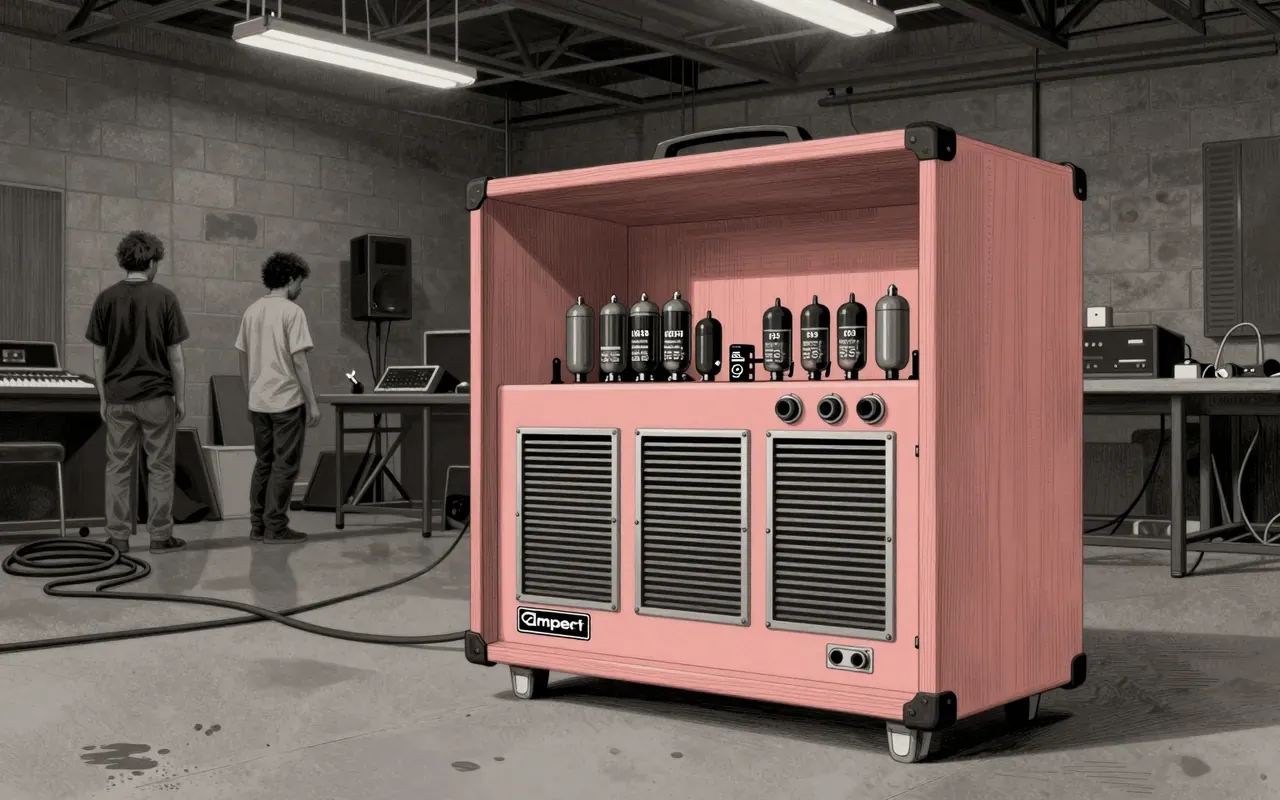
The Ampeg SVT is a 1969 bass amplifier head designed by Bill Hughes and Roger Cox. It uses 14 vacuum tubes to deliver 300 watts of RMS power. Early units used unstable 6146B output tubes, later replaced with 6550s. It is a stand-alone head, not a combo. The Rolling Stones used five prototypes on tour in 1969, playing all guitars and basses through them.

Chapters & takeaways4
  1. 0:54
    Built for volume

    It was the first bass head built for stadiums, not clubs.

  2. 2:19
    Tube count as engineering statement

    Fourteen tubes delivered 300 watts of RMS power — unprecedented for bass in 1969.

  3. 4:10
    A fix, not a finish

    Early 6146B tubes failed under load; the switch to 6550s fixed reliability but not weight or heat.

  4. 5:24
    Proven on stage, not paper

    The Rolling Stones didn’t test it — they deployed it live, across an entire tour.

Worth your time?

Yes. Use the whole thing.

4.5/ 5
What works
  • driving large speaker cabinets with authority
  • sustaining bass fundamentals at high SPL
  • proving tube-based high-power bass amplification viable
What does not
  • deliver clean tone at low volumes
  • offer portability
  • guarantee reliability without maintenance
Use it if
  • bass players who play large venues
  • those who prefer tube saturation and headroom over precision
Skip it if
  • studio-only users
  • players without tube-amp maintenance capability
The written brief1 min read

What it is and what it was built for

The Ampeg SVT is a bass guitar amplifier head introduced in 1969. It was built to project bass clearly in large venues where existing amps failed.

How it works, in terms a player would use

It uses a 14-tube design. Early units used 6146B output tubes. These proved unstable and were replaced with 6550 tubes around mid-1970. It is a stand-alone head — no speaker cabinet included.

What it does better than anything else

It delivers 300 watts of RMS tube power — far more than most contemporary bass amps — making it uniquely capable of driving large speaker cabinets in festivals and arenas without collapsing into distortion.

What it does badly

It runs hot and heavy. It demands regular tube replacement and biasing. It cannot deliver clean, articulate bass at bedroom volumes. Its instability with early 6146B tubes made it unreliable until the switch to 6550s.

What people made with it

The Rolling Stones used five SVT prototypes on tour in 1969, playing all guitars and basses through them. This proved the amp’s viability for high-volume rock applications.

Who should use it, and who should not

Bass players who gig regularly in large spaces and maintain tube gear should use it. Studio-only players, those without a roadie or tech, or anyone needing lightweight or solid-state consistency should not.

Is it worth your time

Yes, if you need raw tube headroom for bass in large venues and accept its weight, heat, and tube maintenance. No, if you need portability, reliability on short notice, or clean headroom at low volumes.

Same bench · Guitars & amps4 of 23
9:28
Rickenbacker 330RickenbackerA semi-acoustic twelve-string electric guitar in the Capri series, introduced in 1958 and designed by Roger Rossmeisl. Built for clarity, projection, and rhythmic definition in ensemble playing.
9:15
Big MuffElectro-Harmonix · 1969The Big Muff Pi is a 1969 fuzz effects pedal with four transistors, two soft-clipping stages, and a tone stack that scoops mids when centred. It delivers smooth, saturated, bass-heavy sustain at any volume—making small amps sound bigger. It was intended to mimic Hendrix but became heavier and more distinctive. It does not offer gain staging, midrange recovery, or dynamic clean-up.
9:22
Fender CoronadoFenderThe Fender Coronado is a true hollow-body electric guitar with no central block, designed in 1965 by Roger Rossmeisl to capitalise on the rising popularity of semi-acoustic guitars. It delivers natural resonance and a bright-and-deep tone, but feeds back at high volumes and failed to win over jazz guitarists due to its bolt-on neck. It found belated favour for what it does sonically—not what it was meant to be.
9:11
Epiphone CoronetEpiphoneThe Epiphone Coronet is an Epiphone-exclusive, entry-level solidbody electric guitar with a single P-90 pickup, one volume and one tone control. First introduced as an amplified archtop in 1939, it was reclassified as a solidbody by 1961. It has been manufactured across multiple eras — 1959 US production, 1960s Dwight-branded variants, discontinuation in the 1970s after Epiphone moved overseas, a late-1990s Korean reissue, and a 2020 reissue. It offers no pickup switching, no neck pickup, and minimal control options. Its design prioritises simplicity and direct tone over versatility or refinement.
Up next in Audio

Yamaha SY99

Yamaha · 9:27

The SY99 lets PCM samples breathe, bend, and scream inside FM—then slaps them with studio-grade reverb before you lift your finger.

9:27