audiobriefs
Topic

Hardware

The physical constraint the software keeps forgetting about.

385
in audio
9:01
average
3472 min
in total
709
across the network
Hardware across the network →
All briefs385
9:42

4003

Rickenbacker · 1980

The Rickenbacker 4003 debuted in 1980 as a near-twin of the 4001 with an updated truss rod system made for roundwound strings. It has neck-through construction, has stayed in continuous production, and has spawned five-string, eight-string, fretless, limited-edition and signature versions.

8:55

Hammond A-100

Hammond · 1959

The Hammond A-100 is a console tonewheel organ introduced in 1959. It is effectively a self-contained version of the B-3 and C-3, with an internal power amplifier and speakers, and it was built in many chassis styles identified by the last two digits of the model number.

8:41

Chamberlin M1

Chamberlin · 1970

The Chamberlin M1 appeared in 1970 as a table-top, much more durable Chamberlin design. It dropped the rhythm tapes, rewound its tapes with a return-roller system and used higher-quality playback heads. About 130 were built before production ended in 1981.

10:52

Electric Mistress

Electro-Harmonix · 1976

The Electric Mistress is an analog flanger from Electro-Harmonix, first sold in 1976 and the first flanger in pedal format. Every version after the first blue and red one has a Filter Matrix mode that freezes the flange at any point for chime-like tones. The Deluxe version is still in production, and NEO Mistress and Stereo Electric Mistress are digital recreations.

9:30

Emax II

E-mu Systems · 1989

The Emax II replaced the original Emax in fall 1989. It is a true 16-bit sampler with more polyphony and digital filters, priced from $3,595. The Emax II Turbo of 1990 added 8 MB of built-in sample memory and an internal SCSI hard disk. It stayed in production until 1995, one of the longest runs of any E-mu product.

10:14

Emulator II

E-mu Systems

The Emulator II, released in 1984, was E-mu's second sampler. It stayed an eight-bit machine but improved fidelity with companding converters and a 27.7 kHz sample rate, and it added resonant analog filters, more flexible editing and far better real-time control. At about $8,000 it was priced like the original, and far below a Fairlight.

9:30

FireworX

TC Electronic

FireworX is a multi-effects processor from the Danish company TC Electronic. It holds distortion, compression, noise and curve generators, ring modulation, vocoding, parametric EQ, tremolo, reverb and delay, and the effects can be routed in a large variety of ways. It won best Hardware Signal Processing Technology at the 1998 TEC Awards, and producers and DJs used it with CD players for live sets.

8:35

J37

Studer · 1964

The J37 is Studer’s first multitrack machine, released in 1964. It recorded four tracks on one-inch tape. At EMI Studios London, later renamed Abbey Road Studios, The Beatles used a pair of J37s to record Sgt. Pepper’s Lonely Hearts Club Band in 1967. Studer went on to build 8-, 16- and 24-track machines with tape up to two inches wide.

9:51

Mellotron Mk II

Mellotron

The Mk II was the update to the first commercial Mellotron, released in 1964 with the full set of sounds selectable by banks and stations. About 160 were made. It has two manuals, an organ-style cabinet and two internal 12-inch speakers with an amp, and it was meant for the home rather than the road.

8:52

MXR Micro Amp

MXR · 1978

The MXR Micro Amp (M133) is an op-amp boost pedal released in 1978. It has a single volume control and offers 26 dB of boost, meant to add volume or distortion, depending on where it sits in the signal chain, without colouring the tone. It has become perhaps the most commonly used boost pedal on the market.

9:18

Musicmaster Bass

Fender · 1971

The Musicmaster Bass is a Fender student-model bass introduced in 1971 as a variant of the Mustang Bass, on the same body and neck shape. Where the Mustang Bass has a split-coil pickup, the Musicmaster has a single-coil pickup that is a six-pole Stratocaster guitar pickup under a solid plastic cover. Production ended around 1981, and Squier reissued it for one year in 1997.

7:48

Nord Lead 2

Clavia

The Nord Lead 2 was launched by Clavia in 1997, two years after the original Nord Lead. It raised polyphony from four voices to 16 and added a ring modulator, a sine waveform on oscillator 1, filter distortion, four individual outputs, more patch storage and a PCMCIA slot. A refreshed Lead 2X followed in 2003 on the same synthesis engine.

9:06

Pianet N

Hohner

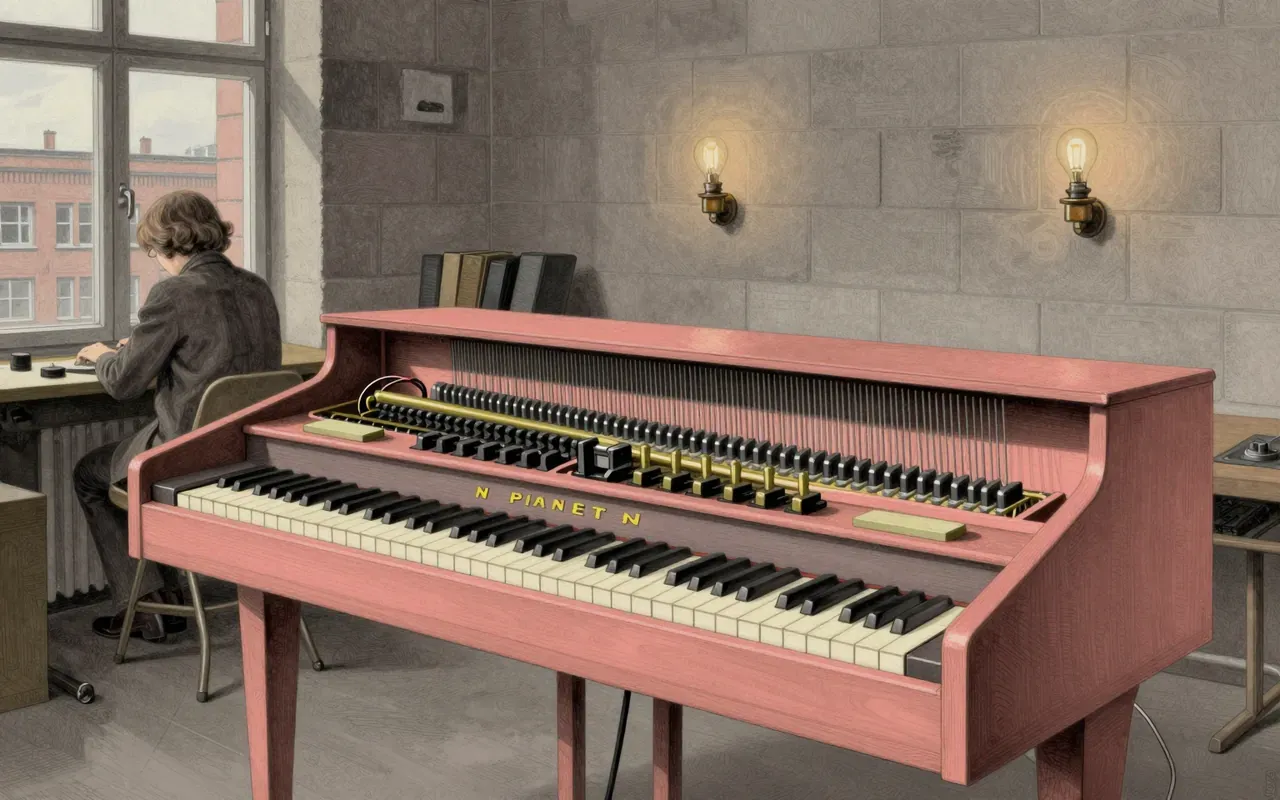
The Pianet N was Hohner's most popular Pianet, made from about 1965 to 1977 in two variants. The N stands for natural wood finish. It has inverted-V legs, a folding top that doubles as a music stand, a transistorised pre-amplifier, a floor pedal for volume and standard vibrato, and it plays through an external amplifier.

8:47

Pianet T

Hohner

The Pianet T was made from 1977 to about 1983 and headed Hohner's second group of Pianets. Plastic suction pads pluck its reeds, an electro-magnetic pick-up like the one in a Rhodes converts the vibration, and the instrument needs no electrical power of its own. Vinyl-covered, with a hinged lid, it was built for live use but has no built-in amplifier.

9:24

Virus B

Access · 1999

The Virus B is a virtual analog synthesizer from Access Music GmbH of Germany, released in 1999 as the follow-up to the Virus A. It is a desktop (rackable) module without a keyboard, with improved converters and expanded polyphony. It has two filters per voice and a modulation matrix, and a keyboard version was sold as the Virus KB.

8:50

Neve 1272 Line Amp

Neve

The Neve 1272 is a solid-state line amplifier. It does not accept microphone signals. It adds clean, transformer-coupled gain to line-level sources. It offers no input flexibility, no EQ, no saturation controls. Its value lies in its place in a fixed-path studio chain — not in versatility.

9:04

Marshall 1960A Cabinet

Marshall

The Marshall 1960A JCM900 is Marshall’s designated main 4x12 cabinet—widely used, widely modified, and widely criticised. Its four Celestion G12T75 speakers deliver 300 watts of aggressive, scooped tone. Birch plywood construction meets an MDF back panel. Rear-panel impedance and stereo switching add flexibility. But air leaks at the seams. Joints feel insecure. Plastic handles flex under load. It excels only where harsh highs and tight lows serve metal—but fails jazz, grunge, and any genre demanding warmth or low-end authority.

9:48

Digidesign 888/24 I/O

Digidesign

The Digidesign 888/24 is a Pro Tools–only analog-to-digital converter with eight XLR I/O channels and four AES-EBU digital paths. It delivers clean conversion, solid build quality, and low used-market cost—but only functions inside a compatible TDM system. No standalone mode. No MIDI. No monitor control. No software editor. It is a tool, not a platform.

9:57

Doepfer A-110 VCO

Doepfer

The Doepfer A-110 Standard VCO is a generator module for modular synthesizers in the A-100 series. It outputs saw, pulse, triangle, and sine waveforms simultaneously. Octave switching and ±1 semitone fine tuning set pitch range. Manual and CV-controlled pulse width modulation are available. A Sync input allows hard-syncing to another VCO. It lacks FM, LFO-range operation, and tuning beyond ±1 semitone.

10:34

Doepfer A-120 VCF

Doepfer

The Doepfer A-120 is a Eurorack filter module built to replicate the Moog 24dB low pass filter. Five potentiometers control cutoff, resonance, input level, and two CV amplitudes. Three CV inputs allow layered, complex modulation. It delivers Moog-like saturation and character at low cost. It offers no multimode filtering, no self-oscillation feedback control, and no visual indicators for resonance peak or clipping. Use it for warm, resonant, hands-on low-pass filtering in modular systems. Avoid it if you need versatility beyond 24dB low pass.

7:50

Doepfer A-140 ADSR

Doepfer

The Doepfer A-140 ADSR is a basic ADSR envelope generator for the A-100 modular system. It has no published specs. It has no CV inputs. It has no visual indicators. It does one job, simply.

9:17

Alembic Series II

Alembic

The Alembic Series II is a 4-string bass guitar with stereo output, a 30.75-inch short scale option, and individual low-pass filters with continuously variable Q per pickup. It differs from Series I only in stereo capability and price. No claims are made about tonal superiority, build innovation, or broader usability.

9:14

Auratone 5C Super Sound Cube

Auratone

The Auratone 5C is a passive monitor requiring an external amplifier. Its extremely flat response and limited frequency range make it useful for quick A/B checks — but its lack of low-end response rules it out for primary mixing. It does one thing well: revealing what a mix loses when stripped of bass and extension.

8:36

Avalon Design Avalon AD2022

Avalon Design

The Avalon AD2022 is a two-channel, analog, solid-state, pure class A microphone preamplifier. It delivers transparent, low-noise amplification. It has variable input impedance. It accepts microphones and DI sources. It includes phantom power, a 20dB pad per channel, polarity reversal, and a switchable variable high-pass filter. It uses XLR connections. It has front-panel XLR and jack connectors for instruments. It is rackmounted and occupies two standard rack spaces.

10:04

Avalon Design Avalon VT-737sp

Avalon Design

A vacuum tube-based, rack-only channel strip with two identical preamp channels, each offering gain, phantom power, pad, phase reverse, Lo-Z input, compressor, EQ, and flexible routing. It trades portability and recall for consistent warmth and headroom — especially with transformerless mics.

8:00

Boss BF-2 Flanger

Boss

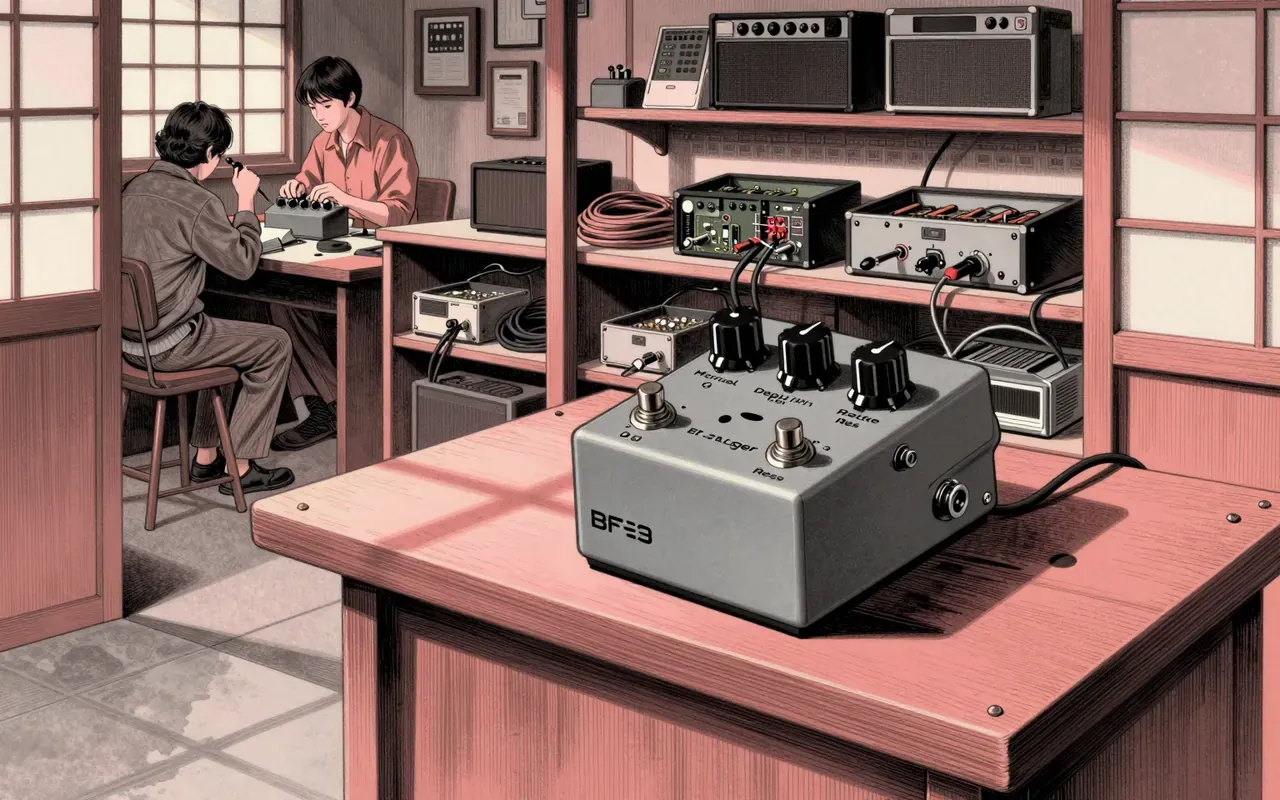
The Boss BF-2 Flanger is an analog stomp-box flanger pedal sold from June 1980 to December 2001. It has 1/4-inch inputs and outputs, four controls (Manual, Depth, Rate, Res), and runs on 9V battery or AC adapter. It is not rackable. It was succeeded by the digital BF-3.

9:50

Binson Echorec 2

Binson

The Binson Echorec 2 is a delay/echo unit. No technical specifications exist. Its category is confirmed. Nothing else is verifiable.

7:26

Bozak CMA-10-2DL

Bozak

The Bozak CMA-10-2DL is a 4+ channel analogue mixer. It routes four inputs to two outputs. It has no equalisation, no dynamics, no monitoring path, and no amplification. Its name appears in multiple inconsistent spellings. No use cases, dates, or technical specifications are verified in available sources.

8:11

AKG C414 EB

AKG

The AKG C414 EB is a large diaphragm condenser microphone. It is one of 13 products in the AKG C414 series. No technical, historical, or functional detail beyond that is provided in the source material.

7:56

Boss CE-1 Chorus Ensemble

Boss

The Boss CE-1 Chorus Ensemble is Boss’s first chorus pedal: an analog stomp box offering chorus or vibrato — never both — with dedicated controls, tone toggle, and fixed power.

8:11

Boss CE-2 Chorus

Boss

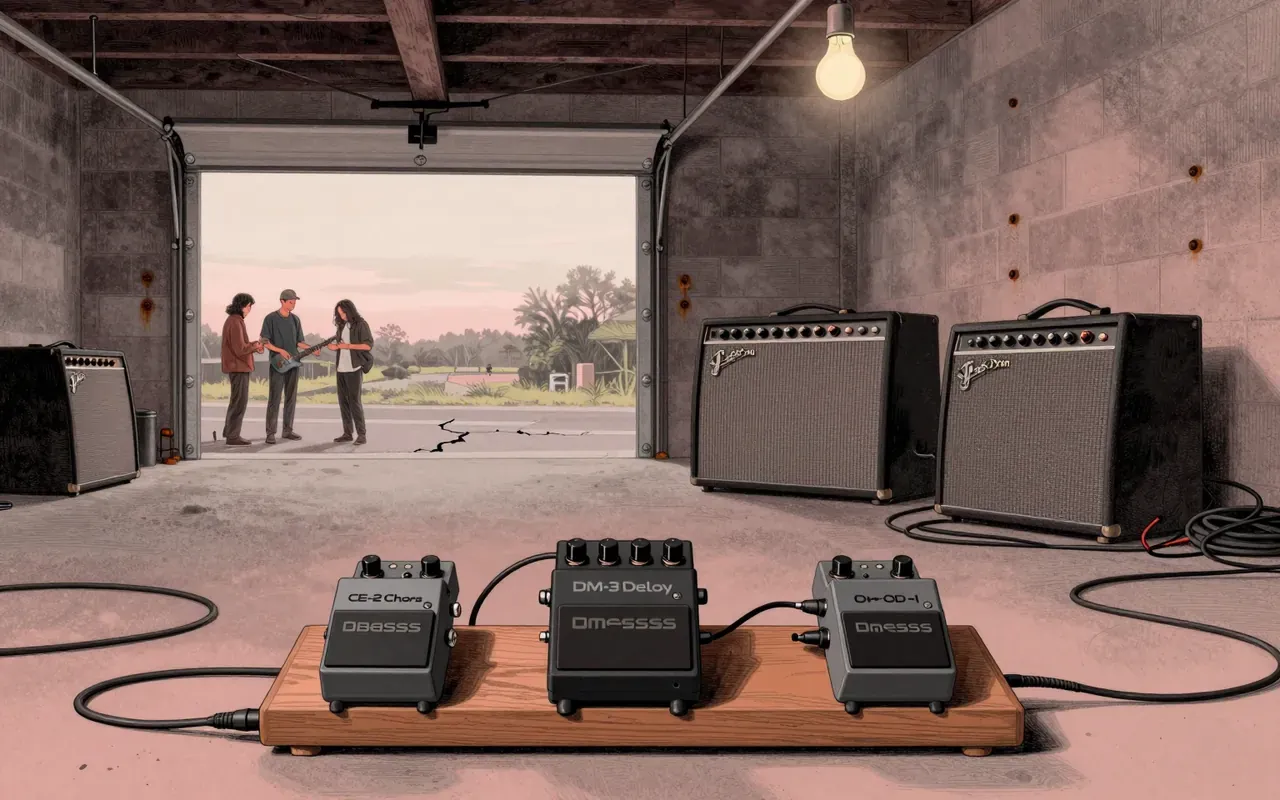
The Boss CE-2 Chorus is an all-analog stomp box introduced in the early 1980s. It has two controls: Rate and Depth. It was Boss’s first compact chorus pedal and the first they housed in a stomp box. Production ended in 1990. It runs on 9V battery or transformer. It was made in Japan.

9:33

Boss CE-3 Chorus

Boss

The Boss CE-3 Chorus is an analog guitar pedal built for stereo routing. It has no mix or level control. Its sound matches the CE-2 exactly — lush, hazy, shimmering — but its dual outputs enable wet/dry or true stereo setups. It is useful only where those outputs matter.

9:26

Boss CH-1 Super Chorus

Boss

The Boss CH-1 Super Chorus is an analog stomp-box chorus pedal for guitar and keyboards. It has four dedicated knobs — Effect Level, EQ, Rate, Depth — and supports mono input with mono or stereo output. It runs on 9 V battery or AC power. It is Boss’s best-selling chorus pedal. It is not rackable.

7:18

Colorsound Overdriver

Colorsound

The Colorsound OverDriver is a fixed-gain overdrive pedal. It has no controls. It offers no specifications. It does one thing, consistently, without variation.

9:22

Daking Mic Pre IV

Daking

The Daking Mic-Pre IV is a 4-channel solid-state analog preamp with minimal controls and no colouration. It amplifies cleanly and intensely—revealing rather than refining the source. Its design prioritises workflow over flavour.

8:14

Sony DAT DTC-1000ES

Sony

The Sony DTC-1000ES is a DAT deck in Sony’s DTC series. No technical specifications are available. Nothing else is verifiable.

9:13

dbx 165

dbx

The dbx 165 is a studio compressor. No technical specifications exist for it. It is categorised as a studio compressor. That is all that is confirmed.

9:56

Boss DD-3 Digital Delay

Boss

The Boss DD-3 is a digital delay pedal for guitar. It uses four knobs to control effect level, feedback time, delay time, and delay mode. It delivers clear, sharp echo without muddiness. It is extremely durable. It is probably the most well-known digital delay pedal.

8:57

Boss DM-1 Delay Machine

Boss

The Boss DM-1 Delay Machine is an analog foot pedal — among the first delay pedals made by Boss — with three knobs (delay time, intensity, balance/mix), an output level switch (0 dB, -15 dB, -35 dB), built-in power cord, and 1/4 inch connections. It is not rack mountable. Its sound is warm, rich, and outstanding. It is considered one of the best delay pedals Boss has made.

9:39

Boss DM-3 Delay

Boss

The Boss DM-3 is the last compact analog delay Boss made. It runs from 1984 to 1988. Its 20ms–300ms delay is set by Repeat Rate, Echo, and Intensity knobs—the only Boss pedal with this shape and layout. It has an unlabeled stereo output and revised filtering to reduce noise. It does not do digital, modulation, or long delays. It does warm, decaying repeats with physical immediacy.

7:46

Tascam DTRS DA-88

Tascam

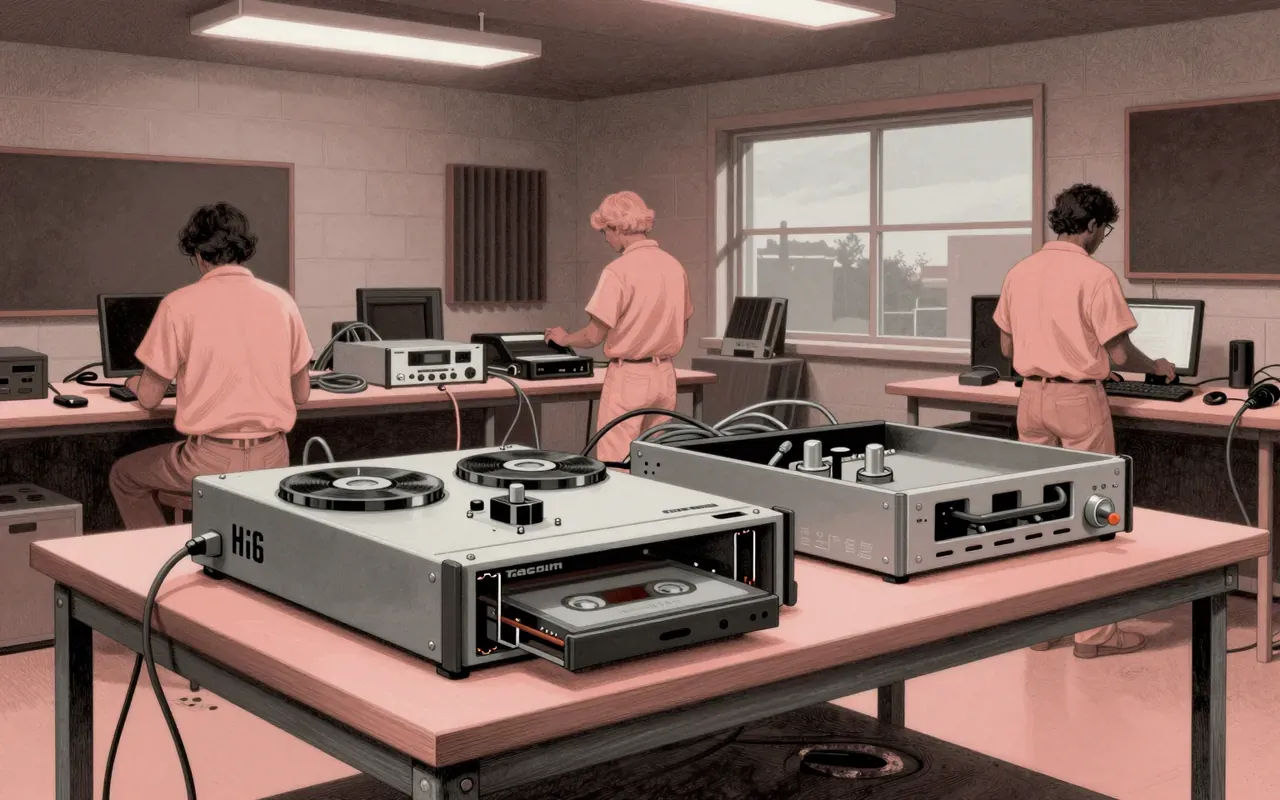
The Tascam DA-88 is a dedicated eight-track digital recorder using Hi8 tape. It occupies four rack units. It has XLR and RCA inputs. It uses large VU meters. Its audio quality remains acceptable today.

9:08

Ibanez FL9 Flanger

Ibanez

The Ibanez FL9 Flanger is an analog stompbox flanger pedal for guitar. It delivers swooshing phase-based effects via four knobs: Speed, Regen, Width, and Delay Time. It is not true bypass, so it colours the signal even when disengaged. It does not claim to be anything else — no digital emulation, no stereo outputs, no expression input, no presets.

9:23

Boss FZ-2 Hyper Fuzz

Boss

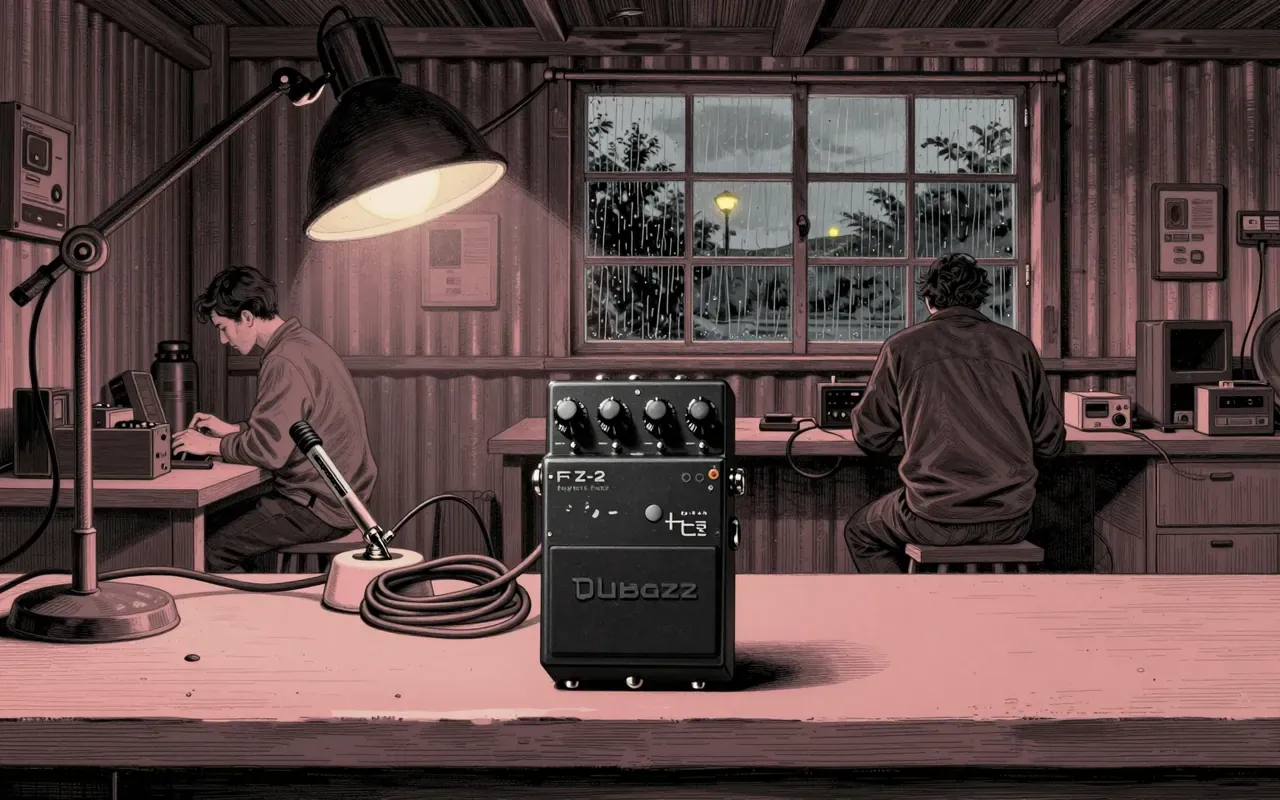
The Boss FZ-2 Hyper Fuzz is a discontinued analog fuzz pedal with three selectable modes and five physical controls. It lacks true bypass. It was succeeded by the FZ-5.

9:00

Grace Design m201

Grace Design

The Grace Design m201 is a single-channel solid-state microphone preamplifier. It provides clean, high-headroom gain with no EQ, no compression, no digital conversion, and no additional signal path options. It serves one purpose: to amplify a mic signal without alteration. It is not a channel strip. It is not an interface. It is not a tool for tonal manipulation. It is a specialist device for specialists who know exactly when they need it — and when they do not.

8:31

Great River MP-2NV

Great River

The MP-2NV gives two channels of the ME-1NV’s analog preamp circuit — no more, no less. It does not add features. It does not subtract fidelity. It occupies one rack space. It accepts mic and line-level sources directly. It meters input and output. It sounds warm, clear, and accurate — as verified by users.

7:54

Hiwatt DR103

Hiwatt

The Hiwatt DR103 is a 100-watt all-tube guitar amplifier head built for clarity, dynamics, and power-tube saturation at high volume. It has four inputs, two speaker outputs, bass/mid/treble/presence/master volume controls, voltage and impedance selectors, and no effects loop or direct output. Its crystalline highs and strong presence suit rock over jazz. Saturation requires driving both channels simultaneously. It is physically heavy and operationally uncompromising.

9:27

Ibanez Musician MC924

Ibanez

The Ibanez MC924 is a 4-string bass guitar from the Musician series, introduced in 1978. It is heavy, sustain-rich, and exceptionally durable — one unit stayed mint for over 25 years. Its active three-band EQ and responsive pickups give broad tonal control. But its weight demands strap-locks live, and age brings failing switches and jacks. It is not lightweight. It is not low-maintenance. It is built to endure.

10:14

Marshall JCM800 2203

Marshall

The Marshall 2203 JCM800 Master Volume Lead is a tube guitar amp head introduced in 1981 and produced until 1989. It delivers aggressive, mid-forward distortion at manageable stage volumes — but offers no clean headroom, no effects loop, and no modern conveniences.

10:22

Boss OD-1 OverDrive

Boss

The Boss OD-1 is a 1977–1985 overdrive pedal with Level and Overdrive knobs only. It uses a FET boost circuit that degrades the dry signal when bypassed. It delivers low-gain saturation by pushing an already overdriven amp’s front end—not by distorting on its own. It lacks tone control. It preceded the SD-1. It performs best in that narrow context—and nowhere else.

7:15

Boss PH-1 Phaser

Boss

The Boss PH-1 is a compact phaser pedal released by Boss in 1977 as one of its first three pedals. It emulates Leslie speaker phasing with greater versatility. It has only two controls: Rate (speed) and Depth (dry/wet mix). Production ran from 1977 to 1981.

9:13

Boss PS-2 Digital Pitch Shifter/Delay

Boss

The Boss PS-2 is a mono digital pitch shifter and delay pedal with fixed +1/−1 octave modes and three delay time ranges. It delivers immediate, stable octave doubling and atmospheric delay tails — but offers no stereo output, no expression control, and no fine pitch adjustment. It belongs on a gigging guitarist’s board, not in a stereo studio chain.

7:37

Boss RV-2 Digital Reverb

Boss

The Boss RV-2 is a fixed-function digital reverb pedal. It gives guitarists six preset spaces — no editing, no tone control, no stereo input. It is stomp-box-only. It runs on nine volts. It is discontinued. It was Boss’s first reverb.

8:50

Rane/Serato Scratch Live SL1

Rane/Serato

The Rane Serato SL 1 is a purpose-built bridge between vinyl and digital audio. It does one job: translating timecode signals into Serato Scratch Live 2.5. It asks for turntables, a mixer, and a laptop — and gives back stable, low-latency control. It offers no flexibility, no expansion, no autonomy. It is obsolete as a product, but functional as a node — if your setup still runs on it.

6:46

Soundcraft 2400

Soundcraft

The Soundcraft 2400 is an analog mixer made by Soundcraft. No technical specifications are published. Nothing else is confirmed.

8:54

DigiTech Space Station XP300

DigiTech

A fixed-function digital floor pedal for guitar. Eight synth-effects deliver octave, fifth and third on demand. No editing. No true bypass. An always-on preamp degrades tone even when off. AC-powered. Stereo out. One treadle. That’s all.

8:33

Boss TR-2 Tremolo

Boss

The Boss TR-2 Tremolo is an analog foot pedal for guitarists. It has three knobs: Rate, Depth, and Wave. Rate goes faster than the PN-2. Wave shifts the LFO from triangle to square. It is not rackable.

8:24

Trace Elliot AH250

Trace Elliot

The Trace Elliot AH250 is a bass guitar amp head made by Trace Elliot. No technical specifications are available for it.

8:54

Trident Series 24

Trident

The Trident Series 24 is an analog mixer made by Trident. No specifications, availability, usage history, or technical details are provided in the source. It is documented only as a category and manufacturer assignment.

8:21

Ibanez Tube Screamer TS808

Ibanez

The Ibanez TS808 Tube Screamer Reissue is an analog overdrive pedal in the Tube Screamer series. It has three knobs: tone, level, and overdrive. It uses the JRC4558 chip. It runs on a 9-volt battery or AC adapter. Its metal housing is 4.9" x 2.8" x 2" and weighs just over a pound. It delivers warm, smooth, mid-heavy overdrive suited for solos and blues-rock—not high-gain riffing. It is very strongly built.

8:23

Boss VB-2 Vibrato

Boss

The Boss VB-2 Vibrato is an analog foot pedal that modulates pitch — not volume — for electric guitar and other electronic instruments. It uses depth, rate, and rise time controls, plus a mode switch. It has no MIDI, no rack mounting, and no presets. Its strength is expressive, natural-sounding vibrato. Its weakness is inflexibility and a learning curve. It belongs in the hands of players who value analog immediacy over convenience.

8:38

Wurlitzer 200A

Wurlitzer

The Wurlitzer 200A is a 73-key electro-mechanical electric piano with built-in speakers, output jacks, a sustain pedal, carrying handles, and two knobs — one for volume, one for tremolo speed. Its keyboard action is tactile and easy to play. Its tone is uniquely recognizable. It is a newer model than earlier Wurlitzer electric pianos. It offers more tonal range than those earlier models only via dedicated tremolo and volume controls.

9:07

Yamaha DM2000

Yamaha

The Yamaha DM2000 is a discontinued digital mixer console built for professional live sound reinforcement and studio tracking/mixing.

7:58

Yamaha PM1000

Yamaha

The Yamaha PM1000 is a channel strip. No technical specifications are available. Nothing else is confirmed.

7:46

Genelec 1022A

Genelec

The Genelec 1022A is an active monitor in the Genelec 1000 series. Genelec manufactured it. That is all the source material confirms.

8:18

Genelec 1031A

Genelec

The Genelec 1031A is a large, active, self-powered studio monitor built for stationary use in professional recording studios. It delivers full-spectrum sound with strong low-end presence and tight high-end response. It plays loudly without colouration and reveals fine audio detail. Its built-in amplification is highly effective. Its size and sonic neutrality make it unsuitable for small rooms or home studios. Users report it excels in medium-to-large spaces and is trusted for critical mixing and tracking.

8:48

Genelec 1032A

Genelec

The Genelec 1032A is a high-end, individually sold, active two-way near-field studio monitor. It uses a 10-inch woofer and 1-inch tweeter. Its frequency response is 36 Hz to 23 kHz. It delivers a clean sound with tight highs and reportedly accurate mids and lows. It requires no external power amplifier. It is sold singly, not in pairs.

7:28

AMS Neve 1073 DPA

AMS Neve

The AMS Neve 1073 DPA is a solid-state, pure class A, 2-channel preamp with DI, variable impedance, phantom power, and phase inversion — but no EQ, no insert, no flexibility beyond its fixed tonal signature. It gives you a clear, present midrange, smooth highs, and round, deep lows. It is not neutral. It is not modular. It is not subtle. It is specific.

7:54

dbx 160XT

dbx

The dbx 160XT is a studio compressor. No technical specifications are available for it.

8:04

Aphex 204 Aural Exciter

Aphex

The Aphex 204 Aural Exciter is a two-channel hardware processor that enhances bass tone while preserving attack and avoiding speaker damage. It uses optical low-end enhancement and aural excitation to deliver creamy, fat sound with sleek tone and crystal-clear attack. Users report success in loud live contexts with drums and distorted guitars — the bass remains powerful yet clear and defined. It pulls clean, fat low-end from existing bass amplifiers and speakers, eliminating the need for bulky speaker upgrades. It does not address midrange or high-frequency detail beyond attack preservation. Bass players using standard rigs in loud live settings should use it. Studio engineers seeking surgical EQ or harmonic control should not.

9:02

API 205L

API

The API 205L is a DI unit made by API Audio. No technical specifications are available. No retailers or classified ads currently offer it. Its alternate names are '205l' and '205 l'.

7:39

API 215L

API

The API 215L is a 500-series filter module with no published technical specifications. It exists only as a hardware component for users already invested in API’s ecosystem. Its utility is narrow: it adds API’s transformer-coupled colour to filtered signals, but offers no modulation, no bypass, and no documented response curve. It is not a synthesiser filter, not a creative sound-design tool, and not usable outside a compatible rack.

9:24

TC Electronic 2290 P Dynamic Digital Delay

TC Electronic

The TC Electronic 2290 P Dynamic Digital Delay is a guitar-focused delay, echo, and phrase sampler. No technical specifications are available. Its package weight is 1.7 kg. Nothing else is verified.

8:19

MOTU 2408

MOTU

The MOTU 2408 is a discontinued PCI/ISA rack-mount soundcard built for multitrack recording and mixing in home and project studios.

9:12

Neve 31105

Neve

The Neve 31105 is a channel strip. No technical specifications are available. Nothing else is confirmed.

8:02

API 3124+

API

The API 3124+ is a 1U, 4-channel analog microphone preamplifier using the 2520 op-amp and classic console circuit. Each channel has gain, polarity, phantom power, 20 dB pad, mic/line selection, and a VU meter. It accepts XLR inputs at the rear and unbalanced 1/4" inputs at the front. It delivers high headroom and consistent colour across all four channels — but offers no impedance control, channel linking, or digital integration.

9:26

Neve 33115

Neve

The Neve 33115 is a compact, broadcast-optimised channel strip built in Cambridge between 1974 and 1975. It uses the same class A preamp and EQ circuitry as the 1081 but drops the fourth EQ band and simplifies the layout. Its 300/1200 Ω input switch supports ribbons. It belongs in small consoles like the Melbourne and broadcast frames like the 5315 and 5316—not in large-format studio rigs.

8:50

TEAC 3340S

TEAC

The TEAC 3340S is an analog multitrack recorder with no available technical specifications. It is identified only by category and alternate name spellings. Nothing is confirmed about its operation, sound, reliability, or creative use.

8:10

Neve 33609

Neve

The Neve 33609 is a dual-channel, all-analog studio compressor and limiter occupying two rack units. Each channel contains independent compressor and limiter sections. The compressor section provides threshold, recovery, gain, ratio, and bypass. The limiter section provides threshold, recovery, fast/slow attack, and bypass. It supports dual-mono or stereo operation with per-channel gain reduction metering.

7:42

SSL 4000 E

SSL

The SSL 4000 E is a channel strip. No technical specifications are available. Nothing else is confirmed.

7:26

Rickenbacker 4005

Rickenbacker

The Rickenbacker 4005 is a 4-string bass guitar. That is all the source material confirms.

8:35

JBL 4350

JBL

The JBL 4350 is a passive studio monitor requiring bi-amplification, offering no passive filter adjustments, and demanding extensive room integration and speaker placement. It is physically imposing and highly detailed in sound reproduction. It is not turnkey-ready.

8:19

JBL 4430

JBL

The JBL 4430 is a 2-way active monitor built for studio monitoring. It delivers stable, wide, non-directional dispersion and excellent overall homogeneity. Its horn is more neutral than predecessors like the 4331 and L200 — eliminating long repetitive directional artifacts. It lacks the top-end finesse of the 2405 tweeter. Bi-amplification enables sonic evolution, but mechanical decoupling from the floor is mandatory. It was produced continuously for 20 years with iterative hardware updates: the 1-inch compression driver shifted from aluminum diaphragm and alnico magnets to titanium and ferrite. Each unit supports up to 80 kg.

7:50

JBL 4435

JBL

The JBL 4435 is a passive monitor built for raw output — not finesse. It trades integration for extension.

9:21

MOTU 828

MOTU

The MOTU 828 MKI is a discontinued FireWire audio interface introduced around 2001–2002. It offered two mic preamps with phantom power and XLR/1/4" inputs, six additional balanced line inputs, eight balanced outputs, ADAT and optical I/O, 24-bit 64x/128x oversampling converters, and front-panel monitoring controls. Priced at $800 at launch, it was considered expensive but highly stable and easy to install. It remains functional for years in typical home studio use but is no longer sold and has been succeeded by newer models including the 828 (2024).

7:57

Digidesign 888 I/O

Digidesign

The Digidesign 888 I/O is a 16-bit analog/digital converter with eight XLR inputs, eight XLR outputs, and digital I/O via AES/EBU and S/PDIF. It was used in home studios, often alongside the 24-bit 888/24. It offers no processing, no preamps, and no variable gain — just fixed-path conversion. Its value lies only in compatibility with legacy Pro Tools TDM systems.

9:23

SSL 9000 K

SSL

The SSL 9000 K is an analog mixer. That is all the sources confirm. It belongs to the category of analog mixers. Nothing more is verified.

8:24

Studer A807

Studer

The Studer A807 is an analog multitrack recorder. No technical specifications exist for it. That absence defines it.

8:42

Studer A810

Studer

The Studer A810 is an analog multitrack recorder that functions reliably in steady-state operation. But it fails sharply and obscurely after power interruptions. Troubleshooting those failures is very hard. One user explicitly prefers the A807 over the A810. Nothing is stated about its format, track count, year introduced, or what recordings were made on it.

6:44

Studer A827

Studer

The Studer A827 is an analog multitrack-studio. No technical specifications are provided. Its function, design, and use remain undocumented in the source.

8:47

Vox AC100

Vox

The Cort AC100 is a nylon string guitar. No technical specifications are provided.

8:57

Vox AC4

Vox

The Vox AC4HWR1 AC4 Hand-Wired is a tube combo guitar amp in Vox’s AC Hand-Wired series. Its full model name includes ‘HWR1’, indicating hand-wired construction. No technical specifications are provided — power, speaker size, valve type, or circuit details are absent from the source material. It offers no documented sonic or functional distinction beyond its build method. It is not verifiable as an upgrade, alternative, or variant — only as a named model in a series.

9:18

Apogee AD-8000

Apogee

The Apogee AD-8000 is an eight-channel analog-to-digital converter built for recording studios. It was introduced circa 1996. It supports 24-bit resolution at up to 48 kHz. It has eight XLR analog inputs and AES/EBU and S/PDIF digital connections. Front-panel level meters and controls let you monitor and adjust all eight channels. It includes a 1/4-inch headphone jack for direct monitoring. Optional cards enable ADAT, TDIF and Pro Tools connectivity.

9:21

Prism Sound ADA-8

Prism Sound

The Prism Sound Dream ADA-8 is a dual-path AD/DA converter built for clean, separated signal routing at up to 96 kHz. It delivers stable internal clocking and user-friendly displays, but lacks built-in sample rate conversion and fails under external sync with Pro Tools HD interfaces. It belongs in studios where path independence matters more than interoperability.

7:34

Ampex AG-440

Ampex

The Ampex AG-440 is an analog multitrack recorder. No technical specifications are available. Its alternate names include ag440, a 440, and a440. Nothing else is verifiable.

8:31

Akai ASQ-10

Akai

The ASQ-10 is a sequencer-only instrument. It has no sound generation. It does not sample. It exists solely to trigger, time, and lock external gear. Its design enables rhythmic complexity unplayable by hand — then corrects timing drift across the chain. It is the first MPC-shaped workflow, before the MPC existed.

9:04

Echo AudioFire 12

Echo

The Echo Audiofire 12 is a FireWire audio interface in the Audiofire series. It has 12 line inputs and 12 outputs. It has no mic preamps. It has no headphone output. It supports daisy-chaining up to three units for 36 I/O. It achieves 2.9 ms round-trip latency at 24-bit/96 kHz. Its line inputs are transparent and electrically isolated. Users record 12 tracks simultaneously at up to 192 kHz, firmware permitting.

8:01

M-Audio Audiophile 2496

M-Audio

The M-Audio Delta Audiophile 24/96 is a PCI/ISA sound card for Windows-based music production and amateur vocal recording. It connects MIDI controllers and turntables. It supports 24-bit/96 kHz audio when host software allows. Latency drops to 4ms with buffer reductions. It runs silently in Cubase VST, Pro Tools, Fruity Loops, and six other DAWs. Recordings are clean. Softsynths sound great. Wave Table Synthesis is absent — but users found it unnecessary. I/O is limited. Modern OS support is not provided.

7:12

Lynx Aurora 16

Lynx

The Lynx Aurora 16 is an Analog/Digital Converter. No technical specifications are available for it. It belongs to the category of Analog/Digital Converters.

8:05

Neve BCM10

Neve

The Neve BCM10/2 Mk2 is an analog mixer made by AMS-Neve. No technical specifications are available. Nothing else is verified.

8:09

Dynaudio Acoustics BM15A

Dynaudio Acoustics

The Dynaudio Acoustics BM15A is an active studio monitor designed for nearfield monitoring. It integrates amplification, reproduces down to 45 Hz at 0 dB, and complies with EU and FCC electromagnetic shielding standards. One unit exhibited unintended FM radio reception at 104.1 MHz — isolated to the right channel. Users report no distortion or hum, even at maximum volume. No information is given about music, artists, or recordings made with it.

10:26

AKG C24

AKG

The AKG C24 is a Pro Tools-specific motorized control surface with 24 bankable channel strips, touch-sensitive motorized faders, 16 mic/line/DI preamps, an 8x2 stereo line submixer, a 5.1 analog monitor section, talkback mic inputs, and illuminated dedicated switches for mute, solo, record, select, EQ, dynamics, sends, and inserts.

8:04

Neve Capricorn

Neve

The AMS-Neve Capricorn is a digital mixer. That is all the source confirms. No specifications. No year. No sound. No interface description. No user reports. No cultural footprint. It exists only as a category entry.

9:12

Pioneer CDJ-2000

Pioneer

The Pioneer CDJ-2000 is a discontinued tabletop DJ player. It supports playback from CDs, DVDs, SD cards, USB devices, and wirelessly via WiFi from computers and phones. It has a ~6-inch colour LCD display. Its loop quantisation is automatic and highly accurate. User preferences are saved across power cycles. It was replaced by the CDJ-2000 Nexus.

8:24

Sequentix Cirklon

Sequentix

The Cirklon is a hardware sequencer. It outputs MIDI, audio (HP), and optionally CV/Gate. It produces no sound. Its clock accuracy and track synchronisation are exceptional. All data saves to flash memory and survives power failure. It operates in step and real-time modes, organising music into SONGs and SCENES.

9:18

Farfisa Compact

Farfisa

The JB Systems Compact is a no-nonsense 3-channel DJ mixer from 2008. It delivers reliable talk-over, basic EQ, and straightforward monitoring — all at entry-level cost and fidelity. It does not pretend to be more.

7:56

Farfisa Compact Duo

Farfisa

The Farfisa Compact Duo MK1 is a portable electronic organ with drawbars and vibrato. It delivers a distinctive, aggressive organ tone. No technical specifications are available. Its design prioritises immediacy over documentation or expandability.

10:55

Boss CS-2 Compression Sustainer

Boss

The Boss CS-2 Compression Sustainer is a guitar compressor/sustainer. This unit is a modified version branded 'Fat Old Comp' by MSM Workshop. No technical specifications are provided.

8:33

Yamaha CS-50

Yamaha

The Yamaha CS-50 is a 4-voice, 49-key, pressure-sensitive synthesizer released in 1977. It visually resembles a scaled-down CS-80, weighs about 100 pounds, and shares the CS-series sound — but with thin chords (one oscillator per voice, 12 dB/oct filters), no user memory, and unstable tuning.

9:26

Yamaha CS-60

Yamaha

The Yamaha CS-60 is a polyphonic analog synthesizer released in 1977. It is smaller and cheaper than the CS-80. It lacks polyphonic aftertouch.

8:40

Ibanez CS9 Stereo Chorus

Ibanez

The Ibanez CS9 Stereo Chorus is an early-1980s analog chorus pedal using Bucket Brigade Delay chips. It has two knobs (speed and width), one switch, one analog input, and two outputs (L(mono) and R stereo). It operates on 9V battery or AC/DC adapter. Its metal case ensures durability and repairability. The effect is subtle: cranking both knobs yields only gentle thickening—not pronounced modulation. It warms the clean tone rather than applying overt chorus. It does not deliver strong, fast, or wide modulation. It belongs in the rig of players who prioritise warmth, stereo spread, and reliability over dramatic movement.

10:32

Roland Cube 60

Roland

The Roland Cube-60 is a 60-watt solid-state modelling combo guitar amplifier introduced in 2004. It uses COSM processing to deliver eight amp models on the drive channel. It has two channels — clean and drive — each with independent gain and volume, sharing a four-band EQ. Built-in effects and a combined headphone/line-out jack support private practice and simple recording. It offers no footswitching, no per-model EQ recall, and no pre-model effects routing.

9:20

Roland D-110

Roland

The Roland D-110 is a 1988 rackmount sound module — the upgraded rack version of the D-10 and rack counterpart to the D-20. It delivers Linear Arithmetic synthesis, second-generation D-50 style, using tones, partials, and timbres. It has 32-voice polyphony, on-board drum sounds, reverb, internal/external memory, and six individual outputs. It requires external MIDI control. Programming is tricky but yields characteristic LA textures. Its filter resonates but does not self-oscillate. It is a cheaper alternative to the D-50, offering decent acoustic and synthetic sounds — but no keyboard, no sequencer, and no intuitive interface.

7:30

AKG D19

AKG

The AKG D19 B200 is a dynamic microphone. No technical specifications are available. It cannot be evaluated against alternatives. It offers no documented advantage. It provides no actionable information to a user.

7:07

AKG D202

AKG

The AKG d202 is a dynamic microphone. That is all the material confirms. No specs. No year. No use cases. Just its category and its $299 price.

7:57

Doepfer Dark Time

Doepfer

The Doepfer Dark Time is an analogue sequencer released in 2010. It has no sound module. It controls external gear via CV/Gate, MIDI, and USB. It sequences either 16 steps on one channel or 8 steps across two channels. Real-time knob control covers transposition, note skipping, and playback alternation. Firmware 1.10 resolves bugs present in earlier versions.

8:31

M-Audio Delta 1010

M-Audio

The M-Audio Delta 1010 is a discontinued PCI/ISA + rack-mount soundcard. It delivers 8 analogue I/Os plus SPDIF. It achieves 5ms latency. It runs stably with Cubase and Sonar on legacy desktops. It crashes beyond 24 tracks — due to host computer limits, not the card. It inserts real-time effects during mixdown without issue. It requires a Pentium 4–era PC with a free PCI slot. It has no USB or FireWire support. It is no longer manufactured.

7:49

Roland DEP-5

Roland

The Roland DEP-5 is a mid-1980s multi-effects processor. It gives you reverb, delay, chorus, flanger, double, and a three-band parametric EQ. Its interface is direct — one button, one function — but some parameters demand layered adjustment. Program 5 delivers a long, arching reverb. Its midrange tone is distinctive and hard to replicate. It does not do clean, neutral processing. It does not offer recallable presets. It does not suit users who need precision over character.

6:20

Publison DHM 89 B2

Publison

The Publison DHM 89 B2 is an Other Studio Effect made by Publison. No technical specifications exist for it. Nothing else is confirmed.

10:22

Digidesign Digi 001

Digidesign

The Digidesign Digi 001 is the original Pro Tools audio interface. It is a rack-mountable PCI/ISA soundcard with two mic preamps, phantom power, gain knobs, -25 dB pads, front headphone output, MIDI, eight outputs (including monitor outs), and six line inputs. It connects via D-Sub and serial port — not FireWire or USB — so it is incompatible with laptops and newer computers. It is obsolete outside legacy systems.

10:50

Digidesign Digi 002

Digidesign

The Digidesign Digi 002 is a FireWire audio interface built exclusively for Pro Tools LE. It delivers four mic preamps, S/PDIF and MIDI, and autonomous digital mixing — but only within that narrow software ecosystem. It is desktop-formatted and non-rack-mountable. Its limits are defined by Pro Tools LE’s track count and host compatibility. It belongs in a period-correct studio, not a modern one.

9:17

Pioneer DJM-1000

Pioneer

The Pioneer DJM-1000 is a rack-mountable 4+ channel DJ mixer with two master outputs and one booth output sharing a single volume control. It has no built-in effects. Its equalizer is low quality and offers parametric control only on mic channels. Its preamps and potentiometers are poor. Its output level of 2V + 6dB causes distortion across frequency ranges.

7:52

Pioneer DJM-500

Pioneer

The Pioneer DJM-500 is a 4-channel DJ mixer with RCA, 1/4" jack and XLR connectors. Its EQ is adequate. Its effects section is limited but sufficient. It can be rack-mounted—with a modification. Some users doubt its rack-mountability. Its signal path is transparent. Its build invites daily use—but demands maintenance as it ages.

9:35

Pioneer DJM-800

Pioneer

The Pioneer DJM-800 is a 4-channel, 96 kHz / 24-bit digital mixer designed for live DJ performance. It delivers tight, immediate control over EQ, beat effects (Roll, Reverse Delay, Filter), and harmonic effects (Sweep, Crush). Its 61 assignable MIDI/HID controls integrate hardware and software without abstraction. But it offers no resonance adjustment on its filter effect, and headphone monitoring routing is rigid.

8:44

Ensoniq DP/4

Ensoniq

The Ensoniq DP/4 is a rack-mounted digital multi-effects processor. It uses four 24-bit DSPs to process four signals in parallel. Input gain is adjustable for saturation. Effects are intentionally non-realistic. Transformer noise occurs when idle. Front-panel editing is cumbersome. MIDI control via MIDIQuest is unreliable. The manual is unusable. An internal battery is user-replaceable.

9:22

Make Noise DPO

Make Noise

The Make Noise DPO is a dual-oscillator Eurorack VCO built for FM synthesis and wavefolding. It produces deep, rich FM-type sounds using its dedicated wavefolder section. Its output is clean and cold—not Moog-style warm. It has no built-in LFO, envelope, or quantizer. It is not a full voice module. It is a precision tool for FM texture generation.

8:37

BSS DPR-402

BSS

The Waves BSS DPR-402 is a plugin rendition of a hardware dynamics processor. It is categorised as an 'other effects bundle or multi-effect'. No technical details are given. No usage examples are cited. It exists as software, not circuitry.

9:12

Prism Sound Dream ADA-8XR

Prism Sound

The Prism Sound Dream ADA-8XR is an eight-channel analog/digital converter built for fixed-install mastering and DAW integration. It provides eight balanced XLR I/O at +4 dBu, two RCA monitoring outputs, DB-25 AES I/O, and dual BNC Word-Clock. Its build quality is impeccable—but it runs hot, demanding 1U of rack clearance. It does not offer USB, optical, headphone output, or variable monitor level control.

10:18

Eventide DSP4000

Eventide

The Eventide DSP4000 is a discontinued multi-effects processor. It converts at 18 bits. It includes pitch shifting, reverb, and compression. Its effects span from subtle to cataclysmic. Learning it requires time and the manual.

10:06

Fender Dual Showman

Fender

The Fender Dual Showman Reverb is a 100-watt all-tube head built for volume, clarity, and built-in modulation. Two channels—clean and reverb/vibrato—each have full EQ and a Bright switch. No master volume. No channel switching on the fly. Heavy. Loud. Uncompromising.

9:14

Yamaha DX7II

Yamaha

The Yamaha DX7 II FD Centennial is a 76-key, fully-weighted FM synthesizer released in 1987. It delivers 16-voice polyphony, a built-in sequencer and arpeggiator, and 64 user presets. Its interface is menu-driven and lacks real-time controls. It serves players who prioritise weighted-action playability and integrated sequencing over flexible sound design.

8:18

Fostex E16

Fostex

The Fostex E-16 is an analog multitrack recorder. No technical specifications are available for it.

9:38

E-mu Systems E4XT Ultra

E-mu Systems

The E-MU E4XT Ultra is a 1999 hardware sampler. It delivers verbatim audio playback, 128-voice polyphony, and studio-grade reliability. It has no onboard effects, shallow editing, and fixed storage. It belongs in a rack—not a laptop bag.

8:37

Telefunken ELA M 250

Telefunken

The Telefunken ELA M 250 is a large diaphragm condenser tube microphone made by Telefunken Elektroakustik. That is all the source confirms. No specifications, no use cases, no sonic characterisation, no historical context — just category, type, and maker.

8:10

Korg Electribe ES-1

Korg

The Korg Electribe ES-1 is a sampling sequencer built for live beat construction and loop manipulation.

9:01

E-mu Systems Emulator III

E-mu Systems

The E-mu Emulator III is a 1987 digital sound production system. It was E-mu's biggest and most professional sampler-synthesizer before the 1990s. It was the first sampler to offer 16-bit, 44.1 kHz stereo or mono sampling. RAM is 4 MB expandable to 8 MB. It includes extensive sample editing features including looping and rate conversions. Its on-board 16-track sequencer and arpeggiator are superb. It is equipped with MIDI, SMPTE, SCSI, a built-in disk drive, and multiple outputs. A Macintosh can be hooked up for graphical editing because the LED screen is so tiny.

8:48

E-mu Systems ESI-32

E-mu Systems

The E-mu ESI-32 is a 1994 16-bit desktop sampler. It delivers 32-voice polyphony, stereo sampling at 22.05 or 44.1 kHz, and real-time editing including Doppler, exciter, and transform multiply. Base RAM is 2 MB—11 seconds at 44.1 kHz stereo—but expands to 32 MB (six minutes). Auto-looping, auto-truncate, and auto key placement streamline sampling. It requires SCSI peripherals and Turbo Expansion for digital I/O and extra effects. It does not support variable sampling rates, higher bit depths, or modern connectivity out of the box.

8:33

RME Fireface 800

RME

The RME Fireface 800 is a FireWire audio interface built for professional studio routing, synchronization, and digital I/O—not tracking or mixing alone, but glueing hardware together.

8:02

MXR Flanger

MXR

The MXR Flanger is a guitar flanger pedal. No technical specifications are available. It belongs in the category of flangers for guitar. That is all the material confirms.

10:08

Fulltone Fulldrive 2

Fulltone

The Fulltone Fulldrive 2 is a hand-wired analog overdrive/booster pedal introduced in 1996. It gives players four knobs, two footswitches, and two 3-way toggles to shape tone, drive, boost, voicing, and clipping. It excels at delivering three distinct tonal identities — clean boost, mid-boosted overdrive, and flat-mid transparency — from one circuit. It falls short where independence and expandability matter: Boost requires overdrive to be active, and it offers no rack option, no buffered bypass, and no external control. It belongs in the hands of guitarists who want tactile, analog tonal switching — not those building a programmable, integrated rig.

12:28

Shin-ei Fuzz-Wah

Shin-ei

The Shin-ei Fuzz-Wah is a 1968 analog pedal that merges wah and fuzz into one foot-controlled unit. Rocking controls wah. Sliding left-right controls fuzz gain. Two switches activate effects independently. A third switch sets order. A knob adjusts fuzz volume. Powered by 9V battery or adapter. It remained in production, in some form, until 1984. Fender reissued it in 2008.

6:48

Marshall Guv'nor

Marshall

The Marshall Guv'nor is a no-compromise analog distortion/overdrive pedal. It gives guitarists direct, unmediated access to Marshall-style grit through five physical controls. It refuses modern conveniences: no USB, no rack ears, no presets. It was discontinued in 2023.

9:30

Eventide H3000

Eventide

The Eventide H3000 Ultra Harmonizer is one of the first analog harmonizers. It is an all-analog, rack-mountable unit occupying two rack spaces. Its layout is sometimes hard to follow. It has few parameters. Its configuration isn't the easiest to follow. Its sound quality is pretty good for its age.

9:36

Eventide H9 Harmonizer

Eventide

The Eventide H9 Harmonizer is a pedal-format multi-effects unit built to consolidate four Eventide Factor-series stompboxes into one device.

8:49

Eventide H949 Harmonizer

Eventide

The Eventide H949 Harmonizer is a pitch shifter and time stretcher. It has no published technical specifications. It is also known as H949Harmonizer, H 949 Harmonizer, and H 949Harmonizer.

8:52

Focusrite ISA 110

Focusrite

The Focusrite ISA 110 is a discontinued solid-state microphone preamplifier. It belongs to Focusrite’s ISA series. It was replaced by the ISA 430 MKII. It is no longer sold.

10:29

Marshall JCM900

Marshall

The Marshall JCM900 is a series of valve guitar amplifiers produced between 1990 and 1999, with some models reissued from 2003 onward. It was built for guitarists needing high-gain distortion and built-in reverb in a professional touring and studio context.

11:48

Ibanez JEM777

Ibanez

The Ibanez JEM777 is a made-in-Japan STC-shaped guitar built from 1987 to 1996 for Steve Vai’s technical demands. It features a basswood body, maple or rosewood fretboard, 24 frets (some scalloped), HSH pickups, passive volume/tone/five-way switching, and either an Edge or Lo Pro Edge tremolo. It delivers exceptional upper-fret access and stable tremolo performance — but offers no coil-splitting, no active circuitry, and no tolerance for neglected tremolo maintenance.

8:09

Korg Kaoss Pad KP1

Korg

The KP1 is a 1999 touch-driven effects box for DJs. It runs six effects at once. It has no sampling. It has no synthesis. It has no presets. It has no deep editing. It has a pad, four buttons, and a fader. It rewards gesture over precision. It belongs on a deck, not in a DAW.

9:09

Neumann KM 56

Neumann

The Neumann KM 56 is a small diaphragm condenser microphone in the KM series. It belongs to the category of small diaphragm condenser microphones. It is also referred to as ‘km 56’ or ‘km56’. No technical specifications are provided.

8:00

UREI LA-4

UREI

The UREI/JBL LA-4 "s" is a studio compressor. UREI and JBL made it. No technical specifications are available. That is all the sources say.

8:54

Fender Lead III

Fender

The Fender Lead III is a discontinued STC-shaped electric guitar with a smaller body and small-size neck designed for lead playing. Its pickup configuration delivers a wide tonal range: crunchy distortion from the bridge pickup and smooth clean tones from the neck pickup.

7:54

Leslie Leslie 122

Leslie

The Leslie 122 is a rotating speaker cabinet designed for organs—not a preamp, not an effects unit, not a standalone amplifier. Its entire function depends on connection to a compatible organ like the Hammond M3. It offers no user controls. Its effect is purely mechanical: rotation creates tremolo and vibrato through air displacement. It cannot be used without modification for guitar or other instruments. It belongs only where an organ lives—and nowhere else.

9:10

Lexicon Lexicon 480L

Lexicon

The Lexicon 480L is a rack-mounted digital reverb processor introduced in 1986. It contains 200 internal programs. It supports RAM and ROM cartridges. It is controlled via the LARC remote control unit. It has 2 or 4 XLR analog outputs. Two units can be cascaded for two independent engines. Version 1.01 launched in 1986 and immediately became the new world standard for high-end studio reverb machines. Firmware extended to version 4.01 with a surround kit before being replaced by the 960L.

10:01

Focusrite Liquid Channel

Focusrite

The Focusrite Liquid Channel is a rack-mounted channel strip that uses convolution to deliver 80 preamp and compressor presets — but only with mandatory software and a steep learning curve.

10:20

Neumann M 50

Neumann

The Korg M50 61 is a 2008 sampling workstation built for real-time layering and editing. It delivers 80-voice polyphony, 1077 samples across 608 editable programs, and up to 896 combinations — all controlled via an angled panel and full-size TouchView interface. It includes one GM2-compatible sound bank. It was reviewed as industry-ready but criticised for weak electro/lead sounds and lack of built-in sampler compared to the M3.

9:27

Hammond M3

Hammond

The Korg M3 88 is a workstation belonging to the M3 series. It features a dynamic 88-note RH3 keyboard with aftertouch. It supports expansion via an EXB-Radias card to reach nearly 1700 sounds across HD-1, EDS, and optional MMT synthesis. KARMA functions as a highly sophisticated and flexible live arpeggiator. A Kaos Pad is accessible via the touchscreen. The onboard sampler is size-limited despite memory expansion. The instrument is modular: the module can be separated from the keyboard or added to a RADIAS rack. Its six pads are less accurate than those on an MPC.

13:36

Mesa/Boogie Mark II

Mesa/Boogie

The Mesa Boogie Mark II is a series of ten tube guitar amplifiers — all combos or heads — designed for high-gain responsiveness and channel-switching control. It delivers saturated lead tones with tight low-end and immediate touch dynamics. It does not offer clean headroom at low volume, built-in effects, or silent operation. It remains in production, with the Mark IIC+ 1x12 Combo released in 2024.

9:56

Manley Massive Passive

Manley

The Manley Massive Passive is a stereo, all-tube, passive parametric EQ. It occupies four rack spaces. It runs hot. It has four bands per channel plus high-pass and low-pass filters. It does not boost or cut actively — tubes restore level after passive attenuation. It is built for stereo bus and mastering, not surgical channel work.

7:58

Matamp Matamp GT120

Matamp

The Matamp GT120 is a tube guitar amp head. No technical specifications are available. Nothing else is confirmed.

9:13

Oberheim Matrix-1000

Oberheim

The Oberheim Matrix-1000 is a 1987 rackmount analog synthesizer. It contains 1,000 Matrix 6 patches. Each voice has two DCOs, one low-pass filter, two VCAs, three envelope generators, two LFOs and two ramp generators. Editing requires external MIDI tools. It is optimised for pads, textures and ambient sound design.

7:33

Oberheim Matrix-6

Oberheim

The Oberheim Matrix-6 is a discontinued analog synthesizer made by Oberheim. No technical details, availability or usage context are given in the source. It exists only as a named category and manufacturer claim.

6:50

Pultec MEQ-5

Pultec

The Pultec MEQ-5 is a clean, transparent, three-band analog EQ. It occupies two rack spaces. Each band uses a frequency switch and a gain knob. It covers nearly the full frequency spectrum. It alters sound cleanly—nothing more, nothing less.

6:22

Ampex MM-1000

Ampex

The Gemini DJ MM-1000 is a 3-channel analogue mixer. It offers no EQ, no effects, no headphone output, no crossfader, and no cueing. It exists only to sum three line-level signals and send them to one output. Its value lies entirely in its simplicity and reliability — not in versatility or sonic character.

6:54

Ampex MM-1200

Ampex

The Ampex MM-1200 is an analog multitrack recorder. No technical specifications exist for it. That absence defines its limits.

8:19

Rane MP2016

Rane

The Rane MP2016 is a 3U rack-mount DJ mixer with six inputs — four phono/line, two mic/line — each with bass/mid/treble and gain. Master/House and Booth outputs each have a 3-band EQ. It delivers crystal-clear sound with no noise or bleed. It has no built-in effects.

10:56

Akai MPC1000

Akai

The MPC1000 delivers the MPC workflow in a smaller, cheaper, more portable form. It adds six outputs, built-in effects, and memory expansion over the MPC2000 — while storing samples as WAV and sequences as MIDI on CompactFlash. Build quality is reduced, but sound quality is preserved. It is a sampling and sequencing instrument — not a synth, not a DAW, not a controller.

10:25

Akai MPC2500

Akai

The MPC2500 upgrades the MPC2000 with 16-bit/44.1 kHz sampling, individually adjustable pad sensitivity, and the Grid editor — but keeps 64-track sequencing, 32-voice polyphony, and no automated effects sends.

9:39

Akai MPC500

Akai

The MPC500 is Akai’s entry-level sampling sequencer—a portable, self-contained beat-making station built for quick capture, arrangement, and performance.

7:30

Roland MSQ-100

Roland

The Roland MSQ-100 is a sequencer with no documented technical specifications. It exists only as a named object with alternate spellings. Nothing is verified about its function, capacity, interface behaviour, or sonic role.

9:00

Roland MSQ-700

Roland

The Roland MSQ-700 is an 8-track MIDI sequencer with lithium battery-backed memory, step-time and real-time recording, punch-in, merge, quantization, chaining, and analog tape sync. It stores 6500 notes per track. It has no screen, no file export, no velocity editing, and no USB.

8:20

Otari MTR-10

Otari

The Otari MTR-10 is an analog multitrack recorder. No technical specifications are available. It is also referred to as 'mtr 10' or 'mtr10'.

10:16

Otari MTR-12

Otari

The Otari MTR12 is an analog multitrack recorder. No technical specifications exist for it. That absence defines its utility — or lack thereof.

6:52

Otari MTR-90

Otari

The Otari MTR-90 is listed as an analog multitrack recorder. No technical specifications are available. Nothing else is confirmed.

9:01

Buchla Music Easel

Buchla

The Buchla Music Easel is an analog synth with no technical specifications. That is all that is verified.

9:10

Roland MV-8000

Roland

The Roland MV-8000 is a 2004 sampling sequencer built for producers who want to record, edit, sequence, and master full tracks without a computer.

10:47

Roland MV-8800

Roland

The Roland MV-8800 is a sampling sequencer. It hosts VSTs internally. It requires external video monitoring. It accepts a USB mouse. It is complex. Its hard drive is slow. Its manual is poor. One user tested it for three hours in a retail store and found it capable of handling many music production tasks.

8:28

GenoQs Nemo

GenoQs

The GenoQs Nemo is a hardware sequencer. That is all that is verified.

8:59

TC Electronic Nova Delay

TC Electronic

The TC Electronic ND-1 Nova Delay is a digital guitar effects pedal offering six studio-quality delay types—including Delay line, Dynamic, Reverse, Ping-pong, Pan, and Slap-back—with up to 2290 ms delay time, audio-generated tap tempo, delay spillover, true stereo I/O, true bypass, and nine user-programmable presets; it operates in manual or preset mode and includes analog-tone emulation via a tone knob.

13:06

Boss OC-2 Octave

Boss

The Boss OC-2 Octave is a stompbox that adds one or two sub-octaves to a guitar signal. Its three knobs control each layer. It runs on 9V DC or battery. Higher notes track smoothly — without digital harshness. But notes below the 12th fret on the low E string mis-track badly: wobbly, out-of-tune, uncorrectable. It is unfit for conventional use. Only noise or experimental players gain anything from its failure.

8:29

Fulltone OCD

Fulltone

The Fulltone OCD V1.1 is an analog overdrive pedal. It has volume, drive, and tone controls. It has a high-pass/low-pass switch. It uses true bypass. It is white with black knobs and a red LED.

10:52

Orange OR120

Orange

The Orange OR120 is a 120-watt tube guitar amp head built around four EL34 tubes. It has high and low inputs, echo send/return, handles, and controls for master, gain, presence, treble, bass and FAC — but no middle control or standby switch. It delivers rich overdrive and vibrant clean tones at volume, but cannot be used quietly without compromising tone or risking tube stress.

7:58

Vestax PMC-05 Pro

Vestax

The Vestax PMC-05 Pro III VCA is a 2-channel DJ mixer with RCA inputs and outputs, a headphone output jack, post-fader effect send with level control, and a 2-band EQ. It delivers a warm and generous low-end sound. Users find it super easy to use and effective. Its EQ limitation makes it unsuitable for genres like DnB and Dubstep.

8:30

Vestax PMC-07 Pro

Vestax

The Vestax PMC-07 Pro is a 2-channel scratch mixer. It prioritises precision, durability, and clarity over features. Its crossfader is adjustable and preferred for scratching over competitors including the PMC-05, Numark, Ecler, Rane, and PMC-07 PSI. It sounds clear and unsaturated. It has no digital functions, no headphone cueing beyond basic monitoring, and no more than two channels.

9:14

Vestax PMC-25

Vestax

The Vestax PMC-25 is a 2-channel DJ mixer designed for house music. It is 3U tall and rack mountable. It features PGM vs. Master LED VU metering, split cue, a third cueable aux input, and EQ kill switches implemented as mini faders to avoid clicks and achieve -85 dB attenuation. The crossfader has a fixed curve. Faders and crossfader are replaceable. Sound quality is perceived as superior to a cheap Numark mixer.

9:54

Boss PN-2 Tremolo/Pan

Boss

The Boss PN-2 Tremolo/Pan is an analog stomp box released in May 1990 and discontinued in March 1995. It delivers tremolo and stereo panning via rate, depth, and a 4-way mode switch. It needs two amps for panning and runs on 9V DC. It was replaced by the mono TR-2.

7:10

Tascam Portastudio 246

Tascam

The Tascam Portastudio 246 is an analog multitrack-studio. No technical specifications exist for it. It belongs to the category of Analog Multitrack-studios.

8:54

Rupert Neve Designs Portico 5012

Rupert Neve Designs

The Portico 5012 is a solid-state mic preamp with intuitive gain staging and a subjective Silk function that transforms its clean base tone into something euphoric — but unpredictable.

9:08

Rupert Neve Designs Portico 5033

Rupert Neve Designs

The Portico 5033 is a parametric EQ in Rupert Neve Designs’ Portico series. No technical specifications are published. It offers hands-on control but no documented performance metrics.

8:05

Roland PR-100

Roland

The Epiphone PR-100 is a Chinese-made, US-designed dreadnought acoustic guitar with 22 frets, a mahogany neck, rosewood fretboard, and plastic bridge. It has no electronics or controls. It is built for unamplified play only.

8:07

Digidesign Pro Tools 24 MIX

Digidesign

The Digidesign Pro Tools|24 Mix + is a discontinued PCI DSP board for Pro Tools|24 systems. It requires Pro Tools 6.4.1 and Mac OS 10.3.8. Installation is difficult. Setup is simple. Once running, it performs reliably and professionally.

9:36

Sequential Circuits Prophet-10

Sequential Circuits

The Prophet-10 is two Prophet-5s stacked into one instrument. It delivers ten-voice analog thickness no other 1980 synth matches. But it overheats, detunes, and demands physical and technical concessions. Version 3 fixes stability with CEM chips — at the cost of low-end weight.

8:44

Sequential Circuits Prophet-600

Sequential Circuits

The Prophet-600 is a 1982 6-voice analogue synth. It introduced MIDI to commercial instruments. It gives players two oscillators per voice with sync, variable pulse, and triangle/saw waveforms. Its VCF, VCA, and Poly-Mod come from the Prophet-5. It includes an arpeggiator and 2-track sequencer. It glides. It modulates flexibly. It does not track reliably over time. It has no velocity or aftertouch. It is not expandable. It belongs in rooms where history and immediacy matter more than precision.

8:16

Sequential Circuits Prophet-T8

Sequential Circuits

The Prophet-T8 is an 8-voice analog polysynth released by Sequential Circuits in 1983. It features digital control of analog sound, a 76-key weighted keyboard with velocity and aftertouch, full MIDI implementation, split/layer/double/unison modes, and a real-time sequencer. Its tone resembles the Prophet-5. It was Sequential’s finest analog synthesizer—but faced commercial pressure from the Yamaha DX7.

8:12

Make Noise QMMG

Make Noise

The QMMG is a filter module for modular synthesizers. That is all the sources confirm. It is made by Make Noise. It belongs in the category 'Filter modules for modular synthesizers'. Nothing else is verified.

8:23

Alesis Quadraverb

Alesis

The Alesis Quadraverb is a rack-mount digital multi-effects processor introduced in the early 1990s. It focuses on reverb and delay but also offers pitch, EQ, and 'Change' effects. It runs up to four effects simultaneously in stereo or mono, covers 20 Hz–20 kHz, and connects via 1/4" stereo I/O and MIDI. Users value its lo-fi character—not its fidelity—for feedback loops and textural layering.

8:27

Yamaha QY70

Yamaha

The Yamaha QY70 is a 16-track MIDI sequencer with AWM2 synthesis, 519 voices, 20 drum kits, and XG editing for ADSR, cutoff, and resonance. It runs two hours on batteries. Its screen is Game Boy–sized. It is portable, self-contained, and limited to MIDI — no audio I/O, no extended runtime, no large interface.

9:55

Roland R-70

Roland

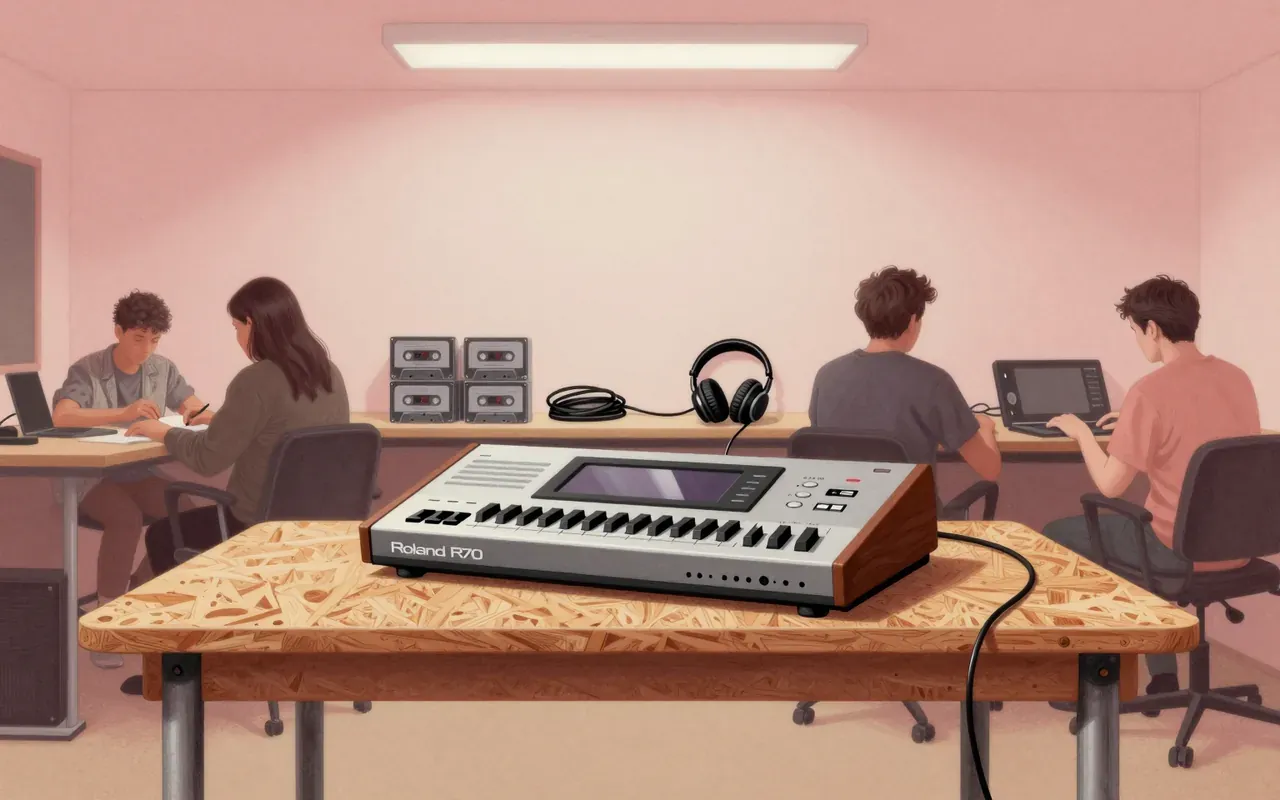
The Roland R-70 is a 1992 full-sized, sample-playback drum machine from Roland’s R series. It offers up to 210 drum sounds across Rock, Jazz, Electronic, and Ethnic kits. It stores 100 programmable patterns and chains them into 20 songs. Its positional pad changes sound by strike location. It includes reverb, flanger, delay, chorus, and humanization. Sound editing is limited to attack, sustain, and pan. Its built-in sequencer is complex—users prefer external sequencing. Kick and cymbal sounds emulate the TR-808. It is a popular, all-purpose drum machine.

10:35

Gibson RD Artist

Gibson

The Gibson RD Artist is a 1978 solid-body electric guitar with active Moog electronics, all-maple construction, a 25.5-inch scale, two humbuckers, and no vibrato. Its controls enable compressor (bridge), expander (neck), bright mode, or neutral, plus bass/treble boost/cut. Stock humbuckers are weak for rock. It was built for precise, processed tone — not vintage warmth or expressive pitch play.

8:52

Way Huge Red Llama

Way Huge

The WM23 Smalls Red Llama Overdrive MKIII is an overdrive pedal made by Way Huge Electronics. It costs $150 including VAT. That is all that is verified.

9:41

Yamaha REV1

Yamaha

The Yamaha REV1 is a two-part digital reverb: a rack unit and a separate remote. It runs at 16-bit/44.1 kHz. It has one XLR input, two XLR outputs, external clock sync, and RS232 remote connectivity. Its sound is clear, clean, soft, and distinct from other Yamaha gear. Only the Lexicon 224 XL surpassed it in finesse among contemporaneous units.

8:31

Ibanez RG550

Ibanez

The Ibanez RG550 is an STC-shaped electric guitar from the RG Standard series, manufactured from 1987 to 1994. It features a Floyd Rose locking tremolo, H-S-H pickups, a 5-way switch, and a thin maple neck. It is discontinued. Users praise its playability and tuning stability but note its weight and fragile finish.

9:01

Rhodes Rhodes Mark II

Rhodes

The Rhodes Mark II Stage Piano is a Fender-built electric piano in the Rhodes series. No technical specifications are available. Its value is $900. That is all that is known.

8:27

Korg Rhythm 55 KR-55

Korg

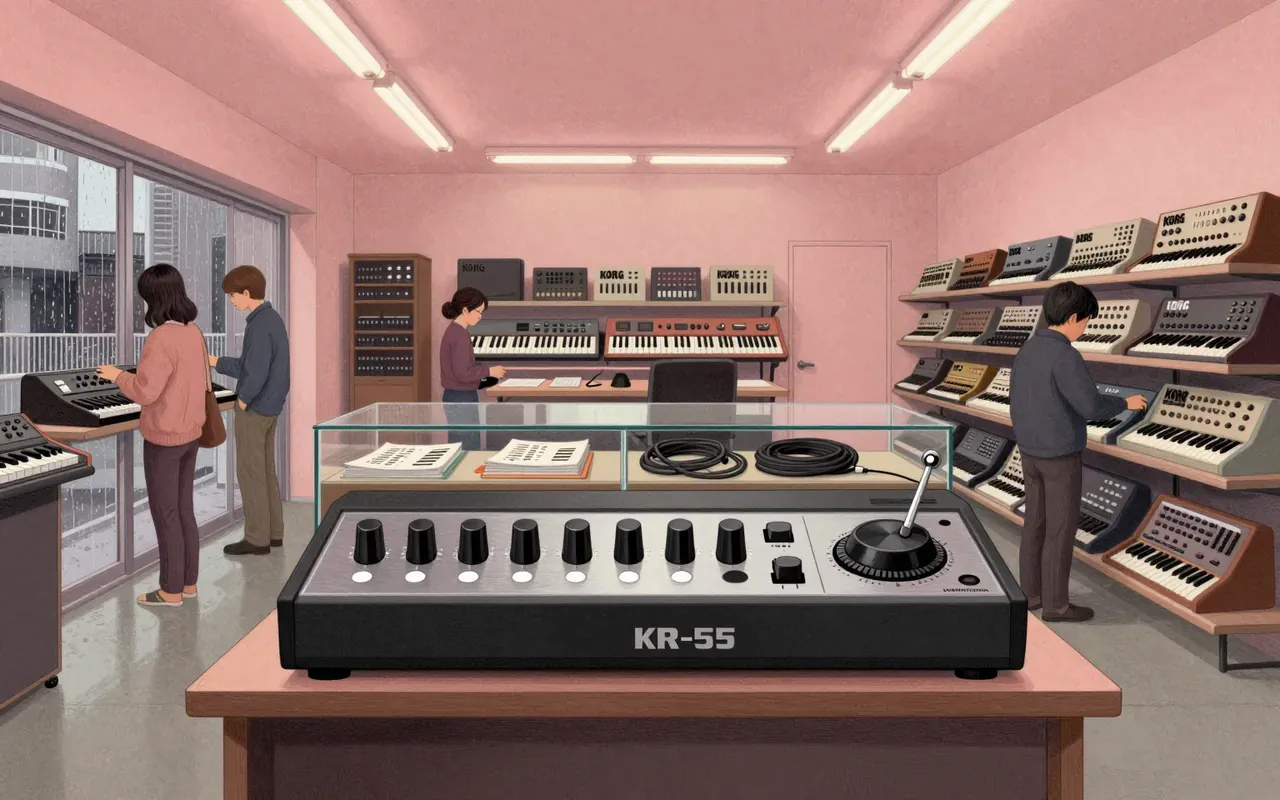
The KR-55 is a fixed-rhythm drum machine from 1979. It plays 48 preset patterns across genres including Waltz, Samba, Rhumba, Bossa Nova, Tango, Slow Rock, Swing, and Rock. It uses sample-based synthesis for 12 drum tones. It has individual level controls per drum sound per pattern. A dedicated swing knob alters groove feel. A footswitch jack enables external Start/Stop and Intro/Fill control. It has no keyboard, no pattern editing, no MIDI, no sync outputs beyond footswitch, and no individual drum outputs.

8:51

Mutable Instruments Rings

Mutable Instruments

Rings is an 'other module for modular synthesizer' made by Mutable Instruments. That is all the source confirms. It is not described as a resonator, a physical modeller, or a filter. It is not assigned a year, format, or synthesis method. Its role is defined solely by its category and manufacturer.

8:37

Orange Rockerverb 50

Orange

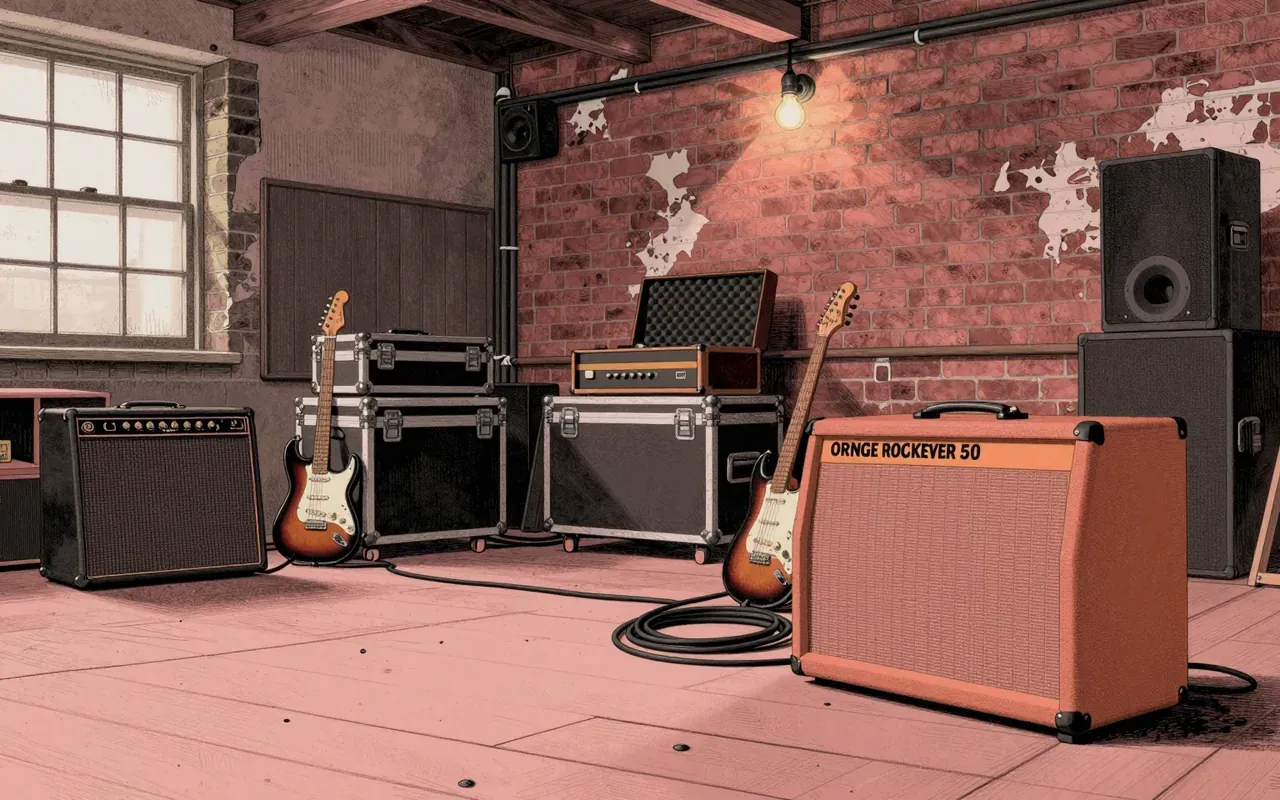
The Orange Rockerverb 50 is a discontinued dual-channel tube head built around four 6V6 power tubes. It delivers 50 watts of British rock tone — immediate, mid-forward, compressed — with minimal controls and shared EQ. It was succeeded by the MKIII. It does not offer channel-specific EQ, master volume, or tight high-gain definition.

7:49

Apogee Rosetta 800

Apogee

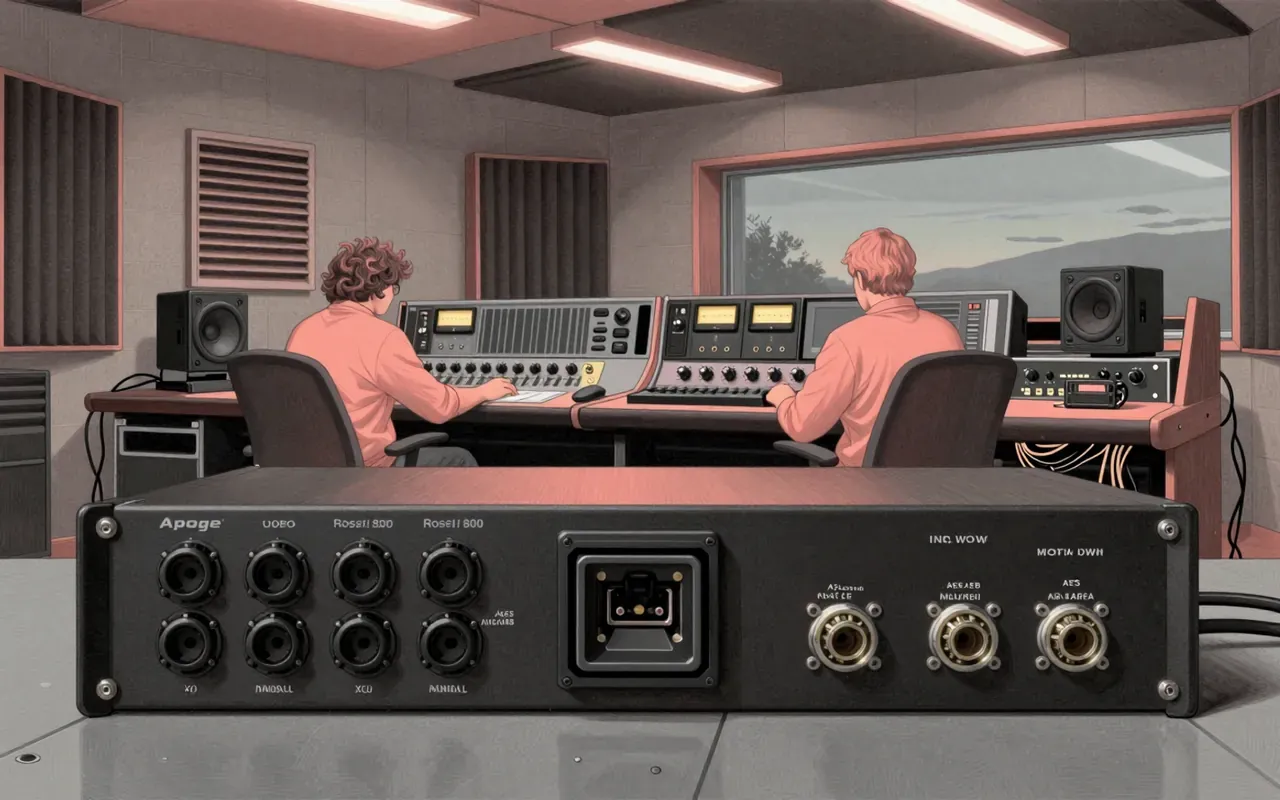
The Apogee Rosetta 800-192k is a rack-mountable analog-to-digital converter. It connects via rear-panel analog, ADAT, and AES. It serves Pro Tools HD systems. It runs at 48 kHz, 96 kHz, or 192 kHz. It produces a clean, transparent, smooth signal. It does not do D/A, preamp, or processing.

8:35

Yamaha RX21

Yamaha

The Yamaha RX21 is a fixed-function drum machine. It plays 100 preset patterns and 5 song sequences. It has stereo and headset outputs, plus a footswitch input. Its operation is intuitive and manual-free. Its sound is basic, loop-based, and dynamically flat—characteristic of early 1980s beatboxes.

8:09

Roland S-760

Roland

The Roland S-760 is a 1990 rackmount sampler. It samples at 44.1 kHz or 48 kHz with 16-bit stereo resolution. It supports 24-voice polyphony across 32 multitimbral parts. It uses no synthesis method beyond sampling. It has built-in filters but no effects.

9:50

Akai S1100

Akai

The Akai S1100 is a sampler. Its name appears in alternate forms: 's1100' and 's 1100'. No technical specifications are available. Nothing else is confirmed.

10:28

Akai S700

Akai

The Akai S700 is a 1987 rack-mount 12-bit sampler derived from the X7000 keyboard model. It samples mono at 4–32 kHz, holds up to 8 seconds, but at 16 kHz allows only six 0.8-second samples. It offers 6-voice polyphony, non-resonant low-pass filtering, and QuickDisk storage. It is user-friendly but rigid: no stereo, no resonance, no modern file support, no workarounds.

10:53

TC Electronic SCF Stereo Chorus Flanger

TC Electronic

The TC Electronic SCF Stereo Chorus Flanger is an analog guitar pedal introduced in the mid-1980s. It offers Chorus, Pitch Mod, and Flanger modes via a 3-way switch. Controls include Speed, Width, and Intensity knobs, independent input gain, and a momentary footswitch. It has mono/stereo outputs, an overload LED, an external bypass jack, and draws power directly from AC mains. Its chorus mode is widely praised for its clean, studio-grade sound — but its flanger and pitch mod modes are less consistent. It is discontinued, replaced by the SCF Gold.

6:57

Manikin Electronic Schrittmacher

Manikin Electronic

The Schrittmacher is a sequencer made by Manikin Electronic. No technical specifications are available. That is all that is known.

7:19

ATC SCM100

ATC

The ATC SCM100ASL Pro is an active studio monitor. No technical specifications are available. It requires no external amplifier. Its performance boundaries are undocumented.

7:53

ATC SCM50

ATC

The ATC SCM50 ASL is an active monitor with no published technical specifications. Nothing about its sound, construction, or performance is documented in the source material.

9:28

Roland SDE-1000

Roland

The Roland SDE-1000 is one of the first digital delay rack units. It delivers up to 1.5 seconds of breathless, crystal-clear delay. Four front-panel keys store delay time and on/off state. Modulation knobs do not memorise—but their activation does. A footswitch controls global on/off. It was bought in 1983 or 1984.

9:12

Roland SDE-3000

Roland

The Roland SDE-3000 is a mono digital delay unit introduced in 1984. It delivers up to 4500 ms of delay with 10 Hz–17 kHz frequency response and low distortion. It has wet/dry outputs, time loop, and TRS footswitch support. It is built for reliability, not versatility.

9:04

Technics SL-1100

Technics

The Technics SL-1100 is an 88-key MIDI controller keyboard built for studio and stage use by performers who need precise, multi-channel keyboard zoning without onboard synthesis.

8:03

Technics SL-1300

Technics

The Technics SL-1300 is a Hi-Fi turntable made by Technics. It has no stated technical specifications, no DJ features, and no digital functionality. Its design prioritises mechanical stability over versatility.

8:34

Manley SLAM!

Manley

The Manley SLAM! is a stereo microphone preamp and limiter. It uses lamp-based preamplification and two analog limiting circuits — optical (ELOP) and FET — in a fixed signal path. It mounts in 2U of rack space. It does not offer variable routing, metering, or sidechain control.

9:54

Technics SP-10

Technics

The Squier SP-10 is a 10W solid-state guitar amp for beginners. It delivers clean and gain channels through a single volume knob, bass and treble tone controls, and a gain switch. It has no midrange control, no effects loop, and no channel-specific volume. Input and headphone jacks are separate. Its design prioritises simplicity and portability over tonal range or headroom.

8:16

Eventide SP2016

Eventide

The Eventide SP2016 Reverb plug-in is a faithful software recreation of the 1982 hardware unit. It gives users six algorithmic reverbs — Room, Stereo Room, and Hi-Density Plate, each in Vintage and Modern variants — with authentic early reflections, evolving echo density, and smooth decay. It prioritises immediacy and character over flexibility or physical accuracy.

8:22

Yamaha SPX900

Yamaha

The Yamaha SPX900 is a 1U digital multi-effects processor with analog-only I/O, 16-bit/44.1 kHz processing, and 99 fixed presets. It delivers studio-ready reverb, delay and modulation in a compact, MIDI-controllable package — but offers no digital connectivity and no on-the-fly parameter editing.

10:18

Alesis SR-16

Alesis

The Alesis SR-16 is a 1990 drum machine built for immediacy: twelve velocity-sensitive pads, four outputs, and step editing deliver fast, routable, mechanical rhythm tracks. Its Dynamic Articulation varies tone with hit strength. Its 233 samples sound distinctly synthetic—not acoustic, not modern. It was used by Autechre and Vangelis. It has no swing, no audio input, no built-in effects beyond reverb on some samples. It remains valuable for hands-on pattern building and discrete signal routing—but only if that’s what you need.

9:44

Eventide TimeFactor

Eventide

The Eventide TimeFactor is a 2011 stompbox-format digital delay/echo/phrase sampler for guitar. It offers ten distinct delay types, two independent 3-second delays, stereo I/O with level switches, true analog bypass, rugged cast metal construction, MIDI and expression pedal control, USB firmware updates, and 100 factory presets. Its 12-second looper is integrated into the same unit.

9:19

Roland TR-626

Roland

The TR-626 is a 1987 digital drum machine. It upgrades the TR-606 and TR-505 with 12-bit sampled sounds, individual tuning and mixing, eight outputs, a basic sequencer (48 preset + 48 user patterns), a TR-505–style matrix display, and strong MIDI implementation. Its samples are drab and low-quality. Its routing and MIDI are its strengths.

7:52

Rane TTM 56

Rane

The Rane TTM 56 is a 2-channel DJ performance mixer. It uses magnetic faders impervious to smoke or moisture. Its EQ cuts frequencies completely. It produces no fader bleed or swipe sounds. Its signal-to-noise ratio is outstanding. It has adjustable fader contour and inversion. It has an integrated effects loop with dry/wet control.

8:14

Chandler/Butler Tube Driver

Chandler/Butler

A tube overdrive pedal built around one 12AX7 tube. Metal case. Own power supply. High output. Creamy distortion. Nearly a decade of field reliability. No EQ. No blend. No compromise on toughness.

9:32

Yamaha TX816

Yamaha

The Yamaha TX816 is a 1984 rack-mount FM digital synthesizer system composed of up to eight TF1 modules. Each TF1 is a 16-voice, 6-operator FM engine. Together they provide up to 128 voices and 48 operators, with 8-part multitimbrality. It has independent audio and MIDI I/O per module. It has no built-in stereo mix output. It was designed for live performance requiring portability, high polyphony, and multiple discrete outputs. It is fully compatible with other DX synthesizers and the FM7 software plug-in.

8:12

EMS Vocoder 5000

EMS

The EMS Vocoder 5000 is classified as an 'Other Effects Processor'. No technical specifications are available for it.

6:40

Neve VR

Neve

The Neve VR LEGEND 60 is confirmed only as an analog mixer. No technical specifications exist in the source material. Nothing is verified about its design, operation, application, or outcome.

8:26

Allen & Heath Xone:62

Allen & Heath

The Allen & Heath Xone:62 (Old Design) is a rack-mountable analog DJ mixer with twelve inputs, six channels, four balanced XLR outputs, per-channel analog high-pass/band-pass/low-pass filters, six channel sends, a four-band EQ whose knobs do not fully cut the signal, and a crossfader that does not fully cut the signal.

9:44

Allen & Heath Xone:92

Allen & Heath

The Allen & Heath Xone:92 (Old Design) is a discontinued 4+ channel DJ mixer. It features dual voltage-controlled filters and low-frequency oscillators. You assign either filter to any channel using switches — including to the cross fader. A tap button sets LFO speed to match tempo or lock in a custom rate. It includes a semi-parametric equalizer. Rackmount is optional. It was replaced by the Xone:92 MK2. It is no longer sold.

8:17

Allen & Heath Xone:V6

Allen & Heath

The Xone:V6 is a 4+ channel analogue DJ mixer from Allen & Heath. It routes four main sources plus an effects return. It has no digital features, no software, no built-in effects. It delivers clean, hands-on control—nothing more, nothing less.

8:31

Akai XR10

Akai

The Akai XR10 is a budget drum machine released in the early nineties. It plays fixed PCM drum sounds from ROM. It has four modes, no backlight, no MIDI Thru, no internal amp or speakers. It is simple, stable, and silent until patched out.

9:21

Waldorf XTk

Waldorf

The Waldorf MicroWave XTk is a 1998 wavetable synthesizer. It has 10-voice polyphony. It uses a 44-key semi-weighted keyboard. It includes a built-in arpeggiator. It is multitimbral.

8:49

Tiptop Audio Z-DSP

Tiptop Audio

The Z-DSP is an effects module for modular synthesizers. Tiptop Audio makes it. That is all the source material states.

9:37

Tiptop Audio Z3000

Tiptop Audio

The Z3000 is a generator module for modular synthesizer. That is all the source states. No specifications. No context. No function described beyond its category. It cannot be evaluated, compared or used meaningfully from the information given.

10:09

Alesis Andromeda A6

Alesis

The Alesis Andromeda A6 is a 16-voice, 16-channel multitimbral analog synthesizer released in 2000. It combines a pure analog audio path with digital control. Its VCOs include pitch correction—a feature missing on older synths. Alesis developed a custom ASIC for it. Axel Hartmann designed it. It is high-end, innovative gear from Alesis, a company known for budget equipment. Alesis developed studio equipment during the 1990s.

9:17

ARP Avatar

ARP · 1977

The ARP Avatar was a 1977 guitar-controlled synthesizer module. It copied the ARP Odyssey’s synthesis architecture but removed the keyboard and added a 6-way fuzzbox. It required a hexaphonic pickup and pitch-to-voltage conversion. It failed commercially. Sales totalled $1 million over two years against $4 million spent on R&D and production. It contributed to ARP Instruments’ bankruptcy in 1981.

9:48

Korg DDD-5

Korg

The Korg DDD-5 is documented only by two PDF files: a 3.3 MB owner’s manual and a 466.4 KB pattern chart, both published on 22 November 2017 and requiring Adobe Reader. Neither contains technical specifications, sonic description, interface details, or operational guidance. No use case, user, or creative output is stated. It is a product defined entirely by its licensing constraints and file formats — not by what it does.

10:08

MXR Distortion +

MXR

The MXR Distortion + is a 1974 distortion pedal using a single op-amp and germanium diodes. It has Output and Distortion controls only. Increasing Distortion raises both clipping and treble. It was one of MXR’s earliest original pedals, released shortly after the Phase 90. It later appeared in the Series 2000 line in 1982.

8:44

Line 6 DL4

Line 6

The Line 6 DL4 is a 1999 digital delay pedal. It models 16 vintage delays. It has a 14-second looper. It is one of the first digital modeling effects units.

9:16

Doepfer A-100

Doepfer

The Doepfer A-100 is an analog modular synthesizer system introduced in 1995. It uses 3U-height, 2HP-width modules patched with 3.5 mm leads. It established the Eurorack standard adopted by many manufacturers. It enables emulation of the Trautonium and Theremin using specific modules.

10:31

Movement Systems Drum Computer

Movement

A British drum computer from 1981–1983. It merges analogue synthesis and 8-bit digital sampling across 14 independent voices (5 digital), sequenced via CRT graphics and controlled by a Nascom 2 computer.

9:00

Boss DS-1

Boss · 1978

The Boss DS-1 is a 1978 distortion pedal built for tight, aggressive tones using hard-clipping circuitry. It uses input/output buffers, a transistor boost stage, an op-amp gain stage with hard clipping diodes, and a tone control. A JFET switching circuit engages or bypasses the effect via a momentary push button. It helped popularise distortion as a distinct pedal category and served as a template for later designs. The 1994 circuit redesign introduced volume loss and a fizzy or waspy edge—problems that spawned a community of modifiers. It remains Boss’s bestselling drive pedal.

8:50

E-mu Emulator

E-mu Systems

A foundational but bare-bones sampler that traded sonic refinement for accessibility.

8:48

Eurorack

Doepfer

Eurorack is a modular synthesizer format introduced in 1995 by Doepfer Musikelektronik. It defines mechanical, electrical and interconnection standards so modules from different makers fit the same cases and communicate reliably. It has no built-in keyboard, sequencer or interface. It demands manual patching and physical organisation. It supports deep signal routing and long-term system expansion. It is used by musicians and designers to build custom synthesis environments.

10:10

Frankenstein (guitar)

Eddie Van Halen

Frankenstein is a custom guitar built by Eddie Van Halen to combine Gibson’s PAF humbucker tone with Fender Stratocaster playability and tremolo. It uses one potted PAF in the bridge, mounted offset for string spacing, wired through a single 500k pot labelled 'TONE' and an output jack. No tone controls. No working selector. Middle and neck positions hold non-functional parts. It delivers aggressive, feedback-resistant lead tone — nothing else.

10:15

Roland JX-10

Roland

The Roland JX-10 is a 12-voice analog keyboard synthesizer introduced in 1986. It combines two independent 6-voice Tone Modules for layering and splitting. Its 76-note velocity-sensitive keyboard includes aftertouch. Internal memory holds 64 patches, each configurable as one 12-voice tone or two 6-voice tones. Original firmware lacks SysEx for Tone or Patch data—but updating it restores that capability. PWM was omitted despite existing hardware resources. Its architecture differs sonically from the JX-8P due to distinct chorus and amplifier sections.

9:10

Roland JX-3P

Roland · 1983

The Roland JX-3P is a six-note polyphonic synthesizer produced by Roland Corporation of Japan from 1983 to 1985. Its name stands for 'Programmable Preset Polyphonic'. It uses two digitally controlled oscillators with sawtooth, 50% and 10% pulse waveforms plus noise. It stores 32 factory and 32 user programs. It features a built-in 128-step polyphonic sequencer synced to external clock pulses — not MIDI clock. Its MIDI implementation supports only note on/off, pitch bend, hold, modulation and program change. The PG-200 programmer enables deeper editing but disables MIDI while connected.

9:02

Ensoniq Mirage

Ensoniq

The Ensoniq Mirage is an 8-bit sampling keyboard introduced in late 1984 as Ensoniq's first product. It offered eight-voice polyphony, analog Curtis CEM3328 filtering, and wavetable synthesis via alternative OS. It booted and stored data on a built-in 3.5-inch floppy drive — one of the first consumer uses of that format. Priced at $1695, it sold 8,000 units in its first year, undercutting the Fairlight CMI and E-MU Emulator.

8:58

Elektron Monomachine

Elektron

The Elektron Monomachine is a 2007 hardware synthesizer and music sequencer. It runs six sequencer tracks, each assigned one of five synthesis engines: SID, VO, FM+, SuperWave, or DigiPro. Every step stores a full snapshot of all track parameters — what Elektron calls parameter locks. It routes audio to six mono or three stereo outputs. Two physical variants exist: the SFX-6 keyboard version with joystick, and the SFX-60 desktop module. The MkII revision improved signal-to-noise ratio, reduced size, and added user waveform support via OS 1.20.

8:08

Moog Modular

Moog · 1964

The Moog synthesizer is a modular, voltage-controlled analog synthesizer invented by Robert Moog in 1964. It was the first commercial synthesizer and established the analog synthesizer concept through its use of patch-cord-connected modules—including voltage-controlled oscillators, filters, envelope generators, and amplifiers—to implement subtractive synthesis.

9:56

Moog Source

Moog · 1981

The Moog Source is a monophonic analog synthesizer made by Moog Music from 1981 to 1985. It was Moog’s first with patch memory and the only Moog with a membrane keyboard and multihued panel graphics. It stores 16 presets onboard and expands memory via audio cassette. Its 24 dB/octave VCF, two analog ADSRs, LFO and sample-and-hold deliver classic Moog tone — but its interface sacrifices playability for recall.

10:49

Korg MS-20

Korg · 1978

A monophonic analog synthesizer from 1978. Two VCOs. Two VCFs in series: high-pass then low-pass. Ring modulation on VCO2. Modulation generator with pulse and sloped outputs. Two envelope generators. Noise source. Modulation VCA. External control via frequency-voltage converter and envelope follower. Patch panel enables rerouting of audio and modulation signals.

7:57

Multimoog

Moog · 1978

The Multimoog is a monophonic analog synthesizer built by Moog Music from 1978 to 1981. Derived from the Micromoog, it adds a second circuit board to deliver aftertouch and expanded modulation routing—features missing from the Minimoog. It was intended as a less expensive alternative to that flagship instrument. It does not store patches. It drifts. It demands attention. But it gives aftertouch control over filter, pitch and amplitude in real time—rare in 1978.

9:24

OSC OSCar

Oxford Synthesiser Company

The OSCar is a 1983–1985 subtractive synthesizer with digital oscillators enabling additive synthesis, dual analog filters with independent cutoff, duophonic mode, and a built-in sequencer. Designed by Chris Huggett (electronics) and Anthony Harrison-Griffin (aesthetics and build), around 2000 units were produced.

9:18

Lexicon (company)

Lexicon · 1971

Lexicon is a company, not an instrument. Its first product was a digital delay system released in 1971. It pioneered commercial digital audio processing hardware for professional and live applications — notably digital reverb starting with the Model 224 in 1978. Its hardware is rack-mounted, hardware-controlled, and designed for integration into analog signal paths. It does not run as software, has no built-in synthesis or recording, and offers no modern digital workflow features.

9:10

Prophet '08

Dave Smith Instruments

The Prophet '08 is an eight-voice analog synthesizer released in 2007 by Dave Smith Instruments. It uses analog subtractive synthesis with digitally controlled oscillators, voltage-controlled filter and amplifier, ADSR envelopes, and three playing modes. It was conceived as an affordable eight-voice analog synthesizer.

10:14

EMI REDD

EMI

The EMI REDD was not a product. It was Abbey Road’s first custom-built, vacuum-tube-based stereo mixing system — engineered in-house, adapted for four-track tape, and retired when it could not scale beyond four outputs. Its sound came from saturation, not precision. Its limits were physical: fixed routing, no patching, no serviceability. Its legacy is inseparable from the room, the tape machines, and the engineers who worked it daily.

8:56

Roland S-50

Roland

The Roland S-50 is a 61-key 12-bit sampler keyboard introduced in 1986. It uses variable sampling rates (15–30 kHz), stores samples on a 3.5-inch DSDD floppy disk drive, supports external CRT monitor editing, and holds up to 32 samples. A rack-mounted version with expanded memory was also available.

9:25

Boss SD-1

Boss · 1981

The Boss SD-1 is a 1981 overdrive pedal. It is the second overdrive made by Boss. It adds a tone control and refines the OD-1’s circuit for more gain and aggression. Its asymmetrical soft-clipping uses two diodes on the positive waveform peak and one on the negative—producing both even and odd harmonics. It is midrange-focused at 800Hz and rolls off less bass than the OD-1. Its circuit has remained unchanged since release.

9:45

Roland SH-1000

Roland

The Roland SH-1000 is a compact 1973 synthesizer — the first made in Japan and the first by Roland. It resembles a home organ, with 10 preset voices and a manually editable section. It has no user program memory. Its effects include white noise, portamento, octave transposition, two LFOs and a random note generator. It simulates multiple oscillators using 8 sub-osc keys; a ninth key triggers white or pink noise.

8:04

Roland SH-3A

Roland

The Roland SH-3A is a monophonic analog synthesizer introduced in 1975. It supports both subtractive and additive synthesis. It includes two LFOs and a unique sample-and-hold section. It was Roland’s first non-preset based synth. It uses a transistor ladder-filter to produce Moog-like sounds.

9:48

Six-Trak

Sequential Circuits · 1984

The Six-Trak is a six-voice analogue synthesizer released by Sequential Circuits in January 1984. It was built as an inexpensive, portable 'scratch-pad' for trying out arrangements.

8:59

Roland System-100M

Roland

The Roland System-100M is a modular analog synthesizer built in the late 1970s. It delivers independent LFOs, envelopes, and patchbay-enabled feedback—not convenience, not recall, not polyphony.

9:15

Yamaha TG77

Yamaha

The Yamaha TG77 is a 1989 rack synth that merges FM and sample-based synthesis with unprecedented routing flexibility—but at the cost of immediacy and tactile control.

8:39

Gibson Thunderbird

Gibson

The Gibson Thunderbird is a 34-inch scale electric bass introduced in 1963. Designed by auto stylist Raymond H. Dietrich, it features neck-through construction and a reverse body shape. It was Gibson’s first bass at that scale and originally came in two models: the single-pickup Thunderbird II and dual-pickup Thunderbird IV. Its soapbar humbuckers deliver focused midrange. In 1966, Gibson altered the design to a non-reverse body and set-neck construction following a lawsuit from Fender.

9:13

Roland TR-606

Roland

The Roland TR-606 is a fixed-voice analog drum machine built from 1981 to 1984. It generates bass drum, snare, toms, cymbal, and open/closed hi-hat sounds using analog synthesis—not samples—and offers no sound editing. Its 32-pattern sequencer includes accent controls and song chaining. DIN sync enables tight integration with the TB-303. It does one thing decisively: deliver unvarnished, immediate rhythm. It refuses everything else.

8:38

Uni-Vibe

Shin-ei · 1968

The Uni-Vibe is a 1968 Shin-ei footpedal phaser designed by Fumio Mieda. It creates chorus and vibrato simulations using an optical circuit: an incandescent bulb shining on LDRs inside a reflective shield drives staggered phasing filters—without op-amps. Its effect is a throbbing, hypnotic pulse rooted in atmospheric radio modulation, not Leslie emulation. It was modified to improve fuse access and add a speed foot pedal. Players value its lo-fi sweep but contend with bulb burnout, speed instability, and lack of precision.

8:12

Gibson Victory Bass

Gibson

The Gibson Victory Bass is a four-string solid-body electric bass designed by Wayne Charvel for Gibson from 1981 to 1986. It shares its lineage with the Gibson Victory, uses fixed materials (maple body, three-ply maple neck, rosewood fingerboard), and offers a fretless option — but nothing more. It was not a successful model. No evidence confirms distinctive tone, player adoption or recorded use.

8:52

List of vocoders

Roland

The 'List of vocoders' is not an instrument. It is a sparse, unattributed enumeration of models and band counts. It contains no operational detail, no historical context for the devices, and no connection to the Roland Corporation. It is a footnote masquerading as a subject.

8:39

Voyetra-8

Octave-Plateau

The Voyetra-8 is an eight-voice, rack-mountable, analog synthesizer introduced in 1982 by Octave-Plateau Electronics. It features 8 programmable analog voice cards, a sophisticated modulation matrix with four banks per voice, and supports Whole-8, Split, and Layer modes. Its memory stores 100 Programs and 100 Steps, and it dumps presets via MIDI using controller changes rather than SysEx. Each voice includes two VCOs, a 24 dB/octave lowpass VCF, two LFOs, two ADSRs, noise, and VCO sync. Key assignment modes and extended envelope parameters allow deep real-time control over voice behavior and articulation.

8:47

Warwick Thumb SC

Warwick

The Warwick Thumb SC is a 2010 single-cut bass born from a fan forum contest. It adapts the Thumb NT shape with new tonewoods and adds coil-splitting via two mini toggles—its sole functional departure from the NT. It has no passive mode, no 6-string option, and no historical lineage beyond its 2009–2010 development cycle.

10:23

1176 Peak Limiter

UREI

The UREI 1176 Peak Limiter is a fast, characterful, all-solid-state audio compressor introduced in 1968. It uses a field-effect transistor in feedback configuration for gain reduction. Compression is soft-knee with a fixed threshold controlled by input level. Four ratios — 4:1, 8:1, 12:1, 20:1 — each raise the threshold. Attack and release are program-dependent. Stereo linking is supported. The 'all-button mode' adds harmonic distortion and alters compression behaviour. It marked the transition from vacuum tube to solid-state technology in studio dynamics processing.

8:19

Mutable Instruments Braids

Mutable Instruments

Braids delivers radical timbral variety in minimal space—but with no internal editing, no tuning stability guarantees, and no analogue circuitry. It is a selector, not a synthesizer.

10:15

Doepfer Dark Energy

Doepfer

A compact, monophonic, fully analog synthesizer released in 2010 as a stand-alone version of the Doepfer A-111-5 Eurorack module. It features dual LFOs capable of audio-rate FM (~5 kHz), a 24 dB/octave low-pass VCF, and a triangle-based VCO. The VCF can function as a sine oscillator when the VCO is disengaged and resonance is maxed. All sound generation and modulation are analog; only USB/MIDI contain digital components. It has no polyphony, no patch memory, no velocity or aftertouch, and no audio input. Superseded by the Dark Energy II in 2012.

8:34

Korg DW-6000

Korg

The Korg DW-6000 is a 1985 six-voice hybrid digital-analog synthesizer using sampled waveforms in ROM, analog VCA/VCF, dual oscillators per voice with detune, and a programmable stereo chorus — while noting design limitations like lack of touch sensitivity and single parameter control.

8:54

E-mu Modular System

E-mu Systems

The E-mu Modular System is an analog modular synthesizer introduced in 1972 by E-mu Systems as a competitor to ARP and Moog modular synthesizers. It featured a microprocessor-controlled polyphonic keyboard and sequencer — claimed by E-mu to be the first of its kind — and allowed sound creation via patch cord routing among user-specified modules. Users could store configurations using 'firm-wire' patches, and the system was capable of producing any popular synthesizer sound of the era, noted for a 'cleaner' sonic character than competitors.

9:46

Eventide Eclipse

Eventide

A professional-grade digital effects processor with dual independent effects blocks, nearly 100 algorithms—including 11 reverbs—and 24-bit/96kHz conversion. Supports true stereo reverb I/O and extensive looping (up to 20 seconds per block). Firmware updates require Compact Flash and strict version dependencies; bootloader corruption requires factory reprogramming.

9:58

E-mu Emax

E-mu Systems

The Emax is a line of samplers introduced by E-mu Systems in 1986 as a low-cost version of the Emulator II. It stored samples on 3½" floppy disks — more reliable than the Emulator II’s 5¼" disks. Models include the HD (with 20 MB hard drive), SE (with additive synthesis), and Plus (with SCSI). All models retain 512 KB of sample memory.

9:28

Apogee Ensemble

Apogee

The Apogee Ensemble (FireWire) and Ensemble Thunderbolt are legacy audio interfaces with fixed end-of-life dates, discontinued software support, and hard macOS version limits. They offer no documented sonic distinction, no stated creative use cases, and no path forward beyond legacy maintenance.

9:34

Make Noise Maths

Make Noise

MATHS is a 20hp Eurorack module by Make Noise Music that functions as an analog computer for generating, transforming, and routing control voltages and digital timing signals. It extends Buchla’s legacy of analog control voltage processing, enabling scaling, inversion, amplification, integration, arithmetic, logic, and autonomous function generation — including LFOs and envelopes — with timing ranging from milliseconds to minutes.

9:40

Korg MS2000

Korg

The Korg MS2000 delivers the MS-10/MS-20 workflow in virtual analog form — with dual timbres, real-time knob control, and mod sequencing — but enforces a strict 4-voice polyphony limit that defines its practical use. It competes directly with the Nord Lead and Roland JP-8000 series. Its physical forms are a 44-key keyboard and a rack module. Connecting both via MIDI yields eight offset voices — not true polyphony expansion.

8:22

Eventide Orville

Eventide

The Eventide Orville is a dual-DSP, 24-bit digital audio processor with fully flexible I/O routing, near-three-minute sampling (DSP A), 40-second delay on both engines, UltraShifter™, DistortionCurve™ analog distortion modelling, and Predictive Vocoder™ based on a high-resolution physical model of the vocal tract. Firmware updates require Windows XP and a USB-to-serial adapter—and delete all User Programs unless backed up.

11:12

Korg Prophecy

Korg

The Korg Prophecy is a monophonic synthesizer released by Korg in 1995. It uses MOSS (Multi Oscillator Synthesis System) to emulate analog synthesis, FM, and physical modelling. It offers five synthesis methods encompassing nine oscillator types: analog, variable phase modulation, brass, reed, and plucked string modelling, noise with comb filtering, and three types of analog-style models — sync, ring modulation, and cross modulation — collectively referred to as 'MOD'. Each oscillator is processed by a linked waveshaper for generating distortion or resonance effects. The signal, combined with outputs from a sub-oscillator and noise generator, and feedback, is then fed through two multi-mode filters, which can be arranged in series, parallel, or split configurations. The Prophecy's modulation options include six multi-stage envelopes and four low-frequency oscillators (LFOs) with a selection of 30 types. The keyboard features velocity sensitivity and aftertouch and is complemented by three physical wheels dedicated to pitch bending, modulation, and the Wheel 3, a cylindrical control that combines a modulation wheel with a pressure- and position-responsive ribbon controller. It is equipped with five programmable Performance Editors (PE) knobs, each of which can control up to four parameters simultaneously, enabling precise manipulation of aspects like filter cutoff frequencies, envelope attack times, filter resonance, and stereo panning with a single turn. KORG was the first company to feature effects on a synthesizer, and the first to use a sample + synthesis sound design.
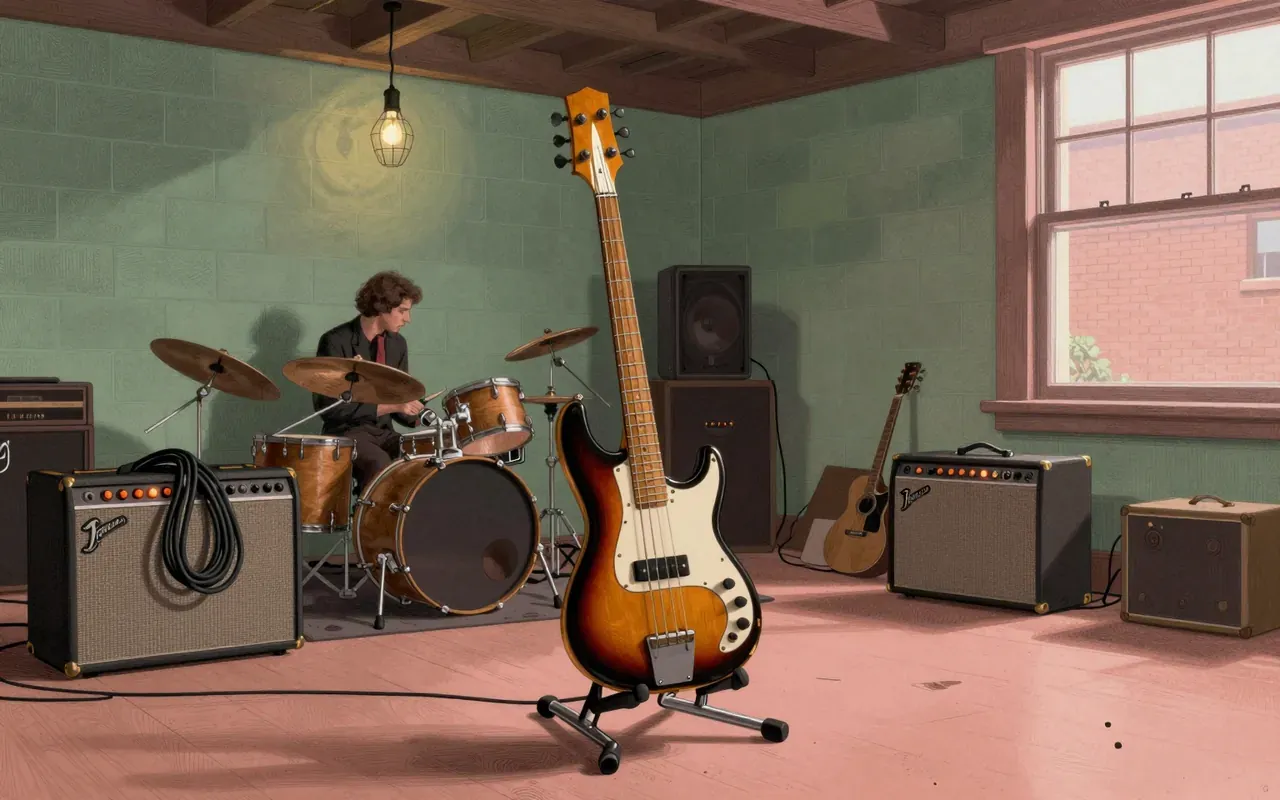
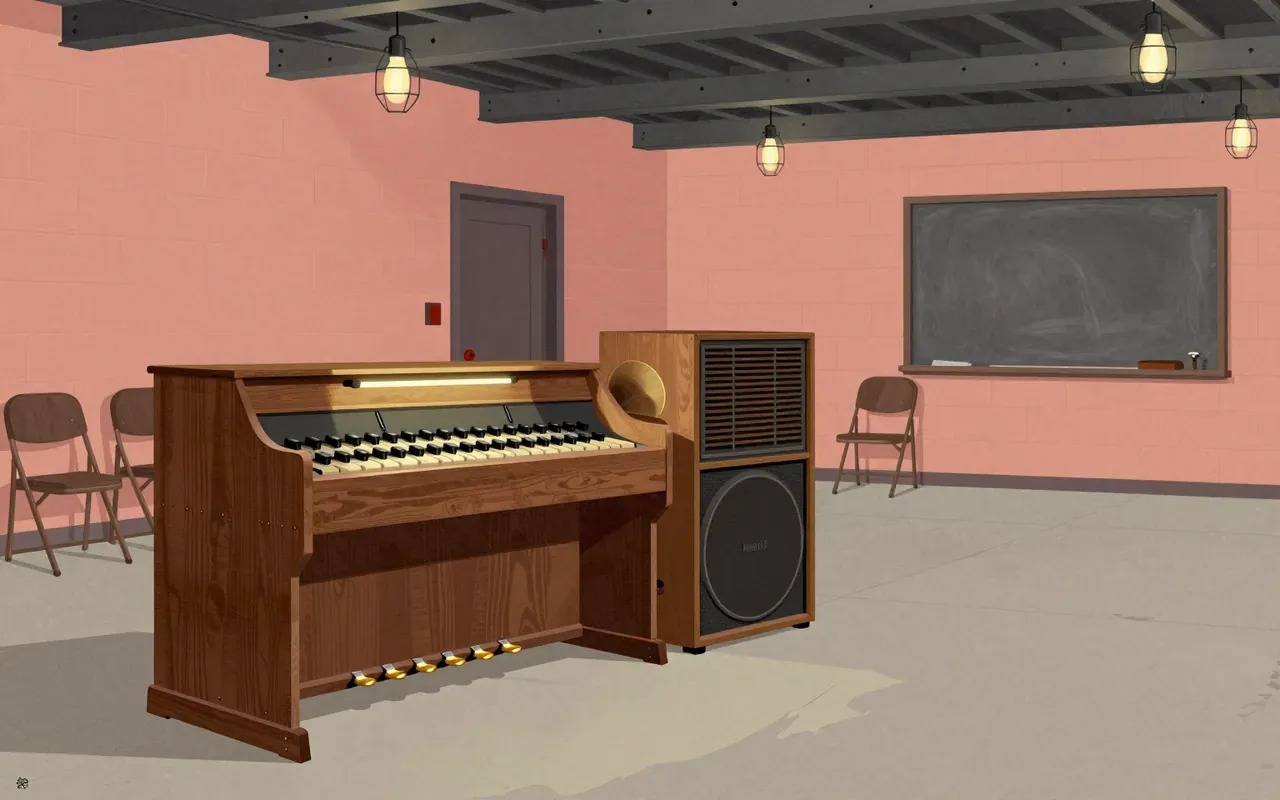
9:20

Korg PS-3300

Korg

The Korg PS-3300 is a 1977 polyphonic analog synthesizer built from three PS-3100-derived units (PSU-3301), delivering 144 voices with independent oscillators, filters, envelopes, and amplifiers per note. It enables multitimbral sound creation through individual module adjustment and mixing. It omits the PS-3100's ensemble effect. It supports extensive voltage control and patching — including pitch modulation from envelopes or external sources — and uses a detachable keyboard format. It belongs to Korg’s 1970s line of large, expensive, patchable instruments, positioned as a high-end professional device.

9:51

Eventide Space

Eventide

The Eventide Space is a reverb-and-delay pedal offering 12 algorithmic spatial effects—including Hall, Plate, Blackhole®, and Shimmer—controlled via 10 knobs, MIDI, expression pedal, or HotSwitch. It features 100 presets (some artist-designed), true analog bypass, tap tempo/MIDI clock sync, and mono/stereo I/O in a rugged metal pedal format. Software tools FactorLib and H9 Control manage presets; the SpaceTime algorithm combines modulation, two delays, and reverb.

9:33

Ensoniq SQ-80

Ensoniq

The SQ-80 is a digital/analog synthesizer introduced in 1987 and manufactured until 1989. It features Polypressure Keyboard technology, 43 additional waveforms (including five drumkits), an enhanced sequencer, a floppy disk drive, MIDI in/out/thru, and the 2nd Release reverb simulation. Its OS was later back-ported to the ESQ-1. It was promoted professionally alongside the EPS sampler, including in a limited-edition CD with the Dixie Dregs.

10:33

Novation Supernova

Novation

The Novation Supernova is a 1998 3U virtual analogue rack synth with 16+ note polyphony and multitimbral operation. It models subtractive synthesis digitally and includes a resonant self-oscillating filter. Its defining strength is a 7-effect-per-part engine retained per part in multitimbral use, with no polyphony loss. It lacks triangle and sine wave oscillators — requiring their derivation via a hardness attenuator. No other details about sound character, interface layout, modulation matrix, LFO count, or physical controls are verified.

8:04

Coles 4038

Coles

The Coles 4038 is a BBC-designed ribbon microphone from 1953. It uses a bi-directional polar pattern and has a flat frequency response from ~30–15,000 Hz. High-frequency attenuation reduces sibilance but also reduces detail. Its technical specifications have remained unchanged since its design in the 1950s.

8:24

RCA Type 77-DX microphone

RCA

The RCA Type 77-DX is a 1954 poly-directional ribbon microphone with mechanical pattern control, low-tension 2.5-micron ribbon, and user-selectable impedance and low-frequency rolloff.

9:26

ADAT

Alesis

The ADAT was a tape-based digital multitrack recorder introduced by Alesis in 1991 and shipped in early 1992. It recorded eight tracks of 16-bit audio on S-VHS cassettes, supported locate points and auto play/record for precise editing, and could be synchronised with up to 15 other units for 128-track recording. Its CD-resolution audio and low price disrupted home and project studios. Later models like the HD24 moved to hard disk and introduced File Streaming Technology.

9:45

Yamaha AN1x

Yamaha

The Yamaha AN1x is a 1997 virtual analog synthesizer using DSP-based modelling of analog subtractive synthesis components. It features duo-timbral architecture with two programmable Scenes per voice, parameter interpolation via morphing, and a maximum polyphony of ten notes—dependent on playing mode. Its synthesis engine includes dual oscillators, multimode resonant filtering, extensive modulation routing, and real-time control via assignable knobs and ribbon controller.

9:26

ARP 2500

ARP

The ARP 2500 is a monophonic or duophonic analog modular synthesizer introduced in 1970 as the first product of ARP Instruments. It used matrix switches instead of patch cables, enabling a cable-free experience but suffering from dirty connections and crosstalk. Its voltage-controlled oscillators achieved good tuning stability compared to competitors, due to patented exponential converters and a dual core design. The matrix switch scheme allowed any module's output to connect to any other module's input.
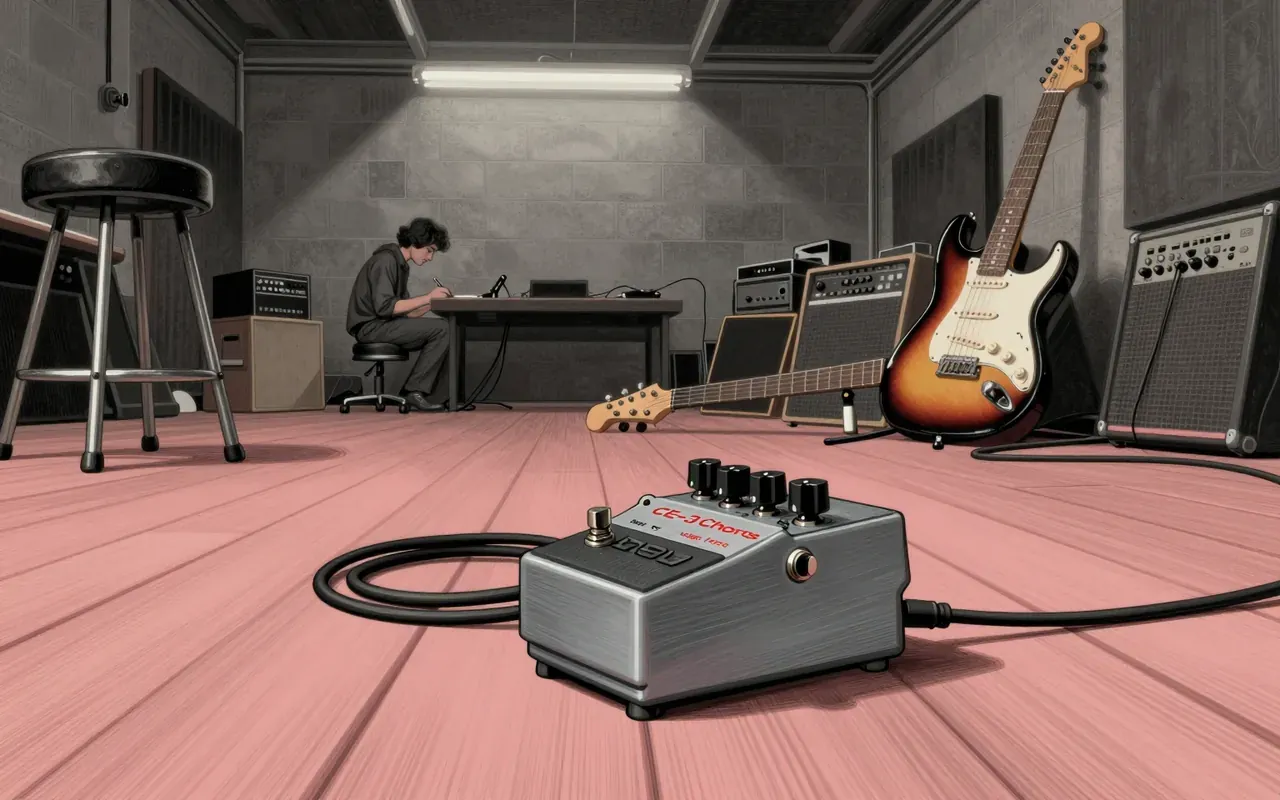
9:37

ARP Instruments

ARP · 1969

ARP Instruments (1970) built analog synthesizers focused on stability, usability, and performance readiness—not abstraction or infinite patchability.

9:36

ARP Omni

ARP

The ARP Omni is a polyphonic analog synthesizer with preset orchestral string voices, a monophonic bass section, and a polyphonic synthesizer section featuring a 24 dB/oct VCF, ADSR envelope, triangle LFO, and waveform enhancement switch. Its string and synth sections used divide-down architecture for full polyphony, and it offered simultaneous, mixable, separately outputted sections — Strings, Synthesizer, and Bass — with onboard chorus phasing applied primarily to the strings.

9:18

ARP Quadra

ARP

The ARP Quadra is a 61-key analog synthesizer introduced in 1978. It was built as a paraphonic instrument using pre-existing ARP modules. It features four sound sections (Bass, String, Poly Synth, Lead), limited memory that recalls only on/off states and intervals—not slider positions—and relies on manual real-time adjustment. Its architecture uses divide-down circuits for the string section and shares controls like the hollow wave button across sections. It is not truly polyphonic and includes an arpeggiator specific to the lead section.

9:49

Ampex ATR-100

Ampex

The Ampex ATR-100 is a mastering-grade analogue tape recorder introduced in Spring 1976 at the AES Conference in Los Angeles. Designed exclusively for stereo or quadraphonic mixdown and mastering, it features a servo-controlled direct-drive-capstan transport and interchangeable headblocks for quarter-inch or half-inch tape. Its wow and flutter performance set a new standard for analogue accuracy. It does not support multitrack recording. No verified claims exist about recordings made on it, its users, or its sonic signature beyond accuracy.
9:21

Fender Telecaster

Fender

The Telecaster is the original mass-produced solid-body electric guitar. It established the bolt-on neck, single-cutaway solid-body template. It remains in continuous production since autumn 1950. Its simplicity enables durability and directness—but offers no noise cancellation, ergonomic contouring, or tonal versatility beyond its two-pickup circuit.

9:07

Rhodes Chroma

Rhodes

The Rhodes Chroma is a microprocessor-controlled analog synthesizer originally developed by ARP Instruments, Inc. in 1979–1980 and produced by Rhodes in 1982. It features sixteen-voice polyphony, digitally encoded parameter processing, and software-generated envelopes and LFOs. Its architecture relies on software-based control of analog voice channels, enabling programmable multitimbral synthesis but introducing latency and instability.

9:25

Vox Continental

Vox

A portable transistor organ designed for touring musicians as a lightweight alternative to the Hammond organ.
10:48

Yamaha CP-70

Yamaha

The CP-70 is a mechanically faithful grand piano stripped of its soundboard and fitted with piezo pickups for touring. It delivers unmatched keybed realism and feedback resistance—but at the cost of acoustic presence, convenience, and tonal flexibility.
8:30

Yamaha DX1

Yamaha

The Yamaha DX1 is the top-level member of Yamaha's prolific DX series of FM synthesizers.

9:54

Yamaha DX21

Yamaha

The Yamaha DX21 is a 1985 bi-timbral FM synthesizer with four sine-wave operators, 128 ROM presets, 61 non-velocity keys, and eight-note polyphony — split into four notes per zone when divided.

8:37

Gibson EB-0

Gibson

The Gibson EB-0 is a bass guitar introduced in 1959 to replace the underperforming EB-1. It used the EB-1’s mahogany neck, body, and 30.5-inch scale but adopted a double-cutaway body inspired by the Les Paul Junior. Production ended in 1979 after 20,844 units. Early models were cherry red only. In 1961, the body was redesigned to match the SG. In 1962, the pickup’s black plastic cover became metal. Around 1964/5, nickel hardware gave way to chrome.

8:56

Ensoniq EPS

Ensoniq

The Ensoniq EPS is a 13-bit sampling keyboard introduced in 1988 as the Mirage's successor. It uses dual processors and a dedicated sound engine to enable load-while-play. It reads double-density 3.5" floppies formatted to 800k. It integrates MIDI for control or computer connection. Early units suffered mechanical issues with their polypressure keyboard.

9:11

Ensoniq EPS-16 Plus

Ensoniq

The EPS-16 Plus is a purpose-built 1990 sampler that trades flexibility for immediacy. It records mono, plays back 16-bit samples at seven fixed rates, and routes everything through stereo panning and 13 effects. Its ES5505 OTIS chip gives it tight, responsive playback—but no sample rate conversion, no stereo input, and no non-destructive editing. Turbo versions added flash and SCSI, but Ensoniq replaced it with the ASR-10 in 1992. It belongs in a room where decisions are made by ear and fingers—not by menu diving.

8:11

Synton Fenix

Synton

The Synton Fenix is a rare, handbuilt modular synthesizer from 1997 — 75 units total — designed by Marc Paping and Bert Vermeulen to include only the vintage-analogue features they personally valued, and nothing more.

9:11

Gibson Firebird

Gibson

The Gibson Firebird is a solid-body electric guitar introduced in 1963. It features neck-through-body construction—the first Gibson solid-body to do so—with a stepped neck, reverse headstock, treble-side banjo-style planetary geared tuners, and fully covered mini-humbucking pickups with metal surrounds. The neck is built from five plies of mahogany and four narrow strips of walnut.

10:52

Yamaha FS1R

Yamaha

The FS1R is a rare hybrid: a formant-driven FM module that expanded what FM synthesis could model — but collapsed under its own complexity. It delivered new waveforms, deeper operator mapping, and vocal resonance no DX7 could match. Yet its interface, manual, and lack of tactile feedback made it a lab tool, not a stage instrument. Its legacy lives in Montage — but not its formants.

8:57

Fender Jaguar

Fender · 1962

The Fender Jaguar is a 1962 electric guitar with an offset-waist body, 24-inch scale, 22-fret neck, dual-circuit switching (lead/rhythm), smaller single-coil pickups with notched side plates for improved RF shielding, a spring-loaded string mute, and design lineage from the Jazzmaster.

9:17

Kurzweil K250

Kurzweil

The Kurzweil K250 was an 88-key, ROM-based sampling keyboard introduced in 1984. It used proprietary 'contoured modelling' compression to store acoustic instrument and oscillator waveform samples. Twelve separate DACs converted the data to analog. CEM 3335 analog envelopes restored dynamics lost in compression. It delivered 12-note polyphony and was the first electronic instrument to faithfully reproduce an acoustic grand piano.

9:30

Klon Centaur

Klon · 1994

The Klon Centaur is an overdrive pedal introduced in 1994. It was designed to emulate high-volume amplifier distortion while preserving tone. Its circuit uses a JFET-based TL072 op amp and hard-clipping 1N34A diodes. After internal voltage doubling, the signal splits into three paths. It adds slight midrange emphasis. It was built as a standalone pedal in a custom-cast enclosure.

10:29

Gibson Les Paul

Gibson · 1952

A physically dense, sonically authoritative solid-body guitar built for sustain and midrange focus — not speed or lightness.

10:14

Gibson Les Paul Special

Gibson

The Les Paul Special is a 1955 Gibson variation designed as an intermediate instrument between the Junior and Standard Les Paul. It launched in TV Yellow for black-and-white television visibility. In 1958, it shifted from singlecut to doublecut. In 1961, it became the SG after Les Paul’s contract expired; original models returned in 1968 upon renewal.

10:19

Marshall Major

Marshall

The Marshall Major is a 200-watt guitar amplifier built from 1967 to 1974. It was designed to produce more volume and clean headroom than Marshall's other amplifiers like the Super Lead. The 200 had only three controls on the front panel and used a preamplifier circuit that was closer in design to a hi-fi amplifier rather than a guitar amp. In 1968, Marshall updated the 200 with a typical EQ compliment of treble, middle, bass, and presence controls, and it was now named the Major. This tone stack—which was passive compared to the 200's active controls—was placed between the second and third gain stages created using ECC83 (12AX7) preamp tubes. Ritchie Blackmore of Deep Purple and Mick Ronson of David Bowie's band are frequently associated with the Major.

10:22

Roland MC-4 Microcomposer

Roland

The Roland MC-4 Microcomposer is a 1981 microprocessor-based CV/Gate sequencer with four output channels, programmable via numeric keypad or live monophonic keyboard input, using numeric pitch values (Middle C = 24), step time values, and gate time values; it features volatile memory requiring cassette storage, supports syncing to other MC-4s or Roland gear, and predates MIDI.

9:39

Sennheiser MD 441

Sennheiser

A purpose-built dynamic mic from 1971 that prioritises rejection, bass control, and electromagnetic immunity over sonic versatility or modern convenience.

8:55

Micromoog

Moog · 1975

The Micromoog is a monophonic analog synthesizer produced by Moog Music from 1975 to 1979. Designed as a scaled-down, lower-priced alternative to the Minimoog, it was intended for musicians new to synthesis who could not afford the $1,500 Minimoog. Priced at $650–$800, it features a single VCO with variable waveshape from sawtooth to pulse, sub-octave generation one or two octaves below the fundamental, a −24dB per octave low-pass filter with its own envelope generator and VCO frequency modulation capability, a voltage-controlled amplifier with its own envelope generator, and two A(S)R envelope generators with switchable sustain — a design choice that distinguishes it from most budget synths of the era which used a single ADSR. It includes Moog Open System control inputs, an audio input for external signal processing, and uses 0.95V/oct CV scaling. It was designed by Moog engineer Jim Scott in consultation with Tom Rhea, with electronic refinement input from David Luce and Robert Moog.

8:52

Korg miniKORG 700

Korg

The miniKORG 700 is Korg’s first monophonic analog synthesizer, released in 1973. Designed for organists, it sits atop an organ with controls facing upward. It features five oscillator waveforms including two pulse-width modulation variants, an envelope with attack and 'singing' (decay/release), a 'sustain' toggle that functions only as release, and a dual-filter 'Traveler' system with a safety constraint preventing silence. Its filters produce vocal-like sounds.

8:49

Moog Sonic Six

Moog · 1972

The Moog Sonic Six is a duophonic analog synthesizer introduced in 1972. It was built for portability and education after Bill Waytena acquired R.A. Moog Inc. and rebranded the Sonic V as the Sonic Six. Its folding control panel is unique in Moog’s history. It was widely used for lectures and educational purposes, often by Bob Moog himself. It delivers weak sound compared to the MiniMoog and suffers from reliability issues. Its single contour generator is shared between VCA and VCF, limiting independent envelope shaping. It is worth your time only if you need a portable, self-contained analog synth for live lecture demos or classroom use — not for studio depth, reliability, or sonic authority.

9:22

Nord Modular

Clavia

The Nord Modular is a 1997 software-based semi-modular synthesizer that uses DSP to emulate analogue circuitry and supports multiple synthesis methods including subtractive, additive, FM, and physical modelling. Patch editing is performed on a PC using graphical editor software, while sound generation occurs independently on the hardware. Patch complexity is constrained by available DSP resources, and polyphony varies from 4 to 32 voices depending on patch complexity. It was upgraded in 2004 as the Nord Modular G2 with endless rotary knobs and a larger keyboard with aftertouch.

9:32

Oberheim OB-1

Oberheim

The Oberheim OB-1 is a monophonic analog synthesizer introduced in late 1977. It was the world's first completely programmable synthesizer, offering eight preset memories. It features two VCOs with selectable and continuously-variable waveforms, a switchable 2- or 4-pole VCF, and two ADSR envelopes—one for the filter and one for the VCA. Its design built upon technology from the Polyphonic Synthesizer Programmer.

8:02

Fender amplifier

Fender

Fender amplifiers are electric instrument amplifiers produced by the Fender Musical Instruments Corporation. The first guitar amplifiers attributed to Leo Fender were manufactured by the K&F Manufacturing Corporation (K&F) in 1945. Later, Fender began building its own line of electric guitars. Fender amplifiers would become favorites of guitarists like Jimi Hendrix, Eric Clapton, and Stevie Ray Vaughan, also known in these cases for playing Fender guitars. Fender amps have come in many configurations and styles. The early K&F and Fender amplifiers relied upon vacuum tube circuitry, with solid-state models appearing in the late 1960s. Fender frequently updated the internal circuitry of its amps, and changed their appearance throughout its history.

8:40

Prophet 2000

Sequential Circuits

The Prophet 2000 is Sequential Circuits’ first sampler — released in 1985. It uses 12-bit sampling at up to 41.667 kHz, with 256 kilowords of memory. It offers 8-voice polyphony and early multitimbral operation via MIDI channels. Its analog VCFs and VCAs give it warmth absent in later samplers. It was relatively affordable at £2,000.

8:54

Gibson Ripper

Gibson

The Gibson Ripper is a purpose-built electric bass: set-neck, two Bill Lawrence Super Humbuckers, and a Q System circuit that prioritises midrange control over flexibility. It delivers punch and presence but withholds neck-pickup isolation and tonal versatility.

10:14

Akai S3000XL

Akai · 1995

The Akai S3000XL is a 1995 sampling instrument with 32-voice polyphony and 2 MB of RAM. It features a large screen and intuitive interface for fast sample editing. It loads sounds via a 3.5" floppy drive and SCSI port, and plays back MIDI files for live triggering. Akai discontinued it in 1995. It belongs to the S3000 series, which succeeded the S1000 series and offered optional CD-ROM.

8:55

S612

Akai · 1985

The S612 was Akai’s first rack-format digital sampler — 12-bit, single-sample, one-second max at 32 kHz, loaded via external Quick Disk drive. It defined the form factor and affordability threshold for what followed, but offered no polyphony, no internal storage, and no upgrade path.

8:53

Serge Modular

Serge

The Serge synthesizer is an analogue modular system developed at CalArts in late 1972. It was built to be inexpensive and powerful, a democratic alternative to Buchla systems. It shipped as DIY kits assembled unofficially on a CalArts balcony. Modules expose circuit aspects on the front panel for unconventional patching. All signals use banana jacks—no separation between audio and control voltage. Stackable banana plugs reduce the need for mults. One unit was used on the 1975 Greenpeace anti-whaling expedition to approximate and broadcast whale sounds.

10:34

Gibson SG

Gibson

The Gibson SG is a 1961 solid-body electric guitar built to deliver upper-fret access and playing speed at the expense of body mass and low-end sustain. Its design choices — double cutaway, thinner contoured body, outward-shifted neck joint, slender mahogany neck — are all functional responses to physical limits players hit on earlier Gibsons. It does not try to be a Les Paul. It tries to be faster, lighter, and more direct — and succeeds on those terms alone.

8:32

E-mu SP-1200

E-mu Systems

The E-mu SP-1200 is a sampling drum machine introduced in August 1987 by E-mu Systems. It uses 12-bit linear sampling at 26.04 kHz, drop-sample pitch-shifting, analog SSM2044 lowpass filters on channels 1 and 2, volatile RAM loaded from 3.5" disk, and offers 10 seconds of total sampling time—with a 2.5-second limit per sound. It succeeded the SP-12 and offered integrated sequencing and sample looping in a single unit.

8:44

Roland SP-808

Roland

The SP-808 is a self-contained sampling workstation built for immediacy—not convenience. Its limits are absolute: four stereo voices, Zip-only storage, no modern connectivity. Its strength is integration: sampler, synth, and sequencer in one tactile unit, holding over 1,000 samples internally while demanding physical media discipline.

10:03

Yamaha SY77

Yamaha

The Yamaha SY77 is a 1989 16-voice multitimbral workstation combining AFM (expanded 6-operator FM), AWM2 PCM sampling, and their real-time hybrid RCM. It features a 61-key keyboard with velocity and aftertouch, two modulation wheels, pitch wheel, backlit LCD, floppy drive, expansion slots, on-board effects, and a 16,000-note sequencer. AWM2 waveforms can be used standalone, layered with FM Elements, or — uniquely in the SY/TG series — as modulators for FM operators. Its AFM is a superset of the DX7’s FM, adding waveforms, algorithms, feedback routing, and filter integration.

7:42

Steiner-Parker Synthacon

Steiner-Parker

The Steiner-Parker Synthacon is a monophonic analog synthesizer released in 1975. Its defining feature is Nyle Steiner’s 12dB/octave multimode filter, which self-oscillates and sustains full amplitude at all resonance settings—a deliberate departure from the Minimoog and ARP Odyssey. Several hundred units were made. It has no polyphony, no LFO, no patch memory, and tuning stability is not documented. Its value lies in its singular filter behaviour, not versatility or convenience.

8:42

Elka Synthex

Elka

The Elka Synthex is an 8-voice analog keyboard synthesizer produced by Italian music instrument manufacturer Elka from 1981 to 1985.

9:00

Roland System 700

Roland · 1976

The Roland System 700 is a professional monophonic modular synthesizer released in 1976 by Roland Corporation.

8:07

Moog Taurus

Moog

The Moog Taurus is a foot-operated analog synthesizer introduced in 1975. It uses an organ-style pedal board. It is monophonic, with a single voice generated by two oscillators and one VCA. Taurus I and III offer only a distorted sawtooth wave. Taurus II introduced a pulse wave. All models use a 24dB/octave resonant low-pass filter with key tracking. Early models lack an LFO; Taurus III includes one routable to oscillator pitch or filter frequency.

9:16

Fender Telecaster Bass

Fender

A no-compromise bass that sacrifices versatility for presence. It does one thing well — deliver tight, articulate low end with zero detours — and refuses to do anything else.

10:08

Korg Trident

Korg · 1980

The Korg Trident is a 1980 subtractive synthesizer with eight-note polyphony, integrating three independent sections — polyphonic, string, and brass — into one keyboard. It allows assignment to two keyboard zones, includes a flanger effect and joystick for pitch and modulation. The 1982 MkII revision added memory, improved stability via better heat-sinking and power supply, and separate ADSR envelopes for filter and VCA — unlike the MkI’s shared envelope. It does not use effects or sample+synthesis, despite KORG pioneering both elsewhere.

9:45

Korg Triton

Korg

The Korg Triton is a 1999 music workstation synthesizer with digital sampling and sequencing. It introduced 62-note polyphony, dual polyphonic arpeggiators, RPPR phrase recording, onboard sampling with expandable RAM, five insert effects per Program, dual filters per oscillator (24dB/octave low-pass or parallel 12dB/octave HP/LP), faster touchscreen response, category search UI, and expanded memory and outputs. It was available in 61-, 76-, and 88-key Classic versions and as a rackmount Triton-Rack with optional ADAT/Word Clock via EXB-DI.

9:22

Yamaha TX81Z

Yamaha

The TX81Z is a stripped-down, rack-only FM synth that trades expressive controls for affordability and waveform novelty. Its non-sine oscillators opened new sonic doors — but its single-chip architecture left out pitch envelopes, velocity sensitivity, and operator depth. It belongs in a modern studio only as a character voice, not a workhorse.

9:53

EMS VCS 3

EMS · 1969

The EMS VCS 3 is a portable analogue synthesizer introduced in 1969 by Electronic Music Studios. Designed largely by David Cockerell and styled by Tristram Cary, it uses a pin-based patchboard matrix instead of cables. It lacks a built-in keyboard, making it better suited for sound effects generation and external signal processing than melodic playing. Its tuning instability stems from exponential voltage-to-frequency conversion. It was one of the first portable commercially available synthesizers, housed entirely in a small wooden case.

7:58

Wasp

Electronic Dream Plant

The Wasp is a 1978 monosynth defined by its copper-plate keyboard, black-and-yellow casing, internal speaker, and proprietary interconnection. It was EDP’s best-received product but flawed in execution: unreliable live, prone to autonomous triggering, and technologically isolated. Its sound is inseparable from its limitations.

9:10

Roland XP-80

Roland

The Roland XP-80 is a 1996 76-key workstation using digital PCM subtractive synthesis, delivering 64-voice polyphony and 16-part multi-timbrality via a semi-weighted keyboard. It merges the JV-1080 engine with the MRC-Pro sequencer for tight internal composition—but offers no aftertouch, limited real-time sound control, and no modern connectivity.

9:06

Oberheim Xpander

Oberheim

A keyboardless, six-voice analog synthesizer launched in 1984 and discontinued in 1988. Rack-mounted. Uses Matrix Modulation to route digital control to analog VCOs, multi-mode VCF, and two sequential VCAs. Each voice is independently configurable — including FM via VCO-to-VCO modulation — via multi-patch mode.

8:38

Korg Z1

Korg

The Korg Z1 is a 1997 digital synthesizer using physical modelling synthesis with 12-voice polyphony. It extends Korg's MOSS system—first introduced in the 1995 Prophecy—into a polyphonic, multitimbral format, incorporating OASYS-based physical modelling engines, two physically modelled oscillators per voice plus sub-oscillator and noise generator, and performance features including a 61-note keyboard with aftertouch and an XY touchpad.

8:48

Fairchild 660

Fairchild

The Fairchild 660 is a mono tube compressor introduced in 1959. It was the first intelligent automatic volume control limiter. Designed by Rein Narma, the first ten units were built by him. The first unit went to Rudy Van Gelder, who used it to cut lacquer masters for Blue Note Records and Vox Records. It functions as a compressor (2:1, threshold 5 dB below normal) or peak limiter (30:1, threshold 10 dB above normal), with fixed 1/10,000-second attack and variable release. Its push-pull amplification and high control voltage yield low distortion, low noise, and no audible thumps.

8:52

Watkins Copicat

Watkins

The Watkins Copicat is a valve-based tape echo unit introduced in 1958. It features three replay heads, a selector switch, and a feedback loop for variable echo-repeat. It was designed to be simple, affordable, and portable. It was one of the first commercially available tape delay units and preceded other major European echo units. The first production run of 100 units sold out on the first day.

9:11

Epiphone Coronet

Epiphone

The Epiphone Coronet is an Epiphone-exclusive, entry-level solidbody electric guitar with a single P-90 pickup, one volume and one tone control. First introduced as an amplified archtop in 1939, it was reclassified as a solidbody by 1961. It has been manufactured across multiple eras — 1959 US production, 1960s Dwight-branded variants, discontinuation in the 1970s after Epiphone moved overseas, a late-1990s Korean reissue, and a 2020 reissue. It offers no pickup switching, no neck pickup, and minimal control options. Its design prioritises simplicity and direct tone over versatility or refinement.

8:47

Roland CR-78

Roland

The CR-78 is historically singular: the first microprocessor-based drum machine and the first to allow user-programmable pattern creation. Its analog synthesis yields 14 fixed drum sounds. Its four-note polyphony defines its rhythmic ceiling. It does not offer sound editing, velocity layers, or sample playback. It belongs in rooms where constraint is compositional strategy—not a flaw to be patched.

8:36

Yamaha CS-80

Yamaha · 1976

The Yamaha CS-80 is an analog synthesizer introduced in 1977. It supports true 8-voice polyphony, with two independent synthesizer layers per voice each with its own set of front panel controls. It has a layered keyboard that is both velocity-sensitive and pressure-sensitive, with polyphonic aftertouch and a ribbon controller for polyphonic pitch-bends and glissandos. Production of the instrument ceased in 1980.

9:20

Casio CZ synthesizers

Casio

The Casio CZ series is a line of low-cost, digitally implemented phase distortion synthesizers introduced by Casio in 1984. They simulate analog filter behaviour without physical filters, using digital phase distortion instead. Each oscillator plays waveforms in series—not parallel—enabling sub-harmonics but restricting waveform pairing. Polyphony drops from eight to four voices when using two oscillators per voice. They were built for amateur musicians, prioritising affordability and portability over expressive control or sonic flexibility.

8:18

Fender Duo-Sonic

Fender

The Duo-Sonic is a compact, fixed-bridge student guitar built for physical accessibility — not sonic flexibility.

9:38

Yamaha DX7

Yamaha

The Yamaha DX7 is a landmark instrument — not for its playability or depth, but for delivering a new kind of digital clarity at scale. It trades expressiveness for precision, intuition for architecture, and warmth for brilliance. Its legacy is sonic, not ergonomic.

9:23

Fender Esquire

Fender

The Fender Esquire is the first commercially marketed solid-body electric guitar. It was designed as an electronic instrument with no acoustic tone manipulation. It introduced the square-edged dreadnought shape with cutaway. It featured a combined bridge-pickup assembly derived from the Champion lap steel. The first 1950 production run had a one-piece maple neck without fretboard or truss rod. The single-pickup version debuted in the RTEC Spring 1950 catalogue.

10:47

Fairlight CMI

Fairlight · 1979

The Fairlight CMI defined sampling by doing it first — not perfectly, but decisively. It traded fidelity for immediacy, memory for recognisability, and speed for novelty. Its legacy is linguistic and architectural: it gave sampling a name, and built the first workstation where sound, sequence, and synth shared one chassis.

9:18

Fuzz Face

Arbiter · 1966

The Fuzz Face is a minimal, high-character fuzz pedal built for affordability—not precision. Its two-knob interface and six-component design deliver immediate, touch-sensitive distortion, especially with NKT275 germanium transistors. But its crude biasing makes germanium units thermally unstable. Silicon versions trade warmth for harshness and reliability. It excels at organic, swelling fuzz tones shaped by the player—not the pedal.

9:32

Eventide, Inc

Eventide · 1971

There is no instrument called 'Eventide, Inc.' from 1971. Eventide, Inc. is a company. Its earliest instruments were the 1745 Digital Delay Line (1971), the PS 101 Instant Phaser (1971), the Omnipressor (1974), and the H910 Harmonizer (1975). Only the PS 101 is confirmed as rack-mount. No instrument described has polyphony, synthesis architecture, or format beyond rack-mount. Claims about sound, feel, or musical use are absent from the source material.

10:14

Höfner 500/1

Höfner

A lightweight, hollow-body electric bass built for resonance and left-handed play—not for gain staging or precision.

8:59

Roland Jupiter-6

Roland

The Jupiter-6 delivers focused, hands-on bitimbral control and waveform stacking unavailable on the Jupiter-8 — but locks you into rigid voice splits and omits expressive dimensions like aftertouch.

9:55

Roland JX-8P

Roland

The Roland JX-8P is a 1985 hybrid analog synthesizer with six-note polyphony, designed to bridge analog warmth and FM-style timbres using new modulation and a DX7-inspired interface. It features two DCOs per voice, software ADSR envelopes, dual filters, chorus, sync modes, multiple play modes, and a polished MIDI implementation — programmable via edit slider or optional PG-800, with limitations on real-time control.

8:06

Minimoog

Moog · 1970

The Minimoog is an analog keyboard synthesizer introduced by Moog in 1970. It was built as a portable, affordable alternative to modular systems — the first synth sold in retail stores. Its three unsynchronised analog oscillators, unique voltage-controlled filter, and pioneering pitch wheel give it immediate, expressive, monophonic voice — but no chords, no presets, no stability. It made blistering funky bass blurps and spacey whistle leads — not because it was precise, but because it wasn’t.

9:00

Minimoog Voyager

Moog · 2002

The Minimoog Voyager is a monophonic analog synthesizer released in 2002. It was modelled after the 1970s Minimoog and intended as its successor. It promised modern features while preserving the original sound quality. Over 14,000 units shipped between 2002 and 2015.

9:16

Fender Mustang

Fender

The Fender Mustang is a solid body electric guitar introduced in 1964 as the basis of a major redesign of Fender's student models. It was produced until 1982 and reissued in 1990. It features two single-coil pickups, an unusual pickup switching configuration, and a unique vibrato system. It was originally available in two short scale lengths: 24 inches and 22.5 inches. It has two angled single-coil pickups, each with an adjacent on-off-on switch, and a master tone and volume control. It introduced the Fender Dynamic Vibrato tailpiece, which together with a floating bridge forms the Mustang vibrato system.

8:45

Nord Lead

Clavia

The Nord Lead redefined hands-on synthesis by replacing menus with knobs and analog circuitry with DSPs — all to deliver immediate, expressive control over virtual analog tones.

8:08

Oberheim OB-X

Oberheim

The OB-X was Oberheim’s first OB-series polyphonic analog subtractive synthesizer. Introduced in June 1979 to compete with the Prophet-5, it replaced modular SEM-based systems with a unified design built around interchangeable voice cards. It offered 4-, 6-, or 8-voice configurations, 32 user-programmable presets, and automated tuning via a Z-80 microprocessor. Its architecture prioritised stability and integration over flexibility or expressivity.

11:30

Oberheim OB-Xa

Oberheim

The OB-Xa is a pragmatic evolution: layering and splitting built in, filter envelope replacing cross modulation, Curtis ICs for stability, and Serial Buss for closed-system integration. It delivers thick, reliable polyphony — but sacrifices the OB-X’s discrete-circuit idiosyncrasy and FM flexibility.

8:26

ARP Odyssey

ARP

The ARP Odyssey is a duophonic analog synthesizer introduced in 1972. It was designed as a portable, performance-oriented alternative to the Moog Minimoog.

11:12

Korg Poly-800

Korg

The Korg Poly-800 is an 8-voice analog synthesizer released by Korg in 1983. It was the first fully programmable polyphonic synthesizer that sold for less than $1,000. It was designed for portability, featuring battery power and a lightweight design that allowed the user to play with it strapped around their neck. It utilised digitally controlled oscillators (DCOs), and was a paraphonic synth with a single filter shared between its eight voices. Each DCO offers sawtooth and square waveforms, which are mixed together with a white noise generator before being sent to a voltage-controlled filter (VCF). The Poly-800 features 2 polyphony modes: Whole mode offers 8-voice polyphony with one DCO per voice, while Double mode places the DCOs in pairs for a richer sound, albeit at the expense of reducing polyphony to four voices. The VCF is shared across all voices, which means the Poly-800 is technically a paraphonic synth, instead of a polyphonic synth. The filter can be set to either single or multiple trigger modes; in single mode, the envelope is triggered by the first key press and won't re-trigger until all keys are released. Multi mode allows each key press to trigger the filter envelope independently.

8:49

Polymoog

Moog · 1975

The Polymoog is a 1975 Moog keyboard that gives unlimited polyphony through divide-down oscillator architecture — but sacrifices per-voice synthesis, programmability, and filter control entirely.

8:46

Prophet-5

Sequential Circuits

The Prophet-5 is an analog synthesizer manufactured by Sequential Circuits. It was designed by Dave Smith and John Bowen in 1977. It was the first polyphonic synthesizer with fully programmable memory. Before the Prophet-5, synthesizers required users to adjust controls to change sounds, with no guarantee of exactly recreating a sound. Sequential used microprocessors to allow users to recall sounds instantly rather than having to recreate them manually. The Prophet-5 facilitated a move from synthesizers creating unpredictable sounds to producing "a standard package of familiar sounds". Initially, Smith and Bowen developed the Prophet-10, a synthesizer with ten voices of polyphony, meaning it could play up to ten notes simultaneously. Smith and Bowen removed half the electronics, reducing the voices to five and creating the Prophet-5. In 1978, Sequential released the Prophet-5, the first programmable polyphonic synthesizer, which was widely used in the music industry. Whereas previous synthesizers required users to adjust cables and knobs to change sounds, with no guarantee of exactly recreating a sound, the Prophet-5 used microprocessors to store sounds in patch memory.

9:00

Prophet VS

Sequential Circuits

The Prophet VS is an 8-voice hybrid synthesizer released in 1986 by Sequential Circuits. It introduced vector synthesis using a diamond-pattern joystick to mix four 12-bit digital single-cycle waveforms per voice, which are then processed through analog CEM3379/3389 chips. Waves 0–31 are user-editable via MIDI sample dump or onboard harmonic mixing; waves 32–126 are fixed in firmware. It does vector morphing better than anything else of its era—but offers no velocity sensitivity, no aftertouch, no effects, and no reliable patch backup.

8:41

Pro Co RAT

Pro Co

The Pro Co RAT is a distortion pedal for electric guitar, first prototyped in 1977 or 1978 and entering full production in 1979. Its distinctive aggressive distortion stems from an accidental 47 ohm resistor substitution that increased op-amp gain, combined with diode-based hard-clipping. It uses an op-amp to amplify and diodes to limit the signal.

9:06

Oberheim Polyphonic Synthesizer

Oberheim

The Oberheim Polyphonic Synthesizer is a series of analog music synthesizers produced from 1975 to 1979. It was the first production synthesizer capable of playing chords. It works by combining multiple SEM modules — each generating one voice — under shared keyboard control and a two-channel sequencer. Its sonic thickness and depth arise partly from random variance between SEM modules. It has no patch memory, suffers tuning drift, and demands high maintenance. Musicians used it for unstable, breathing chordal textures. It suits players who prioritise tactile, variable analog polyphony over stability or recall.

9:04

Roland SH-101

Roland

The Roland SH-101 is a monophonic analog synthesizer made by Roland Corporation between 1982 and 1986. It features a single oscillator, sub-oscillator, low-pass filter, mixer, noise generator, arpeggiator and sequencer. An ADSR envelope controls the filter and VCA. The LFO modulates filter, VCA, pitch and pulse width. It can be played as a keytar using an optional handgrip and shoulder strap, and it can be powered via battery.

8:23

Fender Starcaster

Fender

The Fender Starcaster is a semi-hollowbody electric guitar introduced in 1975. It features a bolt-on neck with a three-bolt joint, an offset body, maple fretboard, and a master volume control — distinguishing it from typical semi-hollow designs.

9:56

Fender Super Reverb

Fender

The Fender Super Reverb is a loud, physical, all-tube guitar amplifier with built-in spring reverb and tremolo — made from 1963 to 1982. Its blackface and silverface variants differ in circuit design, not just looks. It demands space and volume. It rewards touch. It does not apologise.

8:29

Ampeg SVT

Ampeg

The Ampeg SVT is a 1969 bass amplifier head designed by Bill Hughes and Roger Cox. It uses 14 vacuum tubes to deliver 300 watts of RMS power. Early units used unstable 6146B output tubes, later replaced with 6550s. It is a stand-alone head, not a combo. The Rolling Stones used five prototypes on tour in 1969, playing all guitars and basses through them.

8:24

Roland System 100

Roland

The Roland System 100 is an analog semi-modular synthesizer introduced in 1975. It consists of discrete rack- and keyboard-mounted units (101, 102, 103, 104, 109), each independently powered, supporting patch-cable reconfiguration of an otherwise fixed signal path. It forms an expandable two-oscillator monosynth with sequencing and effects, uses 1V/oct control, and avoids fixed oscillator footages for enhanced sound design flexibility.

9:03

EMI TG12345

EMI

The TG12345 was Abbey Road’s first solid-state console, installed in late 1968 to enable 8-track recording. It had 24 mic inputs, 8 tape outputs, and per-channel compression and EQ — a leap from the tube-based REDD .51 and the four-track Studer J37. It did one thing decisively: expand track count while integrating dynamics and tone shaping into every channel. It offered no automation, no recall, and no adaptability beyond that fixed architecture. It belongs in a working historical studio, not a modern hybrid setup.

9:38

Tone Bender

Sola Sound

The Tone Bender is a lineage of germanium-transistor fuzz pedals designed to out-sustain the Maestro Fuzz-Tone. Its revisions trade transistor count, topology, and features—not stability or convenience. It rewards touch. It punishes precision.