What it is and what it was built for
The Fulltone Fulldrive 2 is an all-analog, hand-wired overdrive/booster pedal built for guitarists who want tonal flexibility and responsive gain staging in a single stompbox.
How it works, in terms a player would use
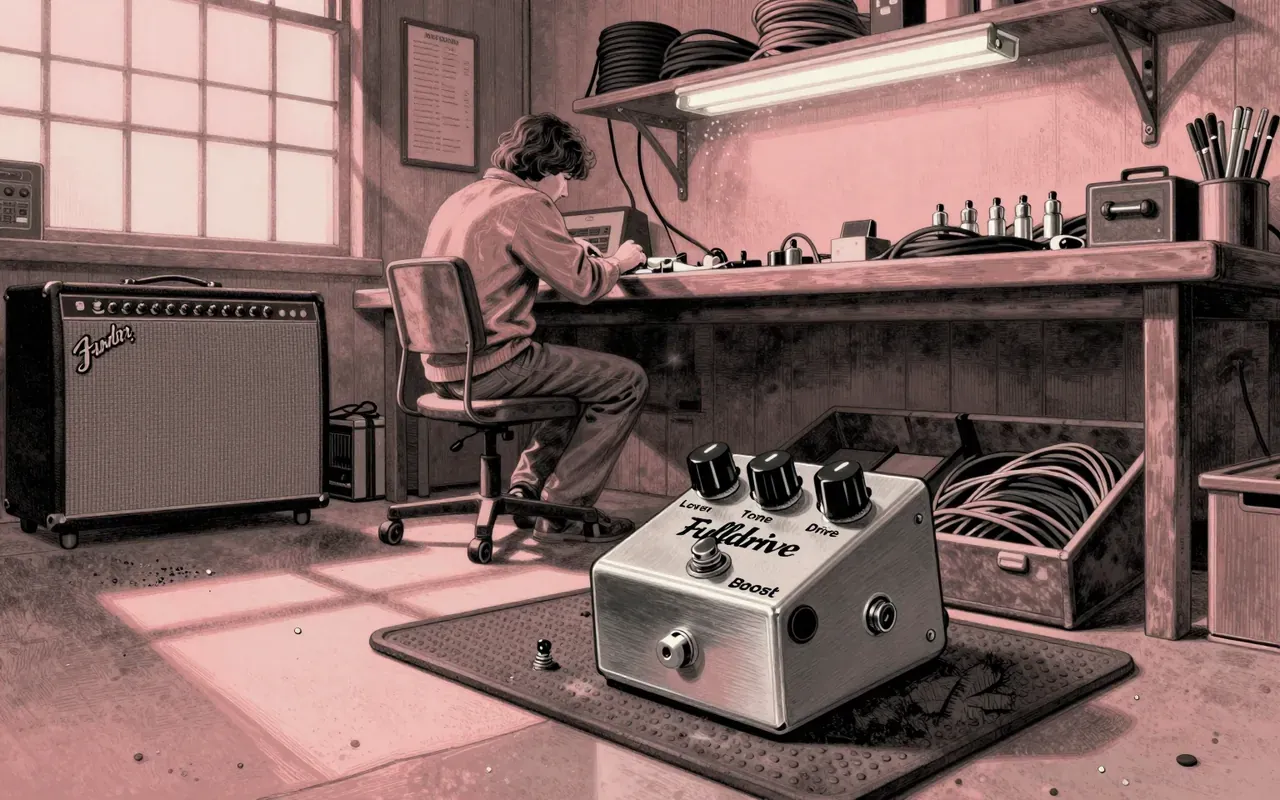
It has four knobs: Level sets output volume, Tone shapes tonal character, Drive controls overdrive intensity, and Boost sets additional gain when the Boost footswitch is engaged. The main footswitch turns the pedal on or off. The Boost footswitch only works when the overdrive section is active. Two 3-way toggle switches select modes: one chooses Comp-Cut (clean boost), Vintage (mid-boosted Tube Screamer–style), or FM (flat-mids); the other selects MOSFET or Normal clipping — Normal described as more asymmetrical and open-sounding.
What it does better than anything else
It delivers three distinct, switchable tonal identities — clean boost, mid-boosted overdrive, and flat-mid transparency — all from one hand-wired analog circuit using a JRC4558 op-amp. Its dual-clipping toggle (MOSFET/Normal) gives immediate access to two fundamentally different saturation textures in one box.
What it does badly
It cannot deliver boost without overdrive engaged. Its non-rackable foot-pedal format excludes studio rack integration. It offers no buffered bypass, no expression input, no preset storage, and no external control options.
What people made with it
The sources do not state what people made with it.
Who should use it, and who should not
Guitarists who prioritise hands-on, real-time tonal switching and value analog signal path integrity should use it. Players who need silent true bypass, MIDI control, or standalone boost functionality should not.
Is it worth your time
Yes — if you need a single analog overdrive/booster with switchable voicings and a dedicated, context-dependent boost. No — if you require independent boost functionality, digital features, or rack-mounting.