What it is and what it was built for
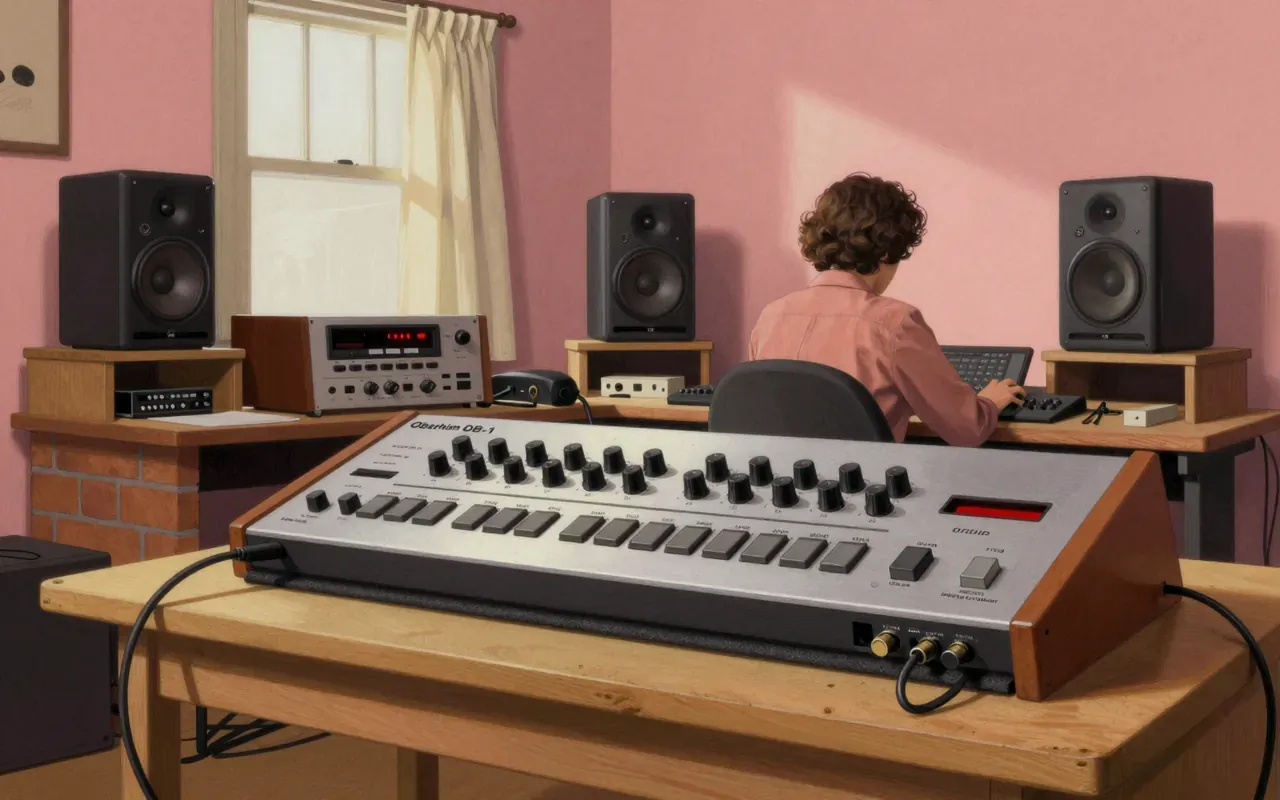
The OB-1 is a monophonic analog synthesizer introduced in late 1977. It was built as a live-performance replacement for SEM-based instruments, using programmability to eliminate manual patching between sounds.
How it works, in terms a player would use
Two VCOs offer pulse or saw waveforms, each with continuous waveform control from square to narrow pulse, or triangle to sawtooth. A switchable 2- or 4-pole VCF shapes tone. Two ADSR envelopes—one for the filter, one for the VCA—control dynamics and timbre. Eight program memories store and recall full sound settings.
What it does better than anything else
It stores and recalls full analog sound settings faster and more reliably than any prior monosynth. It was the first to do so—making live setlist changes practical without rewiring or knob-twisting.
What it does badly
It does not play chords. It offers no modulation matrix, no LFO, no velocity or aftertouch response, and no patch editing while playing. Its eight memories are fixed—not expandable, not editable mid-performance.
What people made with it
The sources do not state what people made with it.
Who should use it, and who should not
A performer who values preset recall over polyphony or modulation depth. Not for producers needing layered textures, sequenced automation, or modern workflow integration.
Is it worth your time
Yes—if you need programmable monophonic analog synthesis with immediate waveform and filter control. No—if you need polyphony, real-time modulation routing, or more than eight presets.