audiobriefs
Instruments

Synths & drum machines

242
briefs
9:16
average
2243 min
in total
41
people
All briefs242
7:48

Nord Lead 2

Clavia

The Nord Lead 2 was launched by Clavia in 1997, two years after the original Nord Lead. It raised polyphony from four voices to 16 and added a ring modulator, a sine waveform on oscillator 1, filter distortion, four individual outputs, more patch storage and a PCMCIA slot. A refreshed Lead 2X followed in 2003 on the same synthesis engine.

9:24

Virus B

Access · 1999

The Virus B is a virtual analog synthesizer from Access Music GmbH of Germany, released in 1999 as the follow-up to the Virus A. It is a desktop (rackable) module without a keyboard, with improved converters and expanded polyphony. It has two filters per voice and a modulation matrix, and a keyboard version was sold as the Virus KB.

9:57

Doepfer A-110 VCO

Doepfer

The Doepfer A-110 Standard VCO is a generator module for modular synthesizers in the A-100 series. It outputs saw, pulse, triangle, and sine waveforms simultaneously. Octave switching and ±1 semitone fine tuning set pitch range. Manual and CV-controlled pulse width modulation are available. A Sync input allows hard-syncing to another VCO. It lacks FM, LFO-range operation, and tuning beyond ±1 semitone.

10:34

Doepfer A-120 VCF

Doepfer

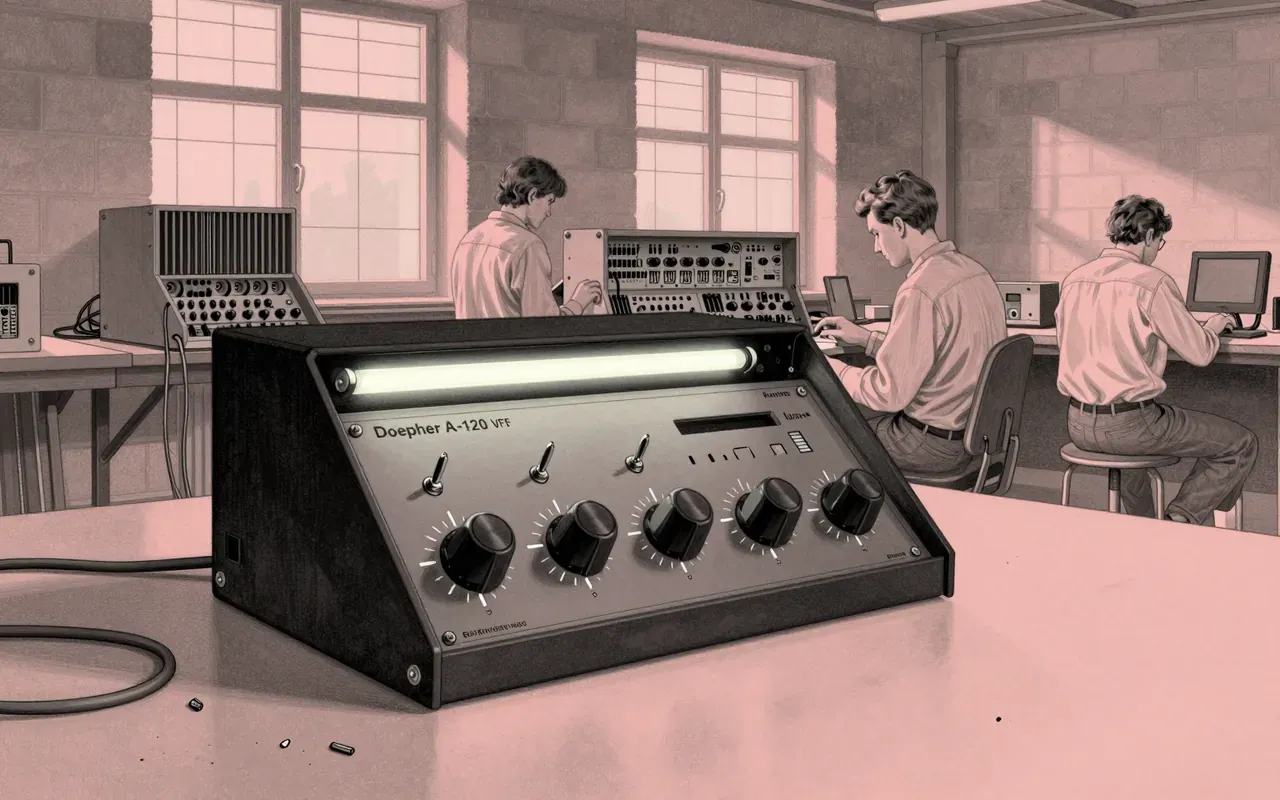
The Doepfer A-120 is a Eurorack filter module built to replicate the Moog 24dB low pass filter. Five potentiometers control cutoff, resonance, input level, and two CV amplitudes. Three CV inputs allow layered, complex modulation. It delivers Moog-like saturation and character at low cost. It offers no multimode filtering, no self-oscillation feedback control, and no visual indicators for resonance peak or clipping. Use it for warm, resonant, hands-on low-pass filtering in modular systems. Avoid it if you need versatility beyond 24dB low pass.

7:50

Doepfer A-140 ADSR

Doepfer

The Doepfer A-140 ADSR is a basic ADSR envelope generator for the A-100 modular system. It has no published specs. It has no CV inputs. It has no visual indicators. It does one job, simply.

8:32

Roland CompuRhythm CR-68

Roland

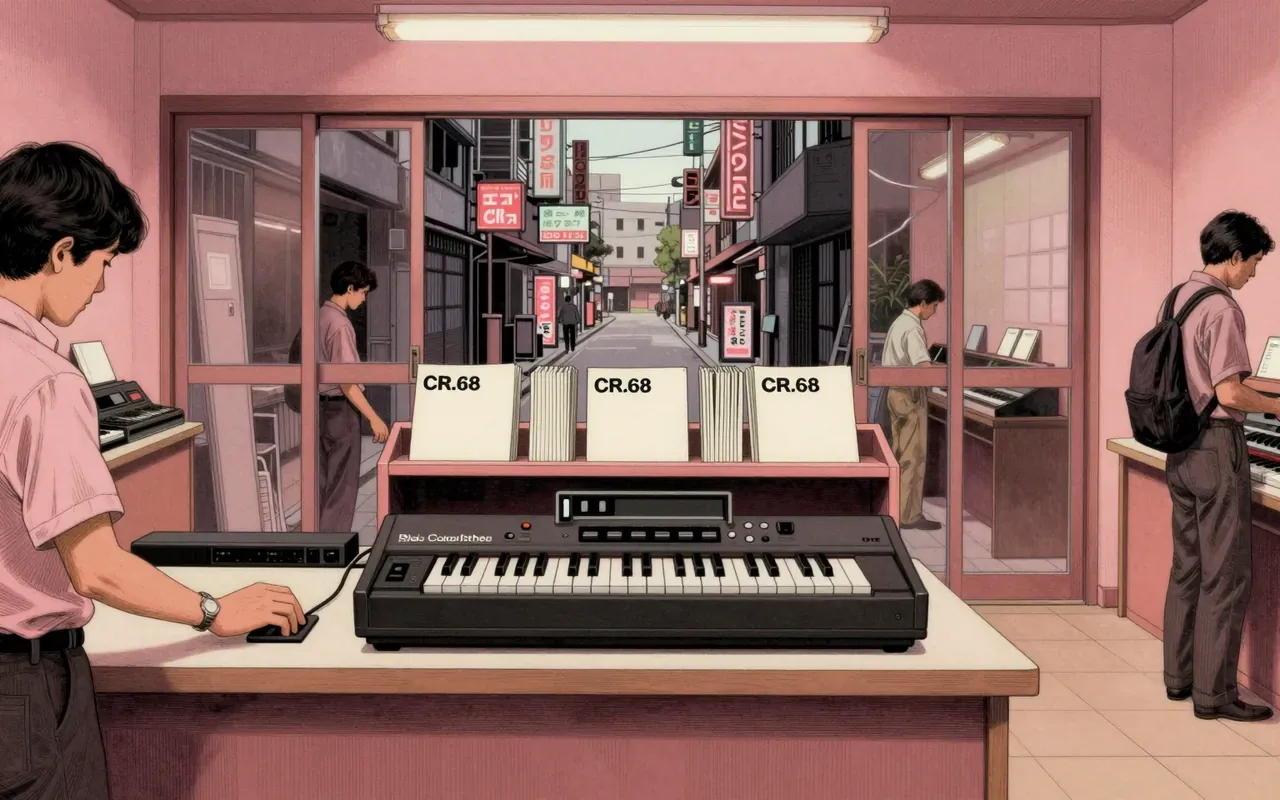
The Roland CR-68 is a non-programmable mono analog rhythm machine from the late 1970s. It shares the CR-78’s sound set and 54 preset rhythms but removes all user programming. Its controls — tempo, level, accent, balance — shape playback in real time. Fills trigger automatically or manually. It has no MIDI, no keyboard, no memory. Its sounds are now more often sampled than played live. Add N To (X) used it.

9:00

Roland CompuRhythm CR-8000

Roland

The Roland CR-8000 is a non-editable analog drum machine from 1980/81. It gives you 13 fixed drum sounds, one mono output, eight user-programmable patterns, and a unique groove knob that alters timing and timbre simultaneously — especially in the hi-hats. That groove cannot be sampled. Everything else is compromised: the sequencer is poorly programmed, the control panel fails under external use, and there are no built-in effects. Artists including Fluke, BT, Jimmy Edgar, and Blondie used it. It belongs in a collection, not a production chain.

8:02

Roland Juno-2 / Alpha Juno-2

Roland

The Roland Juno-2 (Alpha Juno-2) is an 80s hybrid synth: analog filters and voice path, digital control over oscillators, envelopes, LFO, PWM, and chorus. It has 64 factory and 64 user patches, a velocity-sensitive 61-key keyboard, and a single digital wheel for editing. It lacks computer update capability and rack-mounting. Real-time sound switching is slow. It was built for studio use — not live performance.

8:32

Roland MKS-70 Super JX

Roland

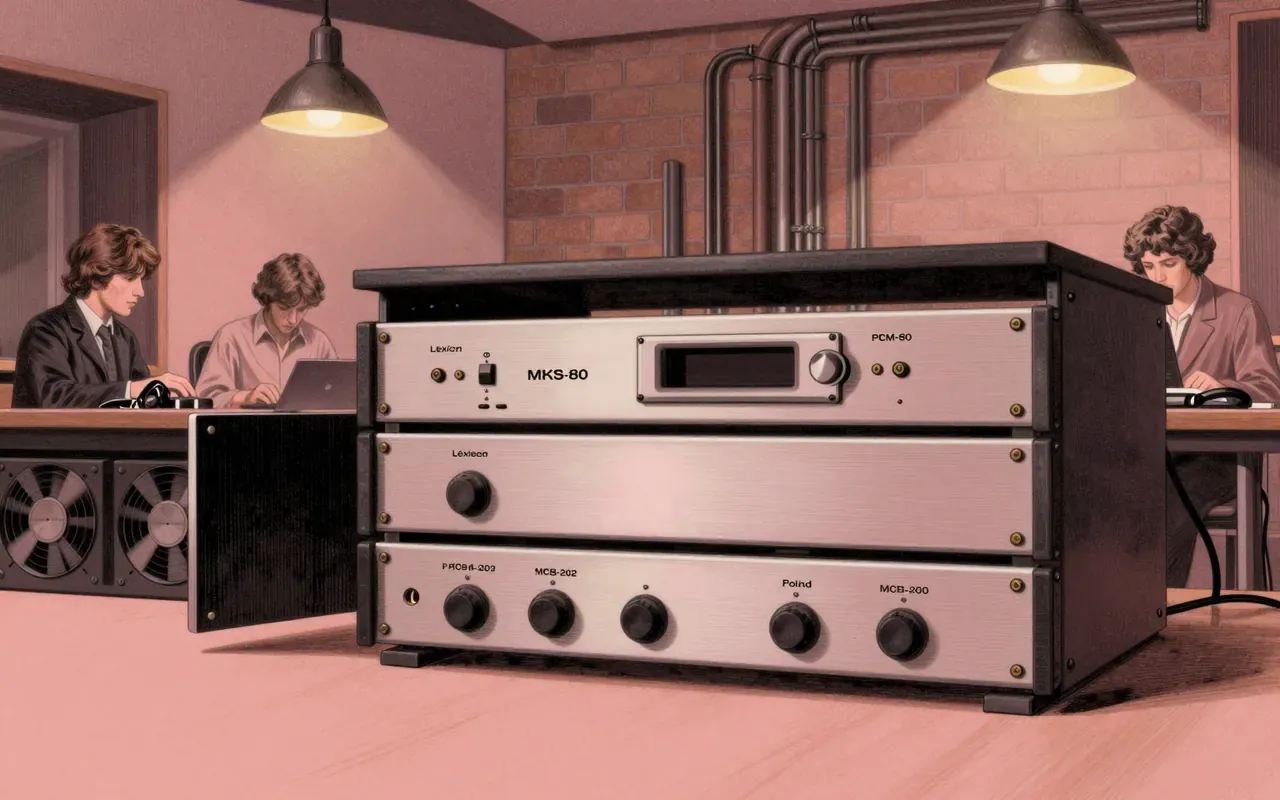
The Roland MKS-70 is a 1986 2U rack-mount analog synthesizer module. It combines two JX-8P engines for 12-voice polyphony and dual-tone layering. It stores 100 patches, each built from two of 64 tones. Chorus has only off/slow/fast settings. Chase-play enables delayed voice repeats. Front-panel editing is cumbersome and tedious. Full SysEx control and PC editing require firmware v1.08. It has three stereo outputs: one per tone and one mix. It lacks arpeggiator, sequencer and keyboard.

8:43

Roland Alpha Juno-1

Roland

The Roland Alpha Juno-1 is a 1986 6-voice analog synth built for techno and rave. It delivers sharp bass and noise, improved MIDI, and chord memory — but sacrifices warmth and hands-on editability.

8:33

Roland Alpha Juno-2

Roland

The Roland Alpha Juno-2 is a 1986 6-voice subtractive synth with velocity and aftertouch, 64 presets, 64 user patches, chord memory, portamento, transpose, and a 24dB analog low-pass filter. It uses membrane buttons and the Alpha Dial for editing. It was built for stage and studio bass and rhythmic work — not for deep, fast sound design.

9:04

Yamaha AN200

Yamaha

The Yamaha AN200 is a 2001 compact table-top physical modelling analog synthesizer and sequencer built for live pattern-based dance production and quick sound sketching.

8:56

Elektron Analog Four

Elektron

The Elektron Analog Four is a tabletop groove machine with four mono analog synth voices, each with two analog oscillators, a 1-pole analog lowpass ladder filter, and a 2-pole analog multi-mode filter. It includes a 6-track MIDI sequencer and two audio inputs and outputs—but no digital connections.

9:17

Elektron Analog Rytm

Elektron

The Analog Rytm is a true analog drum synth. It gives each voice its own engine, up to six oscillators, and a 16-step sequencer. Its pads are velocity-sensitive but small. It enables radical timbral shifts across voices with minimal changes. It falls short on pad ergonomics, stereo per voice, and external audio input. It belongs in the studio of a sound designer—not a live beatmaker.

8:31

Akai ASQ-10

Akai

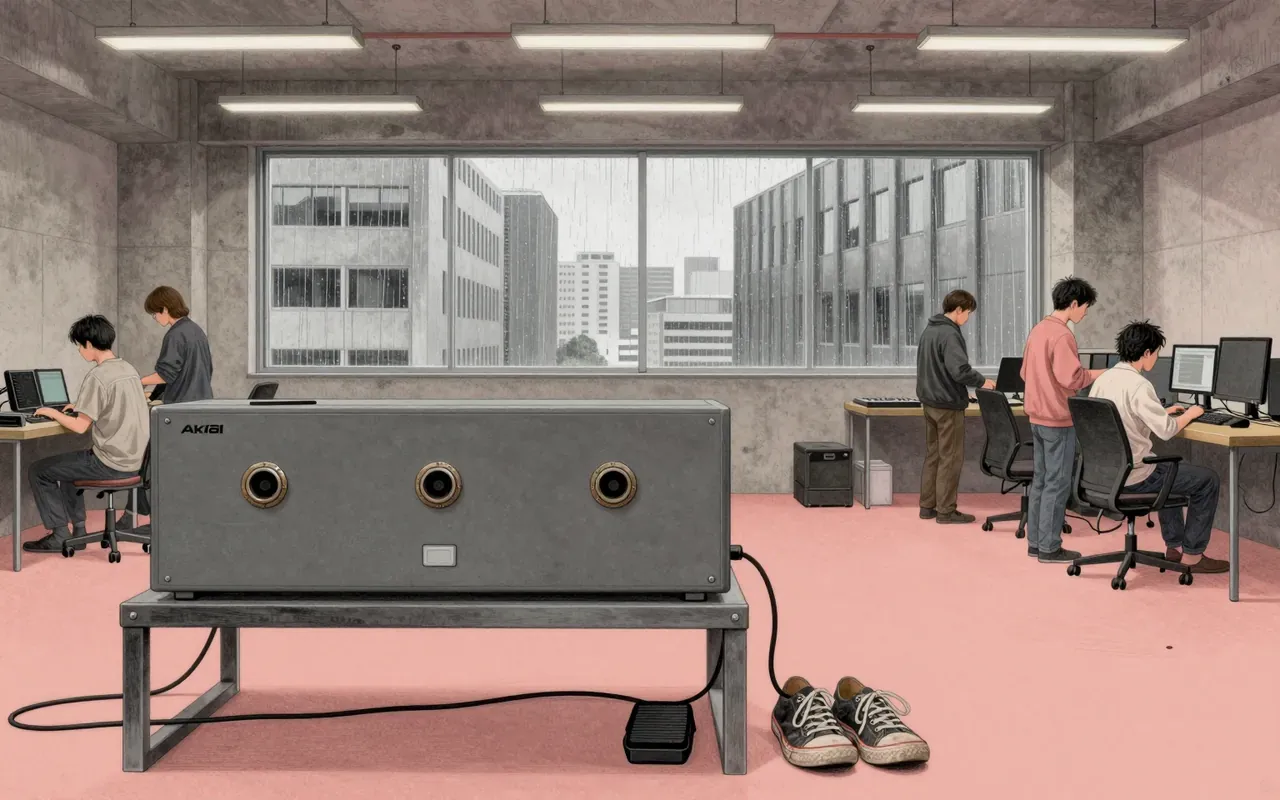
The ASQ-10 is a sequencer-only instrument. It has no sound generation. It does not sample. It exists solely to trigger, time, and lock external gear. Its design enables rhythmic complexity unplayable by hand — then corrects timing drift across the chain. It is the first MPC-shaped workflow, before the MPC existed.

8:24

Sequentix Cirklon

Sequentix

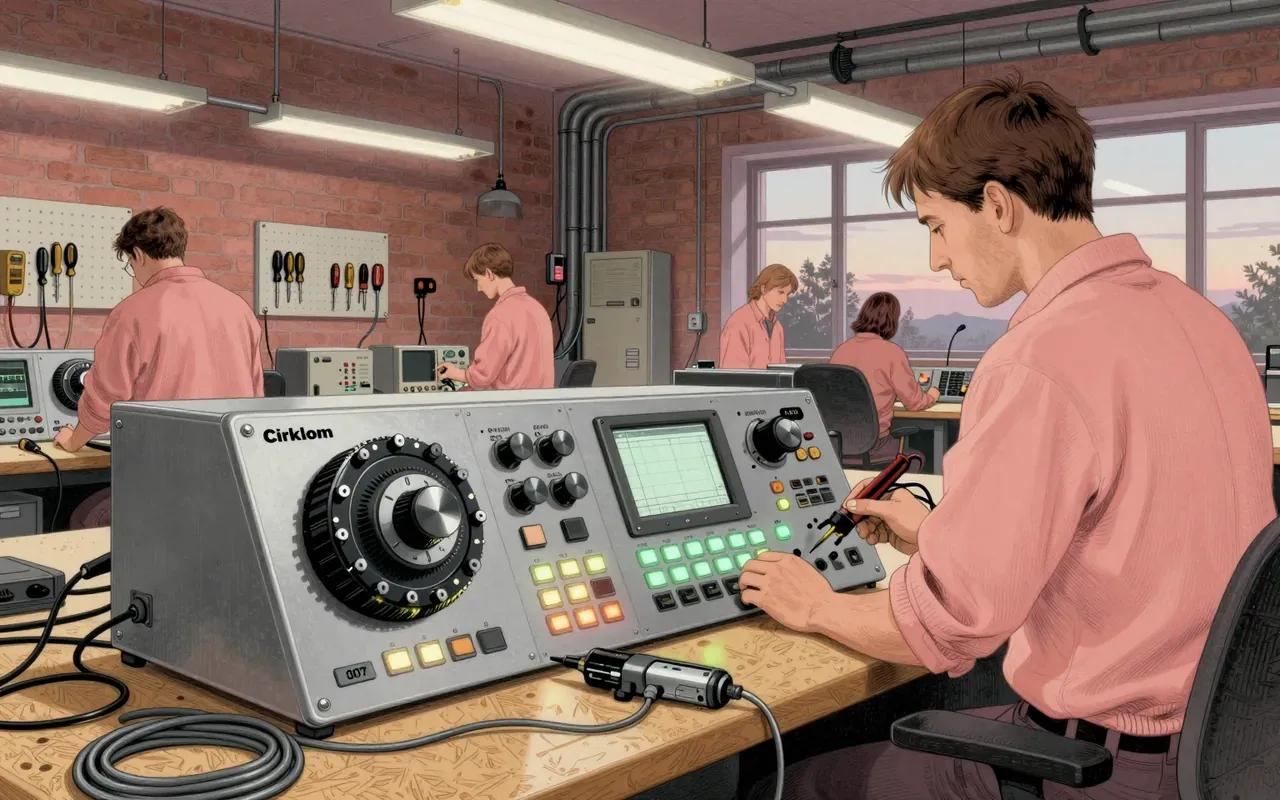
The Cirklon is a hardware sequencer. It outputs MIDI, audio (HP), and optionally CV/Gate. It produces no sound. Its clock accuracy and track synchronisation are exceptional. All data saves to flash memory and survives power failure. It operates in step and real-time modes, organising music into SONGs and SCENES.

8:32

Yamaha CS-30

Yamaha

The Yamaha CS-30 is a monophonic analog subtractive synthesizer introduced in 1977. It has two VCOs, two resonant VCFs, two VCAs, three envelopes, a ring modulator, external audio triggering and an 8-step sequencer. It has a 44-key keyboard. It lacks onboard effects, memory and MIDI. It is used by 808 State.

9:01

Yamaha CS-5

Yamaha

The Yamaha CS-5 is a 1978 monophonic analog synth with one oscillator, a multi-mode 12 dB/Oct filter, and an LFO with sample-and-hold. It has no patch storage, no MIDI, no velocity sensitivity. It is built for immediacy — not recall.

8:33

Yamaha CS-50

Yamaha

The Yamaha CS-50 is a 4-voice, 49-key, pressure-sensitive synthesizer released in 1977. It visually resembles a scaled-down CS-80, weighs about 100 pounds, and shares the CS-series sound — but with thin chords (one oscillator per voice, 12 dB/oct filters), no user memory, and unstable tuning.

9:26

Yamaha CS-60

Yamaha

The Yamaha CS-60 is a polyphonic analog synthesizer released in 1977. It is smaller and cheaper than the CS-80. It lacks polyphonic aftertouch.

8:48

Roland D-10

Roland

The Roland D-10 is a 1988 digital synthesizer using LA Synthesis. It has 61 keys and 32-voice polyphony. It is available as both a keyboard and a rack module. Factory sounds are basic and dated. Editing is required to achieve usable tones. It includes built-in sequencing and nine-part multitimbrality. Onboard effects are limited.

9:20

Roland D-110

Roland

The Roland D-110 is a 1988 rackmount sound module — the upgraded rack version of the D-10 and rack counterpart to the D-20. It delivers Linear Arithmetic synthesis, second-generation D-50 style, using tones, partials, and timbres. It has 32-voice polyphony, on-board drum sounds, reverb, internal/external memory, and six individual outputs. It requires external MIDI control. Programming is tricky but yields characteristic LA textures. Its filter resonates but does not self-oscillate. It is a cheaper alternative to the D-50, offering decent acoustic and synthetic sounds — but no keyboard, no sequencer, and no intuitive interface.

9:56

Roland D-20

Roland

The Roland D-20 is a 1988 digital synthesizer using Linear Arithmetic synthesis. It offers 32-voice polyphony, 8-part multitimbrality, a 61-key velocity-sensitive keyboard, an 8-voice sequencer with rhythm track, a built-in arpeggiator, reverb effects, and internal/external memory storage. LAS programming revolves around tones, partials, and timbres—a method that is difficult to learn but capable of unique results when mastered. It was produced from 1988 to 1992.

7:57

Doepfer Dark Time

Doepfer

The Doepfer Dark Time is an analogue sequencer released in 2010. It has no sound module. It controls external gear via CV/Gate, MIDI, and USB. It sequences either 16 steps on one channel or 8 steps across two channels. Real-time knob control covers transposition, note skipping, and playback alternation. Firmware 1.10 resolves bugs present in earlier versions.

9:25

Korg Delta

Korg

The Korg Delta is a 1979 analog semi-polyphonic string machine and synthesizer. It was built as a slimmed-down, budget alternative to the Korg Trident. It splits into two independent sections—Strings and Synth—with dedicated outputs. The String section uses two pitch sliders and tone/ADSR controls. The Synth section uses four pitch sliders, white noise, a multimode 24dB/oct filter, and full ADSR. A joystick provides pitch bend and modulation. It has CV/gate connectivity but no memory, no MIDI, and no presets. Its 'unlimited polyphony' is inaccurate: pressing multiple keys does not apply independent envelopes to each note. It delivers high-quality layered string-and-synth sounds despite limited range. Its build is robust, but its keyboard is fragile and its filter is bland.

9:22

Make Noise DPO

Make Noise

The Make Noise DPO is a dual-oscillator Eurorack VCO built for FM synthesis and wavefolding. It produces deep, rich FM-type sounds using its dedicated wavefolder section. Its output is clean and cold—not Moog-style warm. It has no built-in LFO, envelope, or quantizer. It is not a full voice module. It is a precision tool for FM texture generation.

8:16

E-mu Systems Drumulator

E-mu Systems

The Drumulator is a fixed-sample, floppy-driven drum machine built to undercut the Linn LM-1 — not match it. It gives you eight gritty 12-bit hits, real-time or step sequencing, and Apple II editing. It withholds sound editing, velocity, swing, and any expansion beyond its ROM.

10:51

Yamaha DX200

Yamaha

The Yamaha DX200 is a 2001 desktop sequencer built for DJs and musicians who need FM synthesis and sample playback in one tight hardware unit. It runs a simplified 6-operator FM engine compatible with DX7 patches. It adds a real-time 16-step sequencer with four tracks, a resonant multi-mode filter — absent in all classic DX synths — and bundled software editing tools. It does not offer deep FM programming, internal effects, or flexible voice sharing between FM and AWM2 engines.

9:14

Yamaha DX7II

Yamaha

The Yamaha DX7 II FD Centennial is a 76-key, fully-weighted FM synthesizer released in 1987. It delivers 16-voice polyphony, a built-in sequencer and arpeggiator, and 64 user presets. Its interface is menu-driven and lacks real-time controls. It serves players who prioritise weighted-action playability and integrated sequencing over flexible sound design.

9:10

Korg Electribe 2

Korg

The Korg Electribe 2 is a groove machine in the ElecTribe series. It supports up to 250 patterns, each limited to four bars in length. It includes 32 master effects modeled after the Kaos Pad. Each track can have one individual effect selected from 38 available types. It offers 25 groove types that can be applied per track. It includes PCM-based sound sources: 56 kicks, 58 snares, 16 claps, 56 hi-hats/cymbals, 71 percussion/toms, 52 synth hits/FX/instrument hits, 16 voices, and 27 instruments. It uses synth modeling with 55 preset oscillators.

8:49

Korg Electribe EA-1

Korg

The Korg Electribe EA-1 is a compact groove machine built for quick, tactile analog sound design and live pattern-based performance.

9:03

Electribe

Korg

The Electribe is a groovebox. It forces drum, bass and synth into one pattern grid. It launched in 1999. It runs on analogue modelling and sampling. It shares sequencing logic across all sound sources. It has no audio recording. It has no expandable storage on early models. It was Korg’s post-Yamaha statement.

8:43

Korg Electribe ER-1

Korg

The Korg Electribe ER-1 is an affordable analogue beat unit. It gives bangs, buzzes, blips and spacey weird noises via four synth keys and four sampled percussion sounds. It saves up to 256 patterns, each up to 4 measures. Real-time changes — like jungle delayed drums or scratching sounds — save instantly. Its PCM sounds (Hclap, HiHat, Crash) are uninteresting. It connects via MIDI in/out/thru. Its housing is plastic.

10:42

Korg Electribe MX EMX-1

Korg

The Korg Electribe MX EMX-1 is a 2003 desktop dance production instrument built for live electronic music creation. It combines synthesis, sampling, sequencing, and effects in a single unit aimed at performers and producers who work in patterns and loops.

8:42

Korg Electribe SX ESX-1

Korg

The Korg Electribe SX (ESX-1) is a 2003 sample-based groovebox built for dance music production and live performance. It uses sample-based sound creation to generate 16 assignable parts—including nine one-shot drum parts, two keyboard parts for melodic playback, two stretch parts for tempo-adjusted loops, one slice part for rhythmic phrase division, one audio-in part, and one drum accent part. It ships with 196 preloaded samples, 128 factory patterns, and 3 demo songs. A major upgrade over earlier ElecTribe models, it offers 285 seconds of sample memory at 44.1kHz for up to 384 user samples, slicing at rhythmic peaks, Motion Sequencing for real-time parameter automation, and three stereo effects processors with chaining.

8:47

Alesis HR-16

Alesis

The Alesis HR-16 is a 1987/88 drum machine with 49 16-bit samples — 10 kicks, 7 snares, and an ethnic set — each tunable and mixable with individual level controls. It supports step or real-time pattern programming, 16-voice polyphony, and syncs via MIDI or external click. Its drum sounds are described as 'pretty cheesy'.

11:18

Kurzweil K2600

Kurzweil

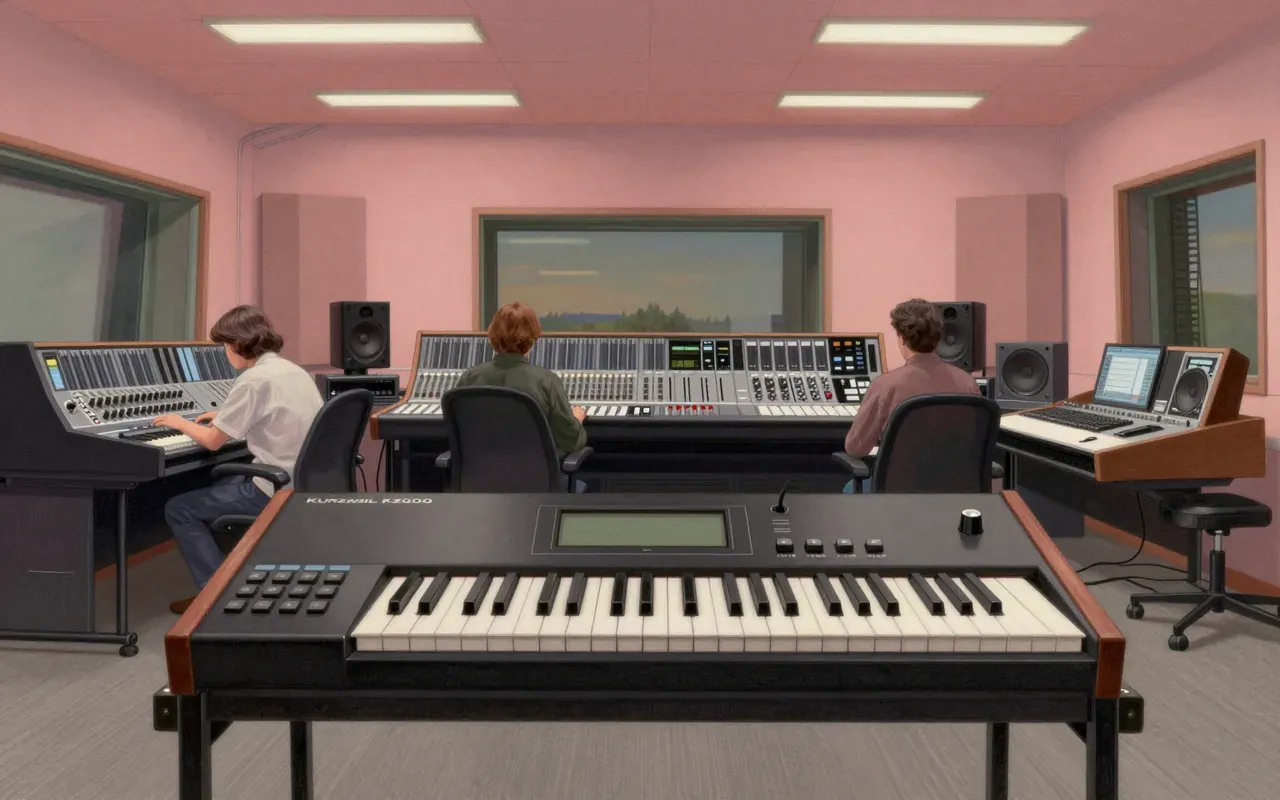
The Kurzweil K2600 is a 1999 workstation built for deep sound engineering — not quick playing. It uses V.A.S.T. synthesis with 60 DSP functions and 438 presets. It holds 12MB of sample ROM (expandable to 44MB) and 64MB of sampling RAM (expandable to 128MB). Its 32-track sequencer supports pattern, linear, and step recording, plus advanced editing. It processes external signals in real time via ADAT, TDIF, and AES/EBU — with any parameter modulating the input and 20-bit digital output. It falls short on immediacy, tactile control, and workflow clarity. It belongs in a fixed studio, not on stage or in a laptop bag.

9:04

Linn Electronics LinnDrum

Linn Electronics

The LinnDrum is a hands-on, sample-based drum machine built for studio precision — not live flexibility.

10:41

Elektron Machinedrum SPS-1

Elektron

The Machinedrum SPS-1 gives you four distinct drum synthesis methods—TR emulation, FM, SP1200/Simmons sampling, and acoustic physical modelling—all editable per voice with multimode filtering, distortion, and sample-rate reduction. Its Extended sequencer stores kits and tweaks across complex patterns; Classic mode abandons both. It delivers unmatched hybrid control—but demands patience, not immediacy.

9:13

Oberheim Matrix-1000

Oberheim

The Oberheim Matrix-1000 is a 1987 rackmount analog synthesizer. It contains 1,000 Matrix 6 patches. Each voice has two DCOs, one low-pass filter, two VCAs, three envelope generators, two LFOs and two ramp generators. Editing requires external MIDI tools. It is optimised for pads, textures and ambient sound design.

9:59

Oberheim Matrix-12

Oberheim

The Oberheim Matrix-12 is a 12-voice, 61-key, fully analog synthesizer introduced in 1985. It uses Matrix Modulation for virtual patching. Every control can affect another parameter. It provides 15 LFO types and VCAs per voice. It is more programmable and sonically fatter than the Matrix-6 and Xpander. It is not intended for beginners. It is renowned for thick analog pads, sweeps, buzzes, basses and textures—and was called the 'king of analog sounds' in the mid-eighties.

7:33

Oberheim Matrix-6

Oberheim

The Oberheim Matrix-6 is a discontinued analog synthesizer made by Oberheim. No technical details, availability or usage context are given in the source. It exists only as a named category and manufacturer claim.

8:32

Roland MC-09 PhraseLab

Roland

The Roland MC-09 PhraseLab is a compact sampling sequencer built as a simplified, budget counterpart to the MC-909. It integrates monophonic synthesis, a TB-303–style 2×16-step sequencer, and a 4-track looper/sampler. Its sampler sounds like an 8bit unit and introduces audible crackle when tempo changes. It supports only four independent audio loops. Its monophonic synth produces FAT acid bass and lead tones. It is suited for live phrase capture but limited by low screen clarity, slow sample loading, and constrained user memory.

7:34

Mellotron Mellotron M400

Mellotron

The Mellotron M4000D Mini is a digital sampling synthesizer released in 2013. It uses a Fatar keybed and delivers 24-voice polyphony. It replaces tape mechanics with sample playback. It offers consistency, portability, and reliability — at the cost of mechanical character.

8:30

Waldorf Microwave XT

Waldorf

The Waldorf Microwave XT is a 1998 rackmount synthesizer using digital wavetable and FM synthesis, featuring 44 real-time control knobs, 20-bit DSP functions, and 10-voice polyphony expandable to 30; it shares its engine with the Microwave II and Wave synths, excels at emulating PPG sounds and generating acid or Moog-style bass, and includes onboard arpeggiator, digital effects, and MIDI-transmitting knobs.

8:16

Make Noise Morphagene

Make Noise

The Morphagene is an effects module for modular synthesizers made by Make Noise. It belongs in the 'Effects modules for modular synthesizer' category. It does not function as a sampler, sequencer, or DAW plugin — it transforms audio live using tape-style operations. Its design gives immediate, irreversible, hands-on manipulation. It withholds saving, syncing, and visual feedback.

10:56

Akai MPC1000

Akai

The MPC1000 delivers the MPC workflow in a smaller, cheaper, more portable form. It adds six outputs, built-in effects, and memory expansion over the MPC2000 — while storing samples as WAV and sequences as MIDI on CompactFlash. Build quality is reduced, but sound quality is preserved. It is a sampling and sequencing instrument — not a synth, not a DAW, not a controller.

9:39

Akai MPC500

Akai

The MPC500 is Akai’s entry-level sampling sequencer—a portable, self-contained beat-making station built for quick capture, arrangement, and performance.

8:50

Korg MS-50

Korg

The Korg MS-50 is a 1978 keyboard-less analog expander module. It has one VCO, two VCFs (highpass and lowpass), two ADSRs, an LFO, pink and white noise, ring modulator, voltmeter, and sample & hold. It uses Hz/V CV/Gate control and was designed to complement the SQ-10 sequencer.

7:30

Roland MSQ-100

Roland

The Roland MSQ-100 is a sequencer with no documented technical specifications. It exists only as a named object with alternate spellings. Nothing is verified about its function, capacity, interface behaviour, or sonic role.

9:01

Buchla Music Easel

Buchla

The Buchla Music Easel is an analog synth with no technical specifications. That is all that is verified.

10:47

Roland MV-8800

Roland

The Roland MV-8800 is a sampling sequencer. It hosts VSTs internally. It requires external video monitoring. It accepts a USB mouse. It is complex. Its hard drive is slow. Its manual is poor. One user tested it for three hours in a retail store and found it capable of handling many music production tasks.

9:36

Sequential Circuits Prophet-10

Sequential Circuits

The Prophet-10 is two Prophet-5s stacked into one instrument. It delivers ten-voice analog thickness no other 1980 synth matches. But it overheats, detunes, and demands physical and technical concessions. Version 3 fixes stability with CEM chips — at the cost of low-end weight.

8:44

Sequential Circuits Prophet-600

Sequential Circuits

The Prophet-600 is a 1982 6-voice analogue synth. It introduced MIDI to commercial instruments. It gives players two oscillators per voice with sync, variable pulse, and triangle/saw waveforms. Its VCF, VCA, and Poly-Mod come from the Prophet-5. It includes an arpeggiator and 2-track sequencer. It glides. It modulates flexibly. It does not track reliably over time. It has no velocity or aftertouch. It is not expandable. It belongs in rooms where history and immediacy matter more than precision.

8:16

Sequential Circuits Prophet-T8

Sequential Circuits

The Prophet-T8 is an 8-voice analog polysynth released by Sequential Circuits in 1983. It features digital control of analog sound, a 76-key weighted keyboard with velocity and aftertouch, full MIDI implementation, split/layer/double/unison modes, and a real-time sequencer. Its tone resembles the Prophet-5. It was Sequential’s finest analog synthesizer—but faced commercial pressure from the Yamaha DX7.

8:40

Korg PS-3100

Korg

The Korg PS-3100 is a rare (600 units), 30kg, 48-voice analog synthesizer from 1977. It uses 12 divide-down VCOs to drive 48 independent voice circuits — one VCO, VCF, VCA and EG per key. Its warm LPF and 3-band resonator enable rich formant and phase effects. LFO1 reaches audio rate and delivers AM up to ring modulation. One EG is polyphonic; the other is universal and paraphonic. Twelve intonation scaling controls allow non-equal-tempered tuning. It has no patch memory.

9:48

Korg PS-3200

Korg

The Korg PS-3200 is the final model in Korg's PS series. It integrates two PS-3100 units into a single chassis. It provides 16 memory locations that can be individually addressed and recalled. It was regarded as remarkable in its era due to having two oscillators per key and 48-note polyphony. Each voltage-controlled oscillator module includes a dedicated voltage-controlled filter and low-frequency oscillator. Its patching and signal routing capabilities were comparatively restricted versus other modular systems. Its envelope generator design was constrained. It was considered sonically rich for its era, and its 16-patch memory was highly valued.

8:12

Make Noise QMMG

Make Noise

The QMMG is a filter module for modular synthesizers. That is all the sources confirm. It is made by Make Noise. It belongs in the category 'Filter modules for modular synthesizers'. Nothing else is verified.

8:27

Yamaha QY70

Yamaha

The Yamaha QY70 is a 16-track MIDI sequencer with AWM2 synthesis, 519 voices, 20 drum kits, and XG editing for ADSR, cutoff, and resonance. It runs two hours on batteries. Its screen is Game Boy–sized. It is portable, self-contained, and limited to MIDI — no audio I/O, no extended runtime, no large interface.

9:55

Roland R-70

Roland

The Roland R-70 is a 1992 full-sized, sample-playback drum machine from Roland’s R series. It offers up to 210 drum sounds across Rock, Jazz, Electronic, and Ethnic kits. It stores 100 programmable patterns and chains them into 20 songs. Its positional pad changes sound by strike location. It includes reverb, flanger, delay, chorus, and humanization. Sound editing is limited to attack, sustain, and pan. Its built-in sequencer is complex—users prefer external sequencing. Kick and cymbal sounds emulate the TR-808. It is a popular, all-purpose drum machine.

8:27

Korg Rhythm 55 KR-55

Korg

The KR-55 is a fixed-rhythm drum machine from 1979. It plays 48 preset patterns across genres including Waltz, Samba, Rhumba, Bossa Nova, Tango, Slow Rock, Swing, and Rock. It uses sample-based synthesis for 12 drum tones. It has individual level controls per drum sound per pattern. A dedicated swing knob alters groove feel. A footswitch jack enables external Start/Stop and Intro/Fill control. It has no keyboard, no pattern editing, no MIDI, no sync outputs beyond footswitch, and no individual drum outputs.

8:51

Mutable Instruments Rings

Mutable Instruments

Rings is an 'other module for modular synthesizer' made by Mutable Instruments. That is all the source confirms. It is not described as a resonator, a physical modeller, or a filter. It is not assigned a year, format, or synthesis method. Its role is defined solely by its category and manufacturer.

10:40

Yamaha RS7000

Yamaha

The Yamaha RS7000 is a 2001 groove production workstation. It combines sampling, sequencing, and AWM2 synthesis. It embeds sound and sample edits into patterns. It supports auto-beat slicing, pattern- and linear-based sequencing, and ROM-based sounds only.

9:55

Yamaha RX11

Yamaha

The Yamaha RX11 is a 1984 digital drum machine using 29 fixed 8-bit PCM samples. It was built to accompany the DX7. Each sound has independent volume, pan, and a dedicated audio output. Its interface is laborious. Its sound is synthetic and dated — yet valued in electro and downtempo for its unvarnished 1980s character.

8:35

Yamaha RX21

Yamaha

The Yamaha RX21 is a fixed-function drum machine. It plays 100 preset patterns and 5 song sequences. It has stereo and headset outputs, plus a footswitch input. Its operation is intuitive and manual-free. Its sound is basic, loop-based, and dynamically flat—characteristic of early 1980s beatboxes.

7:59

Yamaha RX7

Yamaha

The Yamaha RX7 is a sample-based drum machine built for live trigger-based rhythm programming and studio sketching in the mid-1980s.

7:25

Casio RZ-1

Casio

The Casio RZ-1 is a 1986 drum machine built for fast, physical beat-making — not pristine sound. It gives you twelve basic PCM drums, four lo-fi sample slots (0.2 seconds each at 20kHz), tone-only editing, 100 patterns, 20 songs, and ten discrete outputs with volume sliders. It does not do fidelity, flexibility, or effects. It does do immediacy, separation, and constraint-as-creative-tool.

8:53

Akai S6000

Akai

The Akai S6000 is a 1999 rack sampler. It supports up to 256 MB RAM, optional SCSI hard drives, virtual hard disk sampling, and remote operation via detachable RS-232 screen. Its 26 filter types and extensive modulation routing enable synthesis from single-cycle waveforms. OS 2.14 resolved major bugs in OS 1.0. It includes a large built-in sound library.

6:57

Manikin Electronic Schrittmacher

Manikin Electronic

The Schrittmacher is a sequencer made by Manikin Electronic. No technical specifications are available. That is all that is known.

8:37

Roland SH-2

Roland

The Roland SH-2 is a monophonic analog synthesizer introduced in 1978. It has two detunable VCOs, a resonant self-oscillating 24dB lowpass filter, one envelope, one LFO, and a 3-octave keyboard. Its one-button-one-function interface is simple and effective. It produces fat, aggressive, authentic vintage analog tones—especially when the oscillators are detuned. It shares sonic traits with the SH-101 but adds detunability and thickness. It is flexible enough for punchy basses, leads and squelchy sounds. Every sound—including drums—has been made on it in at least one documented case. It is simple, programmable, and sonically aligned with Roland’s high-end SH series.

8:16

Roland SH-2000

Roland

The SH-2000 is a 1973 monophonic analog preset synthesizer. It is Roland’s second synth and a simplified version of the SH-1000. It was built for home organists needing expressive, portable tone colour without synthesis theory.

8:42

Roland SH-5

Roland

The Roland SH-5 is a monophonic analog synthesizer introduced in 1976. It has two VCOs, two LFOs, two multi-mode filters, two VCAs, a 5-source mixer, stereo panning, portamento and ring modulation. It is no longer manufactured. No technical specifications are available.

10:54

Roland SH-7

Roland

The Roland SH-7 is a 1978 duophonic analog synthesizer built to expand on the SH series with greater flexibility and sonic aggression.

10:32

Radikal Technologies Spectralis

Radikal Technologies

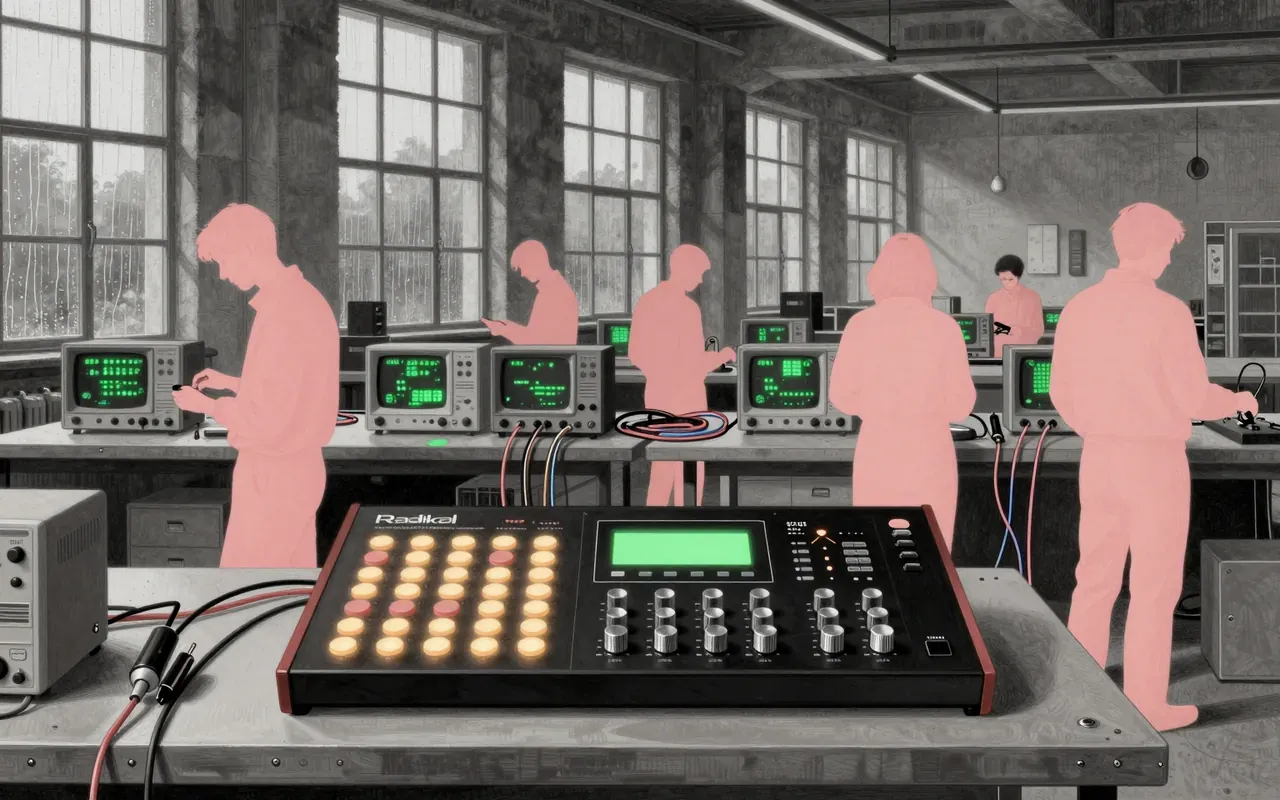
The Spectralis is a 2004 hybrid instrument built for studio composition. It combines a monophonic Asynth (four digital oscillators, two analog filters, time linearity modulation) with a 32-voice, 3-part multi-timbral Dsynth engine (128 MB RAM, unrestricted sample import). Its sequencer ties both engines and external gear together with per-parameter automation. It has no audio interface, no velocity-sensitive Dsynth layers, and no DAW integration. It belongs in a production room — not on stage.

10:18

Alesis SR-16

Alesis

The Alesis SR-16 is a 1990 drum machine built for immediacy: twelve velocity-sensitive pads, four outputs, and step editing deliver fast, routable, mechanical rhythm tracks. Its Dynamic Articulation varies tone with hit strength. Its 233 samples sound distinctly synthetic—not acoustic, not modern. It was used by Autechre and Vangelis. It has no swing, no audio input, no built-in effects beyond reverb on some samples. It remains valuable for hands-on pattern building and discrete signal routing—but only if that’s what you need.

9:33

Yamaha SU700

Yamaha

The Yamaha SU700 is a 1998 all-in-one sampler/sequencer music production studio designed for dance music creation.

9:45

Novation Super Bass Station

Novation

The Novation Super Bass Station is a 1997 monophonic desktop synthesizer built to emulate Roland and Moog bass synths. It adds separate ADSRs for filter and amplitude, key follow, an SH-type sub oscillator, noise generator, ring mod, true mixer, distortion, stereo chorus, panning, two LFOs, arpeggiator with clock out, slide function, and 200-patch memory. It delivers focused, hands-on bass synthesis—but only one note at a time.

7:49

Sequential Circuits TOM

Sequential Circuits

The Sequential Circuits TOM is a 1985 drum machine that treats eight digitally recorded drum sounds as raw material—not fixed instruments, but malleable elements. It excels at per-voice tuning, layering, reversal, and spatial placement. It falls short on sonic range, documentation, and acoustic verisimilitude. It belongs in the studio of someone who composes with constraints, not presets.

9:19

Roland TR-626

Roland

The TR-626 is a 1987 digital drum machine. It upgrades the TR-606 and TR-505 with 12-bit sampled sounds, individual tuning and mixing, eight outputs, a basic sequencer (48 preset + 48 user patterns), a TR-505–style matrix display, and strong MIDI implementation. Its samples are drab and low-quality. Its routing and MIDI are its strengths.

9:32

Yamaha TX816

Yamaha

The Yamaha TX816 is a 1984 rack-mount FM digital synthesizer system composed of up to eight TF1 modules. Each TF1 is a 16-voice, 6-operator FM engine. Together they provide up to 128 voices and 48 operators, with 8-part multitimbrality. It has independent audio and MIDI I/O per module. It has no built-in stereo mix output. It was designed for live performance requiring portability, high polyphony, and multiple discrete outputs. It is fully compatible with other DX synthesizers and the FM7 software plug-in.

8:31

Akai XR10

Akai

The Akai XR10 is a budget drum machine released in the early nineties. It plays fixed PCM drum sounds from ROM. It has four modes, no backlight, no MIDI Thru, no internal amp or speakers. It is simple, stable, and silent until patched out.

9:21

Waldorf XTk

Waldorf

The Waldorf MicroWave XTk is a 1998 wavetable synthesizer. It has 10-voice polyphony. It uses a 44-key semi-weighted keyboard. It includes a built-in arpeggiator. It is multitimbral.

9:45

Roland XV-5080

Roland

The Roland XV-5080 is a 2000 rack-mount sound module built for studio composers needing stereo sample playback, deep modulation via Matrix Control, and expandability through SRX and SR-JV80 boards. It reads Akai S1000 and Roland S-700 CD-ROMs via SCSI, supports up to 128MB of sample memory, and includes COSM effects and digital outputs — features the XV-3080 lacks. It offers no keyboard, no sequencer, no USB, and demands physical navigation. It belongs in a fixed studio with legacy hardware — not on a laptop stand.

9:51

Yamaha YC-45D

Yamaha

The Yamaha YC-45D is a 1976–1980 hybrid organ-synthesizer. It combines drawbar organ, transistor organ, piano, harpsichord, distortion and a 3-octave ribbon synth. Its lateral per-note vibrato/bend is unmatched for its time. Its preset system is rudimentary. Its ribbon lacks visual pitch reference. Its emulations are shallow. It belongs in a room where articulation matters more than fidelity.

8:49

Tiptop Audio Z-DSP

Tiptop Audio

The Z-DSP is an effects module for modular synthesizers. Tiptop Audio makes it. That is all the source material states.

9:37

Tiptop Audio Z3000

Tiptop Audio

The Z3000 is a generator module for modular synthesizer. That is all the source states. No specifications. No context. No function described beyond its category. It cannot be evaluated, compared or used meaningfully from the information given.

10:09

Alesis Andromeda A6

Alesis

The Alesis Andromeda A6 is a 16-voice, 16-channel multitimbral analog synthesizer released in 2000. It combines a pure analog audio path with digital control. Its VCOs include pitch correction—a feature missing on older synths. Alesis developed a custom ASIC for it. Axel Hartmann designed it. It is high-end, innovative gear from Alesis, a company known for budget equipment. Alesis developed studio equipment during the 1990s.

9:17

ARP Avatar

ARP · 1977

The ARP Avatar was a 1977 guitar-controlled synthesizer module. It copied the ARP Odyssey’s synthesis architecture but removed the keyboard and added a 6-way fuzzbox. It required a hexaphonic pickup and pitch-to-voltage conversion. It failed commercially. Sales totalled $1 million over two years against $4 million spent on R&D and production. It contributed to ARP Instruments’ bankruptcy in 1981.

10:08

Yamaha CS-15

Yamaha

The Yamaha CS-15 is a monophonic analog synthesizer produced by Yamaha from 1979 to 1982. It features two voltage-controlled oscillators, two 12 dB/Oct multi-mode voltage-controlled filters (low-pass, high-pass or band-pass), two ADSR envelopes and a low-frequency oscillator. It also features white noise and an external-in for processing other sounds. The CS-15 offers great flexibility with various routing possibilities to the filters and envelopes. You can, for example, route VCO 1 to both VCFs and the VCFs to any of the envelopes positive or negative voltage. It's actually a duophonic / bitimbral synthesizer but you have to connect it to two separate CV/Gate controls (Hz/V like Korg synthesizers not V/Oct) to play the extra voice. In the CS series, the CS-5, CS-10, CS-30 and CS-30L were similar in sound, structure and design. The CS-5 and CS-10 had a single oscillator and one multimode filter, whereas the CS-15, CS-30 and CS-30L each had two oscillators that could be routed in various ways through two multimode filters.

9:48

Korg DDD-5

Korg

The Korg DDD-5 is documented only by two PDF files: a 3.3 MB owner’s manual and a 466.4 KB pattern chart, both published on 22 November 2017 and requiring Adobe Reader. Neither contains technical specifications, sonic description, interface details, or operational guidance. No use case, user, or creative output is stated. It is a product defined entirely by its licensing constraints and file formats — not by what it does.

9:16

Doepfer A-100

Doepfer

The Doepfer A-100 is an analog modular synthesizer system introduced in 1995. It uses 3U-height, 2HP-width modules patched with 3.5 mm leads. It established the Eurorack standard adopted by many manufacturers. It enables emulation of the Trautonium and Theremin using specific modules.

10:31

Movement Systems Drum Computer

Movement

A British drum computer from 1981–1983. It merges analogue synthesis and 8-bit digital sampling across 14 independent voices (5 digital), sequenced via CRT graphics and controlled by a Nascom 2 computer.

8:16

Yamaha DX100 (synthesizer)

Yamaha

The Yamaha DX100 is a 1986 FM synthesiser with 49 mini-keys, eight-voice polyphony, four operators per voice, eight algorithms, 192 presets, 24 RAM-storable user sounds, cassette-based patch storage, and the YM2164 chip. It was the cheapest user-programmable FM synthesiser of the 1980s.

8:50

E-mu Emulator

E-mu Systems

A foundational but bare-bones sampler that traded sonic refinement for accessibility.

8:48

Eurorack

Doepfer

Eurorack is a modular synthesizer format introduced in 1995 by Doepfer Musikelektronik. It defines mechanical, electrical and interconnection standards so modules from different makers fit the same cases and communicate reliably. It has no built-in keyboard, sequencer or interface. It demands manual patching and physical organisation. It supports deep signal routing and long-term system expansion. It is used by musicians and designers to build custom synthesis environments.

10:15

Roland JX-10

Roland

The Roland JX-10 is a 12-voice analog keyboard synthesizer introduced in 1986. It combines two independent 6-voice Tone Modules for layering and splitting. Its 76-note velocity-sensitive keyboard includes aftertouch. Internal memory holds 64 patches, each configurable as one 12-voice tone or two 6-voice tones. Original firmware lacks SysEx for Tone or Patch data—but updating it restores that capability. PWM was omitted despite existing hardware resources. Its architecture differs sonically from the JX-8P due to distinct chorus and amplifier sections.

9:10

Roland JX-3P

Roland · 1983

The Roland JX-3P is a six-note polyphonic synthesizer produced by Roland Corporation of Japan from 1983 to 1985. Its name stands for 'Programmable Preset Polyphonic'. It uses two digitally controlled oscillators with sawtooth, 50% and 10% pulse waveforms plus noise. It stores 32 factory and 32 user programs. It features a built-in 128-step polyphonic sequencer synced to external clock pulses — not MIDI clock. Its MIDI implementation supports only note on/off, pitch bend, hold, modulation and program change. The PG-200 programmer enables deeper editing but disables MIDI while connected.

9:21

Roland MC-303

Roland

The Roland MC-303 is the first groovebox: a fixed-palette, preset-only instrument built for house DJs and amateur home musicians. It combines a JV-80-derived rompler (28-note polyphony) with an 8-track pattern sequencer and real-time phrase tools. It lacks sampling, MIDI-transmittable knob control, and sound editing — making it fast for sketching but inflexible for production.

9:02

Ensoniq Mirage

Ensoniq

The Ensoniq Mirage is an 8-bit sampling keyboard introduced in late 1984 as Ensoniq's first product. It offered eight-voice polyphony, analog Curtis CEM3328 filtering, and wavetable synthesis via alternative OS. It booted and stored data on a built-in 3.5-inch floppy drive — one of the first consumer uses of that format. Priced at $1695, it sold 8,000 units in its first year, undercutting the Fairlight CMI and E-MU Emulator.

10:36

Roland MKS-80

Roland

The Roland MKS-80 is an 8-voice, rack-mount, fully analog subtractive synthesizer made from 1984 to 1987. It is the only MKS-series unit with voltage-controlled oscillators—not digitally-controlled ones. Its voice architecture mirrors the Jupiter-6 but adds an HPF, a low boost circuit in the second VCA, and a DC supply current boost. A February 1985 revision introduced updated VCOs, VCAs, and a filter later shared with the JX-8P, JX-10, and MKS-70. Each voice uses two Curtis CEM3340 VCOs. It has no keyboard, no sequencer, and minimal front-panel editing—requiring SysEx tools for deep programming.

8:58

Elektron Monomachine

Elektron

The Elektron Monomachine is a 2007 hardware synthesizer and music sequencer. It runs six sequencer tracks, each assigned one of five synthesis engines: SID, VO, FM+, SuperWave, or DigiPro. Every step stores a full snapshot of all track parameters — what Elektron calls parameter locks. It routes audio to six mono or three stereo outputs. Two physical variants exist: the SFX-6 keyboard version with joystick, and the SFX-60 desktop module. The MkII revision improved signal-to-noise ratio, reduced size, and added user waveform support via OS 1.20.

8:08

Moog Modular

Moog · 1964

The Moog synthesizer is a modular, voltage-controlled analog synthesizer invented by Robert Moog in 1964. It was the first commercial synthesizer and established the analog synthesizer concept through its use of patch-cord-connected modules—including voltage-controlled oscillators, filters, envelope generators, and amplifiers—to implement subtractive synthesis.

10:02

Moog Rogue

Moog · 1981

The Moog Rogue is a monophonic analog synthesizer introduced in the early 1980s. It has a 32-note keyboard and two VCOs. VCO 2 tunes from a half-step below to an octave above VCO 1. This allows atonal sounds. It includes Sample-and-Hold. Its hard-wired patch system enables varied sounds but offers no full patch programming flexibility. VCF and VCA controls are simple to operate.

9:56

Moog Source

Moog · 1981

The Moog Source is a monophonic analog synthesizer made by Moog Music from 1981 to 1985. It was Moog’s first with patch memory and the only Moog with a membrane keyboard and multihued panel graphics. It stores 16 presets onboard and expands memory via audio cassette. Its 24 dB/octave VCF, two analog ADSRs, LFO and sample-and-hold deliver classic Moog tone — but its interface sacrifices playability for recall.

9:49

Korg MS-10

Korg · 1978

The Korg MS-10 is a monophonic, 32-key analogue synthesizer released in 1978. It has one VCO (triangle, sawtooth, pulse, white noise), one 12dB/octave low-pass VCF, one LFO with pulse and sloped outputs, and one envelope generator with Hold, Attack, Decay, Sustain, and Release. Its normalized patch points allow flexible modulation without cables — but it offers no second envelope, no polyphony, no effects, and no key transpose.

10:49

Korg MS-20

Korg · 1978

A monophonic analog synthesizer from 1978. Two VCOs. Two VCFs in series: high-pass then low-pass. Ring modulation on VCO2. Modulation generator with pulse and sloped outputs. Two envelope generators. Noise source. Modulation VCA. External control via frequency-voltage converter and envelope follower. Patch panel enables rerouting of audio and modulation signals.

7:57

Multimoog

Moog · 1978

The Multimoog is a monophonic analog synthesizer built by Moog Music from 1978 to 1981. Derived from the Micromoog, it adds a second circuit board to deliver aftertouch and expanded modulation routing—features missing from the Minimoog. It was intended as a less expensive alternative to that flagship instrument. It does not store patches. It drifts. It demands attention. But it gives aftertouch control over filter, pitch and amplitude in real time—rare in 1978.

9:33

Oberheim OB-8

Oberheim

The OB-8 gave players twice the programming depth of earlier OB synths—via Page 2—while anchoring Oberheim’s ‘The System’ with the DSX and DMX. It runs on a Z80 CPU, stores 120 patches, and plays eight voices across a 61-note keyboard. It does not hide its age: cassette storage, no effects, and bi-timbral mode cuts voice count in half.

9:24

OSC OSCar

Oxford Synthesiser Company

The OSCar is a 1983–1985 subtractive synthesizer with digital oscillators enabling additive synthesis, dual analog filters with independent cutoff, duophonic mode, and a built-in sequencer. Designed by Chris Huggett (electronics) and Anthony Harrison-Griffin (aesthetics and build), around 2000 units were produced.

9:10

Prophet '08

Dave Smith Instruments

The Prophet '08 is an eight-voice analog synthesizer released in 2007 by Dave Smith Instruments. It uses analog subtractive synthesis with digitally controlled oscillators, voltage-controlled filter and amplifier, ADSR envelopes, and three playing modes. It was conceived as an affordable eight-voice analog synthesizer.

10:20

Roland R-8

Roland

The Roland R-8 is a 1989 PCM drum machine built for expressive, human-sounding rhythm programming—not raw sound design or live sampling.

12:36

Roland RS-202

Roland

The Roland RS-202 is a 1976 string synthesizer that uses sawtooth oscillators and frequency division for full polyphony. Its paraphonic architecture routes all notes through one envelope shaper—but assigns per-note articulation to prevent attack re-triggering. Split-keyboard controls allow independent top/bottom sounds. An analog chorus with LFO-modulated delay lines creates ensemble realism. It does not offer true polyphonic envelopes, per-voice filters, or digital memory.

12:26

Yamaha RX-5

Yamaha

The Yamaha RX-5 is a 1986 programmable digital sample-based drum machine. It delivers 24 built-in and 28 cartridge-based digitally sampled sounds. It has 12 individual outputs—one per vertical drum pad pair. It supports sound editing including chromatic pitch, envelope, reverse, and damp. Its sequencer records up to 100 patterns in Real Time or Step Time, with lengths up to 99 bars.

9:55

Roland Corporation

Roland · 1972

Roland Corporation is a Japanese instrument manufacturer founded in 1972. It pioneered compact synthesizers, programmable drum machines, guitar synths, and early microprocessor sequencers — shaping electronic music through tactile, genre-defining hardware.

9:45

Roland SH-1000

Roland

The Roland SH-1000 is a compact 1973 synthesizer — the first made in Japan and the first by Roland. It resembles a home organ, with 10 preset voices and a manually editable section. It has no user program memory. Its effects include white noise, portamento, octave transposition, two LFOs and a random note generator. It simulates multiple oscillators using 8 sub-osc keys; a ninth key triggers white or pink noise.

8:04

Roland SH-3A

Roland

The Roland SH-3A is a monophonic analog synthesizer introduced in 1975. It supports both subtractive and additive synthesis. It includes two LFOs and a unique sample-and-hold section. It was Roland’s first non-preset based synth. It uses a transistor ladder-filter to produce Moog-like sounds.

9:48

Six-Trak

Sequential Circuits · 1984

The Six-Trak is a six-voice analogue synthesizer released by Sequential Circuits in January 1984. It was built as an inexpensive, portable 'scratch-pad' for trying out arrangements.

8:59

Roland System-100M

Roland

The Roland System-100M is a modular analog synthesizer built in the late 1970s. It delivers independent LFOs, envelopes, and patchbay-enabled feedback—not convenience, not recall, not polyphony.

9:15

Yamaha TG77

Yamaha

The Yamaha TG77 is a 1989 rack synth that merges FM and sample-based synthesis with unprecedented routing flexibility—but at the cost of immediacy and tactile control.

9:13

Roland TR-606

Roland

The Roland TR-606 is a fixed-voice analog drum machine built from 1981 to 1984. It generates bass drum, snare, toms, cymbal, and open/closed hi-hat sounds using analog synthesis—not samples—and offers no sound editing. Its 32-pattern sequencer includes accent controls and song chaining. DIN sync enables tight integration with the TB-303. It does one thing decisively: deliver unvarnished, immediate rhythm. It refuses everything else.

9:38

Roland V-Synth

Roland · 2003

The Roland V-Synth is a 2003 polyphonic synthesizer combining multiple oscillator technologies and built-in sampling, featuring arpeggiation, COSM filtering, and expandable vocoder/vocal synthesis via VC-2; the XT variant is a rack-mount module.

10:18

Korg VC-10

Korg

The Korg VC-10 is a 1978 analog vocoder with a built-in 32-note keyboard, 20-band analysis and synthesis, and support for both internal and external signal modulation — including voice, guitar, and pitch control inputs — making it a self-contained, polyphonic vocoding instrument.

8:39

Voyetra-8

Octave-Plateau

The Voyetra-8 is an eight-voice, rack-mountable, analog synthesizer introduced in 1982 by Octave-Plateau Electronics. It features 8 programmable analog voice cards, a sophisticated modulation matrix with four banks per voice, and supports Whole-8, Split, and Layer modes. Its memory stores 100 Programs and 100 Steps, and it dumps presets via MIDI using controller changes rather than SysEx. Each voice includes two VCOs, a 24 dB/octave lowpass VCF, two LFOs, two ADSRs, noise, and VCO sync. Key assignment modes and extended envelope parameters allow deep real-time control over voice behavior and articulation.

10:41

Roland VP-330

Roland

The Roland VP-330 is a 1979 paraphonic vocoder and string machine. It combines ten-band vocoding, electronic strings, and four synthetic choir sounds using seven shared bandpass filters. Its BBD ensemble effect thickens all three sections. Touring musicians adopted it as a lighter, more robust alternative to the Mellotron — despite its choir and strings being less realistic. It offers no patch memory, no MIDI, and no polyphonic independence.

8:19

Mutable Instruments Braids

Mutable Instruments

Braids delivers radical timbral variety in minimal space—but with no internal editing, no tuning stability guarantees, and no analogue circuitry. It is a selector, not a synthesizer.

8:40

Mutable Instruments Clouds

Mutable Instruments

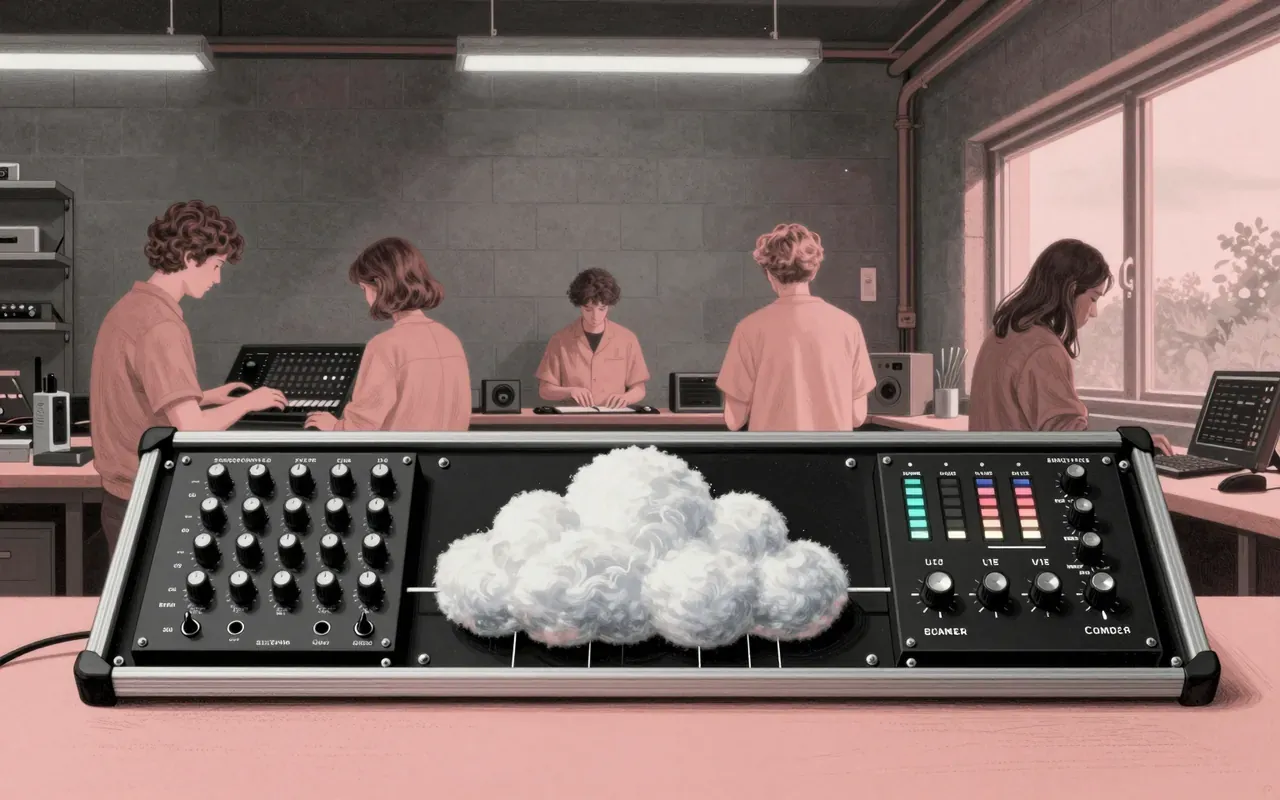
Clouds is a granular audio processor for Eurorack that transforms live input into dense, overlapping grains. It records continuously into a short, variable buffer (up to 8 seconds), allows freezing that buffer to isolate a sonic space, and provides hands-on control over grain position, size, pitch, density, timing distribution, and envelope shape. A diffuser blurs transients using all-pass filters. It supports 40–60 concurrent grains and operates in stereo with extensive CV control, dry/wet blending, feedback, and reverb-like effects during freeze mode. It does not store or recall samples, nor does it support offline processing or waveform editing.

10:15

Doepfer Dark Energy

Doepfer

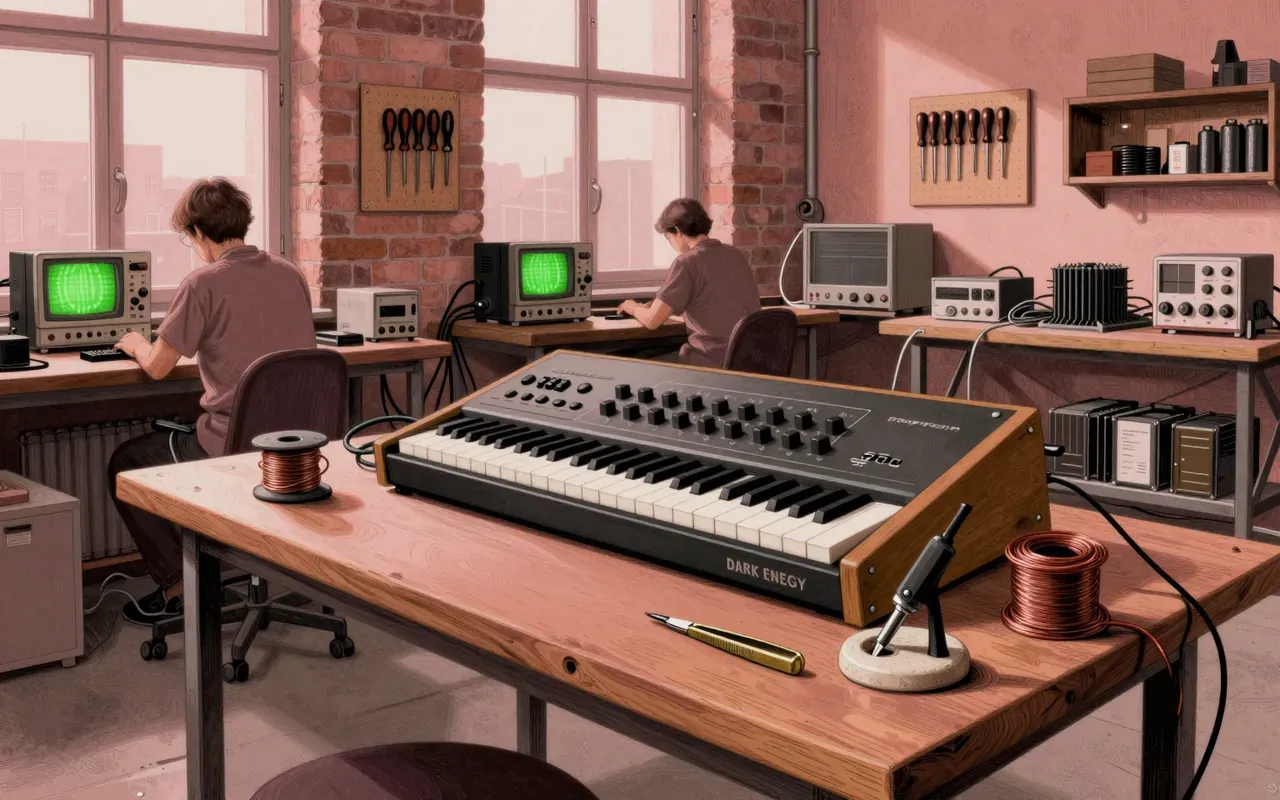
A compact, monophonic, fully analog synthesizer released in 2010 as a stand-alone version of the Doepfer A-111-5 Eurorack module. It features dual LFOs capable of audio-rate FM (~5 kHz), a 24 dB/octave low-pass VCF, and a triangle-based VCO. The VCF can function as a sine oscillator when the VCO is disengaged and resonance is maxed. All sound generation and modulation are analog; only USB/MIDI contain digital components. It has no polyphony, no patch memory, no velocity or aftertouch, and no audio input. Superseded by the Dark Energy II in 2012.

9:03

Korg DDD-1

Korg · 1986

The Korg DDD-1 is a 1986 sampling drum machine with 14 velocity-sensitive pads, 12-bit samples, limited user sampling, five dynamic envelopes, and ROM card expansion (up to four cards, eight sounds each). It has 18 presets and six assignable audio outputs.

9:27

Drumtraks

Sequential Circuits

The Drumtraks is a 1984 sample-based drum machine by Sequential Circuits. It was the company’s first drum machine and first sample-based product. It featured early MIDI implementation, ROM-swappable sounds, velocity-sensitive MIDI input, and flexible synchronization with both MIDI and legacy gear.

9:06

Korg DSS-1

Korg

The Korg DSS-1 is a 1986 polyphonic sampling synthesizer combining sampling, additive synthesis, and hand-drawn waveform creation with an analog signal path. Its 12-bit sampler supports fixed rates from 16–48kHz, yielding up to 16 seconds of recording at the lowest rate. Its synthesis architecture emulates subtractive analog design with dual oscillators, switchable VCF slopes, and an extended ADBSSR envelope.

8:34

Korg DW-6000

Korg

The Korg DW-6000 is a 1985 six-voice hybrid digital-analog synthesizer using sampled waveforms in ROM, analog VCA/VCF, dual oscillators per voice with detune, and a programmable stereo chorus — while noting design limitations like lack of touch sensitivity and single parameter control.

10:10

Korg DW-8000

Korg

The Korg DW-8000 is a hybrid digital-analog synthesizer released in 1985. It features eight-note polyphony, a five-octave keyboard with velocity sensitivity and aftertouch, 16 digital waveforms (created via additive synthesis and stored on ROM chips), analog VCF and VCA, digital delay, arpeggiator, auto-bend, and DWGS architecture. Its rack-mounted counterpart is the EX-8000, which omits the arpeggiator.

8:54

E-mu Modular System

E-mu Systems

The E-mu Modular System is an analog modular synthesizer introduced in 1972 by E-mu Systems as a competitor to ARP and Moog modular synthesizers. It featured a microprocessor-controlled polyphonic keyboard and sequencer — claimed by E-mu to be the first of its kind — and allowed sound creation via patch cord routing among user-specified modules. Users could store configurations using 'firm-wire' patches, and the system was capable of producing any popular synthesizer sound of the era, noted for a 'cleaner' sonic character than competitors.

9:58

E-mu Emax

E-mu Systems

The Emax is a line of samplers introduced by E-mu Systems in 1986 as a low-cost version of the Emulator II. It stored samples on 3½" floppy disks — more reliable than the Emulator II’s 5¼" disks. Models include the HD (with 20 MB hard drive), SE (with additive synthesis), and Plus (with SCSI). All models retain 512 KB of sample memory.

10:15

Mutable Instruments Marbles

Mutable Instruments

Mutable Instruments Marbles is a Eurorack module for generative timing and control voltage. It uses hardware randomness, memory-based reuse (DEJA VU), and adaptive quantization (STEPS) to produce rhythm and pitch that respond to player input. It has no audio output, no presets, no MIDI, and no visual interface beyond LEDs. Its strength is in linking decision-making across domains—timing, pitch, and memory—in real time.

9:34

Make Noise Maths

Make Noise

MATHS is a 20hp Eurorack module by Make Noise Music that functions as an analog computer for generating, transforming, and routing control voltages and digital timing signals. It extends Buchla’s legacy of analog control voltage processing, enabling scaling, inversion, amplification, integration, arithmetic, logic, and autonomous function generation — including LFOs and envelopes — with timing ranging from milliseconds to minutes.

9:11

Waldorf Microwave

Waldorf

The Waldorf Microwave is a hybrid wavetable-analogue synthesizer whose distinctiveness comes from forcing digital waveforms through characterful analogue filters — not from flexibility, expansion, or modern workflow features.

8:56

Waldorf Microwave II

Waldorf

The Waldorf Microwave II is a dedicated wavetable instrument that delivers sharp, immediate, and spectrally distinct tones. It trades flexibility for focus — offering no filter resonance control, no effects, no velocity-driven modulation. Its strength is in launching sounds that pierce rather than blend.

9:40

Korg MS2000

Korg

The Korg MS2000 delivers the MS-10/MS-20 workflow in virtual analog form — with dual timbres, real-time knob control, and mod sequencing — but enforces a strict 4-voice polyphony limit that defines its practical use. It competes directly with the Nord Lead and Roland JP-8000 series. Its physical forms are a 44-key keyboard and a rack module. Connecting both via MIDI yields eight offset voices — not true polyphony expansion.

9:22

Mutable Instruments Plaits

Mutable Instruments

Plaits is a decisive instrument. It forces choices — bank or trigger, pitch or noise, sweep or strike. It gives no second chances, no presets, no visual confirmation. But within those limits, it delivers sixteen coherent sonic identities in one compact, power-efficient package.

11:12

Korg Prophecy

Korg

The Korg Prophecy is a monophonic synthesizer released by Korg in 1995. It uses MOSS (Multi Oscillator Synthesis System) to emulate analog synthesis, FM, and physical modelling. It offers five synthesis methods encompassing nine oscillator types: analog, variable phase modulation, brass, reed, and plucked string modelling, noise with comb filtering, and three types of analog-style models — sync, ring modulation, and cross modulation — collectively referred to as 'MOD'. Each oscillator is processed by a linked waveshaper for generating distortion or resonance effects. The signal, combined with outputs from a sub-oscillator and noise generator, and feedback, is then fed through two multi-mode filters, which can be arranged in series, parallel, or split configurations. The Prophecy's modulation options include six multi-stage envelopes and four low-frequency oscillators (LFOs) with a selection of 30 types. The keyboard features velocity sensitivity and aftertouch and is complemented by three physical wheels dedicated to pitch bending, modulation, and the Wheel 3, a cylindrical control that combines a modulation wheel with a pressure- and position-responsive ribbon controller. It is equipped with five programmable Performance Editors (PE) knobs, each of which can control up to four parameters simultaneously, enabling precise manipulation of aspects like filter cutoff frequencies, envelope attack times, filter resonance, and stereo panning with a single turn. KORG was the first company to feature effects on a synthesizer, and the first to use a sample + synthesis sound design.
9:20

Korg PS-3300

Korg

The Korg PS-3300 is a 1977 polyphonic analog synthesizer built from three PS-3100-derived units (PSU-3301), delivering 144 voices with independent oscillators, filters, envelopes, and amplifiers per note. It enables multitimbral sound creation through individual module adjustment and mixing. It omits the PS-3100's ensemble effect. It supports extensive voltage control and patching — including pitch modulation from envelopes or external sources — and uses a detachable keyboard format. It belongs to Korg’s 1970s line of large, expensive, patchable instruments, positioned as a high-end professional device.

9:48

Make Noise René

Make Noise

René is a 34hp Eurorack module that functions as a three-channel, three-dimensional Cartesian sequencer, enabling real-time, performative programming and delivering maximal musical variation from minimal analog input; it stores up to 64 complete STATEs and features simultaneous Snake and Cartesian patterns, visual feedback via illuminated knobs and touch buttons, and Select Bus integration with TEMPI.

9:01

E-mu SP-12

E-mu Systems

A foundational sampling drum machine introduced in 1985. Built for immediacy, not refinement.

9:33

Ensoniq SQ-80

Ensoniq

The SQ-80 is a digital/analog synthesizer introduced in 1987 and manufactured until 1989. It features Polypressure Keyboard technology, 43 additional waveforms (including five drumkits), an enhanced sequencer, a floppy disk drive, MIDI in/out/thru, and the 2nd Release reverb simulation. Its OS was later back-ported to the ESQ-1. It was promoted professionally alongside the EPS sampler, including in a limited-edition CD with the Dixie Dregs.

10:33

Novation Supernova

Novation

The Novation Supernova is a 1998 3U virtual analogue rack synth with 16+ note polyphony and multitimbral operation. It models subtractive synthesis digitally and includes a resonant self-oscillating filter. Its defining strength is a 7-effect-per-part engine retained per part in multitimbral use, with no polyphony loss. It lacks triangle and sine wave oscillators — requiring their derivation via a hardness attenuator. No other details about sound character, interface layout, modulation matrix, LFO count, or physical controls are verified.

10:39

Korg Trinity

Korg

The Korg Trinity is a 1995 music workstation. It was Korg's first modern workstation. It introduced a large touchscreen for advanced control and editing functions. It became the flagship successor to the M1. It introduced resonant filters to Korg's workstation line. It offered built-in digital audio recording, 32-note polyphony, an extensive internal sound library, and assignable effects.

9:57

Korg 01/W

Korg

The Korg 01/W is a 1991 workstation that expands on the M1 with more polyphony, more memory, and Waveshaping—but does not deepen synthesis control. It delivers reliability and scale, not flexibility.

9:45

Yamaha AN1x

Yamaha

The Yamaha AN1x is a 1997 virtual analog synthesizer using DSP-based modelling of analog subtractive synthesis components. It features duo-timbral architecture with two programmable Scenes per voice, parameter interpolation via morphing, and a maximum polyphony of ten notes—dependent on playing mode. Its synthesis engine includes dual oscillators, multimode resonant filtering, extensive modulation routing, and real-time control via assignable knobs and ribbon controller.

9:26

ARP 2500

ARP

The ARP 2500 is a monophonic or duophonic analog modular synthesizer introduced in 1970 as the first product of ARP Instruments. It used matrix switches instead of patch cables, enabling a cable-free experience but suffering from dirty connections and crosstalk. Its voltage-controlled oscillators achieved good tuning stability compared to competitors, due to patented exponential converters and a dual core design. The matrix switch scheme allowed any module's output to connect to any other module's input.
9:37

ARP Instruments

ARP · 1969

ARP Instruments (1970) built analog synthesizers focused on stability, usability, and performance readiness—not abstraction or infinite patchability.

9:36

ARP Omni

ARP

The ARP Omni is a polyphonic analog synthesizer with preset orchestral string voices, a monophonic bass section, and a polyphonic synthesizer section featuring a 24 dB/oct VCF, ADSR envelope, triangle LFO, and waveform enhancement switch. Its string and synth sections used divide-down architecture for full polyphony, and it offered simultaneous, mixable, separately outputted sections — Strings, Synthesizer, and Bass — with onboard chorus phasing applied primarily to the strings.

9:18

ARP Quadra

ARP

The ARP Quadra is a 61-key analog synthesizer introduced in 1978. It was built as a paraphonic instrument using pre-existing ARP modules. It features four sound sections (Bass, String, Poly Synth, Lead), limited memory that recalls only on/off states and intervals—not slider positions—and relies on manual real-time adjustment. Its architecture uses divide-down circuits for the string section and shares controls like the hollow wave button across sections. It is not truly polyphonic and includes an arpeggiator specific to the lead section.
7:51

Buchla 100

Buchla · 1962

The Buchla Electronic Musical Instruments (1965) were modular, voltage-controlled systems designed for creating novel sounds—not imitating existing ones—using touch/pressure interfaces instead of keyboards, with synthesis based on FM, AM, and dynamic waveshaping.
9:07

Rhodes Chroma

Rhodes

The Rhodes Chroma is a microprocessor-controlled analog synthesizer originally developed by ARP Instruments, Inc. in 1979–1980 and produced by Rhodes in 1982. It features sixteen-voice polyphony, digitally encoded parameter processing, and software-generated envelopes and LFOs. Its architecture relies on software-based control of analog voice channels, enabling programmable multitimbral synthesis but introducing latency and instability.

8:30

Yamaha DX1

Yamaha

The Yamaha DX1 is the top-level member of Yamaha's prolific DX series of FM synthesizers.

9:54

Yamaha DX21

Yamaha

The Yamaha DX21 is a 1985 bi-timbral FM synthesizer with four sine-wave operators, 128 ROM presets, 61 non-velocity keys, and eight-note polyphony — split into four notes per zone when divided.

9:19

Ensoniq ESQ-1

Ensoniq

The ESQ-1 is a hybrid digital-analog workstation that prioritises immediacy and integration over depth or durability.

8:11

Synton Fenix

Synton

The Synton Fenix is a rare, handbuilt modular synthesizer from 1997 — 75 units total — designed by Marc Paping and Bert Vermeulen to include only the vintage-analogue features they personally valued, and nothing more.

9:09

Ensoniq Fizmo

Ensoniq

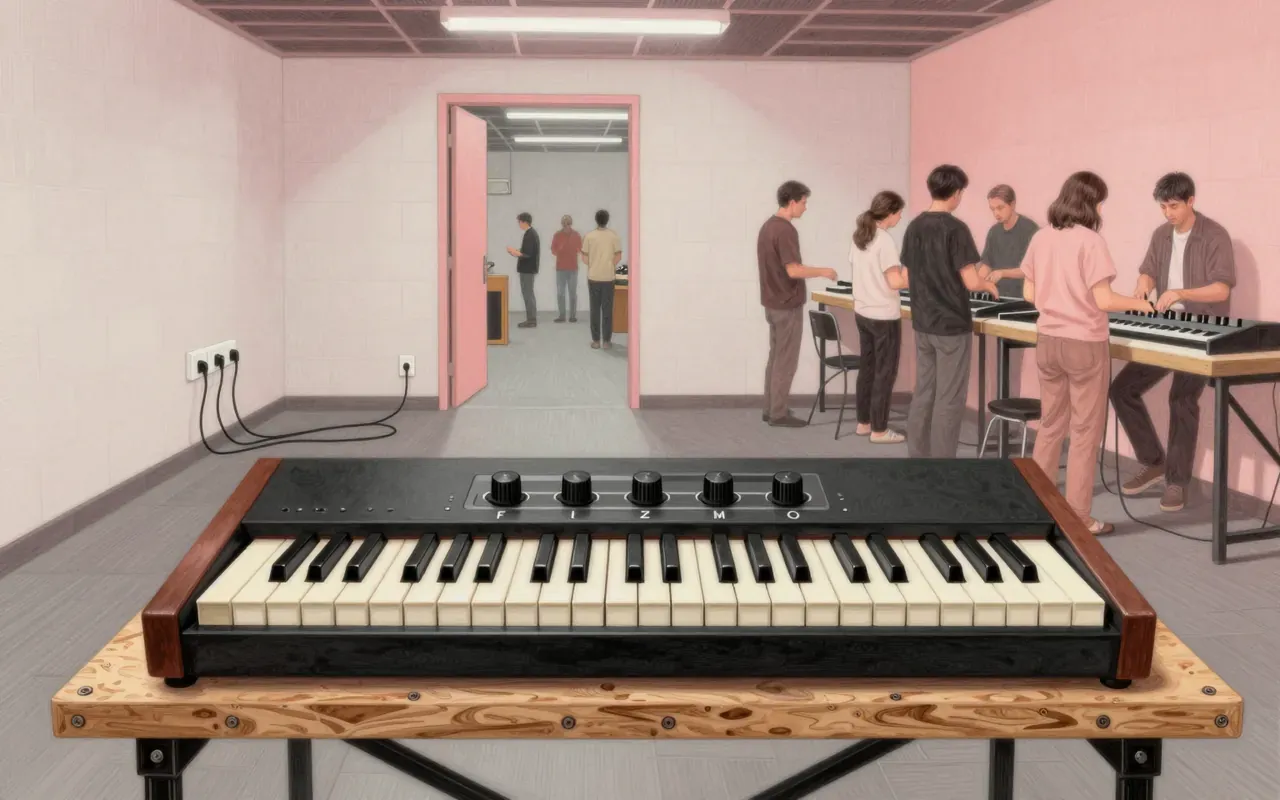
The Ensoniq Fizmo is a 1998 digital synthesizer using Transwave synthesis, capable of 48-voice polyphony, featuring real-time F-I-Z-M-O knob modulation, multi-segment envelopes, and a focus on evolving pads and arpeggiation — though hampered by hardware and UI limitations.

10:52

Yamaha FS1R

Yamaha

The FS1R is a rare hybrid: a formant-driven FM module that expanded what FM synthesis could model — but collapsed under its own complexity. It delivered new waveforms, deeper operator mapping, and vocal resonance no DX7 could match. Yet its interface, manual, and lack of tactile feedback made it a lab tool, not a stage instrument. Its legacy lives in Montage — but not its formants.

9:05

Roland JD-990

Roland

The Roland JD-990 is a 1993 module-based, PCM sample synthesizer. It expands on the JD-800 with more ROM, multitimbrality, front-panel programming, and expansion support. It generates both vintage-analogue-remnant and modern-digital textures—but only from its fixed 6 MB of PCM waveforms, and only via menu navigation.
9:03

Roland JV-1080

Roland

The Roland JV-1080 is a sample-based 2U rack sound module with 64-voice polyphony and 16-part multi-timbrality, introduced in 1995.
8:23

Roland JV-2080

Roland

The Roland JV-2080 is a rack-mount, sample-based MIDI sound module released in early 1997. It supports 768 internal patches and can be stacked up to eight units for 512-voice polyphony.

8:52

Kurzweil K2000

Kurzweil

The Kurzweil K2000 is a digital synthesizer and music workstation introduced in 1991, built around the V.A.S.T. digital signal processing architecture. V.A.S.T. allows users to select different signal paths containing different DSP functions for sound creation and shaping. It includes an extensive modulation system where modulation sources can be assigned to parameters and combined. The instrument was available in keyboard and rack-mountable formats and included 16-bit user sampling.

9:36

Linn 9000

Linn Electronics

The Linn 9000 was the first integrated digital drum machine and MIDI sequencer. It introduced 18 velocity- and pressure-sensitive rubber pads. Its Forth-based OS crashed repeatedly, causing data loss and lock-ups. Those flaws affected the LinnSequencer and prevented release of the LinnDrum Midistudio. They contributed to Linn Electronics’ demise in 1986. It appears on Michael Jackson’s 1987 album Bad.

8:32

Roland MC-202

Roland

The Roland MC-202 is a monophonic analog synthesizer and music sequencer released by Roland in 1983. It was the first groovebox. Its synth is similar to the TB-303 bass synth and the SH-101 synthesizer, featuring one voltage-controlled oscillator with simultaneous saw and square/pulse-width waveforms. The internal synthesizer features one voltage-controlled oscillator with simultaneous saw, square/pulse-width and sub-octave square waveforms. Additionally there is a 24dB Low Pass filter, an LFO and a single ADSR envelope generator. In terms of circuitry, it is nearly identical to the earlier SH-101 synthesizers but lacks the noise generator, choice of LFO shapes and modulation/pitch bend controls. However, unlike the SH-101, it does include a delay on the LFO. The MC-202 includes a sequencer that can play back two separate sequences simultaneously.

10:22

Roland MC-4 Microcomposer

Roland

The Roland MC-4 Microcomposer is a 1981 microprocessor-based CV/Gate sequencer with four output channels, programmable via numeric keypad or live monophonic keyboard input, using numeric pitch values (Middle C = 24), step time values, and gate time values; it features volatile memory requiring cassette storage, supports syncing to other MC-4s or Roland gear, and predates MIDI.

9:19

Roland MC-505

Roland

A 1998 groovebox that prioritises immediacy over depth. It bundles sequencing, synthesis, and classic Roland drums—but locks you into its architecture.

8:02

Roland MC-8 Microcomposer

Roland

The Roland MC-8 Microcomposer is a pioneering CV/Gate sequencer from early 1977. It uses an Intel 8080A CPU and 16 KB RAM to store up to 5,300 notes. It enables polyphonic sequencing via CV/Gate allocation and precise, rapid control of VCOs, VCFs, and lighting. It was designed for large modular systems like the System 700 and System-100M. It does not support real-time recording well and lacks modern interface conveniences.

9:41

Roland MC-909

Roland

The Roland MC-909 is a 2002 groovebox built for live pattern performance. It merges ROM-based synthesis, sampling, and 16-track sequencing into one hardware unit. Its strength is immediacy: hands-on control, fast patch loading, and real-time pattern switching. Its limits are hard-coded: buggy OS, shallow sample editing, rigid pattern flow, and no true synthesis — only tone layering from fixed PCM waves. It belongs on stage, not in a modern production chain.

8:46

MicroKORG

Korg

The MicroKORG is a compact, DSP-based synthesizer/vocoder released in 2002. It uses analog modelling to deliver immediate, expressive sounds — especially through its built-in vocoder and key transpose function. Its four-voice polyphony limits chordal playing and layering, but its hands-on interface and portability made it a staple for live vocalists and electronic performers. Still in production as of 2022, it prioritises utility over expandability.

8:55

Micromoog

Moog · 1975

The Micromoog is a monophonic analog synthesizer produced by Moog Music from 1975 to 1979. Designed as a scaled-down, lower-priced alternative to the Minimoog, it was intended for musicians new to synthesis who could not afford the $1,500 Minimoog. Priced at $650–$800, it features a single VCO with variable waveshape from sawtooth to pulse, sub-octave generation one or two octaves below the fundamental, a −24dB per octave low-pass filter with its own envelope generator and VCO frequency modulation capability, a voltage-controlled amplifier with its own envelope generator, and two A(S)R envelope generators with switchable sustain — a design choice that distinguishes it from most budget synths of the era which used a single ADSR. It includes Moog Open System control inputs, an audio input for external signal processing, and uses 0.95V/oct CV scaling. It was designed by Moog engineer Jim Scott in consultation with Tom Rhea, with electronic refinement input from David Luce and Robert Moog.

8:52

Korg miniKORG 700

Korg

The miniKORG 700 is Korg’s first monophonic analog synthesizer, released in 1973. Designed for organists, it sits atop an organ with controls facing upward. It features five oscillator waveforms including two pulse-width modulation variants, an envelope with attack and 'singing' (decay/release), a 'sustain' toggle that functions only as release, and a dual-filter 'Traveler' system with a safety constraint preventing silence. Its filters produce vocal-like sounds.

10:58

Korg Mono/Poly

Korg

The Mono/Poly is a 1981 analog synthesizer with four VCOs, a 4-pole resonant lowpass filter, dual LFOs, and flexible key assignment modes. It operates either as a monophonic synth using all four oscillators or as a four-voice paraphonic synth. It was the only monophonic synthesizer with an integrated quad-VCO design at launch. Each VCO offers triangle, sawtooth, pulse, and pulse width modulation waveforms. Every VCO can be individually adjusted for octave, volume, and detuning relative to VCO 1, which has Master Tuning. Only the fixed pulse width and the amount of pulse width modulation are shared across all VCOs. The Mono/Poly features a 4-pole resonant lowpass filter with ADSR envelopes modulating both the VCF and VCA. It has two LFOs: one with four waveforms targeting multiple parameters via the modulation wheel, and a second triangle-wave LFO dedicated to pulse width modulation and arpeggiator tempo.

8:49

Moog Sonic Six

Moog · 1972

The Moog Sonic Six is a duophonic analog synthesizer introduced in 1972. It was built for portability and education after Bill Waytena acquired R.A. Moog Inc. and rebranded the Sonic V as the Sonic Six. Its folding control panel is unique in Moog’s history. It was widely used for lectures and educational purposes, often by Bob Moog himself. It delivers weak sound compared to the MiniMoog and suffers from reliability issues. Its single contour generator is shared between VCA and VCF, limiting independent envelope shaping. It is worth your time only if you need a portable, self-contained analog synth for live lecture demos or classroom use — not for studio depth, reliability, or sonic authority.

9:22

Nord Modular

Clavia

The Nord Modular is a 1997 software-based semi-modular synthesizer that uses DSP to emulate analogue circuitry and supports multiple synthesis methods including subtractive, additive, FM, and physical modelling. Patch editing is performed on a PC using graphical editor software, while sound generation occurs independently on the hardware. Patch complexity is constrained by available DSP resources, and polyphony varies from 4 to 32 voices depending on patch complexity. It was upgraded in 2004 as the Nord Modular G2 with endless rotary knobs and a larger keyboard with aftertouch.

9:32

Oberheim OB-1

Oberheim

The Oberheim OB-1 is a monophonic analog synthesizer introduced in late 1977. It was the world's first completely programmable synthesizer, offering eight preset memories. It features two VCOs with selectable and continuously-variable waveforms, a switchable 2- or 4-pole VCF, and two ADSR envelopes—one for the filter and one for the VCA. Its design built upon technology from the Polyphonic Synthesizer Programmer.

10:17

Yamaha QY10

Yamaha

The QY10 is a fixed-function sketchpad—not a flexible instrument. It trades control for immediacy. It works only in C major. It rescales, but never reveals how. It stores patterns internally, but exports only via MIDI. It is portable, self-contained, and stubbornly simple.

9:33

Yamaha RM1x

Yamaha

The RM1x is a fixed-architecture groovebox that prioritises fast, style-based arrangement over flexible sound design or real-time control.

8:53

Serge Modular

Serge

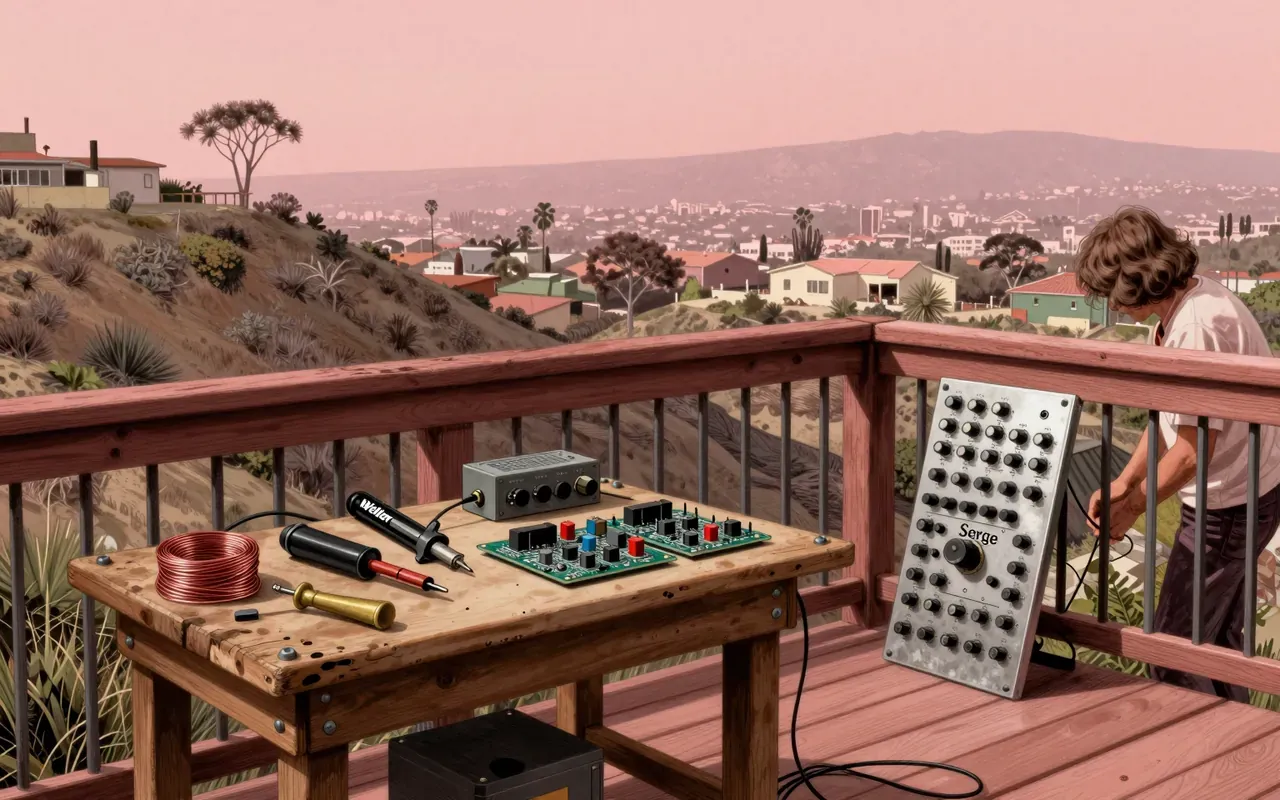
The Serge synthesizer is an analogue modular system developed at CalArts in late 1972. It was built to be inexpensive and powerful, a democratic alternative to Buchla systems. It shipped as DIY kits assembled unofficially on a CalArts balcony. Modules expose circuit aspects on the front panel for unconventional patching. All signals use banana jacks—no separation between audio and control voltage. Stackable banana plugs reduce the need for mults. One unit was used on the 1975 Greenpeace anti-whaling expedition to approximate and broadcast whale sounds.

8:32

E-mu SP-1200

E-mu Systems

The E-mu SP-1200 is a sampling drum machine introduced in August 1987 by E-mu Systems. It uses 12-bit linear sampling at 26.04 kHz, drop-sample pitch-shifting, analog SSM2044 lowpass filters on channels 1 and 2, volatile RAM loaded from 3.5" disk, and offers 10 seconds of total sampling time—with a 2.5-second limit per sound. It succeeded the SP-12 and offered integrated sequencing and sample looping in a single unit.

8:44

Roland SP-808

Roland

The SP-808 is a self-contained sampling workstation built for immediacy—not convenience. Its limits are absolute: four stereo voices, Zip-only storage, no modern connectivity. Its strength is integration: sampler, synth, and sequencer in one tactile unit, holding over 1,000 samples internally while demanding physical media discipline.

10:03

Yamaha SY77

Yamaha

The Yamaha SY77 is a 1989 16-voice multitimbral workstation combining AFM (expanded 6-operator FM), AWM2 PCM sampling, and their real-time hybrid RCM. It features a 61-key keyboard with velocity and aftertouch, two modulation wheels, pitch wheel, backlit LCD, floppy drive, expansion slots, on-board effects, and a 16,000-note sequencer. AWM2 waveforms can be used standalone, layered with FM Elements, or — uniquely in the SY/TG series — as modulators for FM operators. Its AFM is a superset of the DX7’s FM, adding waveforms, algorithms, feedback routing, and filter integration.

7:42

Steiner-Parker Synthacon

Steiner-Parker

The Steiner-Parker Synthacon is a monophonic analog synthesizer released in 1975. Its defining feature is Nyle Steiner’s 12dB/octave multimode filter, which self-oscillates and sustains full amplitude at all resonance settings—a deliberate departure from the Minimoog and ARP Odyssey. Several hundred units were made. It has no polyphony, no LFO, no patch memory, and tuning stability is not documented. Its value lies in its singular filter behaviour, not versatility or convenience.

8:42

Elka Synthex

Elka

The Elka Synthex is an 8-voice analog keyboard synthesizer produced by Italian music instrument manufacturer Elka from 1981 to 1985.

9:12

EMS Synthi 100

EMS

The EMS Synthi 100 is a large analogue/digital hybrid synthesizer commissioned by Radio Belgrade, designed by David Cockerell and documented in 1971. It developed from a concept of three VCS3 systems but contains analogue modules equivalent to six VCS3s. It features 12 voltage-controlled oscillators and eight voltage-controlled filters. Two monophonic keyboards produce four control voltages and two triggers. Its digital sequencer has three duophonic layers and 256 duophonic note events. Two 60×60 matrices connect modules via patch pins. Keyboard spread adjusts for equal temperament or microtonal tunings up to 61 divisions per semitone.

10:43

EMS Synthi AKS

EMS · 1972

The EMS Synthi AKS is a portable modular analog synthesiser introduced in March 1972. It features a built-in keyboard and sequencer, a patch pin matrix, and shares design DNA with the VCS 3. Its sequencer creates eight-note repeating patterns. Users have described it as a 'noise machine'. One full album—Music from the SYNTHI—was made using only this instrument.

9:00

Roland System 700

Roland · 1976

The Roland System 700 is a professional monophonic modular synthesizer released in 1976 by Roland Corporation.

8:07

Moog Taurus

Moog

The Moog Taurus is a foot-operated analog synthesizer introduced in 1975. It uses an organ-style pedal board. It is monophonic, with a single voice generated by two oscillators and one VCA. Taurus I and III offer only a distorted sawtooth wave. Taurus II introduced a pulse wave. All models use a 24dB/octave resonant low-pass filter with key tracking. Early models lack an LFO; Taurus III includes one routable to oscillator pitch or filter frequency.

8:30

Roland TR-505

Roland

The TR-505 delivers rigid, punchy sequencing with integrated Latin percussion — but its 8-voice limit forces trade-offs no modern sequencer accepts.

10:08

Korg Trident

Korg · 1980

The Korg Trident is a 1980 subtractive synthesizer with eight-note polyphony, integrating three independent sections — polyphonic, string, and brass — into one keyboard. It allows assignment to two keyboard zones, includes a flanger effect and joystick for pitch and modulation. The 1982 MkII revision added memory, improved stability via better heat-sinking and power supply, and separate ADSR envelopes for filter and VCA — unlike the MkI’s shared envelope. It does not use effects or sample+synthesis, despite KORG pioneering both elsewhere.

9:45

Korg Triton

Korg

The Korg Triton is a 1999 music workstation synthesizer with digital sampling and sequencing. It introduced 62-note polyphony, dual polyphonic arpeggiators, RPPR phrase recording, onboard sampling with expandable RAM, five insert effects per Program, dual filters per oscillator (24dB/octave low-pass or parallel 12dB/octave HP/LP), faster touchscreen response, category search UI, and expanded memory and outputs. It was available in 61-, 76-, and 88-key Classic versions and as a rackmount Triton-Rack with optional ADAT/Word Clock via EXB-DI.

9:22

Yamaha TX81Z

Yamaha

The TX81Z is a stripped-down, rack-only FM synth that trades expressive controls for affordability and waveform novelty. Its non-sine oscillators opened new sonic doors — but its single-chip architecture left out pitch envelopes, velocity sensitivity, and operator depth. It belongs in a modern studio only as a character voice, not a workhorse.

7:34

Roland U-20

Roland

The Roland U-20 is a 1989 PCM-sample keyboard that plays back stored sounds with no filtering. It uses ADSR envelopes and DSP effects like reverb and chorus for limited modification. It supports expansion via the M-256E RAM card and two ROM PCM-card slots. Its lack of filters and impractical aftertouch are documented drawbacks.

9:53

EMS VCS 3

EMS · 1969

The EMS VCS 3 is a portable analogue synthesizer introduced in 1969 by Electronic Music Studios. Designed largely by David Cockerell and styled by Tristram Cary, it uses a pin-based patchboard matrix instead of cables. It lacks a built-in keyboard, making it better suited for sound effects generation and external signal processing than melodic playing. Its tuning instability stems from exponential voltage-to-frequency conversion. It was one of the first portable commercially available synthesizers, housed entirely in a small wooden case.

7:58

Wasp

Electronic Dream Plant

The Wasp is a 1978 monosynth defined by its copper-plate keyboard, black-and-yellow casing, internal speaker, and proprietary interconnection. It was EDP’s best-received product but flawed in execution: unreliable live, prone to autonomous triggering, and technologically isolated. Its sound is inseparable from its limitations.

8:56

PPG Wave

PPG

PPG Wave pioneered real-time interpolated wavetable scanning—making timbre itself a sequenced parameter. Its hybrid digital-analog signal path (digital oscillators, analog filters and VCAs) delivered spectral animation impossible on analog synths of the era. But it demands peripheral hardware for editing, sampling, or expressive control—and offers no direct waveform manipulation or polyphonic sequencing. It belongs in a studio built for sound design, not stage performance.

8:51

Korg Wavestation

Korg

The Korg Wavestation is a vector and wavetable synthesizer introduced in 1990. It uses Wave Sequencing — a method of multi-timbral sound generation using successively played PCM waveforms — combined with Advanced Vector Synthesis, allowing dynamic mixing and morphing between up to four oscillators. It enables crossfading up to 255 waveforms, jumping to any PCM wave in ROM, and generating complex, evolving timbres and rhythmic sequences from a single keypress. Unlike contemporaries, it lacks an onboard sequencer and is designed as a 'pure' synthesizer.

9:10

Roland XP-80

Roland

The Roland XP-80 is a 1996 76-key workstation using digital PCM subtractive synthesis, delivering 64-voice polyphony and 16-part multi-timbrality via a semi-weighted keyboard. It merges the JV-1080 engine with the MRC-Pro sequencer for tight internal composition—but offers no aftertouch, limited real-time sound control, and no modern connectivity.

9:06

Oberheim Xpander

Oberheim

A keyboardless, six-voice analog synthesizer launched in 1984 and discontinued in 1988. Rack-mounted. Uses Matrix Modulation to route digital control to analog VCOs, multi-mode VCF, and two sequential VCAs. Each voice is independently configurable — including FM via VCO-to-VCO modulation — via multi-patch mode.

8:38

Korg Z1

Korg

The Korg Z1 is a 1997 digital synthesizer using physical modelling synthesis with 12-voice polyphony. It extends Korg's MOSS system—first introduced in the 1995 Prophecy—into a polyphonic, multitimbral format, incorporating OASYS-based physical modelling engines, two physically modelled oscillators per voice plus sub-oscillator and noise generator, and performance features including a 61-note keyboard with aftertouch and an XY touchpad.

9:20

ARP 2600

ARP

The ARP 2600 is a foundational analog synthesizer designed for education. Its semimodular architecture, front-panel signal graphics, and duophonic voice count reflect its classroom purpose—not stage use. Its original filter was replaced after a patent dispute. It teaches synthesis more directly than any contemporaneous instrument, but offers no polyphony, no presets, and unstable tuning.

8:47

Roland CR-78

Roland

The CR-78 is historically singular: the first microprocessor-based drum machine and the first to allow user-programmable pattern creation. Its analog synthesis yields 14 fixed drum sounds. Its four-note polyphony defines its rhythmic ceiling. It does not offer sound editing, velocity layers, or sample playback. It belongs in rooms where constraint is compositional strategy—not a flaw to be patched.

8:36

Yamaha CS-80

Yamaha · 1976

The Yamaha CS-80 is an analog synthesizer introduced in 1977. It supports true 8-voice polyphony, with two independent synthesizer layers per voice each with its own set of front panel controls. It has a layered keyboard that is both velocity-sensitive and pressure-sensitive, with polyphonic aftertouch and a ribbon controller for polyphonic pitch-bends and glissandos. Production of the instrument ceased in 1980.

9:20

Casio CZ synthesizers

Casio

The Casio CZ series is a line of low-cost, digitally implemented phase distortion synthesizers introduced by Casio in 1984. They simulate analog filter behaviour without physical filters, using digital phase distortion instead. Each oscillator plays waveforms in series—not parallel—enabling sub-harmonics but restricting waveform pairing. Polyphony drops from eight to four voices when using two oscillators per voice. They were built for amateur musicians, prioritising affordability and portability over expressive control or sonic flexibility.

11:15

Roland D-50

Roland · 1987

The Roland D-50 is a 1987 hybrid synthesiser that pairs 47 ROM-based PCM attack samples with subtractive synthesis to create realistic, bright, and instantly usable tones. Its architecture — two tones, each with two partials — delivers clarity and presence but imposes strict limits on timbral complexity and real-time control. It was built for affordability and immediacy, not flexibility or depth.

9:08

Oberheim DMX

Oberheim

The Oberheim DMX is a programmable digital drum machine introduced in 1980. It was the second commercially sold digital drum machine after the Linn LM-1. It used sampled sounds of real drums stored in EPROM chips on removable voice cards. It offered 24 drum sounds derived from 11 original samples and supported up to 8-voice polyphony. It included humanizing features like rolls, flams, and timing variations. It was designed to interface with the OB-Xa synthesizer via the Oberheim Serial Buss and marketed as part of 'The System' alongside the DSX sequencer and OB-Xa or OB-8. It was widely used in 1980s new wave, synth-pop, and hip hop recordings.

9:38

Yamaha DX7

Yamaha

The Yamaha DX7 is a landmark instrument — not for its playability or depth, but for delivering a new kind of digital clarity at scale. It trades expressiveness for precision, intuition for architecture, and warmth for brilliance. Its legacy is sonic, not ergonomic.

10:47

Fairlight CMI

Fairlight · 1979

The Fairlight CMI defined sampling by doing it first — not perfectly, but decisively. It traded fidelity for immediacy, memory for recognisability, and speed for novelty. Its legacy is linguistic and architectural: it gave sampling a name, and built the first workstation where sound, sequence, and synth shared one chassis.

9:45

Roland JD-800

Roland

The Roland JD-800 is a hands-on, sample-based digital synthesizer manufactured between 1991 and 1996. It features many knobs and sliders for patch editing and performance control. Roland's intention was to return to the roots of synthesis. It employs sample-based oscillators and a fully digital signal path. It has 108 built-in sampled waveforms, expandable via PCM cards. A patch consists of up to four tones. In Multi mode it is possible to play five different patches over MIDI, plus a 'special' patch — which assigns different waveforms to the 61 keys for drums and percussion.

10:44

Roland JP-8000

Roland

The Roland JP-8000 is an analog modeling synthesizer released in early 1997. It sought to digitally reproduce the analog tonalities and power of its analog predecessors. Although it lacked somewhat in analog warmth due to its early digital architecture, it added many new features, such as RPS (Realtime Phrase Sequencing), which allowed short sequenced phrases to be assigned to keys, and such as motion control. It also featured the unique Supersaw oscillators and analog-style controllers such as an arpeggiator and an assignable touch response ribbon control. The Supersaw in particular was the reason why the JP-8000 was particularly successful as a main keyboard (along with the Virus) in the dance music market, especially for trance music.

8:40

Roland Juno-106

Roland

The Juno-106 is a six-voice analog synthesizer released by Roland in February 1984. It features digitally controlled oscillators, 128 patch memories (up from the Juno-60’s 56), a performance lever for pitch and modulation, and early MIDI implementation enabling parameter change sequencing.

9:26

Roland Juno-60

Roland

The Roland Juno-60 is an analog synthesizer introduced in 1982 as a lower-cost, more stable alternative to contemporaries like the Prophet-5 and Jupiter-8. It features digitally controlled oscillators for tuning stability, a single oscillator architecture compensated by a signature chorus effect, patch memory for 54 sounds, an arpeggiator, and performance controls.

8:59

Roland Jupiter-6

Roland

The Jupiter-6 delivers focused, hands-on bitimbral control and waveform stacking unavailable on the Jupiter-8 — but locks you into rigid voice splits and omits expressive dimensions like aftertouch.

8:29

Roland Jupiter-8

Roland

The Jupiter-8 is an eight-voice polyphonic analog subtractive synthesizer introduced by Roland in early 1981. Each voice features two discrete VCOs with cross-modulation and sync, pulse-width modulation, a non-resonant high-pass filter, a resonant low-pass filter with 2-pole and 4-pole settings, an LFO with variable waveforms and routings, and two envelope generators (one invertible). It includes adjustable polyphonic portamento, a hold function for infinite sustain, an assignable bender for pitch or filter frequency, balanced XLR and unbalanced 1/4" outputs for Upper and Lower presets in Split mode, and a unique polyphonic unison mode where all 16 oscillators stack onto one note and divide down when more keys are pressed. Its arpeggiator syncs externally via DCB or CV. Tuning stability improved from serial #171700 onward.

9:55

Roland JX-8P

Roland

The Roland JX-8P is a 1985 hybrid analog synthesizer with six-note polyphony, designed to bridge analog warmth and FM-style timbres using new modulation and a DX7-inspired interface. It features two DCOs per voice, software ADSR envelopes, dual filters, chorus, sync modes, multiple play modes, and a polished MIDI implementation — programmable via edit slider or optional PG-800, with limitations on real-time control.

8:50

Linn LM-1

Linn Electronics

The Linn LM-1 is the first programmable drum machine to use digital samples of acoustic drums. Released in 1980, it replaced preset patterns with human-performed, non-degrading sounds. Its quantization enforced perfect sixteenth-note timing. It offered twelve fixed samples—mostly played by Art Wood—with handclaps by Tom Petty and the Heartbreakers. It had no synthesis, no editing, no velocity response, and no visual feedback beyond LEDs. It helped establish drum machines as credible tools in popular music.

10:14

Korg M1

Korg

The Korg M1 is a 1988 sampling-based music workstation with 16-note polyphony, 16-bit PCM sample playback, built-in effects including reverb, delay, chorus, tremolo, EQ, distortion and Leslie simulation, and an eight-track MIDI sequencer. It uses sampled attack transients, loops, sustained waveforms and percussive samples. It was the bestselling synthesizer ever at that time, selling over 250,000 units. None of its features was unique, but their integration was unprecedented.

10:10

Memorymoog

Moog · 1982

The Memorymoog is a 6-voice polyphonic analog synthesizer manufactured by Moog Music from 1982 to 1985. It was the first polyphonic Moog to feature dedicated oscillators and filters for each voice. Each voice has three voltage-controlled oscillators with pulse (variable width), saw, and triangle waveforms. Each voice also has its own 24 dB/Octave Low Pass voltage-controlled filter. Moog Music included a discrete implementation of its famed, patented transistor ladder filter. In Mono mode, the Memorymoog functions as a traditional monophonic synthesizer with 1–18 oscillators selectable in unison. A Chord Memory function and an Arpeggiator are included. Audio frequency modulation using Oscillator 3 can produce FM-like timbres.

8:06

Minimoog

Moog · 1970

The Minimoog is an analog keyboard synthesizer introduced by Moog in 1970. It was built as a portable, affordable alternative to modular systems — the first synth sold in retail stores. Its three unsynchronised analog oscillators, unique voltage-controlled filter, and pioneering pitch wheel give it immediate, expressive, monophonic voice — but no chords, no presets, no stability. It made blistering funky bass blurps and spacey whistle leads — not because it was precise, but because it wasn’t.

9:00

Minimoog Voyager

Moog · 2002

The Minimoog Voyager is a monophonic analog synthesizer released in 2002. It was modelled after the 1970s Minimoog and intended as its successor. It promised modern features while preserving the original sound quality. Over 14,000 units shipped between 2002 and 2015.

9:14

Akai MPC

Akai · 1988

The MPC60 redefined beat-making by collapsing sampling, sequencing, and performance into one hardware instrument. Its strength is immediacy. Its weakness is inflexibility.

8:45

Nord Lead

Clavia

The Nord Lead redefined hands-on synthesis by replacing menus with knobs and analog circuitry with DSPs — all to deliver immediate, expressive control over virtual analog tones.

8:08

Oberheim OB-X

Oberheim

The OB-X was Oberheim’s first OB-series polyphonic analog subtractive synthesizer. Introduced in June 1979 to compete with the Prophet-5, it replaced modular SEM-based systems with a unified design built around interchangeable voice cards. It offered 4-, 6-, or 8-voice configurations, 32 user-programmable presets, and automated tuning via a Z-80 microprocessor. Its architecture prioritised stability and integration over flexibility or expressivity.

11:30

Oberheim OB-Xa

Oberheim

The OB-Xa is a pragmatic evolution: layering and splitting built in, filter envelope replacing cross modulation, Curtis ICs for stability, and Serial Buss for closed-system integration. It delivers thick, reliable polyphony — but sacrifices the OB-X’s discrete-circuit idiosyncrasy and FM flexibility.

8:26

ARP Odyssey

ARP

The ARP Odyssey is a duophonic analog synthesizer introduced in 1972. It was designed as a portable, performance-oriented alternative to the Moog Minimoog.

11:12

Korg Poly-800

Korg

The Korg Poly-800 is an 8-voice analog synthesizer released by Korg in 1983. It was the first fully programmable polyphonic synthesizer that sold for less than $1,000. It was designed for portability, featuring battery power and a lightweight design that allowed the user to play with it strapped around their neck. It utilised digitally controlled oscillators (DCOs), and was a paraphonic synth with a single filter shared between its eight voices. Each DCO offers sawtooth and square waveforms, which are mixed together with a white noise generator before being sent to a voltage-controlled filter (VCF). The Poly-800 features 2 polyphony modes: Whole mode offers 8-voice polyphony with one DCO per voice, while Double mode places the DCOs in pairs for a richer sound, albeit at the expense of reducing polyphony to four voices. The VCF is shared across all voices, which means the Poly-800 is technically a paraphonic synth, instead of a polyphonic synth. The filter can be set to either single or multiple trigger modes; in single mode, the envelope is triggered by the first key press and won't re-trigger until all keys are released. Multi mode allows each key press to trigger the filter envelope independently.

8:49

Polymoog

Moog · 1975

The Polymoog is a 1975 Moog keyboard that gives unlimited polyphony through divide-down oscillator architecture — but sacrifices per-voice synthesis, programmability, and filter control entirely.

9:59

Korg Polysix

Korg

The Korg Polysix is a 1981 six-voice polyphonic analog synthesizer designed for affordability through single-oscillator-per-voice architecture, compensated by built-in bucket-brigade-based chorus/phaser/ensemble effects — features that were relatively uncommon at launch and contributed to its accessibility and sonic richness.

8:46

Prophet-5

Sequential Circuits

The Prophet-5 is an analog synthesizer manufactured by Sequential Circuits. It was designed by Dave Smith and John Bowen in 1977. It was the first polyphonic synthesizer with fully programmable memory. Before the Prophet-5, synthesizers required users to adjust controls to change sounds, with no guarantee of exactly recreating a sound. Sequential used microprocessors to allow users to recall sounds instantly rather than having to recreate them manually. The Prophet-5 facilitated a move from synthesizers creating unpredictable sounds to producing "a standard package of familiar sounds". Initially, Smith and Bowen developed the Prophet-10, a synthesizer with ten voices of polyphony, meaning it could play up to ten notes simultaneously. Smith and Bowen removed half the electronics, reducing the voices to five and creating the Prophet-5. In 1978, Sequential released the Prophet-5, the first programmable polyphonic synthesizer, which was widely used in the music industry. Whereas previous synthesizers required users to adjust cables and knobs to change sounds, with no guarantee of exactly recreating a sound, the Prophet-5 used microprocessors to store sounds in patch memory.

9:00

Prophet VS

Sequential Circuits

The Prophet VS is an 8-voice hybrid synthesizer released in 1986 by Sequential Circuits. It introduced vector synthesis using a diamond-pattern joystick to mix four 12-bit digital single-cycle waveforms per voice, which are then processed through analog CEM3379/3389 chips. Waves 0–31 are user-editable via MIDI sample dump or onboard harmonic mixing; waves 32–126 are fixed in firmware. It does vector morphing better than anything else of its era—but offers no velocity sensitivity, no aftertouch, no effects, and no reliable patch backup.

9:06

Oberheim Polyphonic Synthesizer

Oberheim

The Oberheim Polyphonic Synthesizer is a series of analog music synthesizers produced from 1975 to 1979. It was the first production synthesizer capable of playing chords. It works by combining multiple SEM modules — each generating one voice — under shared keyboard control and a two-channel sequencer. Its sonic thickness and depth arise partly from random variance between SEM modules. It has no patch memory, suffers tuning drift, and demands high maintenance. Musicians used it for unstable, breathing chordal textures. It suits players who prioritise tactile, variable analog polyphony over stability or recall.

9:04

Roland SH-101

Roland

The Roland SH-101 is a monophonic analog synthesizer made by Roland Corporation between 1982 and 1986. It features a single oscillator, sub-oscillator, low-pass filter, mixer, noise generator, arpeggiator and sequencer. An ADSR envelope controls the filter and VCA. The LFO modulates filter, VCA, pitch and pulse width. It can be played as a keytar using an optional handgrip and shoulder strap, and it can be powered via battery.

9:27

Yamaha SY99

Yamaha

The Yamaha SY99 is a 1991 hybrid digital synthesizer combining FM, sample-based, and subtractive synthesis. It enables PCM samples to function as FM modulators, controllable via velocity, aftertouch, wheels, pedal, and breath controller. It improves on the SY77 with a 76-key keyboard, expanded ROM, user-loadable PCM samples usable in FM synthesis, and an SPX900-derived real-time controllable effects processor.

8:24

Roland System 100

Roland

The Roland System 100 is an analog semi-modular synthesizer introduced in 1975. It consists of discrete rack- and keyboard-mounted units (101, 102, 103, 104, 109), each independently powered, supporting patch-cable reconfiguration of an otherwise fixed signal path. It forms an expandable two-oscillator monosynth with sequencing and effects, uses 1V/oct control, and avoids fixed oscillator footages for enhanced sound design flexibility.

7:37

Roland TB-303

Roland

The Roland TB-303 is a 1981 subtractive bass synthesizer with a 24 dB/octave low-pass filter controlled by an envelope generator and an internal sequencer for note programming. Designed to simulate bass guitars, it was commercially unsuccessful and discontinued in 1984 due to its unrealistic sound.

9:49

Roland TR-808

Roland

The TR-808 is a programmable analog drum machine introduced in 1980. It generated all sounds via analog synthesis—not sampling—and allowed full percussion track programming including breaks and rolls. It supported up to 32 patterns, chaining up to 768 measures, and beat accents. Roland discontinued it in 1983 after approximately 12,000 units due to semiconductor shortages. It was a commercial failure because the market preferred realistic drum sounds.

9:00

Roland TR-909

Roland

The TR-909 is a rigid, unyielding rhythmic engine. Its strength is timing, not texture. Its legacy is built on what it withheld—not what it offered.

10:14

Ensoniq VFX

Ensoniq

The Ensoniq VFX is a performance-type synthesizer released in 1989. It employs Transwave Wavetable Synthesis, Sample playback and Subtractive Synthesis. It has 21-voice polyphony. It features Poly-Key Pressure (Polyphonic Aftertouch). It allows combining up to three voices into a preset for live performance. It includes the Ensoniq Signal Processing (ESP) chip for 24-bit effects. A single sound can contain up to six oscillators. It integrates synthesis, effects and sequencing into a single-unit digital studio. It delivers terrific acoustic sounds and innovative performance and sequencing features.

9:02

Access Virus

Access

The Access Virus is a series of DSP-based virtual analog synthesizers introduced in 1997 and updated through the TI series. It offers subtractive, phase distortion, and FM synthesis—with wavetable added from the TI generation onward. Formats include rack modules (Virus B, C, TI Snow), keyboard versions (Virus KB, TI Keyboard, TI Polar), and fixed control layouts. It prioritises polyphonic stability, real-time editing, and aggressive tonal character over tactile expressivity or modern integration.