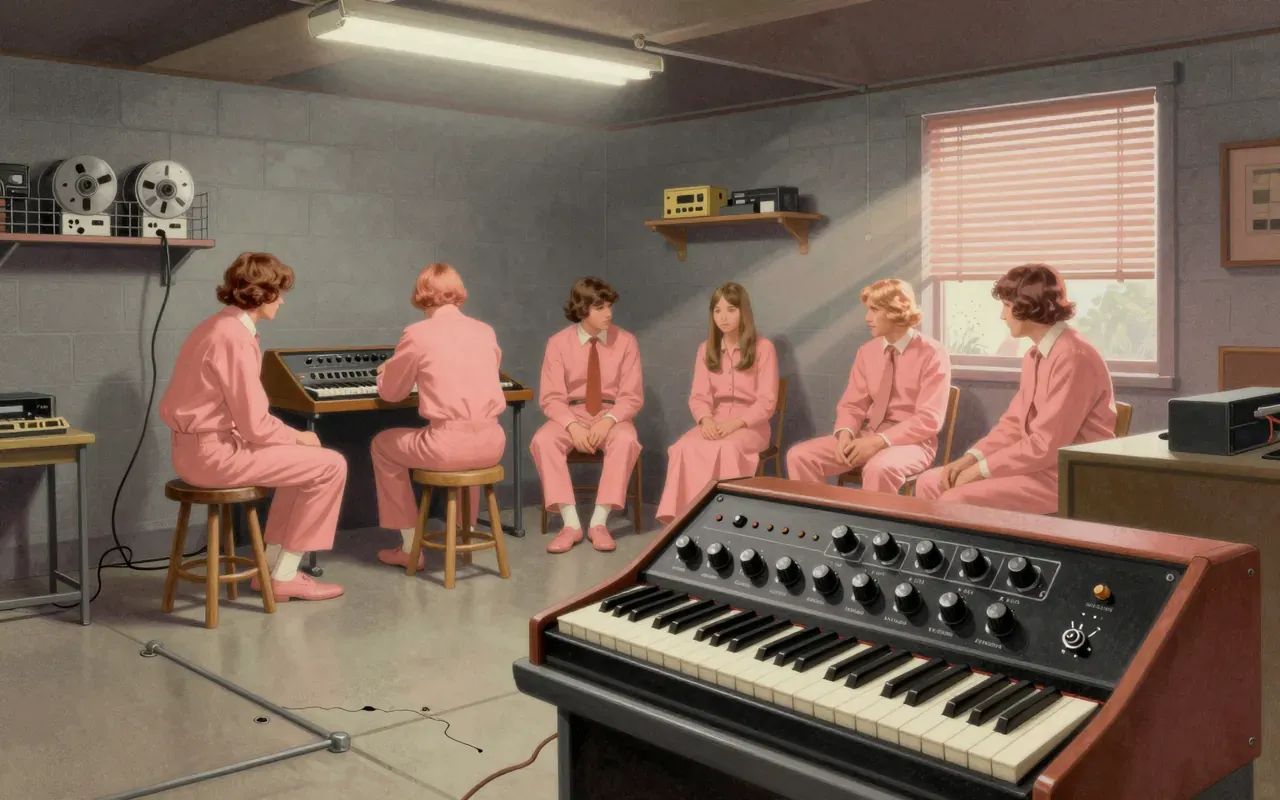
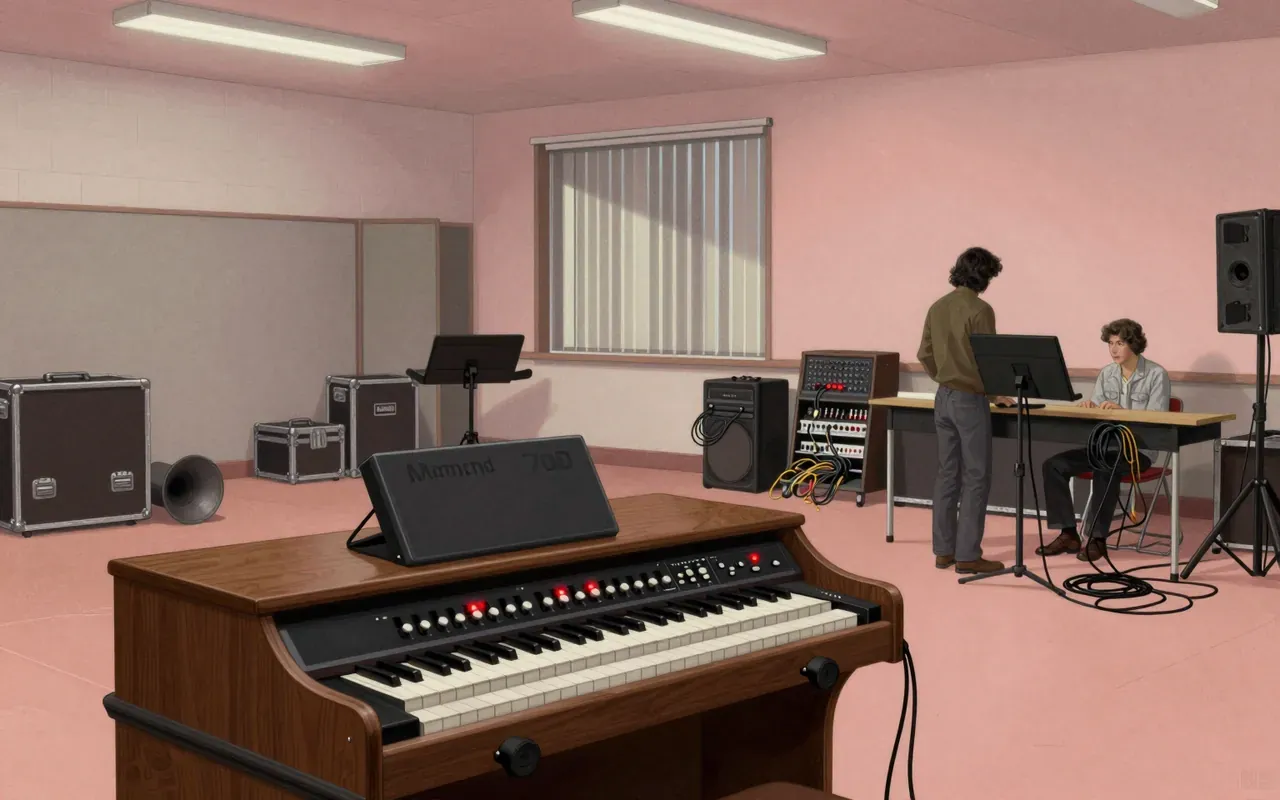
One oscillator, two A(S)R envelopes, and Moog’s filter — all stripped bare, not simplified.
The Micromoog is a monophonic analog synthesizer produced by Moog Music from 1975 to 1979. Designed as a scaled-down, lower-priced alternative to the Minimoog, it was intended for musicians new to synthesis who could not afford the $1,500 Minimoog. Priced at $650–$800, it features a single VCO with variable waveshape from sawtooth to pulse, sub-octave generation one or two octaves below the fundamental, a −24dB per octave low-pass filter with its own envelope generator and VCO frequency modulation capability, a voltage-controlled amplifier with its own envelope generator, and two A(S)R envelope generators with switchable sustain — a design choice that distinguishes it from most budget synths of the era which used a single ADSR. It includes Moog Open System control inputs, an audio input for external signal processing, and uses 0.95V/oct CV scaling. It was designed by Moog engineer Jim Scott in consultation with Tom Rhea, with electronic refinement input from David Luce and Robert Moog.
A monophonic synth built for beginners — not as a compromise, but as a deliberate reduction.
2:33
What it keeps
One oscillator, two A(S)R envelopes, and a filter with its own contour — no redundancy, no extras.
3:58
The filter’s edge
Its −24dB/oct filter responds to VCO FM and has its own envelope — a rare dual capability in 1975.
5:25
Two envelopes, not one
Two A(S)R envelopes — not one ADSR — give independent control over tone and volume shaping.
Worth your time?
Yes. Use the whole thing.
3.5/ 5
What works
It works as a focused monophonic voice with immediate filter and envelope control.
It works as a hands-on introduction to Moog’s analog architecture.
What does not
It does not have an LFO.
It does not have a noise generator.
It does not have portamento.
It does not have patch memory.
Use it if
For players who want Moog filter response without polyphony or modulation layers.
Not for players who need multitimbral operation, sequencing, or modern sync options.
Skip it if
Not for players who need multitimbral operation, sequencing, or modern sync options.
The written brief1 min read
What it is and what it was built for
A monophonic analog synthesizer produced from 1975 to 1979. Built as a lower-priced, scaled-down alternative to the Minimoog for musicians new to synthesis.
How it works, in terms a player would use
It has one VCO with a continuously variable waveshape from sawtooth to pulse, plus sub-octave generation one or two octaves down. Its −24dB/oct low-pass filter has its own envelope and accepts VCO FM. The VCA has its own envelope. Two A(S)R envelopes — each switchable between attack-sustain and attack-only — control the filter and amplifier. It includes audio input, Moog Open System CV inputs, and 0.95V/oct scaling.
What it does better than anything else
It delivers Moog’s −24dB/oct filter with dedicated envelope shaping and VCO FM — a rare pairing at this price in 1975 — and offers two independent A(S)R envelopes where most budget synths used one ADSR.
What it does badly
It cannot layer tones or play chords. It lacks an LFO, noise generator, or sample-and-hold. There is no portamento, no glide control, and no built-in keyboard arpeggiator. The ribbon controller has no dedicated calibration or output labelling.
What people made with it
The document does not state what people made with it.
Who should use it, and who should not
A player who wants hands-on Moog filter response and envelope control without polyphony, modulation complexity, or modern conveniences. Not for anyone needing multitimbrality, sequencing, or external sync.
Is it worth your time
Yes, if you want a focused monophonic voice with Moog’s filter character and tactile immediacy — but only if you accept its single oscillator, no LFO, no noise source, and no patch memory.