audiobriefs
8:52in productionCh. 1 · First/ 8:52 · ceiling 15 min
Synths & drum machines · Keyboards & organs

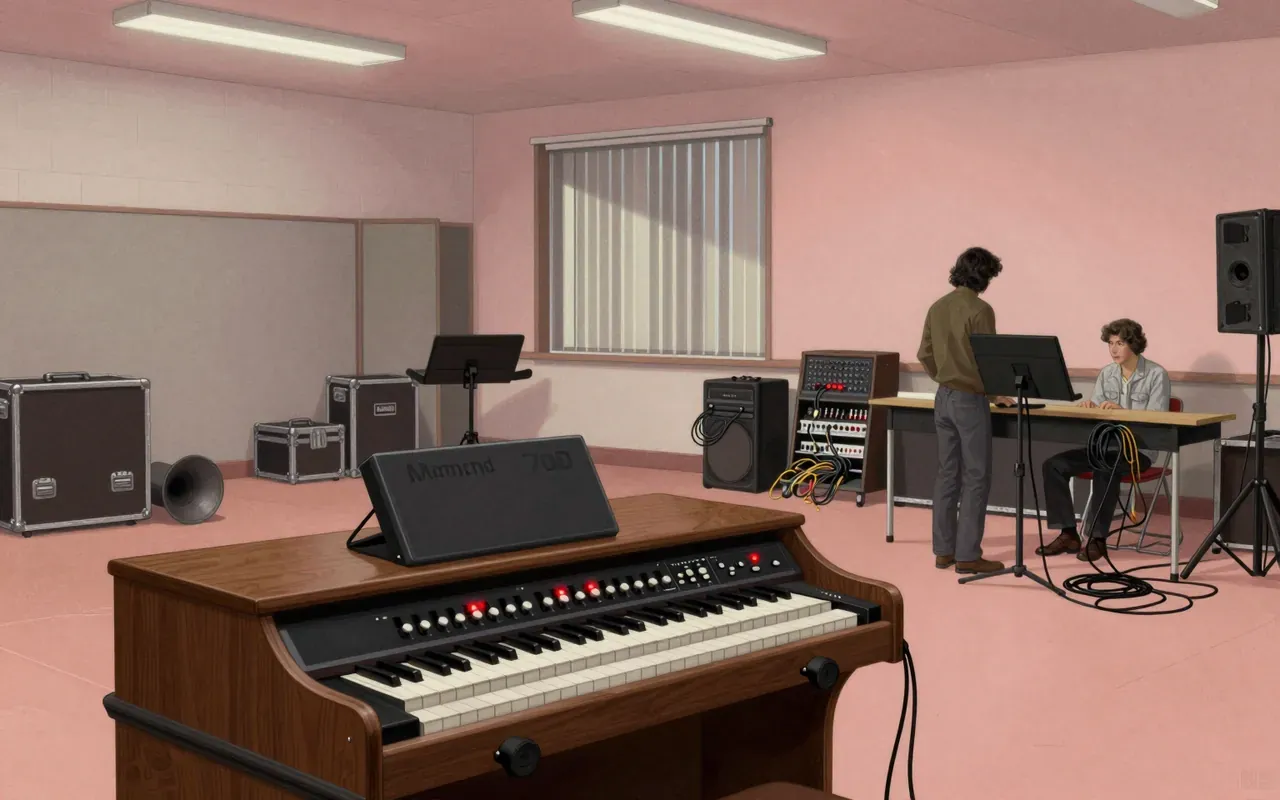
Korg miniKORG 700

A vocal filter on rails — built for organists, not engineers.

The miniKORG 700 is Korg’s first monophonic analog synthesizer, released in 1973. Designed for organists, it sits atop an organ with controls facing upward. It features five oscillator waveforms including two pulse-width modulation variants, an envelope with attack and 'singing' (decay/release), a 'sustain' toggle that functions only as release, and a dual-filter 'Traveler' system with a safety constraint preventing silence. Its filters produce vocal-like sounds.

Chapters & takeaways4
  1. 0:58
    First

    It was Korg’s first synth — and their first mass-produced monophonic analog instrument.

  2. 2:16
    Built for organists

    Its layout puts all controls below the keyboard, facing up — designed to sit atop an organ and be played by organists.

  3. 4:06
    Envelope without sustain

    It replaces traditional ADSR with attack + 'singing' (decay/release) and a 'sustain' toggle that only gates release.

  4. 5:38
    Vocal filter by design

    The 'Traveler' control links low-pass and high-pass filters with a hard safety limit — no silence, just vocal sweeps.

Worth your time?

Yes. Use the whole thing.

3.5/ 5
What works
  • vocal-like filter sweeps
  • Chorus I and II pulse-width textures
  • immediate tactile control for organists
What does not
  • support polyphony
  • include LFO
  • offer external audio input
  • provide traditional sustain stage
Use it if
  • organists
  • players wanting vocal filter sweeps
  • tactile monosynth users
Skip it if
  • producers needing presets
  • sequencing-focused users
  • multitimbral players
The written brief1 min read

What it is and what it was built for

Korg’s first monophonic analog synthesizer. Released in 1973. Designed for organists. Built to sit on top of an organ, with controls facing upward and spaced for tactile use.

How it works, in terms a player would use

It uses five oscillator waveforms: sine, square, sawtooth, and two pulse-width modulation waveforms called Chorus I and II. Its envelope has an attack knob and a ‘singing’ control that sets both decay and release duration. A toggle labelled ‘sustain’ acts as a release switch. The ‘Traveler’ control blends dual 12dB/oct low-pass and high-pass filters with a safety constraint — the low-pass cannot exceed the high-pass, preventing silence.

What it does better than anything else

It delivers vocal-like filter sweeps more intuitively than most early synths — the ‘Traveler’ control moves both filters in tandem while enforcing a safe frequency window. The Chorus I and II waveforms produce rich, swirling textures without extra circuitry.

What it does badly

It offers no sustain stage in the traditional sense. The ‘sustain’ toggle is only a release gate, tied to the ‘singing’ control. It has no vibrato, no LFO, no external audio input, and no way to hold a note without retriggering.

What people made with it

The sources do not state what people made with it.

Who should use it, and who should not

Organists who want hands-on, vocal-filtered monosynths with immediate response. Not for producers needing presets, sequencing, or multitimbral control.

Is it worth your time

Yes — if you want tactile, vocal-filtered monophonic synthesis built for organists in 1973. No — if you need polyphony, patch memory, or modern modulation routing.
Same bench · Synths & drum machines4 of 119
8:29
Novation Digital Music SystemsNovation · 1992The MM10 is a 1992 portable keyboard controller made by Novation Digital Music Systems. It was built to operate with the Yamaha QY10. It has no sound engine. It runs on batteries. It has full-sized keys. It forms, with the QY10, the first completely portable modern music workstation.
8:19
Mutable Instruments BraidsMutable InstrumentsBraids delivers radical timbral variety in minimal space—but with no internal editing, no tuning stability guarantees, and no analogue circuitry. It is a selector, not a synthesizer.
8:40
Mutable Instruments CloudsMutable InstrumentsClouds is a granular audio processor for Eurorack that transforms live input into dense, overlapping grains. It records continuously into a short, variable buffer (up to 8 seconds), allows freezing that buffer to isolate a sonic space, and provides hands-on control over grain position, size, pitch, density, timing distribution, and envelope shape. A diffuser blurs transients using all-pass filters. It supports 40–60 concurrent grains and operates in stereo with extensive CV control, dry/wet blending, feedback, and reverb-like effects during freeze mode. It does not store or recall samples, nor does it support offline processing or waveform editing.
10:15
Doepfer Dark EnergyDoepferA compact, monophonic, fully analog synthesizer released in 2010 as a stand-alone version of the Doepfer A-111-5 Eurorack module. It features dual LFOs capable of audio-rate FM (~5 kHz), a 24 dB/octave low-pass VCF, and a triangle-based VCO. The VCF can function as a sine oscillator when the VCO is disengaged and resonance is maxed. All sound generation and modulation are analog; only USB/MIDI contain digital components. It has no polyphony, no patch memory, no velocity or aftertouch, and no audio input. Superseded by the Dark Energy II in 2012.
Up next in Audio

Korg Mono/Poly

Korg · 10:58

The Mono/Poly isn’t half-polyphonic — it’s monophonic with four oscillators fighting over one filter.

10:58