audiobriefs
9:26in productionCh. 1 · No cables, no compromises?/ 9:26 · ceiling 15 min
Synths & drum machines · Instruments

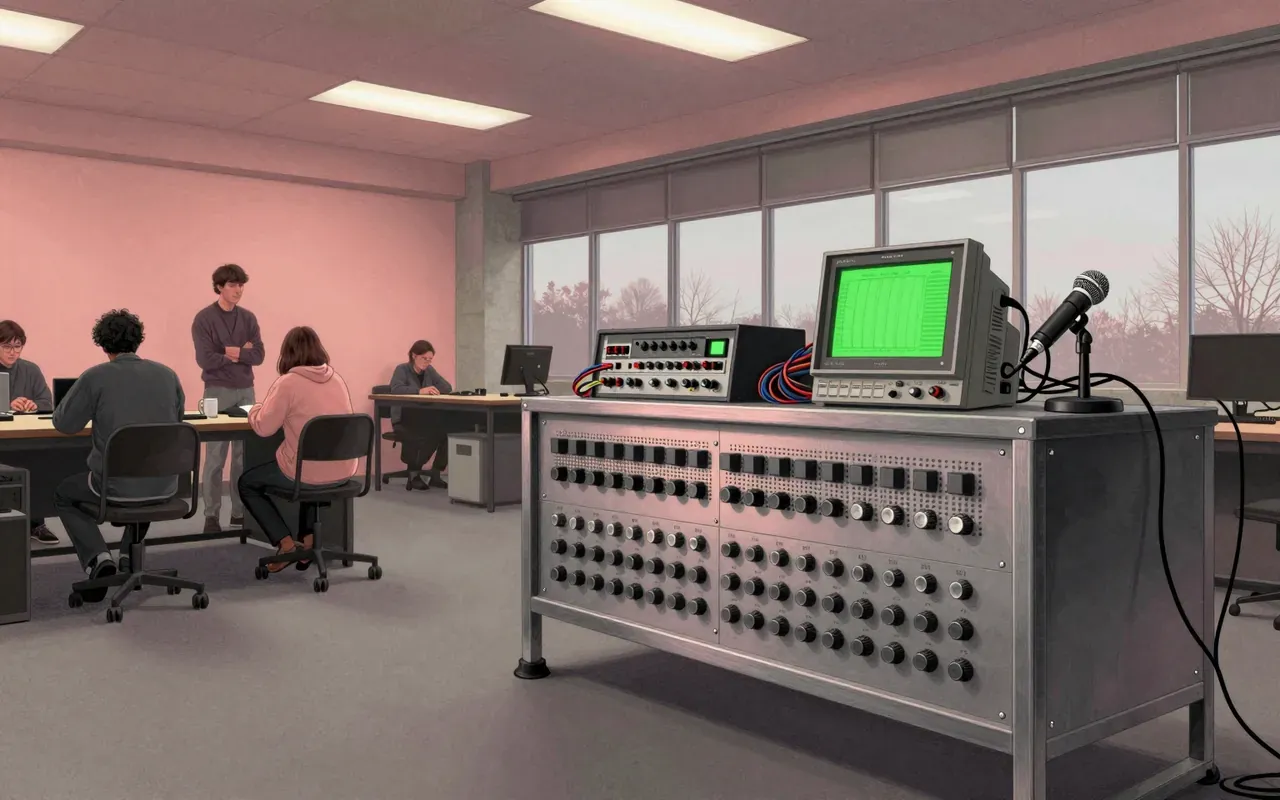
ARP 2500

Cable-free patching and rock-solid tuning—but only if you’re willing to clean the switches every week.

The ARP 2500 is a monophonic or duophonic analog modular synthesizer introduced in 1970 as the first product of ARP Instruments. It used matrix switches instead of patch cables, enabling a cable-free experience but suffering from dirty connections and crosstalk. Its voltage-controlled oscillators achieved good tuning stability compared to competitors, due to patented exponential converters and a dual core design. The matrix switch scheme allowed any module's output to connect to any other module's input.

Chapters & takeaways4
  1. 0:54
    No cables, no compromises?

    It was ARP’s first instrument—and the first synth to replace patch cords with matrix switches.

  2. 2:33
    Tuning that stuck

    Its oscillators stayed in tune where others drifted—thanks to patented converters and dual cores.

  3. 4:09
    Full routing, zero cables

    Any output could go to any input—no rewiring, just switching.

  4. 6:06
    The price of convenience

    Those switches wore out fast—causing noise, bleed, and dropouts.

Worth your time?

Yes. Use the whole thing.

3.5/ 5
What works
  • whatItDoesBetter
  • howItWorksIn
What does not
  • whatItIsAnd
  • whatItDoesBadly
Use it if
  • whatItIsAnd
  • whoShouldUseIt
Skip it if
  • whoShouldUseIt
The written brief1 min read

What it is and what it was built for

It is a monophonic or duophonic analog modular synthesizer. It was the first product of ARP Instruments, built from 1970 to 1981. It was built for studio composition and experimental sound design—not stage portability or polyphony.

How it works, in terms a player would use

It uses matrix switches to route signals: flip a switch to connect any module output to any input. No cables. No re-patching mid-performance. The switches are tactile but prone to intermittent contact.

What it does better than anything else

Its voltage-controlled oscillators deliver better tuning stability than competitors, thanks to patented exponential converters and a dual core design. It holds pitch across temperature shifts and extended play.

What it does badly

Its matrix switches suffer from dirty connections and crosstalk. Signal integrity degrades over time. There is no workaround—only cleaning, adjustment, or replacement.

What people made with it

The sources do not specify what people made with it.

Who should use it, and who should not

A studio-based sound designer who values stable tuning and wants to explore matrix-based routing without cables. Not for gigging musicians, beginners, or anyone unwilling to service vintage switch contacts.

Is it worth your time

Yes—if you want stable tuning and cable-free patching in a monophonic or duophonic analog modular, and can tolerate maintenance on aging switches. No—if you need reliability for live performance without prep time or troubleshooting.
Same bench · Synths & drum machines4 of 119
8:29
Novation Digital Music SystemsNovation · 1992The MM10 is a 1992 portable keyboard controller made by Novation Digital Music Systems. It was built to operate with the Yamaha QY10. It has no sound engine. It runs on batteries. It has full-sized keys. It forms, with the QY10, the first completely portable modern music workstation.
8:19
Mutable Instruments BraidsMutable InstrumentsBraids delivers radical timbral variety in minimal space—but with no internal editing, no tuning stability guarantees, and no analogue circuitry. It is a selector, not a synthesizer.
8:40
Mutable Instruments CloudsMutable InstrumentsClouds is a granular audio processor for Eurorack that transforms live input into dense, overlapping grains. It records continuously into a short, variable buffer (up to 8 seconds), allows freezing that buffer to isolate a sonic space, and provides hands-on control over grain position, size, pitch, density, timing distribution, and envelope shape. A diffuser blurs transients using all-pass filters. It supports 40–60 concurrent grains and operates in stereo with extensive CV control, dry/wet blending, feedback, and reverb-like effects during freeze mode. It does not store or recall samples, nor does it support offline processing or waveform editing.
10:15
Doepfer Dark EnergyDoepferA compact, monophonic, fully analog synthesizer released in 2010 as a stand-alone version of the Doepfer A-111-5 Eurorack module. It features dual LFOs capable of audio-rate FM (~5 kHz), a 24 dB/octave low-pass VCF, and a triangle-based VCO. The VCF can function as a sine oscillator when the VCO is disengaged and resonance is maxed. All sound generation and modulation are analog; only USB/MIDI contain digital components. It has no polyphony, no patch memory, no velocity or aftertouch, and no audio input. Superseded by the Dark Energy II in 2012.
Up next in Audio

ARP Instruments

ARP · 1969 · 9:37

ARP didn’t chase Moog’s patch-cord mystique—it built synths that stayed in tune and got played.

9:37