audiobriefs
9:36in productionCh. 1 · Three sections, one keyboard/ 9:36 · ceiling 15 min
Synths & drum machines · Instruments

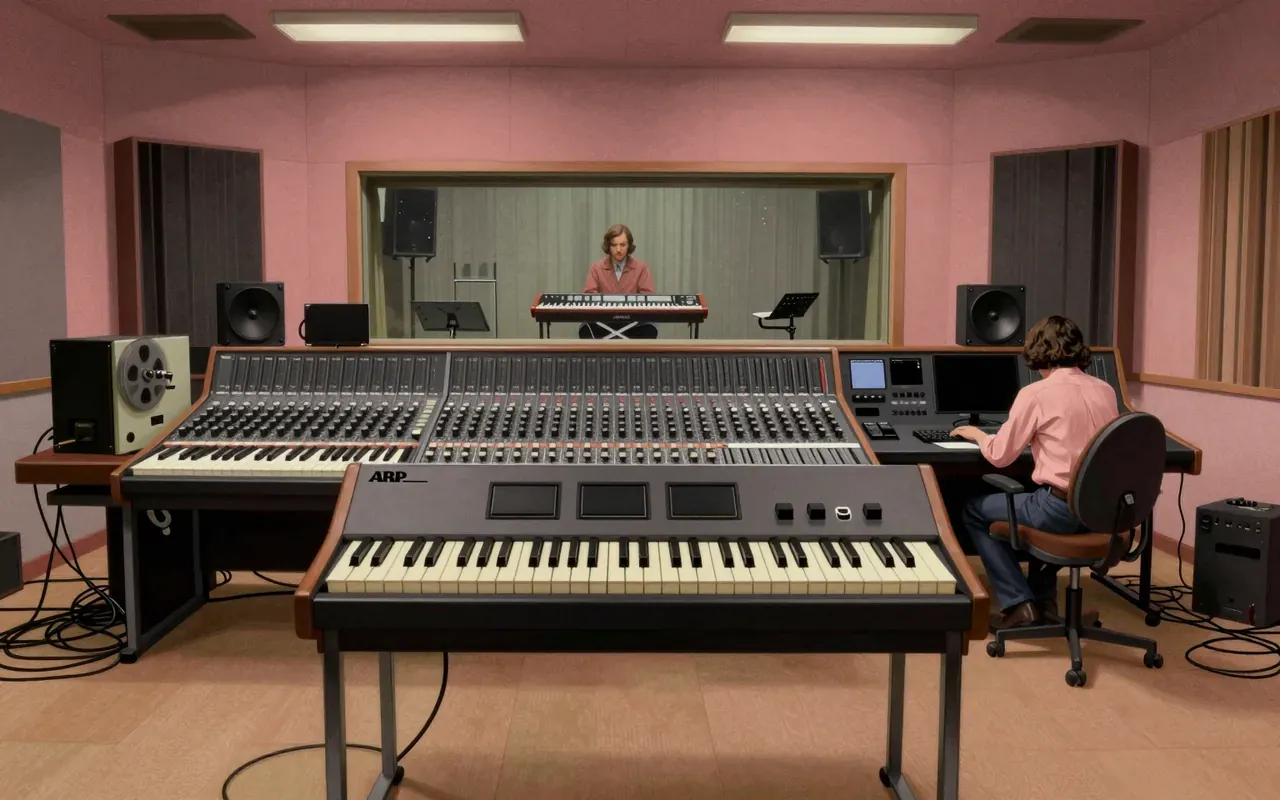
ARP Omni

It doesn’t synthesise—it delegates: one oscillator, three fixed sections, and chorus only on the strings.

The ARP Omni is a polyphonic analog synthesizer with preset orchestral string voices, a monophonic bass section, and a polyphonic synthesizer section featuring a 24 dB/oct VCF, ADSR envelope, triangle LFO, and waveform enhancement switch. Its string and synth sections used divide-down architecture for full polyphony, and it offered simultaneous, mixable, separately outputted sections — Strings, Synthesizer, and Bass — with onboard chorus phasing applied primarily to the strings.

Chapters & takeaways4
  1. 1:03
    Three sections, one keyboard

    Three sections—Strings, Synthesizer, Bass—are always on, always mixable, always separate.

  2. 2:44
    No note stealing, ever

    Divide-down polyphony means no voice stealing—every key plays, every time.

  3. 4:06
    Synth section: minimal, not flexible

    One filter, one LFO, one envelope—and only one waveform choice at a time.

  4. 6:09
    Chorus is a string-only effect

    Chorus phasing is locked to the Strings—and only the Strings.

Worth your time?

Yes. Use the whole thing.

3.5/ 5
What works
  • full polyphony without voice stealing
  • simultaneous, separately routed sections
  • chorus-drenched string texture with zero setup
What does not
  • filter resonance
  • velocity sensitivity
  • aftertouch
  • oscillator sync
Use it if
  • players who need stable, no-setup string textures
  • producers seeking vintage analog layering without patching
Skip it if
  • sound designers needing deep modulation
  • performers requiring expressive articulation
  • anyone needing modern DAW integration
The written brief2 min read

What it is and what it was built for

The ARP Omni is a polyphonic analog synthesizer built to deliver preset orchestral string voices alongside a basic polyphonic synth and monophonic bass—all simultaneously playable and separately routable.

How it works, in terms a player would use

The Omni has three separate, mixable sections: Strings, Synthesizer, and Bass. The Strings use divide-down architecture with a Mostek MK50240 IC for full polyphony. The Synthesizer section is polyphonic and features a 24 dB/oct VCF, ADSR envelope, triangle LFO, and a Waveform Enhancement switch that toggles between quasi-sawtooth and square wave. The Bass section is monophonic. Only the Strings pass through the onboard chorus phaser. All sections have dedicated rear-panel outputs.

What it does better than anything else

It delivers stable, fully polyphonic string textures with built-in chorus phasing—more reliably and densely than any contemporaneous analog synth with dynamic voice allocation. Its divide-down architecture means no note stealing, no voice prioritisation, and no tuning drift across the keyboard.

What it does badly

It cannot play expressive leads or complex timbres. There is no filter resonance. The LFO only modulates VCF cutoff. The Bass section has no envelope control. The Synthesizer section lacks oscillator sync, pulse-width modulation, or multiple waveforms beyond the switch. It offers no keyboard velocity or aftertouch.

What people made with it

It was used for string pads, basslines, and layered synth textures in late 1970s pop, soul, and early electronic recordings—where its stable, chorus-drenched strings provided immediate, no-tweak atmosphere.

Who should use it, and who should not

A player who wants hands-on, no-patch-cord polyphonic strings and simple synth layers without digital emulation or software abstraction. Not for sound designers needing deep modulation, performers needing expressive articulation, or anyone requiring modern workflow integration.

Is it worth your time

Yes—if you need lush, stable, fully polyphonic strings with a simple synth layer and bass, all in one box, and can accept single-oscillator limitations and no filter resonance or modulation routing beyond the VCF.
Same bench · Synths & drum machines4 of 119
8:29
Novation Digital Music SystemsNovation · 1992The MM10 is a 1992 portable keyboard controller made by Novation Digital Music Systems. It was built to operate with the Yamaha QY10. It has no sound engine. It runs on batteries. It has full-sized keys. It forms, with the QY10, the first completely portable modern music workstation.
8:19
Mutable Instruments BraidsMutable InstrumentsBraids delivers radical timbral variety in minimal space—but with no internal editing, no tuning stability guarantees, and no analogue circuitry. It is a selector, not a synthesizer.
8:40
Mutable Instruments CloudsMutable InstrumentsClouds is a granular audio processor for Eurorack that transforms live input into dense, overlapping grains. It records continuously into a short, variable buffer (up to 8 seconds), allows freezing that buffer to isolate a sonic space, and provides hands-on control over grain position, size, pitch, density, timing distribution, and envelope shape. A diffuser blurs transients using all-pass filters. It supports 40–60 concurrent grains and operates in stereo with extensive CV control, dry/wet blending, feedback, and reverb-like effects during freeze mode. It does not store or recall samples, nor does it support offline processing or waveform editing.
10:15
Doepfer Dark EnergyDoepferA compact, monophonic, fully analog synthesizer released in 2010 as a stand-alone version of the Doepfer A-111-5 Eurorack module. It features dual LFOs capable of audio-rate FM (~5 kHz), a 24 dB/octave low-pass VCF, and a triangle-based VCO. The VCF can function as a sine oscillator when the VCO is disengaged and resonance is maxed. All sound generation and modulation are analog; only USB/MIDI contain digital components. It has no polyphony, no patch memory, no velocity or aftertouch, and no audio input. Superseded by the Dark Energy II in 2012.
Up next in Audio

ARP Quadra

ARP · 9:18

A four-zone analog synth that forces you to play — not program — and breaks every time you try to save.

9:18