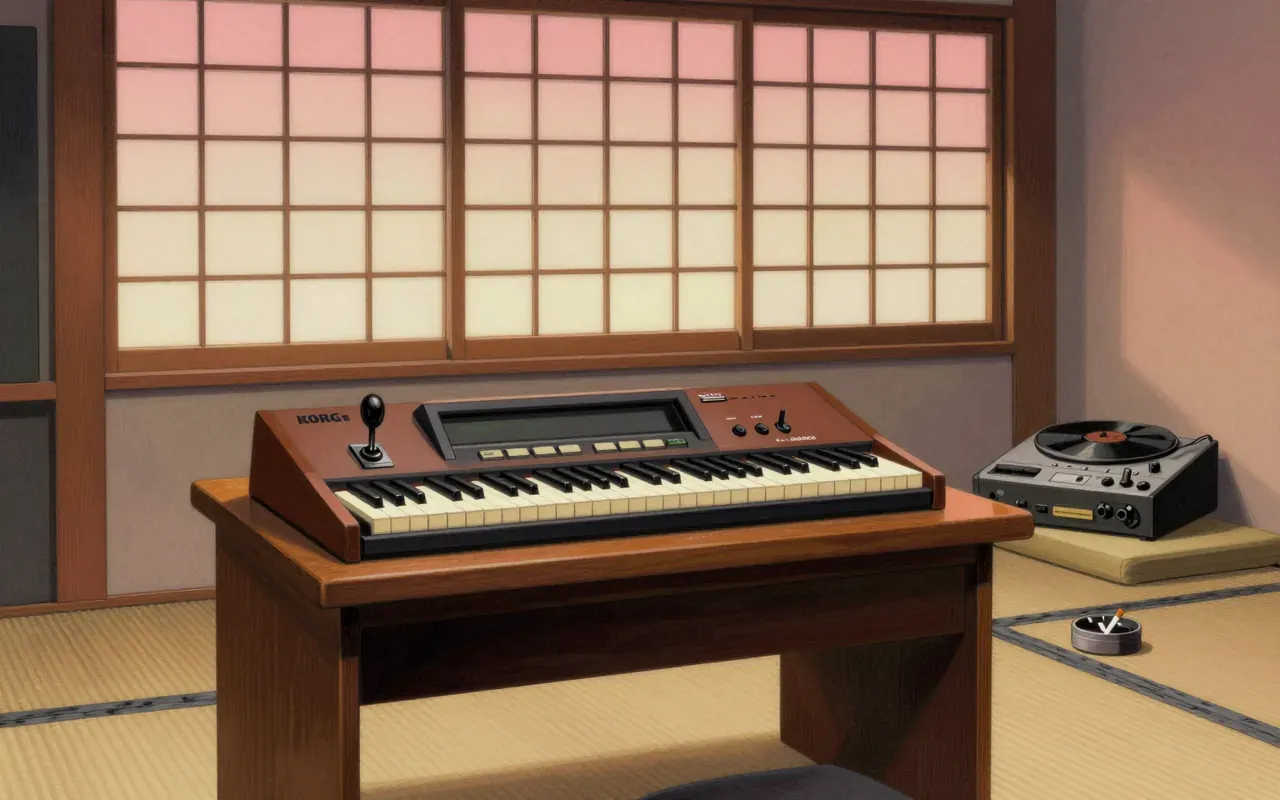
What it is and what it was built for
A sampling-based, 8-voice desktop drum machine and MIDI sequencer released by Roland in 1986. Built for live sequencing, studio sketching, and tight integration with early MIDI gear — not for deep sound design or expressive playing.
How it works, in terms a player would use
It has 16 non-velocity-sensitive pads. Each pad triggers one of 16 PCM drum samples. Accent adjusts volume per step. Patterns are one measure long, 16 steps, 4/4 default. You store 48 factory and 48 user patterns across six groups — A–C for factory, D–F for user.
What it does better than anything else
It integrates five Latin percussion voices — congas, timbales, cowbells — without expansion hardware. It sequences tightly with MIDI clock. Its 25 kHz, 8-bit PCM samples deliver a brittle, immediate snap that cuts through lo-fi mixes without masking.
What it does badly
It cuts off sounds when polyphony is exceeded: low and hi conga cannot sound together; crash and ride cymbals exclude each other; closed and open hi-hat are mutually exclusive. Accent is the only dynamic control. There is no swing, no shuffle, no time-signature variation.
What people made with it
It appears on recordings where crisp, unvarnished 80s rhythm tracks were needed — especially where Latin percussion had to sit alongside standard kit sounds without extra modules or cards.
Who should use it, and who should not
Producers who value immediacy over flexibility. Anyone building a minimal 80s-style setup with TR-707 or Juno synths. Not for players who rely on dynamics, extended pattern forms, or layered cymbal work.
Is it worth your time
Yes — if you want a compact, MIDI-synced sequencer with Latin percussion built in and no synthesis layer to manage. No — if you need velocity response, simultaneous cymbal and tom hits, or pattern lengths beyond one bar.