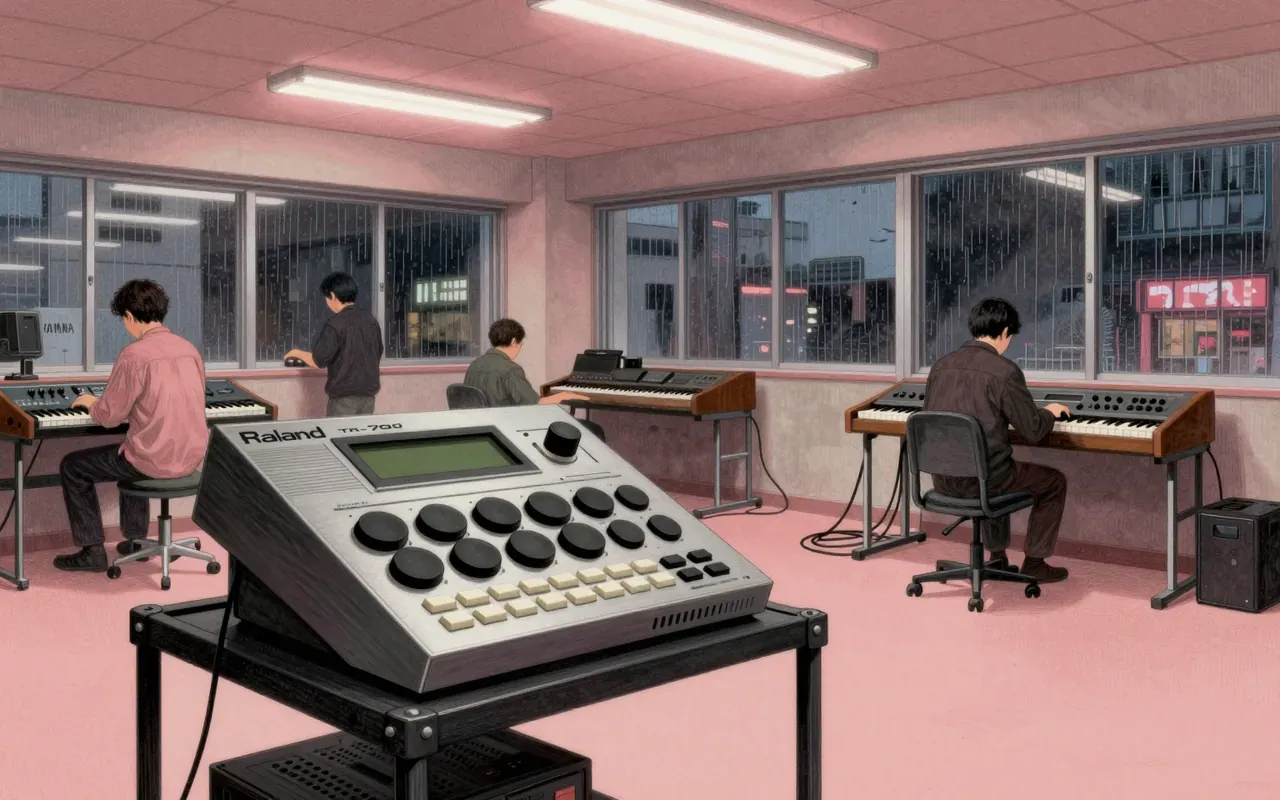
What it is and what it was built for
A digitally sampled drum machine built for live sequencing and studio integration in 1985. It was designed to replace analog drum machines with fixed, repeatable, hardware-synced rhythms — not to emulate acoustic kits or offer expressive control.
How it works, in terms a player would use
It programs patterns step-by-step or by tapping in real time. It offers 64 patterns, four global shuffle levels, and flam on any individual step. Each pattern runs on one of four tracks. It outputs MIDI and DIN sync signals — but only as a master, never as a slave.
What it does better than anything else
It delivers the first fully sampled Roland drum voice set with analog envelope smoothing to tame quantisation noise. Its shuffle is binary and unyielding — a rhythmic anchor, not a subtle groove. Its individual outputs let you route each voice to separate channels for processing.
What it does badly
It cannot be synced to from other gear. Crash and ride cymbals are 6-bit: thin, brittle, with unnaturally long sustain. All sounds suffer compressed dynamics from low bit depth. There is no per-sound envelope control — only analog circuitry shaping decay globally for certain voices.
What people made with it
The sources do not state what people made with it.
Who should use it, and who should not
Use it if you work with late-1980s Roland synths and sequencers and want uncompromising, hardware-locked timing and a specific low-bit timbre. Avoid it if you rely on DAW sync, need per-voice dynamics, or require crash cymbals that decay naturally.
Is it worth your time
Yes — if you need a rigid, characterful, fixed-voice drum machine that locks into vintage Roland gear and imposes its own low-bit texture. No — if you need swing variation per sound, external sync control, or dynamic cymbal decay.