What it is and what it was built for
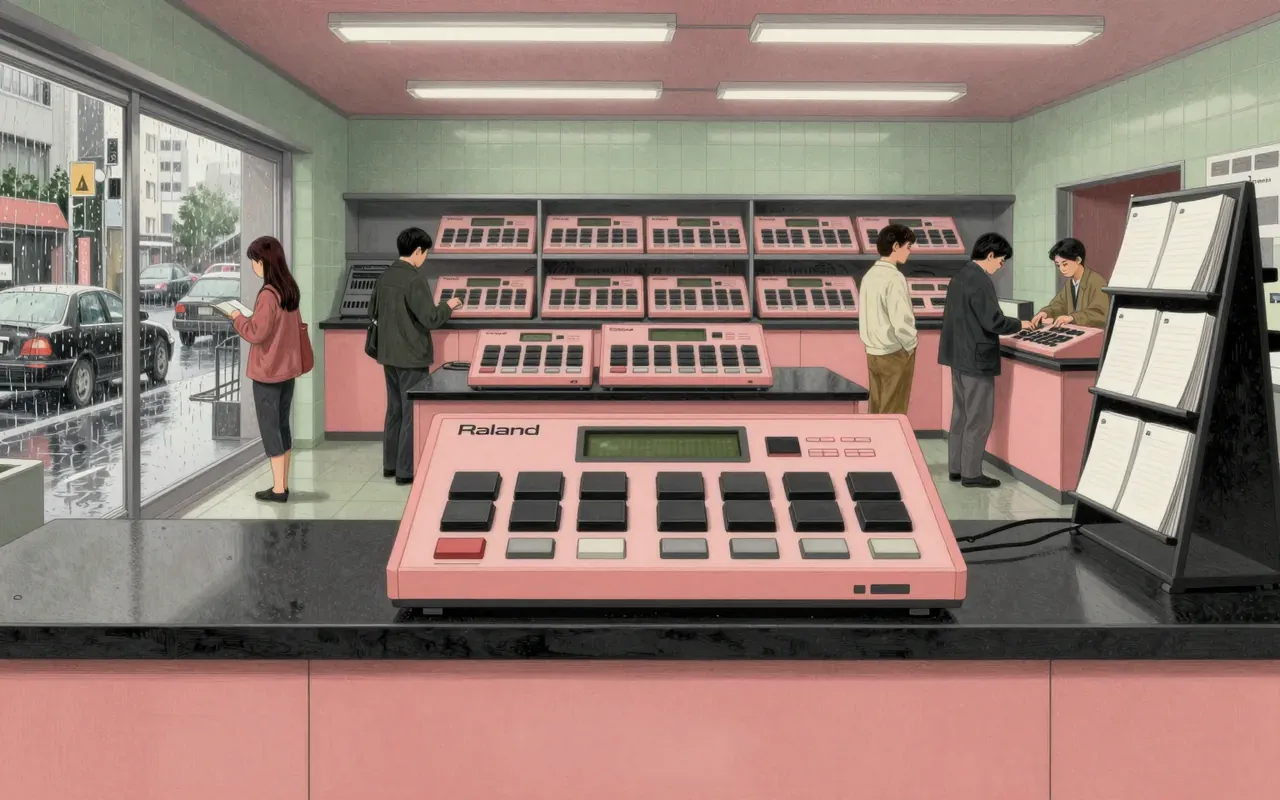
Roland Corporation is a Japanese instrument manufacturer founded in 1972. It built synthesizers, drum machines, guitar synths, and sequencers to give musicians programmable, portable, and reproducible electronic sound — starting with the SH-1000, the first compact Japanese synthesizer.
How it works, in terms a player would use
Roland Corporation built instruments with physical controls, preset and programmable memory, and signal paths that prioritised immediacy over flexibility — the TR-808 had step-time programming and analogue drum voices; the D-50 used sample-based synthesis with digital filters and envelopes; the GR-500 required guitar-to-MIDI conversion via a special pickup and hexaphonic cable.
What it does better than anything else
It delivers immediate, characterful sound generation with minimal setup: the TB-303’s squelching filter, the TR-808’s booming kick, the Juno-106’s chorus-drenched pads — all respond predictably to knob turns and button presses.
What it does badly
It does not support real-time parameter automation across devices without MIDI. It offers no built-in effects processing beyond basic filtering or chorus. Its sequencers lack swing quantisation, velocity editing, or pattern chaining beyond fixed lengths.
What people made with it
Producers made Chicago house with the TB-303 and TR-808. Detroit techno artists used the TR-909 and D-50. Synth-pop bands relied on the Juno-106. Early electronic composers used the MC-8 MicroComposer for precise, microprocessor-driven sequencing.
Who should use it, and who should not
Use it if you work with hardware-first workflows, value hands-on control, and want sounds that carry genre-defining weight. Do not use it if your practice depends on deep sound design, seamless DAW integration, or polyphonic aftertouch and MPE.
Is it worth your time
Yes — if you need tools that shaped entire genres and still function as direct, tactile interfaces for rhythm, bass, and texture. No — if you expect modern editing, deep modulation, or compatibility without adaptation.