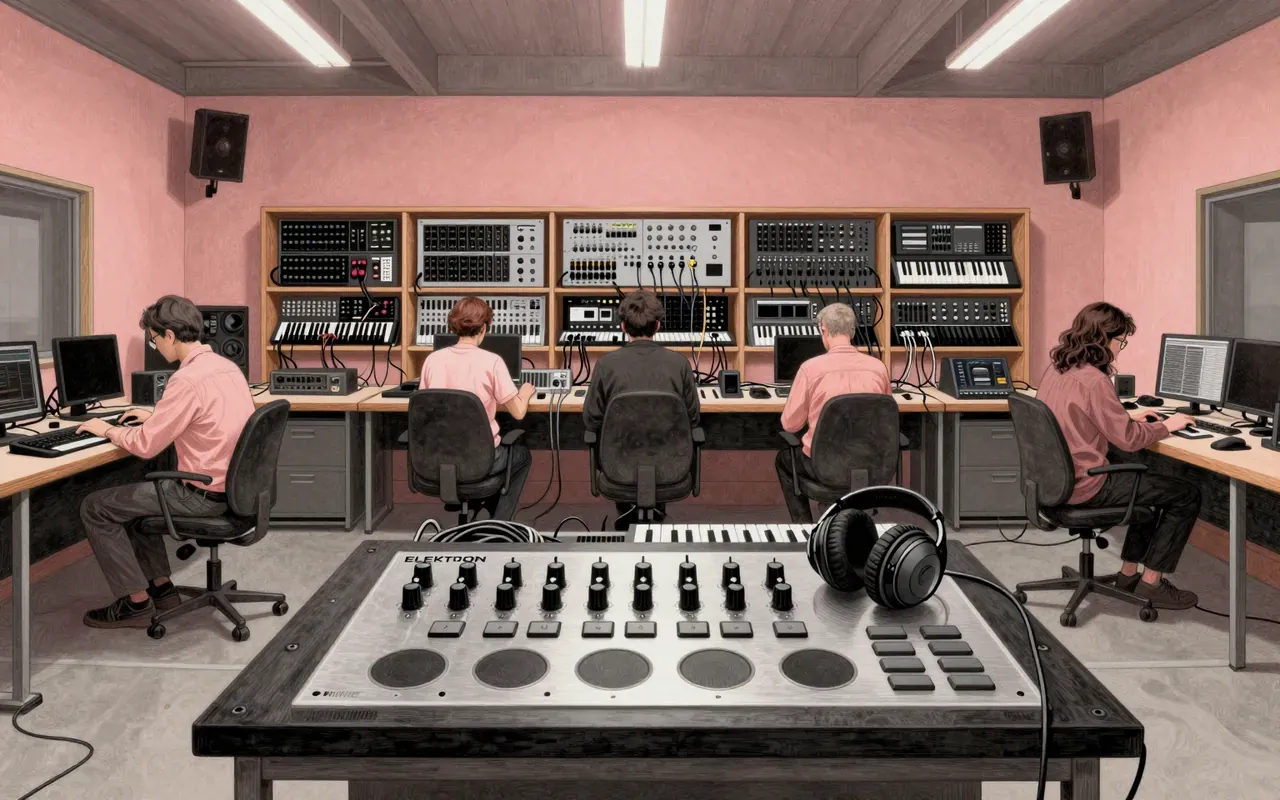
It doesn’t make beats—it mutates them, one oscillator and one locked parameter at a time.
The Analog Rytm is a true analog drum synth. It gives each voice its own engine, up to six oscillators, and a 16-step sequencer. Its pads are velocity-sensitive but small. It enables radical timbral shifts across voices with minimal changes. It falls short on pad ergonomics, stereo per voice, and external audio input. It belongs in the studio of a sound designer—not a live beatmaker.
It is explicitly called a true analog drum synth—not just a drum machine.
2:13
One engine per voice
Each voice runs its own engine and 16-step sequencer, with velocity-sensitive pads for real-time recording.
4:17
Up to six oscillators per voice
Oscillator count varies by voice: Bass Drum uses 2, Cymbal uses 6—and every voice gets its own analog noise source.
5:51
Timbre is editable, not fixed
Radical timbral shifts happen with minimal parameter changes—snare to tom to insect in seconds.
Worth your time?
Yes. Use the whole thing.
4.5/ 5
What works
radical timbral transformation
voice-specific analog engines
parameter locking across steps
What does not
make beats intuitively
support expressive pad performance
offer stereo per voice
Use it if
sound designers
electronic composers
Skip it if
beatmakers relying on pad feel
sample-first producers
The written brief1 min read
What it is and what it was built for
A true analog drum synth released in 2014. Built to follow the Tempest (2011) as Elektron’s second-generation analog drum instrument—designed for deep timbral control, not just preset playback.
How it works, in terms a player would use
Each of the eight voices has its own dedicated analog engine and a 16-step sequencer. Pads are velocity-sensitive and support real-time playing and recording—quantized or unquantized. Parameter locking lets you morph timbre step-by-step across a pattern.
What it does better than anything else
It transforms drum voices more radically than any other analog drum machine: a snare can become a tom or a glitchy insect with just a few parameter changes. Each voice has up to six oscillators and its own analog noise source—unlike the Tempest.
What it does badly
The pads are smaller than an MPC’s and take adjustment. There is no built-in audio input for external sound processing. It offers no stereo output per voice—only global left/right.
What people made with it
Producers used it for evolving, non-repetitive percussion textures in electronic, experimental, and club music—leveraging parameter locking and voice-specific engines to generate organic variation within rigid sequences.
Who should use it, and who should not
Sound designers and electronic composers who prioritise timbral mutation and sequencing precision over immediacy or groove-based playability. Not for beatmakers who depend on large, responsive pads or fast sample loading.
Is it worth your time
Yes—if you need radical, hands-on analog drum synthesis with sequencing depth and hybrid flexibility. No—if you rely on intuitive workflow, expressive pad feel, or sample-first design.