audiobriefs
9:36in productionCh. 1 · Built, not designed/ 9:36 · ceiling 15 min
Synths & drum machines

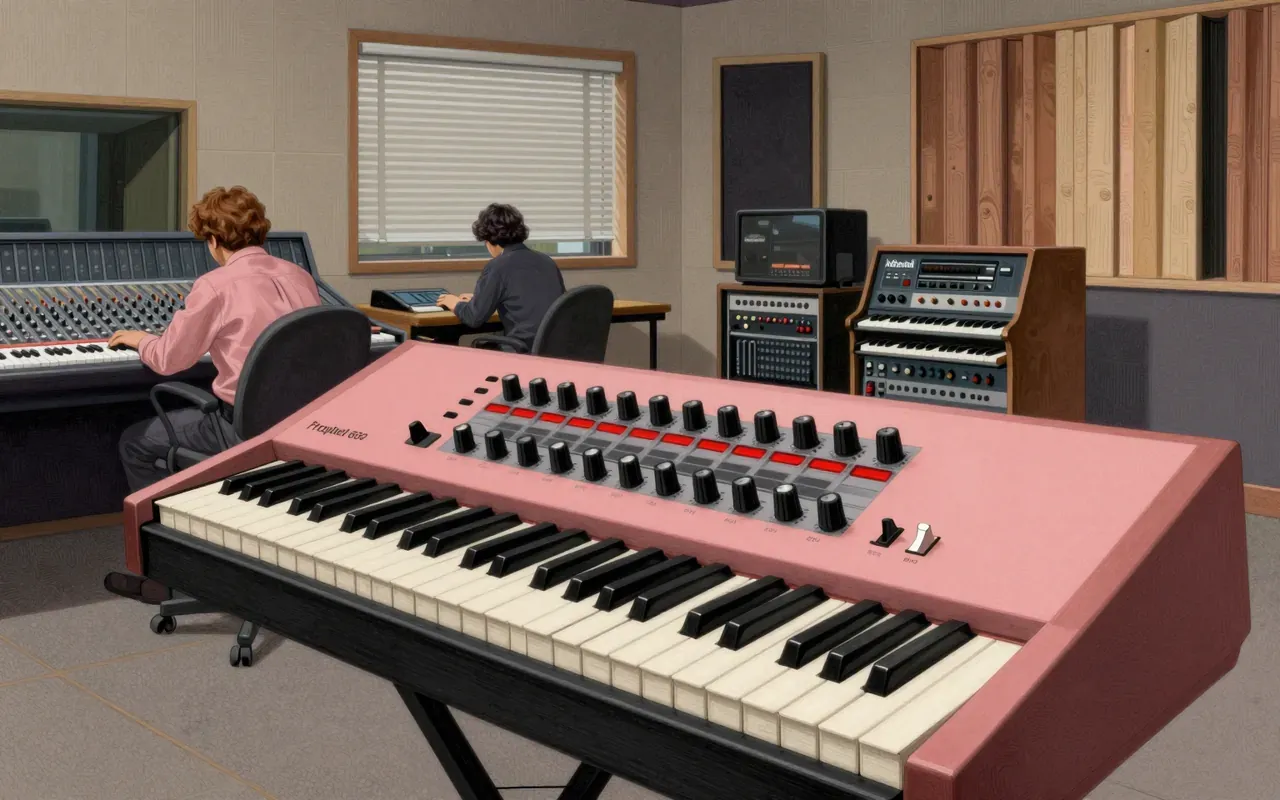
Sequential Circuits Prophet-10

Ten voices of pure analog weight — if you can keep it cool and in tune.

The Prophet-10 is two Prophet-5s stacked into one instrument. It delivers ten-voice analog thickness no other 1980 synth matches. But it overheats, detunes, and demands physical and technical concessions. Version 3 fixes stability with CEM chips — at the cost of low-end weight.

Chapters & takeaways4
  1. 0:49
    Built, not designed

    It is two Prophet-5s bolted together — no digital layer, no compromise on analog voice count.

  2. 1:54
    The chip swap that split opinion

    Version 3 fixed overheating and tuning — but traded SSM warmth for CEM precision.

  3. 3:28
    Why 'fat' isn't hype

    It remains one of the fattest vintage synths — because fat comes from ten independent analog oscillators, not marketing.

  4. 5:38
    The best version is the least loved

    Version 3 is the only one stable enough for serious use — but it sounds thinner than the earlier, unstable versions.

Worth your time?

Yes. Use the whole thing.

3.5/ 5
What works
  • as a ten-voice analog layering engine
  • as a statement of pre-MIDI analog ambition
  • as a benchmark for analog polyphonic weight
What does not
  • work reliably without intervention
  • fit in small spaces
  • suit live performance
  • sound identical across revisions
Use it if
  • studio composers needing dense analog pads
  • collectors prioritising rarity and physical presence
  • technicians comfortable with SSM and CEM chip-level servicing
Skip it if
  • musicians without climate-controlled space
  • players who value consistency over character
  • anyone expecting plug-and-play reliability
The written brief1 min read

What it is and what it was built for

A dual-manual analog synthesizer built by stacking two Prophet-5 units. It was made to extend polyphony beyond five voices while preserving the Prophet-5’s hands-on architecture and sound.

How it works, in terms a player would use

It runs two full Prophet-5 signal paths in parallel — each with its own VCOs, filters, and envelopes — controlled from a dual manual. Players dial in one sound per layer, stack them, and play across 122 keys. Auto-tuning resets drift, but requires stopping play to engage.

What it does better than anything else

It delivers unmatched analog polyphonic thickness — ten simultaneous SSM-based voices in Version 1 or 2, layered with zero digital compromise. Nothing else from 1980 offers that density of discrete analog oscillators in one instrument.

What it does badly

Version 1 overheats and detunes mid-performance. All versions are physically unwieldy: heavy, wide, and loud in operation. The CEM-chip versions sacrifice low-end weight for stability — a real loss for bass and pad work.

What people made with it

Composers and artists used it extensively through the 1980s and 1990s for rich pads, layered leads, and cinematic textures — wherever ten-voice analog weight was required.

Who should use it, and who should not

A studio owner with climate control, space, and a technician on call. Not for gigging musicians, beginners, or anyone who prioritises reliability over sonic character.

Is it worth your time

Only if you need ten-voice analog thickness at the cost of size, heat, and maintenance. It does not scale to modern workflows. It demands space, cooling, and tolerance for chip-dependent sonic trade-offs.

Same bench · Synths & drum machines4 of 243
9:00
Prophet VSSequential CircuitsThe Prophet VS is an 8-voice hybrid synthesizer released in 1986 by Sequential Circuits. It introduced vector synthesis using a diamond-pattern joystick to mix four 12-bit digital single-cycle waveforms per voice, which are then processed through analog CEM3379/3389 chips. Waves 0–31 are user-editable via MIDI sample dump or onboard harmonic mixing; waves 32–126 are fixed in firmware. It does vector morphing better than anything else of its era—but offers no velocity sensitivity, no aftertouch, no effects, and no reliable patch backup.
9:20
Casio CZ synthesizersCasioThe Casio CZ series is a line of low-cost, digitally implemented phase distortion synthesizers introduced by Casio in 1984. They simulate analog filter behaviour without physical filters, using digital phase distortion instead. Each oscillator plays waveforms in series—not parallel—enabling sub-harmonics but restricting waveform pairing. Polyphony drops from eight to four voices when using two oscillators per voice. They were built for amateur musicians, prioritising affordability and portability over expressive control or sonic flexibility.
8:44
Sequential Circuits Prophet-600Sequential CircuitsThe Prophet-600 is a 1982 6-voice analogue synth. It introduced MIDI to commercial instruments. It gives players two oscillators per voice with sync, variable pulse, and triangle/saw waveforms. Its VCF, VCA, and Poly-Mod come from the Prophet-5. It includes an arpeggiator and 2-track sequencer. It glides. It modulates flexibly. It does not track reliably over time. It has no velocity or aftertouch. It is not expandable. It belongs in rooms where history and immediacy matter more than precision.
9:07
Rhodes ChromaRhodesThe Rhodes Chroma is a microprocessor-controlled analog synthesizer originally developed by ARP Instruments, Inc. in 1979–1980 and produced by Rhodes in 1982. It features sixteen-voice polyphony, digitally encoded parameter processing, and software-generated envelopes and LFOs. Its architecture relies on software-based control of analog voice channels, enabling programmable multitimbral synthesis but introducing latency and instability.
Up next in Audio

Sequential Prophet 3000

Sequential · 7:12

A sampler with no editing, no effects, and no reason to exist today.

7:12