audiobriefs
8:44in productionCh. 1 · The First MIDI Keyboard/ 8:44 · ceiling 15 min
Synths & drum machines · Instruments

Sequential Circuits Prophet-600

MIDI’s first keyboard—brilliantly flawed, historically unavoidable.

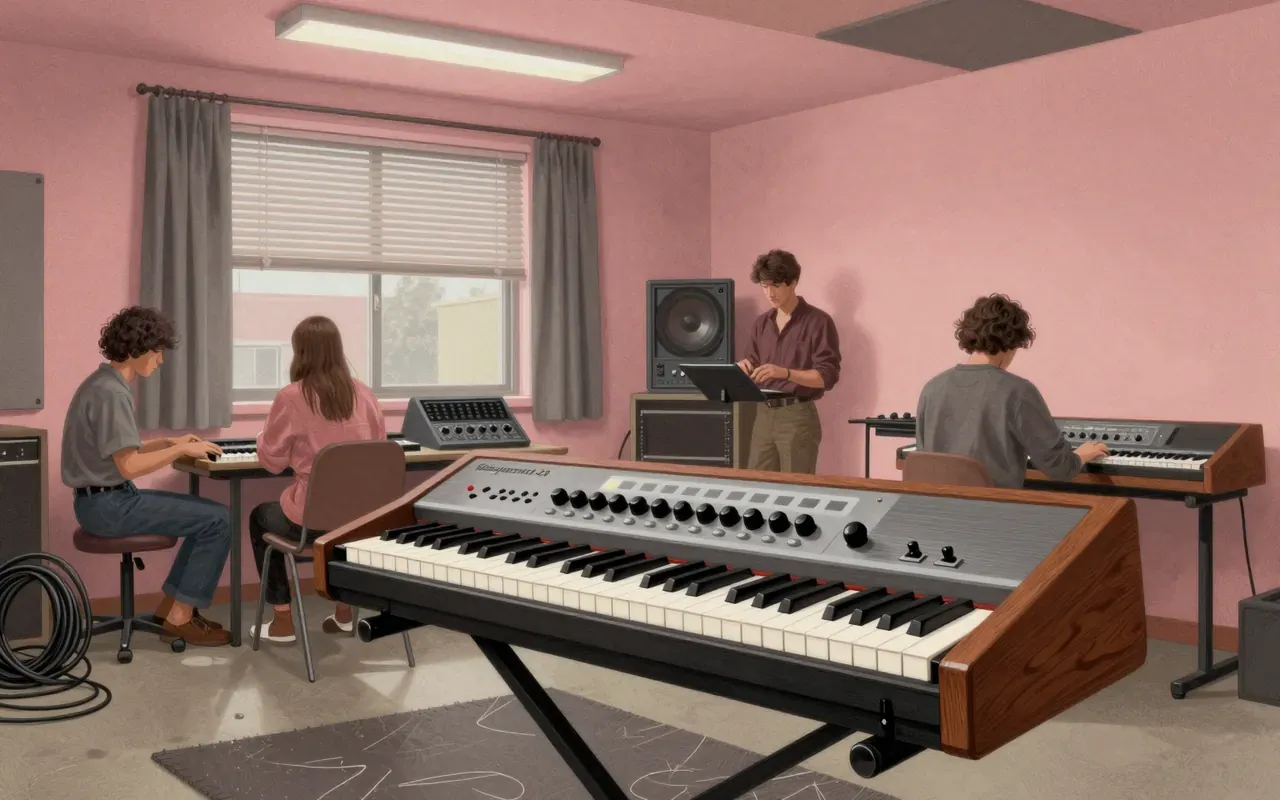
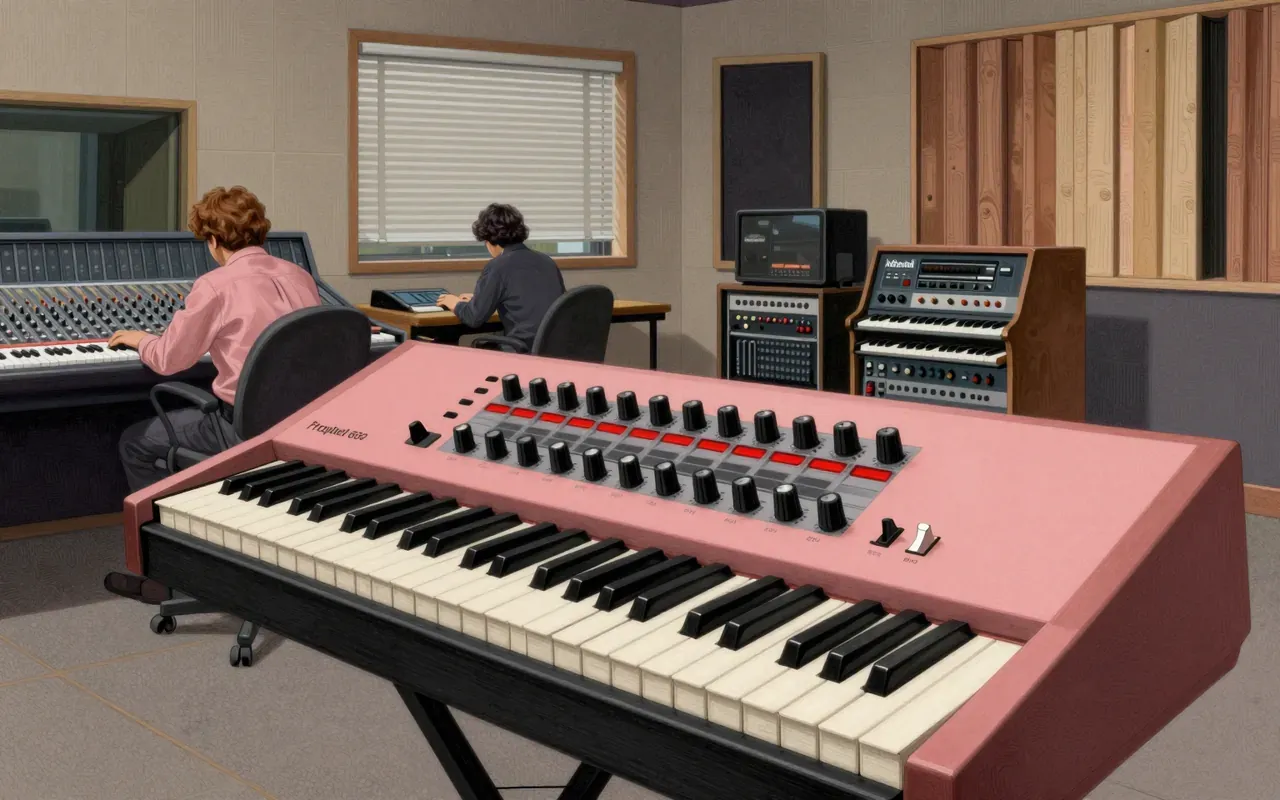
The Prophet-600 is a 1982 6-voice analogue synth. It introduced MIDI to commercial instruments. It gives players two oscillators per voice with sync, variable pulse, and triangle/saw waveforms. Its VCF, VCA, and Poly-Mod come from the Prophet-5. It includes an arpeggiator and 2-track sequencer. It glides. It modulates flexibly. It does not track reliably over time. It has no velocity or aftertouch. It is not expandable. It belongs in rooms where history and immediacy matter more than precision.

Chapters & takeaways4
  1. 0:37
    The First MIDI Keyboard

    It launched MIDI into the world—before any other synth could.

  2. 2:24
    Oscillators That Bite and Blend

    Two oscillators per voice, with sync and variable pulse—giving immediate, gritty control over timbre.

  3. 3:43
    Prophet-5 Parts, Reused and Refined

    Prophet-5 DNA in the filter, mod section, and glide—familiar but narrower in scope.

  4. 5:18
    Sequencing Before It Was Standard

    Arpeggiator and 2-track sequencer built in—no external gear needed for looping ideas.

Worth your time?

Yes. Use the whole thing.

3.5/ 5
What works
  • as the first MIDI instrument
  • as a hands-on sequencer and arpeggiator platform
  • as a bridge between Prophet-5 architecture and digital control
What does not
  • support velocity sensitivity
  • support aftertouch
  • offer more than six voices
  • deliver stable long-term tuning
Use it if
  • historians of interface design
  • players who build ideas from arpeggiated loops
  • producers committed to pre-1983 signal flow
Skip it if
  • anyone needing reliable pitch tracking across sets
  • users requiring modern MIDI feature depth
  • those without access to servicing for vintage analogue
The written brief1 min read

What it is and what it was built for

The Prophet-600 is a 6-voice polyphonic analogue synthesizer released in 1982. It was built to bring programmable synthesis, real-time sequencing, and the new MIDI standard into live and studio use.

How it works, in terms a player would use

It has two oscillators per voice with sawtooth, triangle, and variable pulse waveforms. Oscillators can be individually tuned or synced. It uses VCF and VCA sections derived from the Prophet-5. It includes the Prophet-5’s Poly-Mod section. It features an onboard arpeggiator, a 2-track real-time sequencer, glide, and flexible modulation.

What it does better than anything else

It does MIDI implementation better than any synth before 1982—because it was the first commercially available one to do it. Nothing else offered that capability at launch.

What it does badly

It falls short on tuning stability. Its early MIDI implementation lacks later refinements like SysEx or full channel compatibility. It offers no velocity or aftertouch sensitivity. The 2-track sequencer is basic and non-expandable.

What people made with it

It was used in ambient, dub, and electronic music—genres where its arpeggiator, glide, and flexible modulation supported evolving textures and rhythmic repetition.

Who should use it, and who should not

A player who values historical significance, tactile sequencing, and raw analog character should use it. A producer who needs precise intonation, deep patch memory, or USB-MIDI integration should not.

Is it worth your time

Yes—if you need MIDI’s first implementation in hardware and want hands-on polyphonic synthesis with sequencing and arpeggiation built in. No—if you need more than six voices, stable tuning, or modern reliability.
Same bench · Synths & drum machines4 of 243
9:20
Casio CZ synthesizersCasioThe Casio CZ series is a line of low-cost, digitally implemented phase distortion synthesizers introduced by Casio in 1984. They simulate analog filter behaviour without physical filters, using digital phase distortion instead. Each oscillator plays waveforms in series—not parallel—enabling sub-harmonics but restricting waveform pairing. Polyphony drops from eight to four voices when using two oscillators per voice. They were built for amateur musicians, prioritising affordability and portability over expressive control or sonic flexibility.
9:07
Rhodes ChromaRhodesThe Rhodes Chroma is a microprocessor-controlled analog synthesizer originally developed by ARP Instruments, Inc. in 1979–1980 and produced by Rhodes in 1982. It features sixteen-voice polyphony, digitally encoded parameter processing, and software-generated envelopes and LFOs. Its architecture relies on software-based control of analog voice channels, enabling programmable multitimbral synthesis but introducing latency and instability.
9:48
Six-TrakSequential Circuits · 1984The Six-Trak is a six-voice analogue synthesizer released by Sequential Circuits in January 1984. It was built as an inexpensive, portable 'scratch-pad' for trying out arrangements.
9:36
Sequential Circuits Prophet-10Sequential CircuitsThe Prophet-10 is two Prophet-5s stacked into one instrument. It delivers ten-voice analog thickness no other 1980 synth matches. But it overheats, detunes, and demands physical and technical concessions. Version 3 fixes stability with CEM chips — at the cost of low-end weight.
Up next in Audio

Sequential Circuits Prophet-T8

Sequential Circuits · 8:16

The Prophet-T8 isn’t a relic—it’s the only 1983 synth that plays like a piano and sounds like a Prophet-5.

8:16