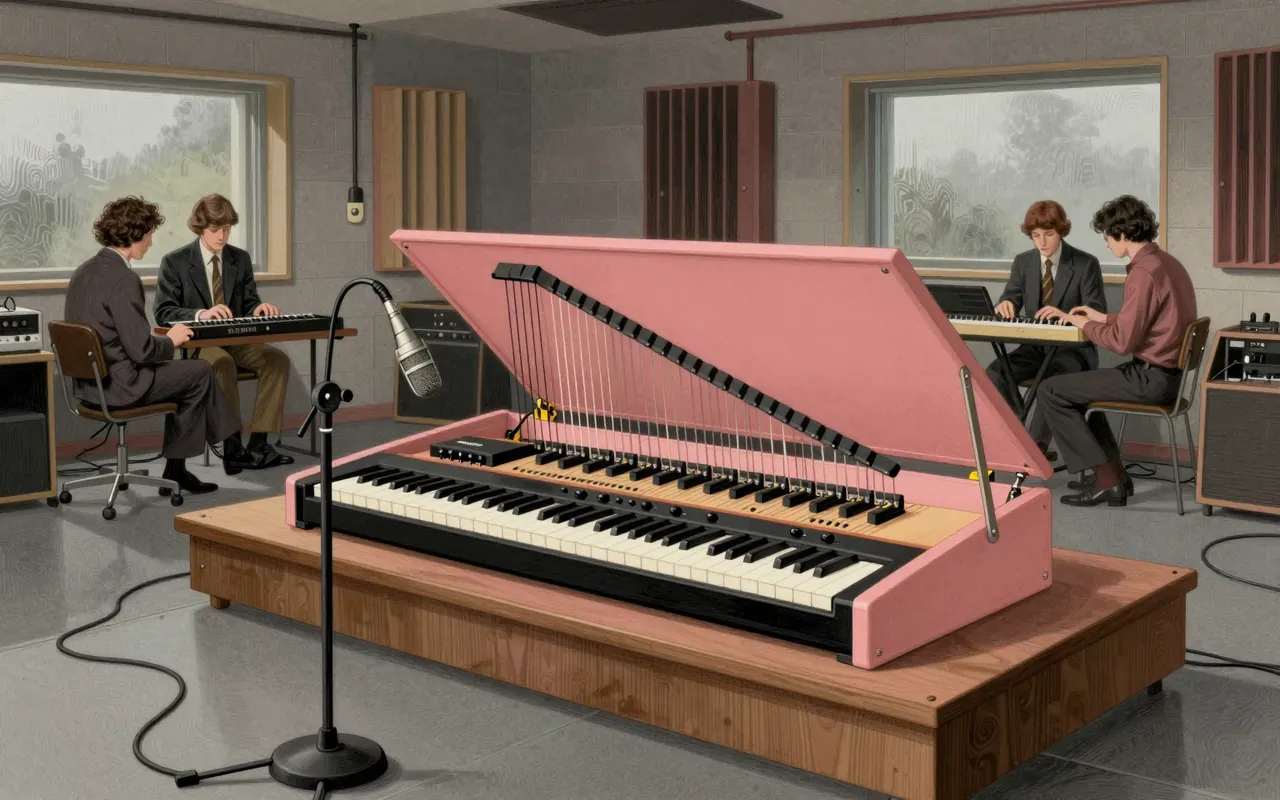
What it is and what it was built for
The Rhodes Chroma is a microprocessor-controlled analog synthesizer built for programmable, multitimbral polyphony. It was designed to give composers precise, repeatable control over complex analog sound structures — not raw immediacy, but structured sonic architecture.
How it works, in terms a player would use
It uses a microprocessor to control analog voice channels. You adjust parameters on the front panel, and those signals are digitised, processed by software, then sent to the voice cards. The embedded computer generates all envelopes and LFOs — thirty-two ADSRs and sixteen LFO sweeps — in software. Each channel is analog, but every control path runs through code.
What it does better than anything else
It delivers sixteen-voice polyphony with per-voice dual ADSR envelopes and independent LFOs — a level of programmable articulation unmatched in analog synths of its time. It pairs channels for thicker 8-voice sounds while retaining multitimbral capability.
What it does badly
It falls short on stability and immediacy. Tuning drifts. The microprocessor introduces latency between knob turn and sound change. Software crashes were documented. Voice allocation and patch recall are not instantaneous. It withholds direct signal-path access — no patch cables, no manual oscillator-to-filter routing.
What people made with it
The sources do not state what people made with it.
Who should use it, and who should not
A studio composer who values programmable polyphony and can service or emulate its firmware. Not a gigging musician needing plug-and-play reliability or hands-on real-time manipulation.
Is it worth your time
Yes — if you need sixteen-voice polyphony with deep, software-managed modulation routing in an analog voice architecture. No — if you need immediate tactile response, stable tuning, or reliability without maintenance.