audiobriefs
10:52in productionCh. 1 · Formant meets FM/ 10:52 · ceiling 15 min
Synths & drum machines · Sound design & sampling

Yamaha FS1R

The FS1R gave FM synthesis a throat — then buried the controls so deep no one could use it.

The FS1R is a rare hybrid: a formant-driven FM module that expanded what FM synthesis could model — but collapsed under its own complexity. It delivered new waveforms, deeper operator mapping, and vocal resonance no DX7 could match. Yet its interface, manual, and lack of tactile feedback made it a lab tool, not a stage instrument. Its legacy lives in Montage — but not its formants.

Chapters & takeaways4
  1. 0:52
    Formant meets FM

    A 1998–2000 Yamaha module that fused formant and FM synthesis — two methods rarely combined before.

  2. 2:22
    Too many knobs, too few labels

    Two thousand parameters per performance — but no front-panel clarity, no clear manual, and no way to navigate fast.

  3. 4:34
    One waveform, one algorithm column

    Each waveform replaces a full column of DX7 operators — making resonating-body instruments finally possible.

  4. 6:40
    The waveform that didn’t migrate

    Its new waveforms fed into Montage — except the Formant waveform, which stayed unique to the FS1R.

Worth your time?

Yes. Use the whole thing.

2.5/ 5
What works
  • formant sequencing
  • resonating-body instrument emulation
  • dense FM waveform layering
What does not
  • replace a modern software formant engine
  • suit live performance
  • offer intuitive real-time control
Use it if
  • archival sound designers
  • Yamaha waveform researchers
  • FM synthesis historians
Skip it if
  • performers needing quick edits
  • beginners learning synthesis
  • anyone without third-party editors
The written brief1 min read

What it is and what it was built for

It is a sound synthesizer module built by Yamaha from 1998 to 2000. It was built to extend FM synthesis with formant modelling — especially for vocal and acoustic instrument textures.

How it works, in terms a player would use

It runs formant synthesis and FM synthesis side by side. You build a ‘performance’ using up to 2,000+ editable parameters. Front-panel controls are sparse and unlabelled. Editing requires external freeware tools or deep manual navigation.

What it does better than anything else

It models resonating-body instruments more authentically than the DX7 family ever could. Each operator waveform replaces an entire column of DX7 operators — a structural leap in FM density.

What it does badly

It falls short on usability: poor front-panel controls, a brief manual, and complexity that deters live tweaking. Its 32-voice polyphony is limited for dense arrangements.

What people made with it

People made vocal textures, evolving pads, and resonant-body emulations — sounds previously difficult or impossible on DX-series synths.

Who should use it, and who should not

A sound designer working with vintage Yamaha waveforms or formant sequencing should use it. A performer needing quick patch changes or intuitive control should not.

Is it worth your time

It is worth your time only if you need formant sequencing or want to explore waveforms later reused in Montage — and are prepared to wrestle with its interface for months.


Same bench · Synths & drum machines4 of 119
8:08
Moog synthesizerMoog · 1964The Moog synthesizer is a modular, voltage-controlled analog synthesizer invented by Robert Moog in 1964. It was the first commercial synthesizer and established the analog synthesizer concept through its use of patch-cord-connected modules—including voltage-controlled oscillators, filters, envelope generators, and amplifiers—to implement subtractive synthesis.
8:19
Mutable Instruments BraidsMutable InstrumentsBraids delivers radical timbral variety in minimal space—but with no internal editing, no tuning stability guarantees, and no analogue circuitry. It is a selector, not a synthesizer.
8:40
Mutable Instruments CloudsMutable InstrumentsClouds is a granular audio processor for Eurorack that transforms live input into dense, overlapping grains. It records continuously into a short, variable buffer (up to 8 seconds), allows freezing that buffer to isolate a sonic space, and provides hands-on control over grain position, size, pitch, density, timing distribution, and envelope shape. A diffuser blurs transients using all-pass filters. It supports 40–60 concurrent grains and operates in stereo with extensive CV control, dry/wet blending, feedback, and reverb-like effects during freeze mode. It does not store or recall samples, nor does it support offline processing or waveform editing.
10:15
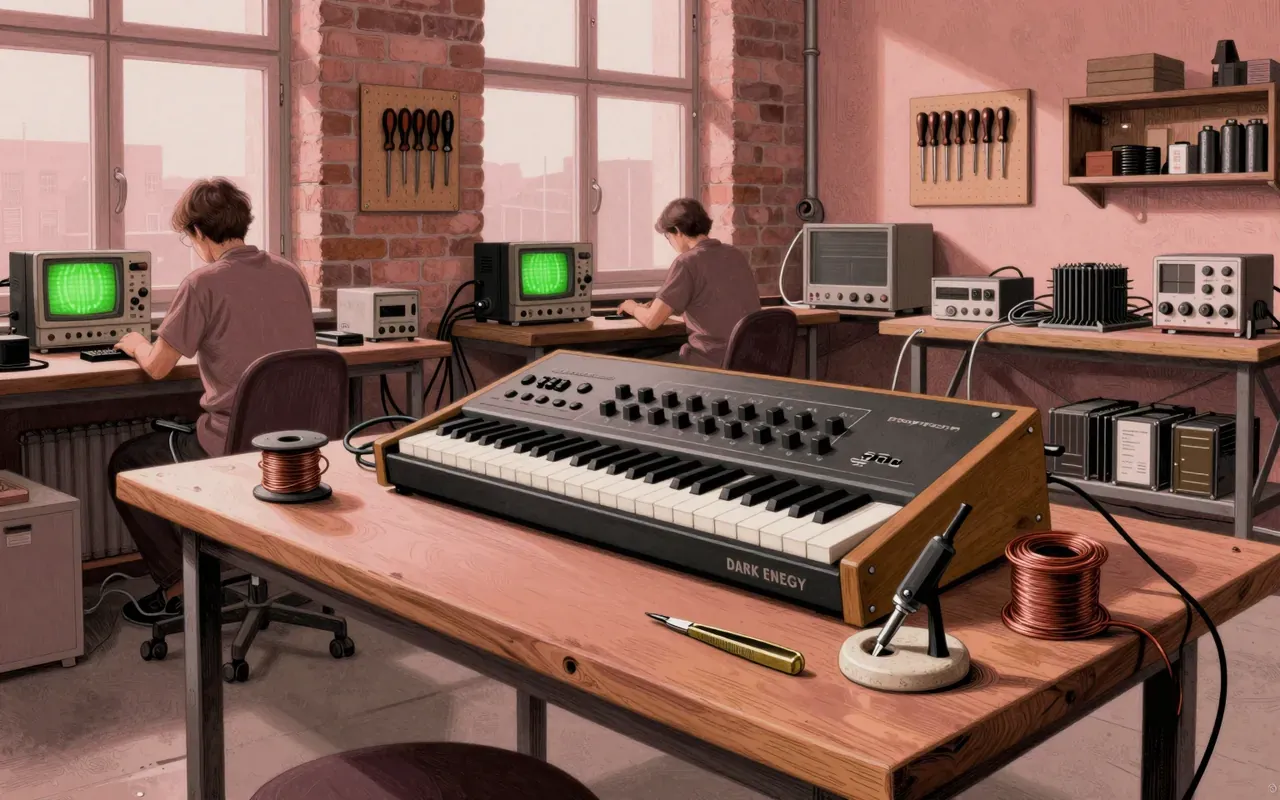
Doepfer Dark EnergyDoepferA compact, monophonic, fully analog synthesizer released in 2010 as a stand-alone version of the Doepfer A-111-5 Eurorack module. It features dual LFOs capable of audio-rate FM (~5 kHz), a 24 dB/octave low-pass VCF, and a triangle-based VCO. The VCF can function as a sine oscillator when the VCO is disengaged and resonance is maxed. All sound generation and modulation are analog; only USB/MIDI contain digital components. It has no polyphony, no patch memory, no velocity or aftertouch, and no audio input. Superseded by the Dark Energy II in 2012.
Up next in Audio

Gibson Grabber

Gibson · 8:56

It doesn’t blend pickups — it slides them. That’s the whole point.

8:56