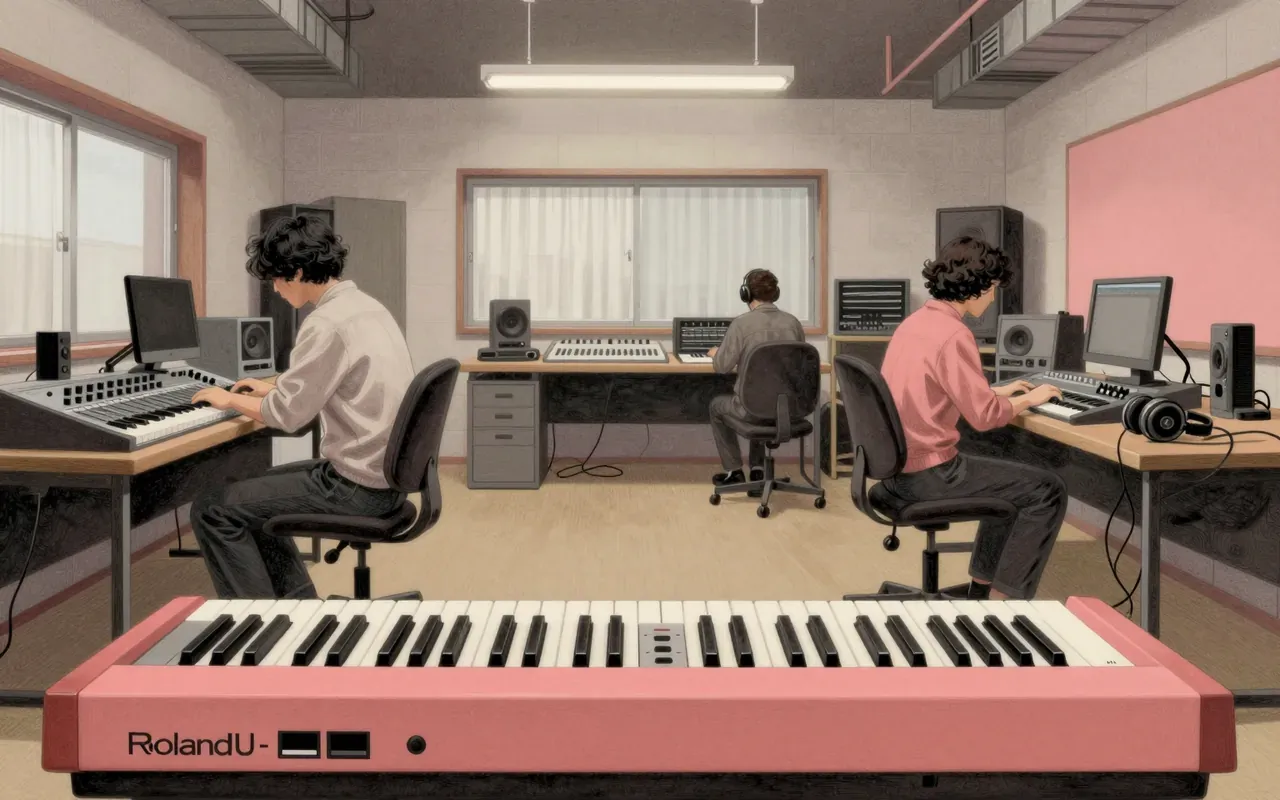
What it is and what it was built for
The Roland U-20 is a 1989 RS-PCM keyboard built for live performers and producers who needed reliable, preset-driven sample playback—not synthesis.
How it works, in terms a player would use
It plays back stored PCM samples. You edit amplitude and pitch with ADSR envelopes. You add reverb or chorus via DSP effects. You load new sounds using RAM cards (M-256E) or ROM PCM cards in two expansion slots.
What it does better than anything else
It delivers immediate, consistent, high-fidelity PCM playback from its 1989 sample library. Its RS-PCM architecture gives predictable, clean access to acoustic instrument tones without the instability of early samplers or the complexity of full workstations.
What it does badly
It does not filter sound. It has impractical aftertouch. It offers only basic envelope control over static samples. There is no oscillator modulation, no LFO, no resonance, no spectral movement.
What people made with it
The sources do not state what people made with it.
Who should use it, and who should not
A player who values simplicity, portability, and unprocessed PCM realism should use it. A sound designer, modular user, or anyone needing timbral evolution or dynamic filtering should not.
Is it worth your time
Yes—if you want a compact, sample-based keyboard from 1989 that prioritises playback over synthesis. No—if you need filter shaping, expressive aftertouch, or real-time timbral control.