audiobriefs
9:03in productionCh. 1 · Not a synth—just a trigger/ 9:03 · ceiling 15 min
Instruments · Synths & drum machines

Roland JV-1080

It doesn’t synthesise—it triggers. And that’s exactly why it ruled the late-90s studio.

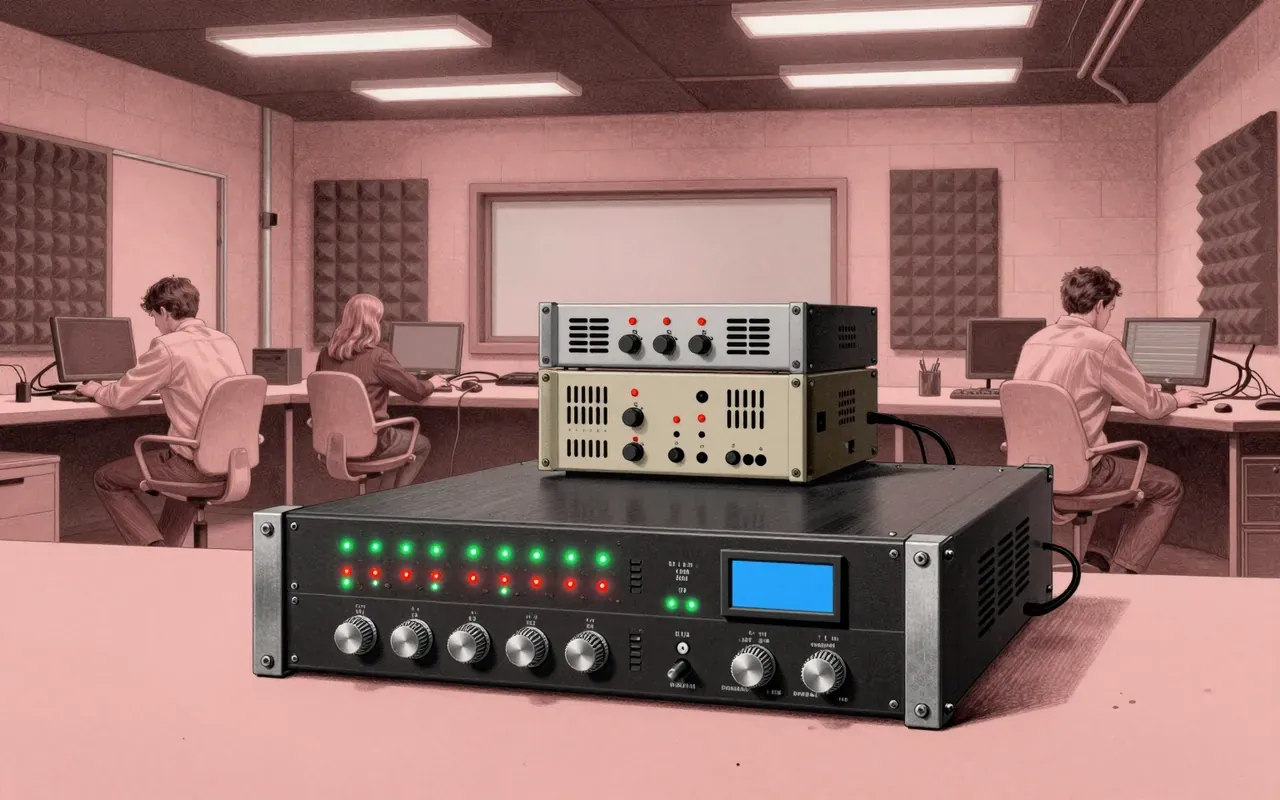
The Roland JV-1080 is a sample-based 2U rack sound module with 64-voice polyphony and 16-part multi-timbrality, introduced in 1995.

Chapters & takeaways4
  1. 0:44
    Not a synth—just a trigger

    It is not a synth in the oscillator-filter-amp sense—it is a sample playback engine housed in a 2U rack.

  2. 1:55
    Polyphony you can trust

    64 voices and 16-part multitimbrality let it run full arrangements without choking.

  3. 3:54
    Rack-mounted, not fingered

    Its 2U rack form means it fits in any studio, but gives up all tactile interface for density.

  4. 5:29
    No oscillators. Just PCM.

    Every sound starts as a recorded sample—not generated in real time.

Worth your time?

Yes. Use the whole thing.

4/ 5
What works
  • as a stable, high-polyphony playback engine
  • with expansion cards for extended tone libraries
  • in tight MIDI studio integrations
What does not
  • offer real-time synthesis
  • include a keyboard
  • support audio input
  • provide deep sample editing
Use it if
  • MIDI-based producers
  • film and game composers
  • live backing-track builders
Skip it if
  • performers needing hands-on control
  • sound designers wanting granular manipulation
  • beginners expecting immediate playability
The written brief1 min read

What it is and what it was built for

It is a sample-based 2U rack sound module built for integration into MIDI studios. It was built to replace hardware samplers and ROMplers in professional production and live setups.

How it works, in terms a player would use

It runs as a 2U rack sound module. It plays back samples. It handles 64 voices at once. It layers 16 different sounds across MIDI channels.

What it does better than anything else

It delivers stable, high-polyphony, multi-timbral playback of Roland’s 1995-era PCM library. It loads expansion cards. It routes 16 parts cleanly over MIDI.

What it does badly

It offers no onboard sampling. It has no keyboard, no sequencer, no audio inputs. It cannot modify samples beyond basic filter and envelope adjustments. It gives no visual feedback for sound design.

What people made with it

Producers used it for film, TV, and game scoring in the late 1990s. It powered string pads, drum kits, and synth textures in mid-budget productions where sampling hardware was too slow or expensive.

Who should use it, and who should not

A producer with a MIDI controller and DAW who values consistency, low CPU load, and classic Roland PCM tones. Not a performer needing real-time tweakability or a beginner seeking intuitive sound design.

Is it worth your time

Yes—if you need a reliable, sample-based workhorse for studio or live backing parts. No—if you need real-time synthesis control, hands-on editing, or modern connectivity.
Same bench · Instruments4 of 68
10:15
Doepfer Dark EnergyDoepferA compact, monophonic, fully analog synthesizer released in 2010 as a stand-alone version of the Doepfer A-111-5 Eurorack module. It features dual LFOs capable of audio-rate FM (~5 kHz), a 24 dB/octave low-pass VCF, and a triangle-based VCO. The VCF can function as a sine oscillator when the VCO is disengaged and resonance is maxed. All sound generation and modulation are analog; only USB/MIDI contain digital components. It has no polyphony, no patch memory, no velocity or aftertouch, and no audio input. Superseded by the Dark Energy II in 2012.
9:20
Korg PS-3300KorgThe Korg PS-3300 is a 1977 polyphonic analog synthesizer built from three PS-3100-derived units (PSU-3301), delivering 144 voices with independent oscillators, filters, envelopes, and amplifiers per note. It enables multitimbral sound creation through individual module adjustment and mixing. It omits the PS-3100's ensemble effect. It supports extensive voltage control and patching — including pitch modulation from envelopes or external sources — and uses a detachable keyboard format. It belongs to Korg’s 1970s line of large, expensive, patchable instruments, positioned as a high-end professional device.
9:57
Korg 01/WKorgThe Korg 01/W is a 1991 workstation that expands on the M1 with more polyphony, more memory, and Waveshaping—but does not deepen synthesis control. It delivers reliability and scale, not flexibility.
9:42
Rickenbacker 4001RickenbackerThe Rickenbacker 4001 is a 1961–1986 electric bass built as a deluxe two-pickup successor to the 4000. Its neck-through construction, toaster top pickup, three-way selector, and later Hi-Gain pickups and Ric-O-Sound output give it a bright, articulate, sustaining tone—but limit low-end depth, repairability, and ergonomic flexibility.
Up next in Audio

Roland JV-2080

Roland · 8:23

It does not make sounds — it plays them, reliably, at scale.

8:23