audiobriefs
7:51in productionCh. 1 · Commissioned to disrupt/ 7:51 · ceiling 15 min
Synths & drum machines · Sound design & sampling

Buchla Electronic Musical Instruments

It doesn’t play music—it composes new physics for sound.

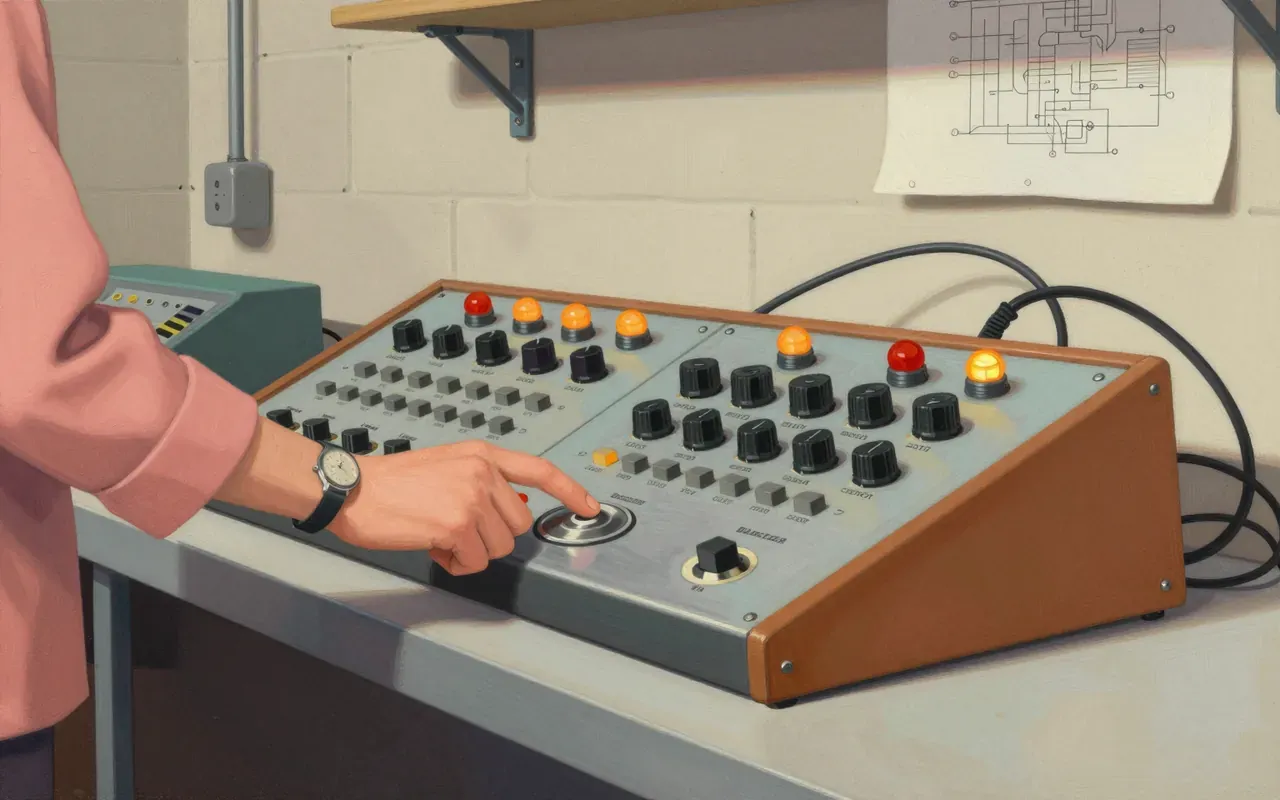
The Buchla Electronic Musical Instruments (1965) were modular, voltage-controlled systems designed for creating novel sounds—not imitating existing ones—using touch/pressure interfaces instead of keyboards, with synthesis based on FM, AM, and dynamic waveshaping.

Chapters & takeaways4
  1. 0:51
    Commissioned to disrupt

    It was built by composers, for composers—not performers—and funded to break from tradition.

  2. 2:24
    Modular by necessity

    Every function lives in its own box: oscillator, filter, envelope, VCA, sequencer—no integration, no compromise.

  3. 3:35
    Voltage, not velocity

    You control pitch, timbre, amplitude, and space—all at once—with touch and pressure, not keys.

  4. 4:52
    No synthesis—only invention

    It refuses imitation. No keyboard. No tuning. No presets. Just raw, untethered sound generation.

Worth your time?

Yes. Use the whole thing.

4.5/ 5
What works
  • creating unprecedented timbres
  • spatialising sound in real time
  • decoupling pitch from amplitude and timbre
  • enabling non-linear compositional workflows
What does not
  • imitate instruments
  • support keyboard-based performance
  • offer preset recall
  • provide equal-tempered pitch reference
Use it if
  • composers building from first principles
  • sound designers rejecting acoustic metaphors
  • researchers mapping voltage-space relationships
Skip it if
  • performers needing melodic fluency
  • producers seeking quick timbral variation
  • students learning traditional harmony
The written brief1 min read

What it is and what it was built for

It is a modular, voltage-controlled electronic music system built in 1965 to create novel sounds—not imitate existing ones. Commissioned by composers Ramon Sender and Morton Subotnick, funded by a Rockefeller Foundation grant.

How it works, in terms a player would use

It works with separate voltage-controlled modules: oscillators, filters, envelope generators, voltage-controlled amplifiers, and analog sequencers. Players patch them together with cables. Touch and pressure-sensitive surfaces replace keys. No keyboard. No equal-tempered tuning.

What it does better than anything else

It does better than anything else at divorcing sound creation from instrumental precedent. It gives direct, voltage-based control over pitch, timbre, amplitude, and spatial location—simultaneously and independently.

What it does badly

It does badly anything requiring immediate melodic recall, harmonic intuition, or tactile familiarity. Untuned touch plates give no pitch reference. No keyboard means no muscle memory for intervals or chords.

What people made with it

Composers used it to generate entirely new sonic events: evolving textures, unpredictable timbres, spatialised gestures, and structures unmoored from melody or rhythm as conventionally understood.

Who should use it, and who should not

A composer who rejects keyboard logic and wants full signal-path sovereignty should use it. A performer needing instant pitch accuracy, groove lock, or preset recall should not.

Is it worth your time

It is worth your time only if you need a tool for composing new sounds—not reproducing old ones—and are prepared to build every gesture from scratch.

Same bench · Synths & drum machines4 of 119
8:29
Novation Digital Music SystemsNovation · 1992The MM10 is a 1992 portable keyboard controller made by Novation Digital Music Systems. It was built to operate with the Yamaha QY10. It has no sound engine. It runs on batteries. It has full-sized keys. It forms, with the QY10, the first completely portable modern music workstation.
8:19
Mutable Instruments BraidsMutable InstrumentsBraids delivers radical timbral variety in minimal space—but with no internal editing, no tuning stability guarantees, and no analogue circuitry. It is a selector, not a synthesizer.
8:40
Mutable Instruments CloudsMutable InstrumentsClouds is a granular audio processor for Eurorack that transforms live input into dense, overlapping grains. It records continuously into a short, variable buffer (up to 8 seconds), allows freezing that buffer to isolate a sonic space, and provides hands-on control over grain position, size, pitch, density, timing distribution, and envelope shape. A diffuser blurs transients using all-pass filters. It supports 40–60 concurrent grains and operates in stereo with extensive CV control, dry/wet blending, feedback, and reverb-like effects during freeze mode. It does not store or recall samples, nor does it support offline processing or waveform editing.
10:15
Doepfer Dark EnergyDoepferA compact, monophonic, fully analog synthesizer released in 2010 as a stand-alone version of the Doepfer A-111-5 Eurorack module. It features dual LFOs capable of audio-rate FM (~5 kHz), a 24 dB/octave low-pass VCF, and a triangle-based VCO. The VCF can function as a sine oscillator when the VCO is disengaged and resonance is maxed. All sound generation and modulation are analog; only USB/MIDI contain digital components. It has no polyphony, no patch memory, no velocity or aftertouch, and no audio input. Superseded by the Dark Energy II in 2012.
Up next in Audio

Epiphone Casino

Epiphone · 9:38

It’s not versatile—it’s volatile. A hollow-body guitar that sings clean and screams loud.

9:38