audiobriefs
10:32in productionCh. 1 · Not a keyboard. Not a plugin./ 10:32 · ceiling 15 min
Synths & drum machines · Sound design & sampling

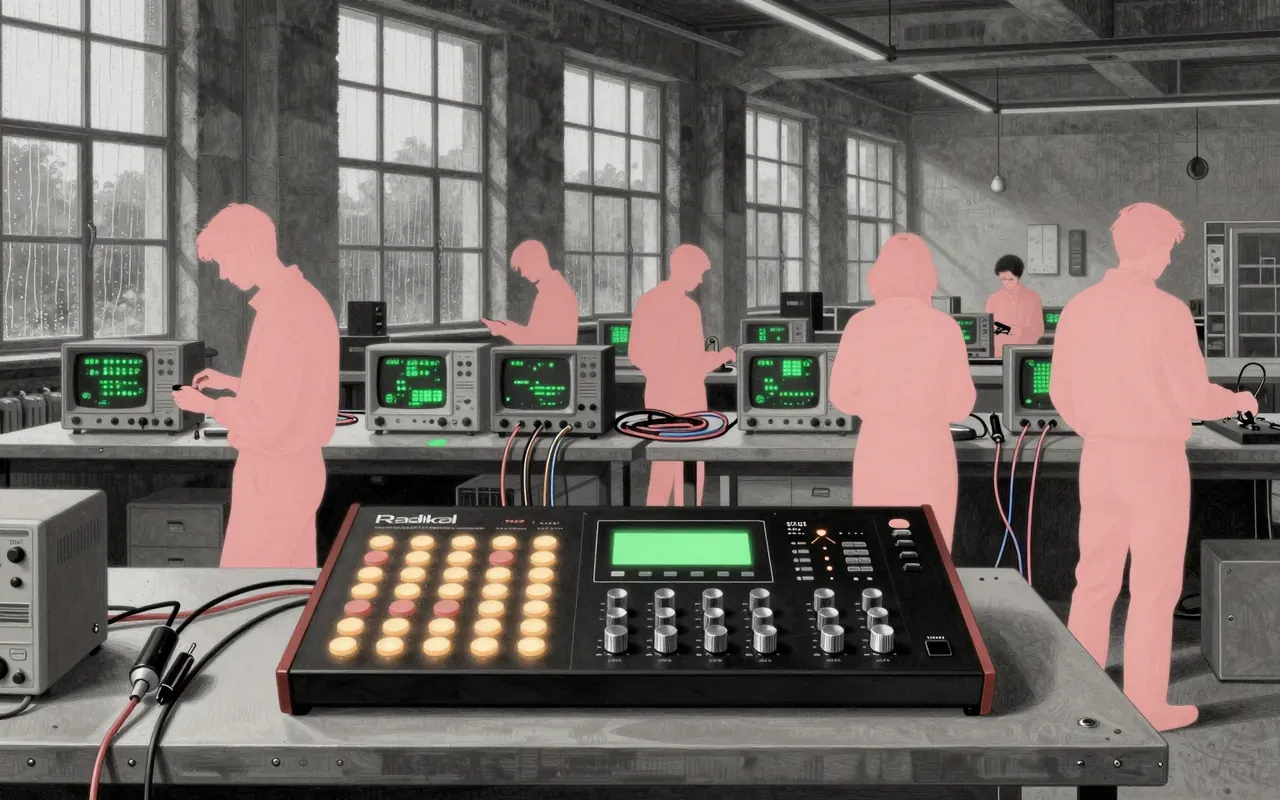
Radikal Technologies Spectralis

A 2004 sequencer-first hybrid that treats sampling and synthesis as equal, editable, and interlocked — not separate modules.

The Spectralis is a 2004 hybrid instrument built for studio composition. It combines a monophonic Asynth (four digital oscillators, two analog filters, time linearity modulation) with a 32-voice, 3-part multi-timbral Dsynth engine (128 MB RAM, unrestricted sample import). Its sequencer ties both engines and external gear together with per-parameter automation. It has no audio interface, no velocity-sensitive Dsynth layers, and no DAW integration. It belongs in a production room — not on stage.

Chapters & takeaways4
  1. 0:53
    Not a keyboard. Not a plugin.

    It is a professional synthesizer, groovebox, and sequencer — not a keyboard or a plugin.

  2. 2:25
    Time linearity modulation

    Each of its four digital oscillators can be pulse-width modulated on any waveform — and triggered independently from two analog filters.

  3. 4:11
    Sample freedom, not sample limits

    Three multi-timbral Dsynth parts load any sampled sound into up to 128 MB of RAM.

  4. 5:58
    Three triggers, not one

    Three Trigger Groups let you sequence oscillators, analog filters, and the 8-bandpass filterbank separately.

Worth your time?

Yes. Use the whole thing.

4/ 5
What works
  • deep sequencing of internal and external gear
  • cross-engine modulation via Trigger Groups
  • unrestricted sample import into 128 MB RAM
  • time linearity modulation on any oscillator waveform
What does not
  • offer velocity sensitivity on Dsynth parts
  • include USB audio
  • support modern operating systems
  • allow real-time parameter morphing across patterns
Use it if
  • studio composers
  • sample manipulators
  • pattern-based sequencers
Skip it if
  • live performers
  • beginners
  • DAW-centric producers
The written brief1 min read

What it is and what it was built for

The Spectralis is a 2004 professional synthesizer, groovebox, and sequencer built for studio-based sound design and complex pattern composition.

How it works, in terms a player would use

It runs two engines in parallel: a monophonic Asynth with four digital oscillators and two analog filters, and a polyphonic Dsynth with 32-voice multisampling. Players trigger oscillators, filters, or the 8-bandpass filterbank using three independent Trigger Groups. Each oscillator accepts time linearity modulation — pulse-width modulation applied to any waveform. The Dsynth runs three multi-timbral parts, each loading samples into up to 128 MB of RAM. Sample import is unrestricted.

What it does better than anything else

It sequences internal synthesis, sampling, and external gear simultaneously with per-parameter automation across all three Dsynth parts and the Asynth — a level of integrated control unmatched in 2004 desktop instruments.

What it does badly

It offers no built-in audio interface or USB audio streaming. It lacks velocity- or aftertouch-responsive Dsynth layers. Its sequencer is pattern-based and non-linear, making real-time improvisation cumbersome. There is no onboard effects routing beyond two delays and fixed digital filtering.

What people made with it

No verified examples of specific works, artists, or recordings are provided in the source material.

Who should use it, and who should not

Studio composers who work with layered sequencing, sample manipulation, and hybrid synthesis should use it. Live performers, beginners, or those reliant on DAW integration should not.

Is it worth your time

Yes — if you need deep sequencing, sample-driven polyphony, and monophonic timbral control in one box. No — if you require real-time hands-on editing, stable live performance, or modern OS integration.

Same bench · Synths & drum machines4 of 243
8:16
Make Noise MorphageneMake NoiseThe Morphagene is an effects module for modular synthesizers made by Make Noise. It belongs in the 'Effects modules for modular synthesizer' category. It does not function as a sampler, sequencer, or DAW plugin — it transforms audio live using tape-style operations. Its design gives immediate, irreversible, hands-on manipulation. It withholds saving, syncing, and visual feedback.
8:56
PPG WavePPGPPG Wave pioneered real-time interpolated wavetable scanning—making timbre itself a sequenced parameter. Its hybrid digital-analog signal path (digital oscillators, analog filters and VCAs) delivered spectral animation impossible on analog synths of the era. But it demands peripheral hardware for editing, sampling, or expressive control—and offers no direct waveform manipulation or polyphonic sequencing. It belongs in a studio built for sound design, not stage performance.
9:27
Yamaha SY99YamahaThe Yamaha SY99 is a 1991 hybrid digital synthesizer combining FM, sample-based, and subtractive synthesis. It enables PCM samples to function as FM modulators, controllable via velocity, aftertouch, wheels, pedal, and breath controller. It improves on the SY77 with a 76-key keyboard, expanded ROM, user-loadable PCM samples usable in FM synthesis, and an SPX900-derived real-time controllable effects processor.
8:52
Kurzweil K2000KurzweilThe Kurzweil K2000 is a digital synthesizer and music workstation introduced in 1991, built around the V.A.S.T. digital signal processing architecture. V.A.S.T. allows users to select different signal paths containing different DSP functions for sound creation and shaping. It includes an extensive modulation system where modulation sources can be assigned to parameters and combined. The instrument was available in keyboard and rack-mountable formats and included 16-bit user sampling.
Up next in Audio

Yamaha SPX90

Yamaha · 8:53

It doesn’t sound clean — it sounds like 1985 trying to be everywhere at once.

8:53