audiobriefs
8:53in productionCh. 1 · Rack-mounted, not pedalboard-ready/ 8:53 · ceiling 15 min
Effects & pedals · Studio & recording

Yamaha SPX90

It doesn’t sound clean — it sounds like 1985 trying to be everywhere at once.

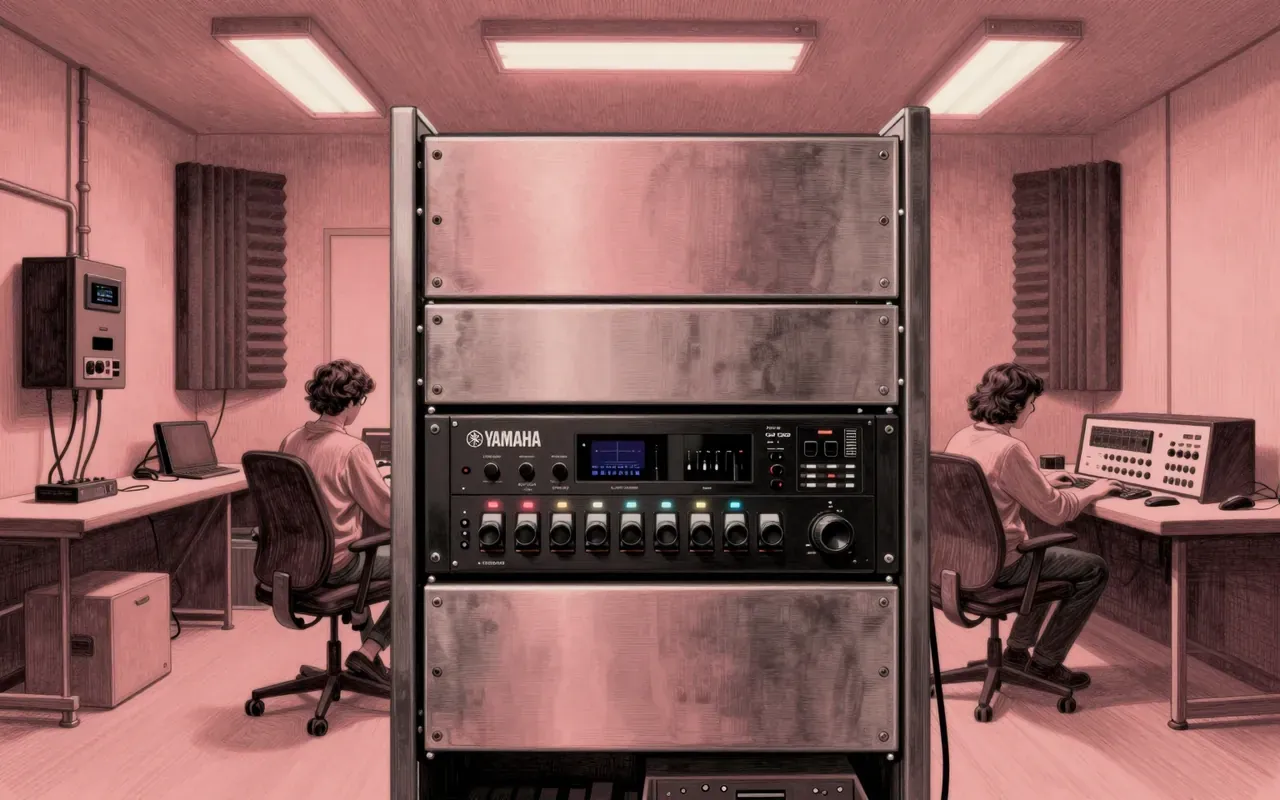
The Yamaha SPX90 is a 1985 digital multi-effects processor in a 1U rack. It offers discrete or combinable effects — reverb, echo, chorus, flanger, phaser, compression, pitch shifting, distortion, tremolo, and delay — but no concurrent processing. Audio is 12-bit, sampled at 31.25 kHz, with a maximum frequency response of 12 kHz. MIDI supports program recall only, not editing. Front-panel controls are simple and direct. It delivers character, not clarity.

Chapters & takeaways4
  1. 0:47
    Rack-mounted, not pedalboard-ready

    A 1U rack unit built for studios that needed digital effects without floor space.

  2. 2:13
    One effect, or a blend — never both at once

    Effects run alone or in fixed combinations — never concurrently or in parallel signal paths.

  3. 4:02
    Resolution ends at 12 kHz

    12-bit processing and 12 kHz bandwidth define its gritty, dated sonic ceiling.

  4. 5:30
    MIDI is a remote, not a controller

    MIDI only jumps presets — no real-time control, no parameter tweaking.

Worth your time?

Yes. Use the whole thing.

3.5/ 5
What works
  • preset recall
  • tactile effect layering
  • rack-space efficiency
What does not
  • deliver high-fidelity audio
  • support real-time editing
  • extend beyond 12 kHz
Use it if
  • producers seeking deliberate digital artefact
  • engineers valuing preset speed over parameter control
Skip it if
  • mastering engineers
  • podcast editors
  • anyone requiring clean wide-bandwidth processing
The written brief1 min read

What it is and what it was built for

The Yamaha SPX90 is a 1U rack-mountable digital multi-effects processor released in 1985. It was built for studio and stage engineers who needed portable, reliable, switchable effects without analog noise or patch cables.

How it works, in terms a player would use

It runs one effect at a time or combines them — no concurrent processing. You select effects using front-panel buttons and knobs. MIDI only recalls presets; you cannot edit parameters live or via MIDI. Input level switches between +4 dBu and -20 dBu. Audio passes through 12-bit processing, capped at 12 kHz bandwidth.

What it does better than anything else

It does preset recall and tactile effect layering better than most 1985 rivals. Its ability to mix reverb, chorus, flanger, and delay in fixed combinations gives immediate, characterful textures — especially for guitar and vocal treatments where grit is welcome.

What it does badly

It does fidelity badly. 12-bit processing delivers grainy, low-resolution audio with audible aliasing above 12 kHz. No onboard editing means every change requires external software or manual front-panel cycling. The narrow frequency response muffles transients and high-end detail.

What people made with it

People made textured guitar solos, smeared vocal beds, and lo-fi drum fills with it — using its pitch shift, flange, and reverb combos as signature colour rather than transparent enhancement.

Who should use it, and who should not

A producer seeking intentional digital artefact should use it. A mastering engineer, podcast editor, or anyone needing clean, wide-bandwidth processing should not.

Is it worth your time

It is worth your time only if you need vintage digital texture, rack-space efficiency, or hands-on preset switching without editing. It is not worth your time if you require clean high-fidelity processing, real-time parameter control, or modern bandwidth.
Same bench · Effects & pedals4 of 121
9:59
Yamaha REV7YamahaThe Yamaha REV7 is a fixed-architecture digital reverb unit from 1985. It occupies two rack spaces. It offers four reverb types — hall, room, flat, and voice — plus chorus, flanger, phaser, tremolo, and delay. All effects layer over reverb. It has XLR and 1/4-inch audio connections and 5-pin DIN MIDI ports. It has no patch memory, no real-time MIDI parameter control, and no stereo-in/stereo-out routing.
9:58
Boss PH-2 Super PhaserBossThe Boss PH-2 Super Phaser is a discontinued analog guitar stompbox pedal built from 1984 to 2001. It adds a rate knob and two-mode switch to the PH-1 lineage. Mode 1 uses 10-step phasing. Mode 2 uses 12-step phasing. Controls are Rate, Depth, Res, and a 2-way Mode switch. LFO speed ranges from 100 ms to 14 s. Input impedance is 1 Mohm (FET). Residual noise is -80 dBm (IHF-A). Current draw is 20 mA at 9 V DC. Early Incubus used it for its distinctive ‘in-your-face’ phase character—especially in mode 2.
9:54
Boss PN-2 Tremolo/PanBossThe Boss PN-2 Tremolo/Pan is an analog stomp box released in May 1990 and discontinued in March 1995. It delivers tremolo and stereo panning via rate, depth, and a 4-way mode switch. It needs two amps for panning and runs on 9V DC. It was replaced by the mono TR-2.
9:24
TC Electronic 2290 P Dynamic Digital DelayTC ElectronicThe TC Electronic 2290 P Dynamic Digital Delay is a guitar-focused delay, echo, and phrase sampler. No technical specifications are available. Its package weight is 1.7 kg. Nothing else is verified.
Up next in Audio

Yamaha SPX900

Yamaha · 8:22

It gives you 99 polished effects in 1U — but locks every one behind uneditable presets and zero digital I/O.

8:22