What it is and what it was built for
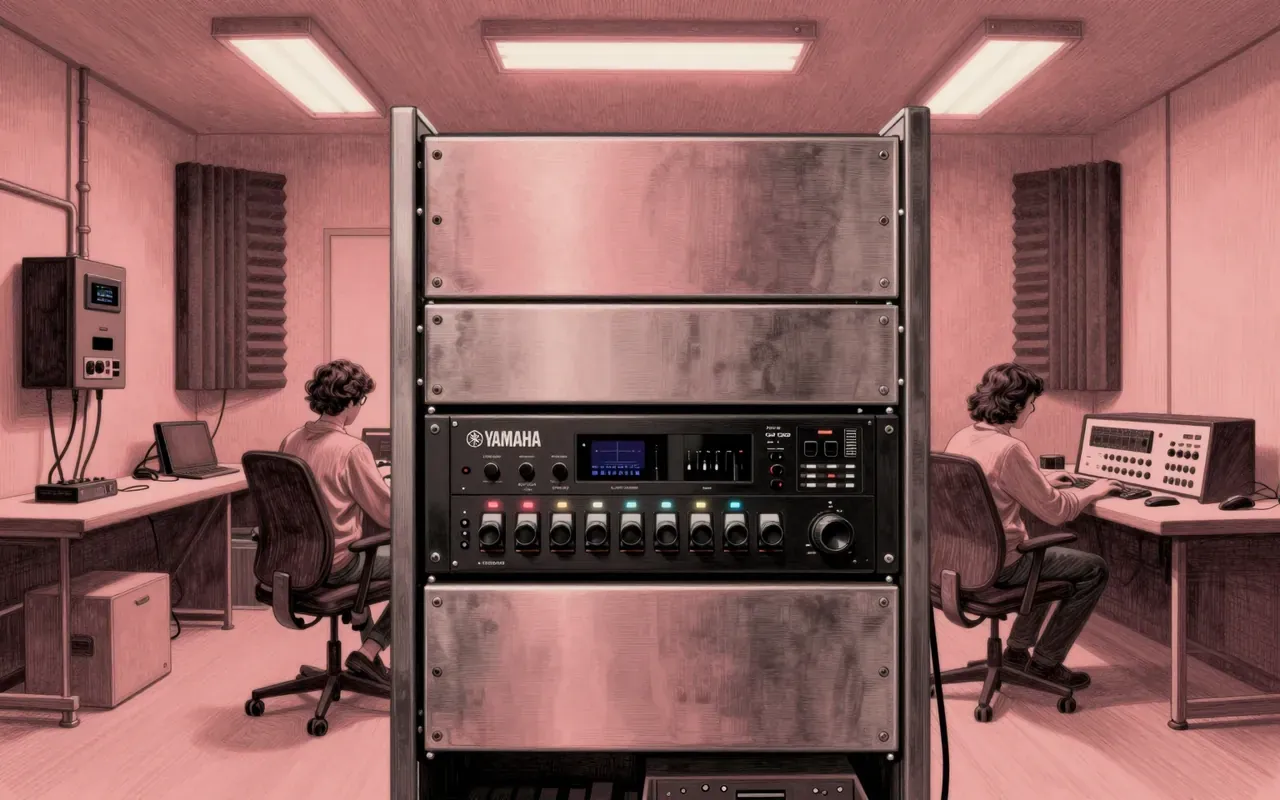
A two-space rack-mount digital reverb unit released by Yamaha in 1985. Built for studio engineers needing quick, preset-based spatial effects with minimal setup — not live performers or modular users.
How it works, in terms a player would use
It runs as a fixed-function digital reverb unit. You select one of four reverb types — hall, room, flat, or voice — then layer chorus, flanger, phaser, tremolo, or delay on top. All controls are front-panel knobs and switches. No patch memory. No MIDI parameter control — only program change and basic sync.
What it does better than anything else
It delivers distinct, slightly brittle, tightly defined hall and room algorithms that cut through dense 1980s mixes. The voice reverb type tailors decay to vocal frequencies. Its flat reverb avoids colouration better than most contemporaries — a rare neutral option before digital became transparent.
What it does badly
It cannot run multiple effects simultaneously in series or parallel. Reverb is always the base layer; other effects are additive only. There is no dry/wet mix per effect — just global output level and reverb/dry balance. No input gain staging or high-pass filtering means low-end mud builds fast on bass-heavy sources.
What people made with it
It shaped drum bus treatments and vocal beds on mid-1980s UK indie and synth-pop records. Its hall setting glued together drum machines and DI’d basslines. Its voice reverb tightened lead vocals without washing them out.
Who should use it, and who should not
Studio engineers restoring or emulating 1985–1989 production aesthetics should use it. Anyone needing recall, stereo independence, or fine-grained editing should not.
Is it worth your time
Yes, if you want early-1980s digital reverb character without modern recall or routing flexibility. No, if you need stereo-in/stereo-out processing, adjustable decay times, or real-time modulation depth control.