audiobriefs
9:54in productionCh. 1 · Bi-timbral FM, eight notes/ 9:54 · ceiling 15 min
Synths & drum machines

Yamaha DX21

The DX21 gives you bi-timbral FM in a box — but only if you’re happy playing without dynamics.

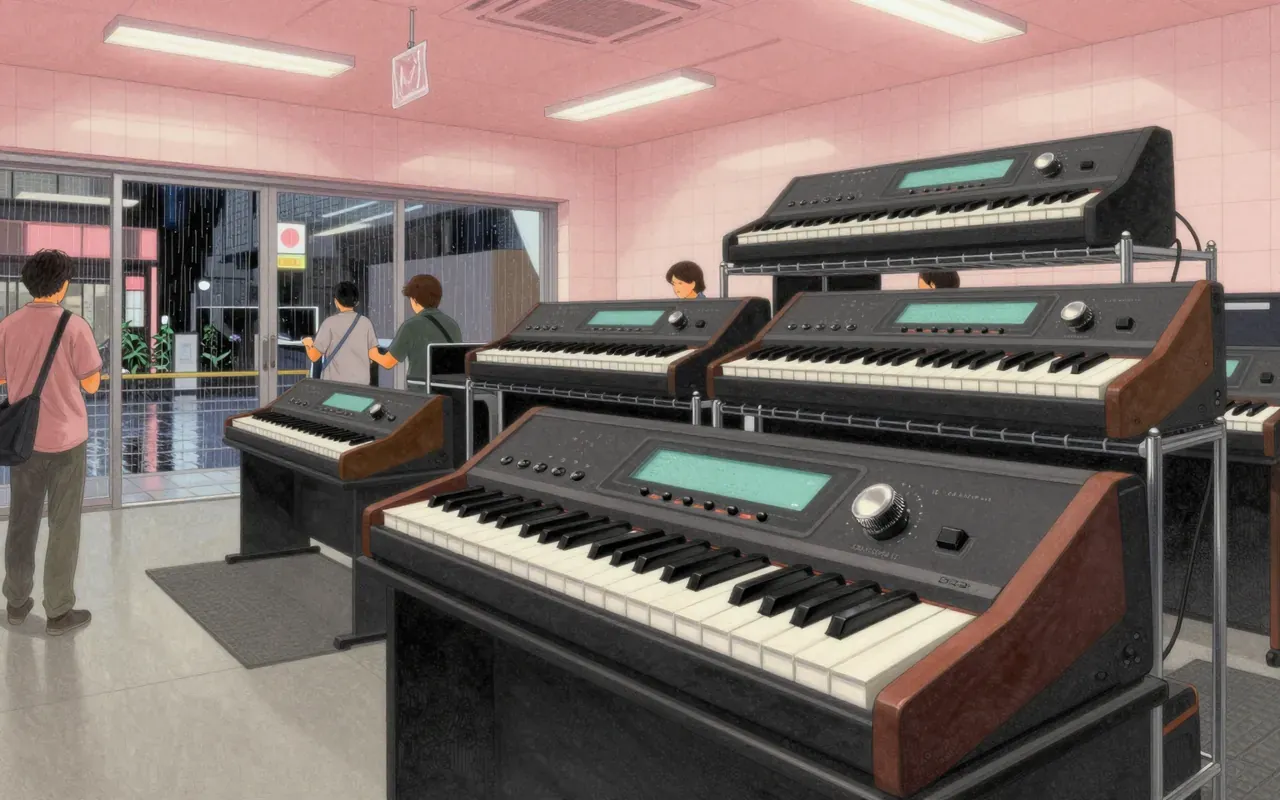
The Yamaha DX21 is a 1985 bi-timbral FM synthesizer with four sine-wave operators, 128 ROM presets, 61 non-velocity keys, and eight-note polyphony — split into four notes per zone when divided.

Chapters & takeaways4
  1. 1:05
    Bi-timbral FM, eight notes

    Eight-note polyphony, split across two independent FM voices.

  2. 2:24
    Four operators, no samples

    Sine-wave operators and algorithms let you sculpt tones from scratch.

  3. 4:11
    No velocity, no escape

    61 non-velocity keys force static expression — even in split mode.

  4. 6:34
    ROM banks and mono splits

    128 presets and mono-split mode suit sketching ideas, not performing them.

Worth your time?

Yes. Use the whole thing.

3.5/ 5
What works
  • bi-timbral layering
  • algorithm-based tone editing
  • split-mode voice allocation
What does not
  • support velocity sensitivity
  • allow real-time modulation beyond chorus
  • sustain more than four notes per split zone
Use it if
  • FM beginners
  • budget-conscious sound designers
Skip it if
  • live performers requiring dynamics
  • producers needing deep modulation
The written brief1 min read

What it is and what it was built for

It is a 1985, 61-key, 8-voice FM synthesizer built for players who needed programmable, bi-timbral digital sound in a compact keyboard format — not for studio depth or live expressiveness.

How it works, in terms a player would use

It uses four sine-wave operators, arranged via selectable algorithms, to build tones. You edit sounds using front-panel knobs and buttons, assigning operators to carriers or modulators. It has 128 factory presets in ROM and 32 user slots in RAM. Split mode divides the 61-key keyboard into two zones, each limited to four-note polyphony. Mono mode gives one note per zone when split.

What it does better than anything else

It does better than most budget FM synths of its era at offering bi-timbral operation with independent tone generation per zone — letting you layer or split two distinct FM voices without external gear.

What it does badly

It does badly at expressivity: the non-velocity-sensitive keys give no dynamic response. Polyphony collapses to four notes per zone in split mode. There is no aftertouch, no modulation wheel, and no real-time performance controls beyond basic chorus on/off.

What people made with it

People made layered bass-and-pad textures, split lead-and-bass lines, and simple FM-based sound effects — using its 128 ROM presets as starting points and editing them via algorithms and oscillators.

Who should use it, and who should not

A beginner exploring FM synthesis should use it. A performer needing velocity sensitivity or real-time modulation should not.

Is it worth your time

It is worth your time if you want hands-on FM synthesis with bi-timbral layering and split functionality at a low entry point — but not if you need velocity response, expressive control, or more than eight notes at once.

Same bench · Synths & drum machines4 of 119
8:29
Novation Digital Music SystemsNovation · 1992The MM10 is a 1992 portable keyboard controller made by Novation Digital Music Systems. It was built to operate with the Yamaha QY10. It has no sound engine. It runs on batteries. It has full-sized keys. It forms, with the QY10, the first completely portable modern music workstation.
8:19
Mutable Instruments BraidsMutable InstrumentsBraids delivers radical timbral variety in minimal space—but with no internal editing, no tuning stability guarantees, and no analogue circuitry. It is a selector, not a synthesizer.
8:40
Mutable Instruments CloudsMutable InstrumentsClouds is a granular audio processor for Eurorack that transforms live input into dense, overlapping grains. It records continuously into a short, variable buffer (up to 8 seconds), allows freezing that buffer to isolate a sonic space, and provides hands-on control over grain position, size, pitch, density, timing distribution, and envelope shape. A diffuser blurs transients using all-pass filters. It supports 40–60 concurrent grains and operates in stereo with extensive CV control, dry/wet blending, feedback, and reverb-like effects during freeze mode. It does not store or recall samples, nor does it support offline processing or waveform editing.
10:15
Doepfer Dark EnergyDoepferA compact, monophonic, fully analog synthesizer released in 2010 as a stand-alone version of the Doepfer A-111-5 Eurorack module. It features dual LFOs capable of audio-rate FM (~5 kHz), a 24 dB/octave low-pass VCF, and a triangle-based VCO. The VCF can function as a sine oscillator when the VCO is disengaged and resonance is maxed. All sound generation and modulation are analog; only USB/MIDI contain digital components. It has no polyphony, no patch memory, no velocity or aftertouch, and no audio input. Superseded by the Dark Energy II in 2012.
Up next in Audio

MXR Dyna Comp

MXR · 8:17

It doesn’t tame dynamics—it stamps them with a squishy, sustaining signature.

8:17