audiobriefs
11:18in productionCh. 1 · V.A.S.T. Is Deep, Not Direct/ 11:18 · ceiling 15 min
Synths & drum machines · Sound design & sampling

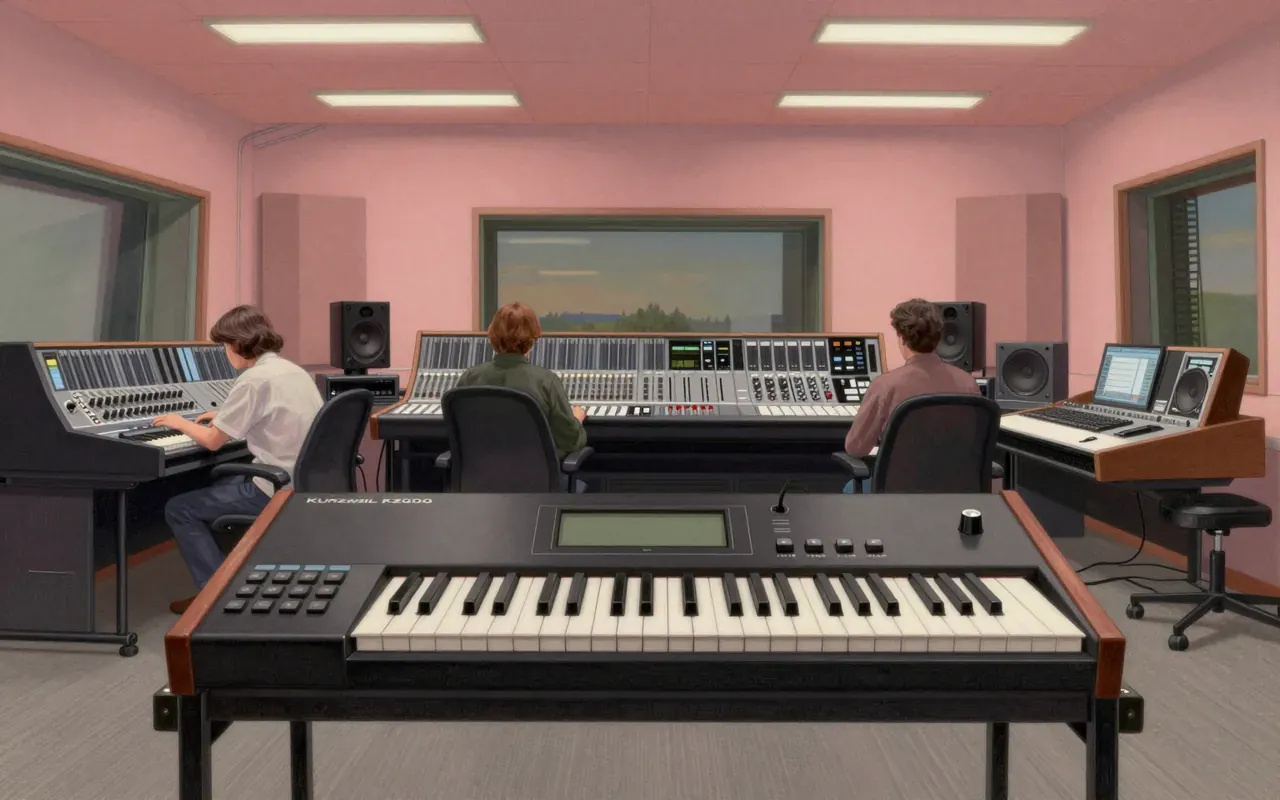
Kurzweil K2600

It doesn’t play — it engineers sound in real time, and it demands you do the same.

The Kurzweil K2600 is a 1999 workstation built for deep sound engineering — not quick playing. It uses V.A.S.T. synthesis with 60 DSP functions and 438 presets. It holds 12MB of sample ROM (expandable to 44MB) and 64MB of sampling RAM (expandable to 128MB). Its 32-track sequencer supports pattern, linear, and step recording, plus advanced editing. It processes external signals in real time via ADAT, TDIF, and AES/EBU — with any parameter modulating the input and 20-bit digital output. It falls short on immediacy, tactile control, and workflow clarity. It belongs in a fixed studio, not on stage or in a laptop bag.

Chapters & takeaways4
  1. 1:14
    V.A.S.T. Is Deep, Not Direct

    V.A.S.T. synthesis gives 60 DSP functions and 438 presets — but no direct access to the signal path.

  2. 2:57
    RAM and ROM Are Expandable, Not Plug-and-Play

    12MB ROM and 64MB RAM let you load and shape sounds — but expansion requires physical boards and SCSI.

  3. 4:37
    Sequencing Is Powerful, Not Transparent

    The 32-track sequencer handles pattern, linear, and step recording — but hides its logic behind layers of menus.

  4. 6:16
    Live Input Processing Is Its Real Edge

    ADAT, TDIF, and AES/EBU inputs let you process eight digital channels live — with any parameter as a modulator.

Worth your time?

Yes. Use the whole thing.

4/ 5
What works
  • deep sound sculpting
  • multi-channel digital input processing
  • complex sequencing with editing tools
What does not
  • play quickly
  • respond intuitively
  • run without expansion hardware
Use it if
  • studio composers
  • sound designers
  • producers needing real-time external processing
Skip it if
  • live performers
  • beginners
  • minimalist workflows
The written brief2 min read

What it is and what it was built for

The Kurzweil K2600 is a professional keyboard synthesizer introduced in 1999. It was built for composers and producers who needed a single instrument to record, process, sequence, and perform complex, evolving soundscapes — especially those blending sampled realism with synthetic abstraction.

How it works, in terms a player would use

It runs V.A.S.T. synthesis with 60 DSP functions and 438 preset programs — 238 in ROM, 200 in RAM. It loads samples from 12MB of sample ROM (expandable to 44MB) and records or manipulates them in 64MB of sampling RAM (expandable to 128MB). The 32-track interactive sequencer supports pattern, linear, and step recording, plus cut, copy, paste, groove quantizing, and event list editing. External signals feed in via ADAT, TDIF, or AES/EBU, then route through real-time Live Mode V.A.S.T. and K.D.F.X. processing — any synth parameter can modulate the signal, outputting at 20-bit resolution.

What it does better than anything else

It integrates sampling, synthesis, sequencing, and multi-channel digital I/O into one unit more thoroughly than any contemporary workstation. Its real-time V.A.S.T. and K.D.F.X. processing of live external inputs — across up to eight digital channels — is unmatched in scope and depth for 1999.

What it does badly

It does not offer fast sound selection or intuitive layering. The interface is menu-dense and lacks dedicated knobs for core V.A.S.T. parameters. There is no built-in display description of signal flow, so routing remains opaque without study. It cannot run standalone without external storage or SCSI devices for full functionality.

What people made with it

Producers used it for film scoring, electronic composition, and hybrid orchestral work where layered realism and real-time manipulation of external sources mattered more than speed or portability.

Who should use it, and who should not

A studio-based composer or sound designer who values expandable RAM, deep DSP routing, and real-time external signal processing should use it. A gigging keyboardist, beginner, or anyone reliant on immediate playability or minimal setup should not.

Is it worth your time

Yes — if you need deep, flexible sound design with integrated sequencing and real-time external signal mangling. No — if you want immediacy, tactile feedback, or lightweight workflow. Its power demands time, patience, and a studio context.
Same bench · Synths & drum machines4 of 243
8:56
PPG WavePPGPPG Wave pioneered real-time interpolated wavetable scanning—making timbre itself a sequenced parameter. Its hybrid digital-analog signal path (digital oscillators, analog filters and VCAs) delivered spectral animation impossible on analog synths of the era. But it demands peripheral hardware for editing, sampling, or expressive control—and offers no direct waveform manipulation or polyphonic sequencing. It belongs in a studio built for sound design, not stage performance.
9:45
Roland XV-5080RolandThe Roland XV-5080 is a 2000 rack-mount sound module built for studio composers needing stereo sample playback, deep modulation via Matrix Control, and expandability through SRX and SR-JV80 boards. It reads Akai S1000 and Roland S-700 CD-ROMs via SCSI, supports up to 128MB of sample memory, and includes COSM effects and digital outputs — features the XV-3080 lacks. It offers no keyboard, no sequencer, no USB, and demands physical navigation. It belongs in a fixed studio with legacy hardware — not on a laptop stand.
8:52
Kurzweil K2000KurzweilThe Kurzweil K2000 is a digital synthesizer and music workstation introduced in 1991, built around the V.A.S.T. digital signal processing architecture. V.A.S.T. allows users to select different signal paths containing different DSP functions for sound creation and shaping. It includes an extensive modulation system where modulation sources can be assigned to parameters and combined. The instrument was available in keyboard and rack-mountable formats and included 16-bit user sampling.
8:16
Make Noise MorphageneMake NoiseThe Morphagene is an effects module for modular synthesizers made by Make Noise. It belongs in the 'Effects modules for modular synthesizer' category. It does not function as a sampler, sequencer, or DAW plugin — it transforms audio live using tape-style operations. Its design gives immediate, irreversible, hands-on manipulation. It withholds saving, syncing, and visual feedback.
Up next in Audio

Korg Kaoss Pad KP1

Korg · 8:09

A touchpad that trades control for charisma — six effects, zero memory, all attitude.

8:09