audiobriefs
8:43in productionCh. 1 · MIDI That Actually Works/ 8:43 · ceiling 15 min
Synths & drum machines · Instruments

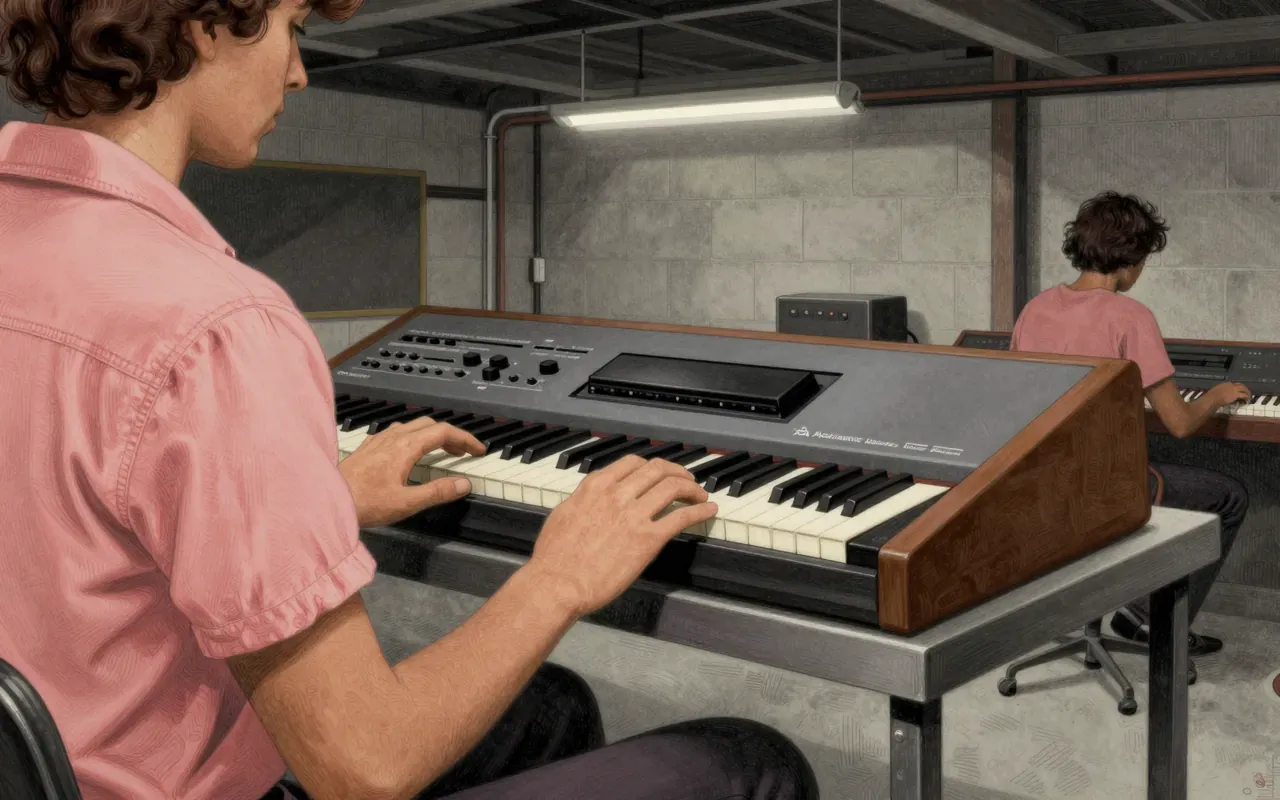
Roland Alpha Juno-1

Less warm than earlier Junos — but its bass punches harder and its MIDI works properly.

The Roland Alpha Juno-1 is a 1986 6-voice analog synth built for techno and rave. It delivers sharp bass and noise, improved MIDI, and chord memory — but sacrifices warmth and hands-on editability.

Chapters & takeaways4
  1. 0:56
    MIDI That Actually Works

    Its MIDI implementation was meaningfully better than earlier Roland synths.

  2. 2:24
    Bass First, Warmth Second

    It trades Juno warmth for tight, cutting bass and noise — ideal for acid and techno.

  3. 4:08
    One Knob, Sixty-Four Parameters

    Editing is menu-diving with a dial — unless you add the PG-300.

  4. 5:16
    Rave-Ready Controls

    Chord memory, portamento, and transposition were built for rave-ready performance.

Worth your time?

Yes. Use the whole thing.

3.5/ 5
What works
  • acid basslines
  • noise textures
  • chord-memory-driven riffs
What does not
  • warm pads
  • intuitive real-time editing
Use it if
  • techno producers
  • acid bassline makers
  • MIDI-focused performers
Skip it if
  • players who need immediate tactile control
  • those seeking classic Juno warmth
The written brief1 min read

What it is and what it was built for

The Roland Alpha Juno-1 is a 1986 6-voice polyphonic subtractive synthesizer built for stage and studio use in emerging electronic genres, particularly techno and rave.

How it works, in terms a player would use

Editing happens via membrane buttons and the Alpha Dial. You scroll through parameters like DCO, LFO, VCF, VCA, chorus, and PWM. No sliders on the unit itself — only the optional PG-300 adds tactile control.

What it does better than anything else

It delivers punchy, resonant bass — especially effective for acid basslines — and clean noise effects. Its improved MIDI implementation and chord memory suit live techno and rave workflows better than prior Roland synths.

What it does badly

It lacks warmth compared to earlier Juno models. Membrane buttons and single-knob navigation make real-time sound shaping slow and imprecise.

What people made with it

People made acid basslines, techno leads, and rhythmic noise textures with it — aided by chord memory and portamento for rapid harmonic layering.

Who should use it, and who should not

Producers focused on 80s-style techno, acid, or lo-fi electronic production should use it. Anyone needing fast, intuitive parameter access or warm Juno-style pads should look elsewhere.

Is it worth your time

Yes — if you want a compact, MIDI-capable 1986 analog synth with strong bass and noise capabilities for techno or acid lines, and are willing to trade hands-on editing for patch depth.
Same bench · Synths & drum machines4 of 243
9:04
Roland SH-101RolandThe Roland SH-101 is a monophonic analog synthesizer made by Roland Corporation between 1982 and 1986. It features a single oscillator, sub-oscillator, low-pass filter, mixer, noise generator, arpeggiator and sequencer. An ADSR envelope controls the filter and VCA. The LFO modulates filter, VCA, pitch and pulse width. It can be played as a keytar using an optional handgrip and shoulder strap, and it can be powered via battery.
8:33
Roland Alpha Juno-2RolandThe Roland Alpha Juno-2 is a 1986 6-voice subtractive synth with velocity and aftertouch, 64 presets, 64 user patches, chord memory, portamento, transpose, and a 24dB analog low-pass filter. It uses membrane buttons and the Alpha Dial for editing. It was built for stage and studio bass and rhythmic work — not for deep, fast sound design.
8:29
Roland Jupiter-8RolandThe Jupiter-8 is an eight-voice polyphonic analog subtractive synthesizer introduced by Roland in early 1981. Each voice features two discrete VCOs with cross-modulation and sync, pulse-width modulation, a non-resonant high-pass filter, a resonant low-pass filter with 2-pole and 4-pole settings, an LFO with variable waveforms and routings, and two envelope generators (one invertible). It includes adjustable polyphonic portamento, a hold function for infinite sustain, an assignable bender for pitch or filter frequency, balanced XLR and unbalanced 1/4" outputs for Upper and Lower presets in Split mode, and a unique polyphonic unison mode where all 16 oscillators stack onto one note and divide down when more keys are pressed. Its arpeggiator syncs externally via DCB or CV. Tuning stability improved from serial #171700 onward.
8:59
Roland Jupiter-6RolandThe Jupiter-6 delivers focused, hands-on bitimbral control and waveform stacking unavailable on the Jupiter-8 — but locks you into rigid voice splits and omits expressive dimensions like aftertouch.
Up next in Audio

Roland Alpha Juno-2

Roland · 8:33

It gives you acid bass and chord memory — but makes you beg for a slider.

8:33