audiobriefs
7:57in productionCh. 1 · No Sound, All Signal/ 7:57 · ceiling 15 min
Synths & drum machines · Instruments

Doepfer Dark Time

A sequencer that refuses to make sound—but gives you knobs for every decision that matters.

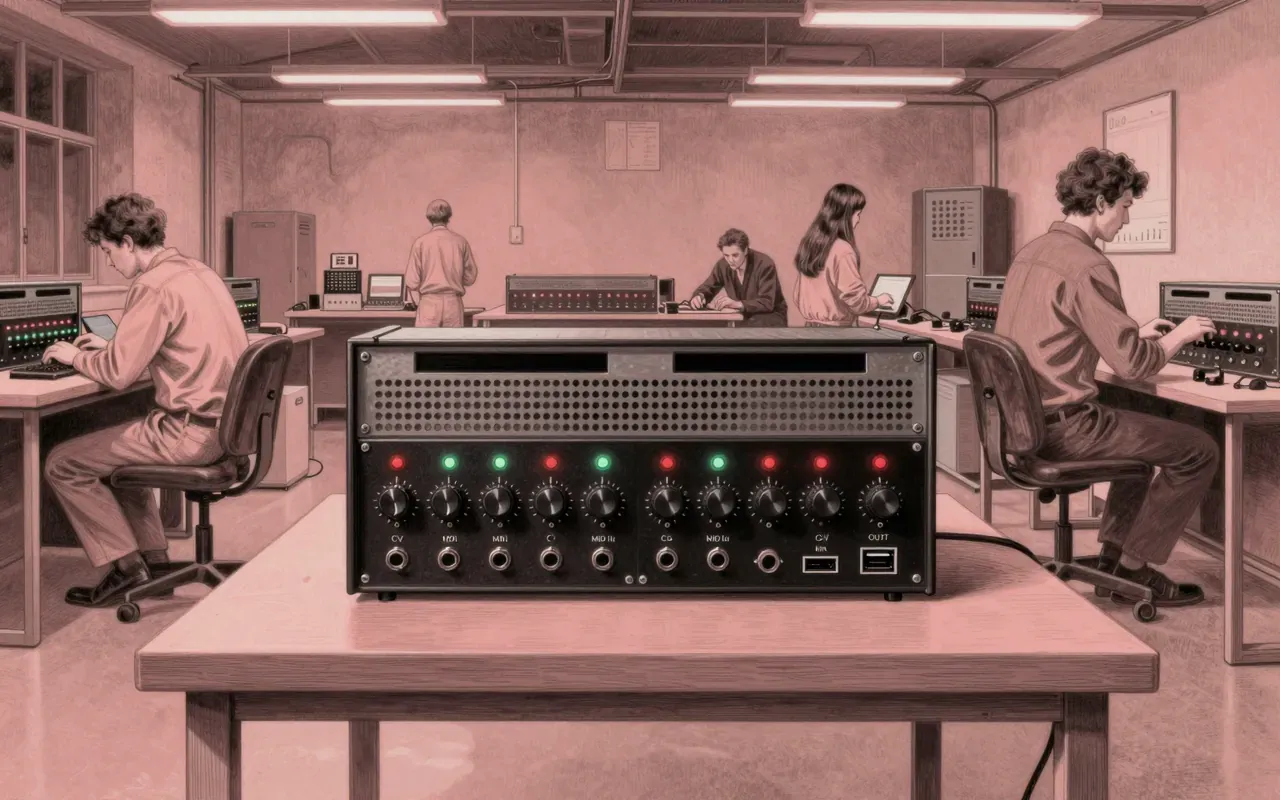
The Doepfer Dark Time is an analogue sequencer released in 2010. It has no sound module. It controls external gear via CV/Gate, MIDI, and USB. It sequences either 16 steps on one channel or 8 steps across two channels. Real-time knob control covers transposition, note skipping, and playback alternation. Firmware 1.10 resolves bugs present in earlier versions.

Chapters & takeaways4
  1. 0:46
    No Sound, All Signal

    It is analogue, and it makes no sound.

  2. 2:03
    Three Ports, Two Modes

    CV/Gate, MIDI, and USB let it talk to anything—but only in two rigid modes: 16×1 or 8×2.

  3. 3:03
    Knobs Over Menus

    Knobs change pitch, skip steps, reverse playback, and transpose—live, without menus.

  4. 4:36
    Update or Break

    Firmware 1.10 fixes what earlier versions break.

Worth your time?

Yes. Use the whole thing.

3.5/ 5
What works
  • real-time step editing
  • dual sequencing modes
  • cross-format connectivity
What does not
  • make sound
  • show visual feedback beyond LEDs
  • support polyphonic sequencing
  • run reliably on pre-1.10 firmware
Use it if
  • modular synth users
  • MIDI-to-CV translators
  • players who prefer knobs to screens
Skip it if
  • beginners unfamiliar with CV
  • those needing embedded audio
  • anyone unwilling to update firmware
The written brief1 min read

What it is and what it was built for

The Doepfer Dark Time is an analogue sequencer released in 2010. It was built as a compact, hands-on controller for external sound sources—not as a standalone instrument.

How it works, in terms a player would use

It runs two sequencing modes: 16 steps on one channel, or 8 steps across two channels. Front-panel knobs adjust step voltage (pitch), skip notes, alternate playback direction, transpose, and set sequence length in real time. It outputs CV/Gate for modular synths, MIDI for digital gear, and USB for DAW integration.

What it does better than anything else

It gives immediate, tactile control over step-level parameters—transposition, skipping, alternation—without menu diving. Its dual-channel/mode flexibility (16×1 or 8×2) is rare at this size and price point.

What it does badly

It cannot generate sound. It offers no visual feedback beyond LED indicators. Earlier firmware versions contain bugs that disrupt sequencing reliability.

What people made with it

No verified examples of specific works, recordings, or artists using it appear in the source material.

Who should use it, and who should not

Modular synth users who want direct CV/Gate sequencing with MIDI/USB fallback. Not for beginners unfamiliar with CV concepts, or anyone needing embedded audio or visual feedback.

Is it worth your time

Yes—if you need a compact, hands-on analogue sequencer that integrates cleanly with both modular and MIDI systems. No if you expect built-in sound, polyphony, or firmware stability without updating to v1.10.
Same bench · Synths & drum machines4 of 243
9:16
Doepfer A-100DoepferThe Doepfer A-100 is an analog modular synthesizer system introduced in 1995. It uses 3U-height, 2HP-width modules patched with 3.5 mm leads. It established the Eurorack standard adopted by many manufacturers. It enables emulation of the Trautonium and Theremin using specific modules.
8:48
EurorackDoepferEurorack is a modular synthesizer format introduced in 1995 by Doepfer Musikelektronik. It defines mechanical, electrical and interconnection standards so modules from different makers fit the same cases and communicate reliably. It has no built-in keyboard, sequencer or interface. It demands manual patching and physical organisation. It supports deep signal routing and long-term system expansion. It is used by musicians and designers to build custom synthesis environments.
10:34
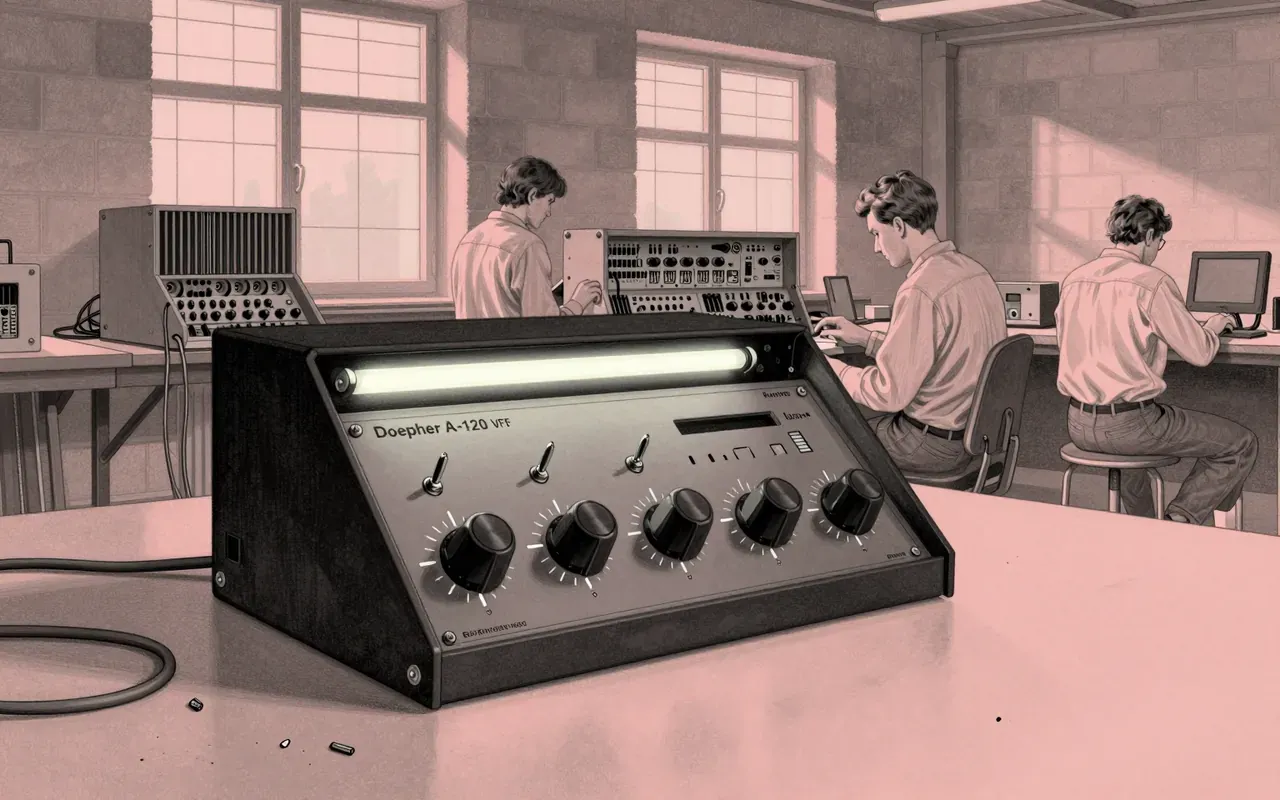
Doepfer A-120 VCFDoepferThe Doepfer A-120 is a Eurorack filter module built to replicate the Moog 24dB low pass filter. Five potentiometers control cutoff, resonance, input level, and two CV amplitudes. Three CV inputs allow layered, complex modulation. It delivers Moog-like saturation and character at low cost. It offers no multimode filtering, no self-oscillation feedback control, and no visual indicators for resonance peak or clipping. Use it for warm, resonant, hands-on low-pass filtering in modular systems. Avoid it if you need versatility beyond 24dB low pass.
9:57
Doepfer A-110 VCODoepferThe Doepfer A-110 Standard VCO is a generator module for modular synthesizers in the A-100 series. It outputs saw, pulse, triangle, and sine waveforms simultaneously. Octave switching and ±1 semitone fine tuning set pitch range. Manual and CV-controlled pulse width modulation are available. A Sync input allows hard-syncing to another VCO. It lacks FM, LFO-range operation, and tuning beyond ±1 semitone.
Up next in Audio

dbx 160

dbx · 9:15

It doesn’t breathe — it bites. And that’s exactly why it works.

9:15