audiobriefs
10:34in productionCh. 1 · What it copies/ 10:34 · ceiling 15 min
Synths & drum machines · Instruments

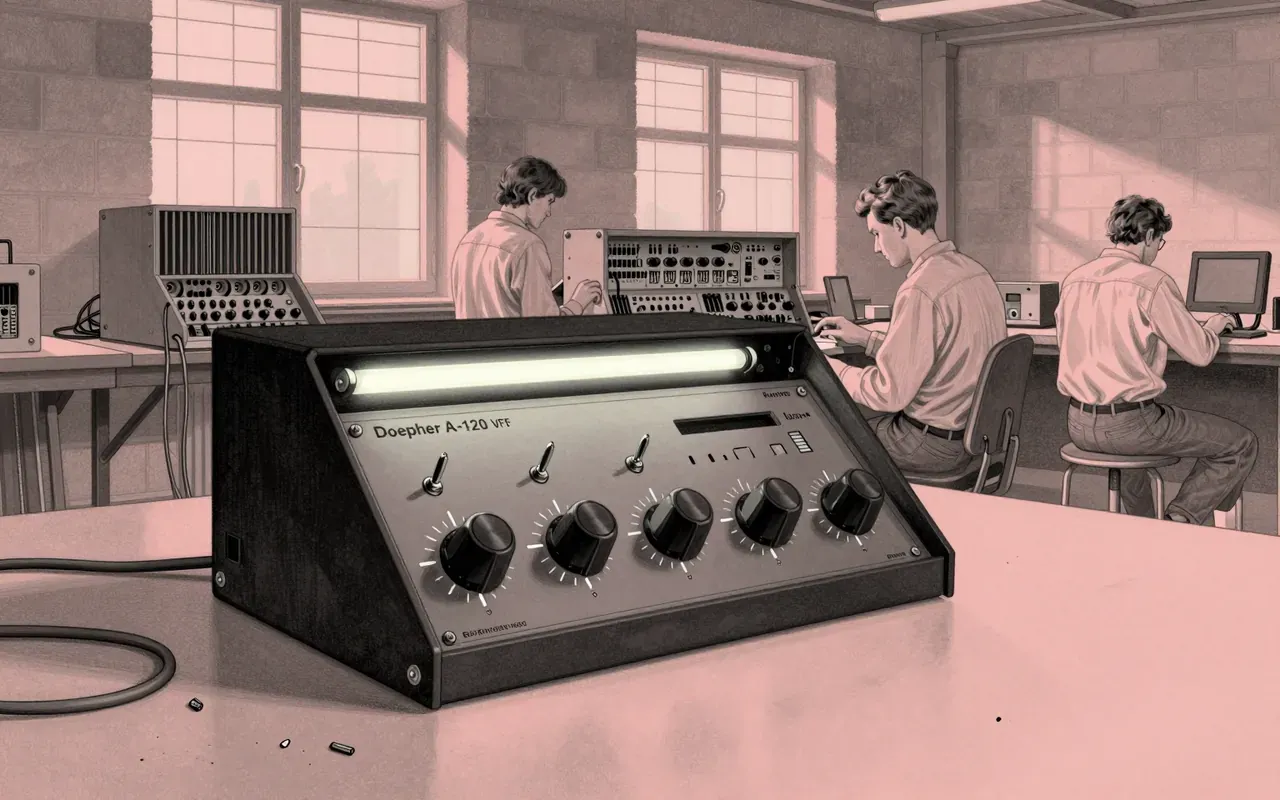
Doepfer A-120 VCF

It’s not a Moog — but it’s the closest Eurorack gets to one without paying Moog prices.

The Doepfer A-120 is a Eurorack filter module built to replicate the Moog 24dB low pass filter. Five potentiometers control cutoff, resonance, input level, and two CV amplitudes. Three CV inputs allow layered, complex modulation. It delivers Moog-like saturation and character at low cost. It offers no multimode filtering, no self-oscillation feedback control, and no visual indicators for resonance peak or clipping. Use it for warm, resonant, hands-on low-pass filtering in modular systems. Avoid it if you need versatility beyond 24dB low pass.

Chapters & takeaways4
  1. 0:47
    What it copies

    It is explicitly designed as a Moog 24dB low pass filter reproduction.

  2. 2:29
    What you touch

    Five potentiometers give direct, tactile control over cutoff, resonance, input level, and two CV amplitudes.

  3. 4:17
    What you patch

    Three CV inputs let you layer modulation sources — one direct, two routed through amplitude pots.

  4. 5:56
    Why it matters

    Its Moog-like sound and triple-CV flexibility make it stand out among budget Eurorack filters.

Worth your time?

Yes. Use the whole thing.

4/ 5
What works
  • as a focused, expressive low-pass filter
  • with complex CV layering
  • at delivering consistent saturation
What does not
  • offer multimode filtering
  • include self-oscillation indicators
  • provide slope selection
Use it if
  • modular players who prioritise Moog-style saturation
  • builders needing reliable CV routing
Skip it if
  • those requiring high-pass or band-pass modes
  • users needing precise digital control
The written brief1 min read

What it is and what it was built for

The Doepfer A-120 is a Eurorack-format modular synthesizer filter module. It was built to reproduce the Moog 24dB low pass filter in a compact, affordable, CV-flexible form.

How it works, in terms a player would use

A potentiometer sets the cutoff frequency. Another adjusts resonance. A third controls audio input level. A fourth potentiometer adjusts the amplitude of CV2 modulation. A fifth adjusts the amplitude of CV3 modulation. One CV input controls frequency directly, without an amplitude pot. Two more CV inputs (CV2 and CV3) feed into the filter frequency control potentiometers. Three CV inputs together enable complex modulation.

What it does better than anything else

It delivers a Moog-like sonic character with saturation at high resonance — more consistently than many cheaper clones — and packs three CV inputs into a compact, stable Eurorack module.

What it does badly

It does not offer high-pass, band-pass or notch modes. It gives no control over filter slope or topology beyond its fixed 24dB low pass response. It has no built-in envelope follower, self-oscillation indicator, or output level trim.

What people made with it

Users made saturated basslines, resonant sweeps, and dynamically modulated textures — especially where multiple CV sources interacted with cutoff and input level.

Who should use it, and who should not

Use it if you want a dedicated, Moog-derived low pass filter with strong saturation and flexible CV routing. Do not use it if you need multimode filtering, digital precision, or self-oscillation stability under extreme resonance.

Is it worth your time

Yes — if you need a Moog-style 24dB low pass filter in Eurorack with hands-on control over saturation and resonance, and three independent CV paths for layered modulation.
Same bench · Synths & drum machines4 of 243
9:57
Doepfer A-110 VCODoepferThe Doepfer A-110 Standard VCO is a generator module for modular synthesizers in the A-100 series. It outputs saw, pulse, triangle, and sine waveforms simultaneously. Octave switching and ±1 semitone fine tuning set pitch range. Manual and CV-controlled pulse width modulation are available. A Sync input allows hard-syncing to another VCO. It lacks FM, LFO-range operation, and tuning beyond ±1 semitone.
7:57
Doepfer Dark TimeDoepferThe Doepfer Dark Time is an analogue sequencer released in 2010. It has no sound module. It controls external gear via CV/Gate, MIDI, and USB. It sequences either 16 steps on one channel or 8 steps across two channels. Real-time knob control covers transposition, note skipping, and playback alternation. Firmware 1.10 resolves bugs present in earlier versions.
10:15
Doepfer Dark EnergyDoepferA compact, monophonic, fully analog synthesizer released in 2010 as a stand-alone version of the Doepfer A-111-5 Eurorack module. It features dual LFOs capable of audio-rate FM (~5 kHz), a 24 dB/octave low-pass VCF, and a triangle-based VCO. The VCF can function as a sine oscillator when the VCO is disengaged and resonance is maxed. All sound generation and modulation are analog; only USB/MIDI contain digital components. It has no polyphony, no patch memory, no velocity or aftertouch, and no audio input. Superseded by the Dark Energy II in 2012.
8:48
EurorackDoepferEurorack is a modular synthesizer format introduced in 1995 by Doepfer Musikelektronik. It defines mechanical, electrical and interconnection standards so modules from different makers fit the same cases and communicate reliably. It has no built-in keyboard, sequencer or interface. It demands manual patching and physical organisation. It supports deep signal routing and long-term system expansion. It is used by musicians and designers to build custom synthesis environments.
Up next in Audio

Doepfer A-140 ADSR

Doepfer · 7:50

It’s not clever. It’s not flexible. But in an A-100 rack, it just works.

7:50