audiobriefs
8:27in productionCh. 1 · An Advanced Preset Machine/ 8:27 · ceiling 15 min
Synths & drum machines

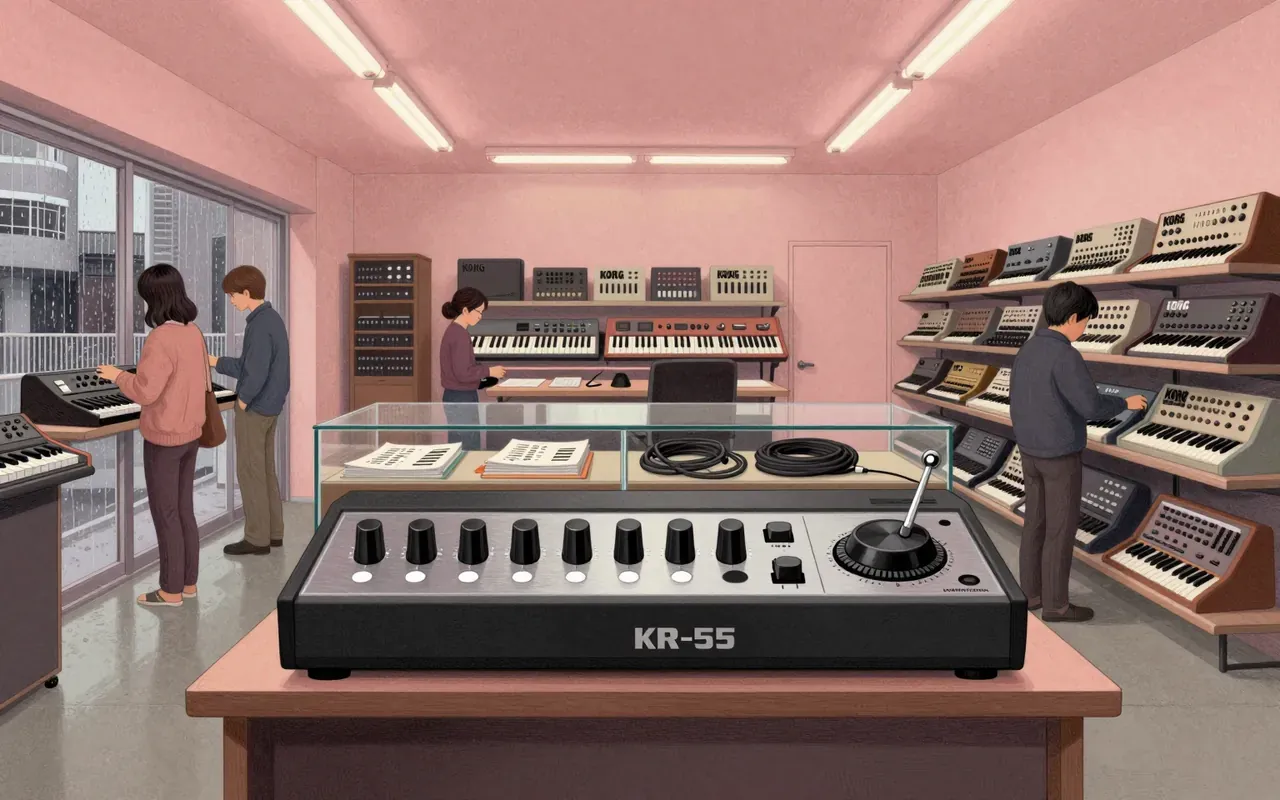
Korg Rhythm 55 KR-55

A groove box that gives you swing and levels—but never a single new beat.

The KR-55 is a fixed-rhythm drum machine from 1979. It plays 48 preset patterns across genres including Waltz, Samba, Rhumba, Bossa Nova, Tango, Slow Rock, Swing, and Rock. It uses sample-based synthesis for 12 drum tones. It has individual level controls per drum sound per pattern. A dedicated swing knob alters groove feel. A footswitch jack enables external Start/Stop and Intro/Fill control. It has no keyboard, no pattern editing, no MIDI, no sync outputs beyond footswitch, and no individual drum outputs.

Chapters & takeaways5
  1. 0:59
    An Advanced Preset Machine

    It was advanced for 1979—not because it was programmable, but because it packed 48 grooves into a desktop unit with hands-on controls.

  2. 2:14
    The Whole Gamut of Presets

    Its patterns cover Waltz, Samba, Rhumba, Bossa Nova, Tango, Slow Rock, Swing, and Rock—no gaps, no genre experiments.

  3. 3:20
    Swing Is a Knob, Not a Setting

    Swing isn’t an effect—it’s a dedicated knob that shifts the groove’s pulse without altering timing values.

  4. 4:25
    Levels Change With the Pattern

    Each drum sound has its own level control per pattern—so the snare can punch in Rock but recede in Waltz.

  5. 5:37
    Footswitch Control, Not Just Tap Tempo

    Start/Stop and Intro/Fill respond to an external footswitch—no hands needed once you’re playing.

Worth your time?

Yes. Use the whole thing.

3.5/ 5
What works
  • groove variation via swing knob
  • pattern-specific level balancing
  • immediate footswitch control
What does not
  • support pattern creation
  • offer tempo automation
  • provide individual drum outputs
  • include MIDI
Use it if
  • players who need fixed, tactile groove control
  • performers using footswitches live
Skip it if
  • producers building custom rhythms
  • users requiring modern sync or DAW integration
The written brief1 min read

What it is and what it was built for

A 1979 desktop preset drum machine built to provide ready-made rhythmic backing for solo performers and small bands.

How it works, in terms a player would use

It plays 48 preset rhythm patterns. Each pattern triggers 12 sample-based drum tones. A knob adjusts swing. Individual level knobs set volume per drum sound per pattern. A footswitch jack controls Start/Stop and Intro/Fill.

What it does better than anything else

It delivers immediate, hands-on control over groove feel via swing and per-instrument level—within rigid presets—more directly than any earlier Korg rhythm unit.

What it does badly

It cannot create new patterns. It cannot change timing resolution or tempo in real time. It cannot layer or mute individual voices mid-pattern. It has no output for individual drum sounds.

What people made with it

No verified claims about specific recordings or artists using it. The sources do not name any music made with the KR-55.

Who should use it, and who should not

Players who value physical immediacy over flexibility. Not for producers needing custom rhythms, quantisation, MIDI, or multi-track integration.

Is it worth your time

Yes—if you want a fixed, tactile, 1979 groove engine with no sequencing, no editing, and no sync beyond footswitch triggers.
Same bench · Synths & drum machines4 of 241
8:40
Korg PS-3100KorgThe Korg PS-3100 is a rare (600 units), 30kg, 48-voice analog synthesizer from 1977. It uses 12 divide-down VCOs to drive 48 independent voice circuits — one VCO, VCF, VCA and EG per key. Its warm LPF and 3-band resonator enable rich formant and phase effects. LFO1 reaches audio rate and delivers AM up to ring modulation. One EG is polyphonic; the other is universal and paraphonic. Twelve intonation scaling controls allow non-equal-tempered tuning. It has no patch memory.
9:25
Korg DeltaKorgThe Korg Delta is a 1979 analog semi-polyphonic string machine and synthesizer. It was built as a slimmed-down, budget alternative to the Korg Trident. It splits into two independent sections—Strings and Synth—with dedicated outputs. The String section uses two pitch sliders and tone/ADSR controls. The Synth section uses four pitch sliders, white noise, a multimode 24dB/oct filter, and full ADSR. A joystick provides pitch bend and modulation. It has CV/gate connectivity but no memory, no MIDI, and no presets. Its 'unlimited polyphony' is inaccurate: pressing multiple keys does not apply independent envelopes to each note. It delivers high-quality layered string-and-synth sounds despite limited range. Its build is robust, but its keyboard is fragile and its filter is bland.
9:48
Korg PS-3200KorgThe Korg PS-3200 is the final model in Korg's PS series. It integrates two PS-3100 units into a single chassis. It provides 16 memory locations that can be individually addressed and recalled. It was regarded as remarkable in its era due to having two oscillators per key and 48-note polyphony. Each voltage-controlled oscillator module includes a dedicated voltage-controlled filter and low-frequency oscillator. Its patching and signal routing capabilities were comparatively restricted versus other modular systems. Its envelope generator design was constrained. It was considered sonically rich for its era, and its 16-patch memory was highly valued.
8:50
Korg MS-50KorgThe Korg MS-50 is a 1978 keyboard-less analog expander module. It has one VCO, two VCFs (highpass and lowpass), two ADSRs, an LFO, pink and white noise, ring modulator, voltmeter, and sample & hold. It uses Hz/V CV/Gate control and was designed to complement the SQ-10 sequencer.
Up next in Audio

Lovetone Ring Stinger

Lovetone · 10:39

This pedal doesn’t play nice—it demands its manual, rejects stable power, and rewards obsession with robot noise and Hendrix octaves.

10:39