What it is and what it was built for
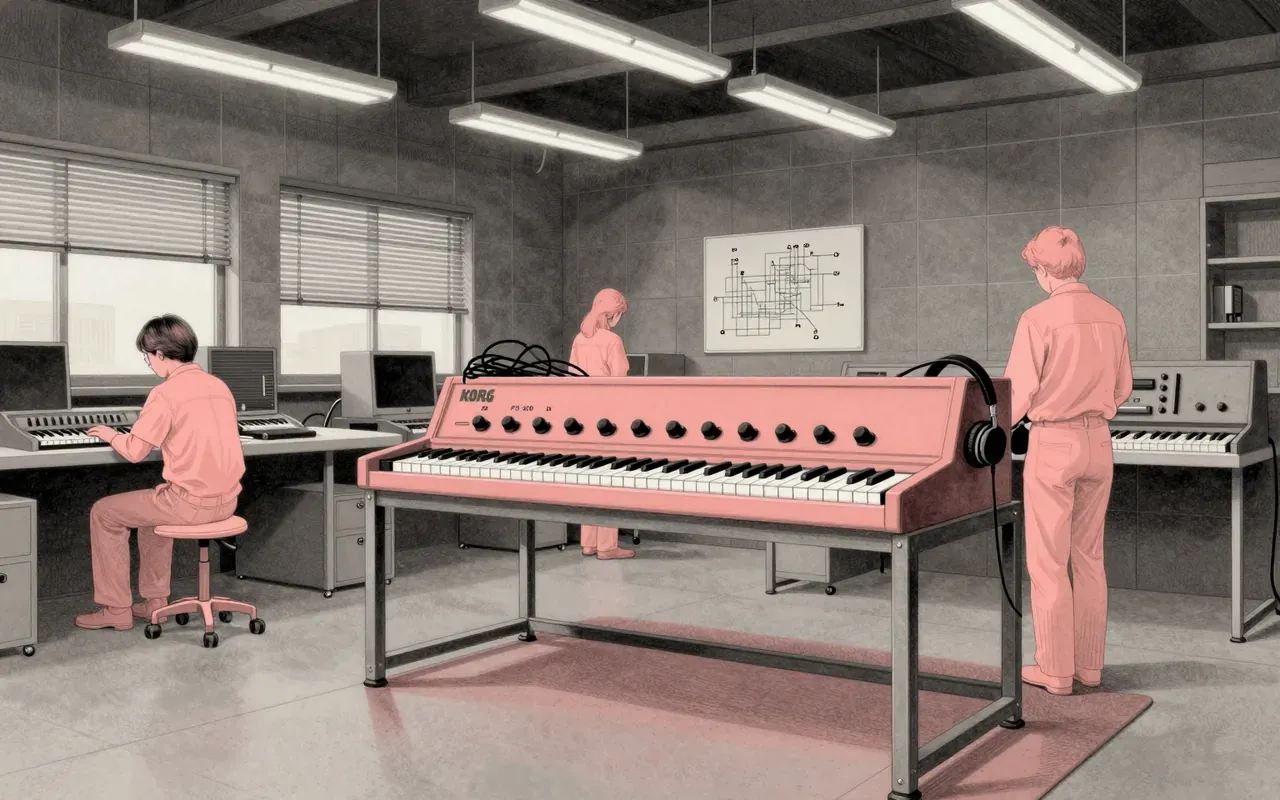
The Korg PS-3100 is a 48-key, 48-voice analog subtractive synthesizer built in 1977. It was built for studio composers and institutions needing stable, multi-voice analog polyphony with timbral depth — not for touring or quick sound design.
How it works, in terms a player would use
It uses 12 divide-down VCOs feeding 48 fully independent voice circuits — one VCO, VCF, VCA and EG per key. The LPF is warmer than Korg’s MS-series. The 3-band resonator creates formants and phase effects. LFO1 runs up to 1 kHz and delivers continuously variable AM up to ring modulation. One envelope generator is polyphonic; the other is universal and paraphonic. Twelve intonation scaling controls adjust tuning away from equal temperament. There is no patch memory.
What it does better than anything else
It delivers richer polyphonic analog texture than any other 1977 synth by giving every key its own VCF, VCA and EG — not just a shared filter or amp. Its resonator section produces vocal-like formants and shifting phase effects unmatched by contemporaries with fixed filters.
What it does badly
It cannot store sounds. It offers only one VCO per voice — no oscillator mixing, no sync, no cross-modulation beyond LFO1’s AM/FM. Its paraphonic EG limits expressive control across held notes. Intonation scaling requires manual adjustment per patch and offers no recall.
What people made with it
No sources state what people made with it.
Who should use it, and who should not
A studio-based sound designer or composer who values hands-on, per-voice filter and amp control and needs formant-rich pads or evolving phase textures should use it. Anyone needing patch recall, portability, or dual-VCO thickness should not.
Is it worth your time
It is worth your time only if you need 48-voice analog polyphony with formant shaping and audio-rate modulation in a single instrument — and can move and maintain a 30kg unit with no presets.