audiobriefs
8:16in productionCh. 1 · Not a studio tool. An organ-top accessory./ 8:16 · ceiling 15 min
Synths & drum machines

Roland SH-2000

A 1973 aftertouch-equipped monosynth that gives you 30 presets and zero memory — perfect for playing, useless for saving.

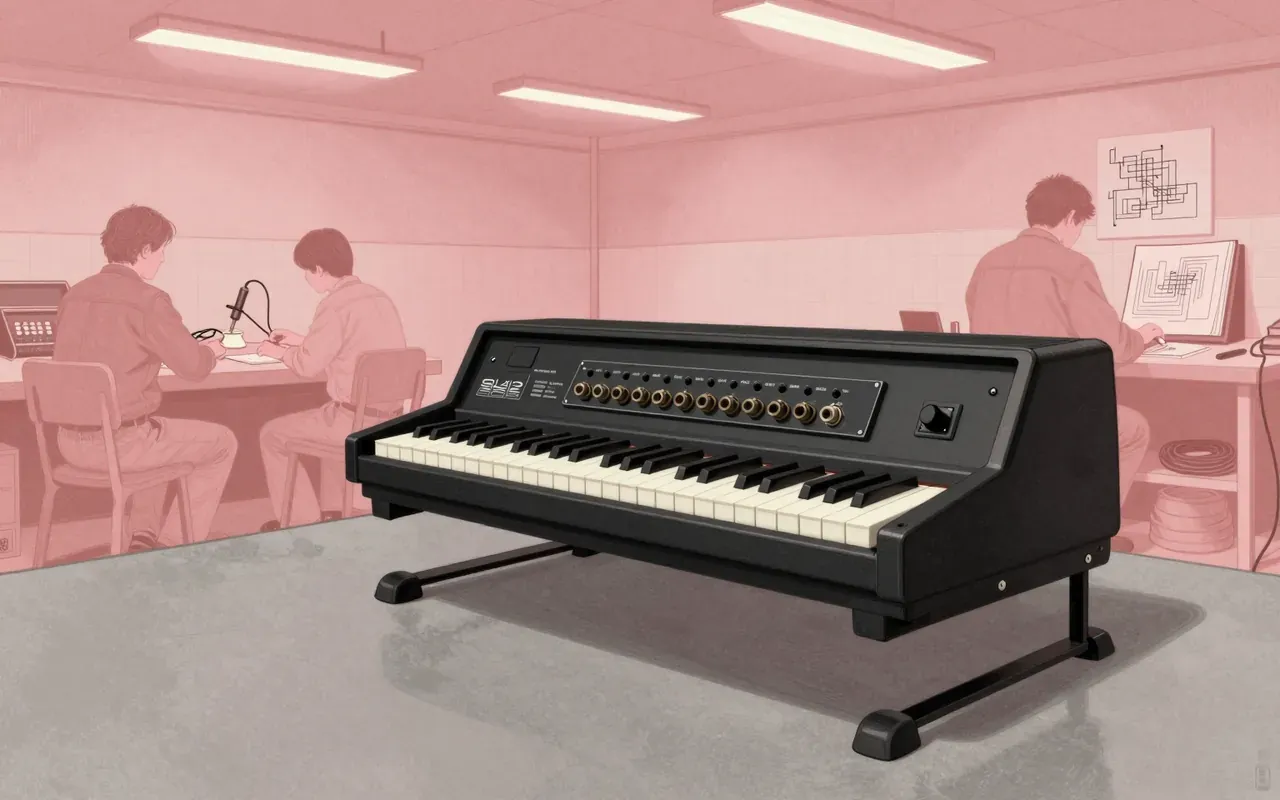
The SH-2000 is a 1973 monophonic analog preset synthesizer. It is Roland’s second synth and a simplified version of the SH-1000. It was built for home organists needing expressive, portable tone colour without synthesis theory.

Chapters & takeaways4
  1. 1:07
    Not a studio tool. An organ-top accessory.

    It is Roland’s second synth and a pared-down version of the SH-1000 — built for organists, not engineers.

  2. 2:40
    30 presets. Eight sliders. No menus.

    You pick a sound with a tab switch, then tweak only cutoff, resonance, LFO rate and a handful of performance controls.

  3. 3:43
    Aftertouch that does five things at once.

    ‘Growl’, ‘Wow’ and Random Note Generator are built-in; aftertouch modulates volume, vibrato, pitch, ‘Wow’ and ‘Growl’.

  4. 5:07
    No save button. No outputs. Just noise.

    It lacks CV/Gate and user memory, but delivers squeaky effects and growling bass notes with zero setup.

Worth your time?

Yes. Use the whole thing.

3.5/ 5
What works
  • squeaky effects
  • growling bass notes
  • aftertouch assignment across five parameters
  • instant access to 30 preset tones via physical tabs
What does not
  • CV/Gate
  • user memory
  • ADSR envelope controls
Use it if
  • home organists
  • performers who prioritise physical immediacy over recall
  • sound designers seeking raw, squeaky or growling monophonic textures
Skip it if
  • anyone needing patch storage
  • anyone needing external sync
  • anyone needing multi-oscillator depth
The written brief1 min read

What it is and what it was built for

The SH-2000 is a 1973 monophonic analog preset synthesizer. It is Roland’s second synth and a simplified version of the SH-1000. It was built for home organists needing expressive, portable tone colour without synthesis theory.

How it works, in terms a player would use

Players select one of 30 preset sounds using colourful tab switches below the 37-key keyboard. Real-time editing is limited to cutoff, resonance and modulation sliders, LFO rate, portamento, vibrato, pitch bend, volume and master tuning. Aftertouch — called ‘Touch Effect’ — assigns to volume, vibrato, pitch, ‘Wow’ or ‘Growl’. ‘Growl’, ‘Wow’ and a Random Note Generator are active on demand.

What it does better than anything else

It does better than anything else in its year the combination of aftertouch assignment across five parameters and instant access to 30 preset tones via physical tabs — all while sitting atop a home organ.

What it does badly

It does badly anything requiring recall, expansion or precision: no user memory, no CV/Gate, no ADSR envelope controls, no oscillator count beyond one, no way to save or name edits.

What people made with it

The sources do not state what people made with it.

Who should use it, and who should not

Home organists, performers who prioritise physical immediacy over recall, and sound designers seeking raw, squeaky or growling monophonic textures should use it. Anyone needing patch storage, external sync, or multi-oscillator depth should not.

Is it worth your time

It is worth your time if you want a tactile, immediate monosynth for bass stabs, squeaky effects and expressive aftertouch-driven swells — but not if you need patch memory, CV/Gate, ADSR control or polyphony.
Same bench · Synths & drum machines4 of 243
10:41
Roland VP-330RolandThe Roland VP-330 is a 1979 paraphonic vocoder and string machine. It combines ten-band vocoding, electronic strings, and four synthetic choir sounds using seven shared bandpass filters. Its BBD ensemble effect thickens all three sections. Touring musicians adopted it as a lighter, more robust alternative to the Mellotron — despite its choir and strings being less realistic. It offers no patch memory, no MIDI, and no polyphonic independence.
12:36
Roland RS-202RolandThe Roland RS-202 is a 1976 string synthesizer that uses sawtooth oscillators and frequency division for full polyphony. Its paraphonic architecture routes all notes through one envelope shaper—but assigns per-note articulation to prevent attack re-triggering. Split-keyboard controls allow independent top/bottom sounds. An analog chorus with LFO-modulated delay lines creates ensemble realism. It does not offer true polyphonic envelopes, per-voice filters, or digital memory.
8:37
Roland SH-2RolandThe Roland SH-2 is a monophonic analog synthesizer introduced in 1978. It has two detunable VCOs, a resonant self-oscillating 24dB lowpass filter, one envelope, one LFO, and a 3-octave keyboard. Its one-button-one-function interface is simple and effective. It produces fat, aggressive, authentic vintage analog tones—especially when the oscillators are detuned. It shares sonic traits with the SH-101 but adds detunability and thickness. It is flexible enough for punchy basses, leads and squelchy sounds. Every sound—including drums—has been made on it in at least one documented case. It is simple, programmable, and sonically aligned with Roland’s high-end SH series.
8:42
Roland SH-5RolandThe Roland SH-5 is a monophonic analog synthesizer introduced in 1976. It has two VCOs, two LFOs, two multi-mode filters, two VCAs, a 5-source mixer, stereo panning, portamento and ring modulation. It is no longer manufactured. No technical specifications are available.
Up next in Audio

Roland SH-5

Roland · 8:42

The SH-5 is not a vintage icon — it is a monophonic modulation laboratory with no manual, no memory, and no mercy.

8:42