audiobriefs
10:39in productionCh. 1 · Two switches, three layers/ 10:39 · ceiling 15 min
Effects & pedals · Guitars & amps

Lovetone Ring Stinger

This pedal doesn’t play nice—it demands its manual, rejects stable power, and rewards obsession with robot noise and Hendrix octaves.

The Lovetone Ring Stinger is an all-analog octave and ring modulator pedal with switchable LFO modulation. It delivers distinctive Hendrix- and Jeff Beck–style tones but requires its manual for calibration and stable power for consistent operation.

Chapters & takeaways4
  1. 0:58
    Two switches, three layers

    Two footswitches control mode and modulation—no presets, no menu, just physical toggling between octave, ring mod, and LFO engagement.

  2. 2:41
    Hendrix and Beck in one box

    It nails specific vintage tones: 'Purple Haze' octaves and Jeff Beck ring mod, plus unfiltered 'robot noise' on any instrument.

  3. 4:34
    No other pedal does this combination

    Its all-analog circuit is unique among ring mod/octave pedals—and the LFO adds rhythmic texture no competitor layers this way.

  4. 6:02
    Manual required, not optional

    Without the manual, calibration fails and usable sounds vanish—this pedal refuses to be intuitive.

Worth your time?

Yes. Use the whole thing.

3.5/ 5
What works
  • audio/effects-and-pedals
  • audio/sound-design-and-sampling
What does not
  • audio/daws-and-software
  • audio/dj-gear
  • audio/guitars-and-amps
  • audio/headphones-and-hi-fi
Use it if
  • audio/effects-and-pedals
Skip it if
  • audio/keyboards-and-organs
  • audio/microphones-and-preamps
  • audio/mixing-and-mastering
The written brief1 min read

What it is and what it was built for

The Lovetone Ring Stinger is an all-analog effects pedal built to generate octaves and ring-modulated tones, with switchable LFO modulation applied to either mode.

How it works, in terms a player would use

It has two footswitches: one toggles between octave and ring mod modes; the other engages LFO modulation. A master bypass switch turns the whole effect off. The LFO applies rhythmic modulation to either mode, with waveform selection affecting smoothness or choppiness.

What it does better than anything else

It combines octave generation and ring modulation in a single all-analog circuit no other pedal replicates. Its dual-mode flexibility—especially the LFO’s rhythmic layering on ring mod—is unmatched in this category.

What it does badly

It fails without its manual. Users cannot reliably calibrate the VCO or set up usable sounds without it. Power instability causes inconsistent performance.

What people made with it

Players used it to nail Hendrix-style ‘Purple Haze’ octave tones and Jeff Beck–style ring mod textures. It also produced ‘mindless robot noise’ across instruments and rhythmic, choppy or smooth modulated effects.

Who should use it, and who should not

It suits players who own the manual, value analog uniqueness over immediacy, and work in experimental, noise, or vintage-inspired guitar contexts. It is unsuited for anyone needing plug-and-play reliability or consistent live operation without prep.

Is it worth your time

It is worth your time only if you accept that calibration and sound setup require the manual—and that power stability directly undermines consistency. It does not reward casual tweaking.
Same bench · Effects & pedals4 of 121
8:47
Lovetone Big CheeseLovetoneThe Lovetone Big Cheese is a UK-made, all-analog fuzz pedal for electric guitar. It has four controls: 'Curds' (gain), 'Whey' (volume), a traditional tone knob, and a stepped tone switch with four positions including bypass. It uses 1/4" input/output jacks and a 1/8" 9V power jack. It is not rack-mountable. It produces high-gain, noisy, aggressive fuzz — but can also deliver subtle overdrive. It is expensive and regarded as top-notch.
13:06
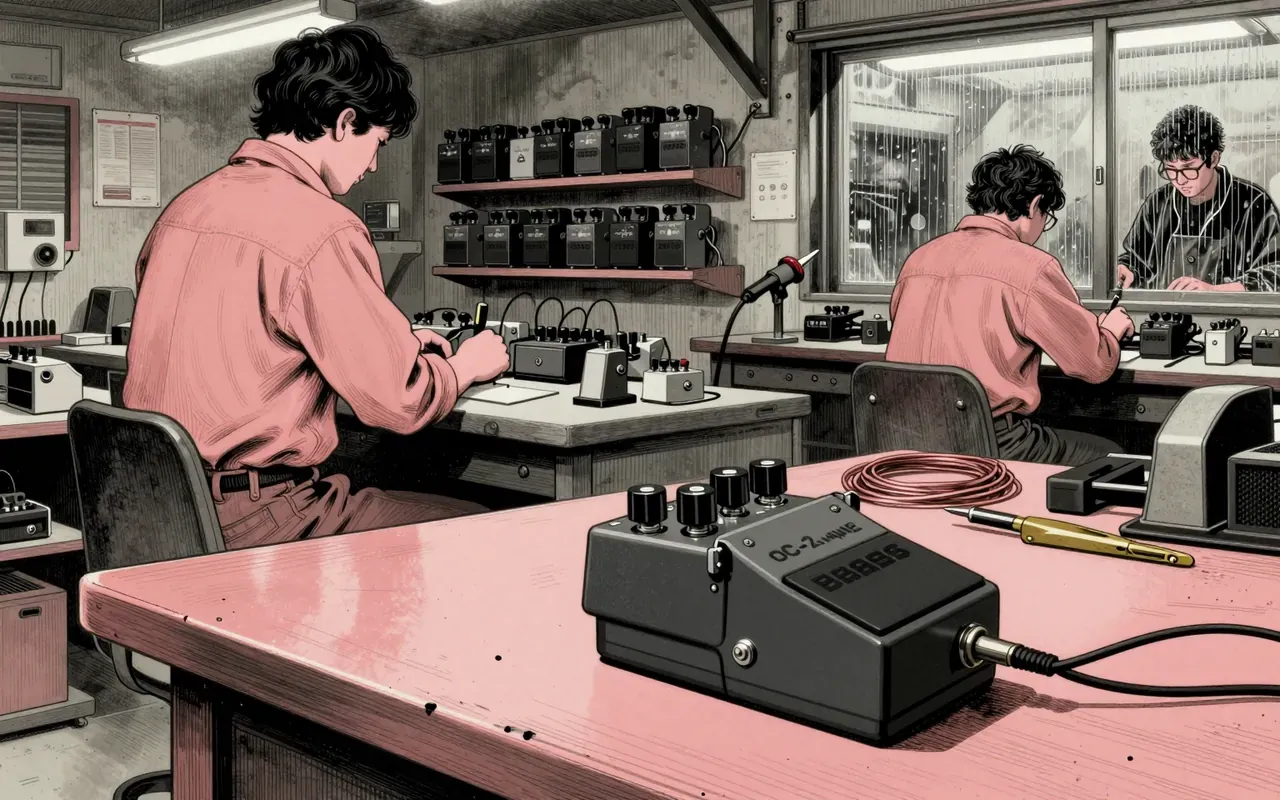
Boss OC-2 OctaveBossThe Boss OC-2 Octave is a stompbox that adds one or two sub-octaves to a guitar signal. Its three knobs control each layer. It runs on 9V DC or battery. Higher notes track smoothly — without digital harshness. But notes below the 12th fret on the low E string mis-track badly: wobbly, out-of-tune, uncorrectable. It is unfit for conventional use. Only noise or experimental players gain anything from its failure.
12:28
Shin-ei Fuzz-WahShin-eiThe Shin-ei Fuzz-Wah is a 1968 analog pedal that merges wah and fuzz into one foot-controlled unit. Rocking controls wah. Sliding left-right controls fuzz gain. Two switches activate effects independently. A third switch sets order. A knob adjusts fuzz volume. Powered by 9V battery or adapter. It remained in production, in some form, until 1984. Fender reissued it in 2008.
10:08
MXR Distortion +MXRThe MXR Distortion + is a 1974 distortion pedal using a single op-amp and germanium diodes. It has Output and Distortion controls only. Increasing Distortion raises both clipping and treble. It was one of MXR’s earliest original pedals, released shortly after the Phase 90. It later appeared in the Series 2000 line in 1982.
Up next in Audio

Mutable Instruments Rings

Mutable Instruments · 8:51

Rings is not a synth — it’s a resonant reactor that turns triggers into timbre.

8:51