Saved
Effects & pedals · Guitars & amps

Boss DC-2 Dimension C

It gives you five unchangeable choruses — and nothing else.

Worth your time?3.5/5Yes.Use the whole thing.What works, what does not, who it is for ↓
9:06in productionCh. 1 · Five presets, no knobs/ 9:06 · ceiling 15 min
4 chapters · 9:06Ceiling 15:00

The brief is written and checked. The video joins this page when it is cut.4 chapters · 1 min read · 9:06 planned

Read the brief

The Boss DC-2 Dimension C is a fixed-preset stereo analog chorus pedal made from 1985 to 1989. It offers five distinct chorus tones — one automatic, four selected by buttons — with no user controls. It reproduces the Roland SDD-320 Dimension D’s spatial effect: thickness, depth and width for a 3D sound. Stereo outputs widen the effect. Built-in noise reduction lowers hiss. It cannot be adjusted mid-performance. It belongs in a rig where consistency matters more than flexibility.

Chapters & takeaways4
  1. 0:44
    Five presets, no knobs

    Made only from 1985 to 1989, with four buttons and one default preset.

  2. 2:35
    A clone of the Dimension D

    It copies the Roland SDD-320’s ‘Dimension’ effect: thickness, depth and width for 3D space.

  3. 4:08
    Stereo = spatial

    Stereo outputs deliver a wider 3D effect — not just left-right spread, but perceived depth.

  4. 5:22
    Quieter than most analog choruses

    Built-in noise reduction keeps hiss low — critical for analog chorus at high gain.

1 more chapterFewer chapters
Worth your time?

Yes. Use the whole thing.

3.5/ 5
What works
  • delivers a stable 3D spatial effect
  • reduces noise relative to other analog choruses
  • provides immediate access to five distinct chorus characters
What does not
  • offer user-adjustable parameters
  • allow real-time modulation control
  • support mono-only operation without loss of spatial character
Use it if
  • players who need repeatable stereo chorus textures
  • collectors of late-1980s Boss hardware
  • engineers seeking low-noise analog chorus in stereo
Skip it if
  • live performers requiring on-the-fly adjustments
  • studio users needing blend or tone shaping
  • anyone unable to source a working unit from 1985–1989
Who should use it, and who should skipHide who it is for
The written brief1 min read

What it is and what it was built for

The Boss DC-2 Dimension C is a stereo analog chorus pedal built to replicate the Roland SDD-320 Dimension D’s spatial effect. It was made for guitarists seeking thickness, depth and width without modulation complexity.

How it works, in terms a player would use

It has four physical buttons to select presets. A fifth preset engages automatically when no button is pressed. There are no knobs, dials or user-adjustable controls. It runs on analog circuitry and outputs stereo signals.

What it does better than anything else

It delivers a consistent, wide 3D spatial effect better than any chorus pedal with user controls — because those controls introduce instability in the exact phase relationships that define the Dimension effect.

What it does badly

It does badly anything requiring real-time adjustment. No rate, depth, mix or tone control means it cannot adapt to tempo shifts, tonal changes or evolving arrangements.

What people made with it

No verified claims describe what people made with it. The sources do not name recordings, artists, genres or tracks.

Who should use it, and who should not

A player who values repeatability over flexibility should use it. Anyone needing to dial in a chorus for a specific song section, amp, or room should not.

Is it worth your time

It is worth your time only if you want a fixed, no-tweak stereo chorus with a specific spatial character — and can source a working unit from its 1985–1989 production run.
Same bench · Effects & pedals4 of 121
9:00
Boss DS-1Boss · 1978The Boss DS-1 is a 1978 distortion pedal built for tight, aggressive tones using hard-clipping circuitry. It uses input/output buffers, a transistor boost stage, an op-amp gain stage with hard clipping diodes, and a tone control. A JFET switching circuit engages or bypasses the effect via a momentary push button. It helped popularise distortion as a distinct pedal category and served as a template for later designs. The 1994 circuit redesign introduced volume loss and a fizzy or waspy edge—problems that spawned a community of modifiers. It remains Boss’s bestselling drive pedal.
9:45
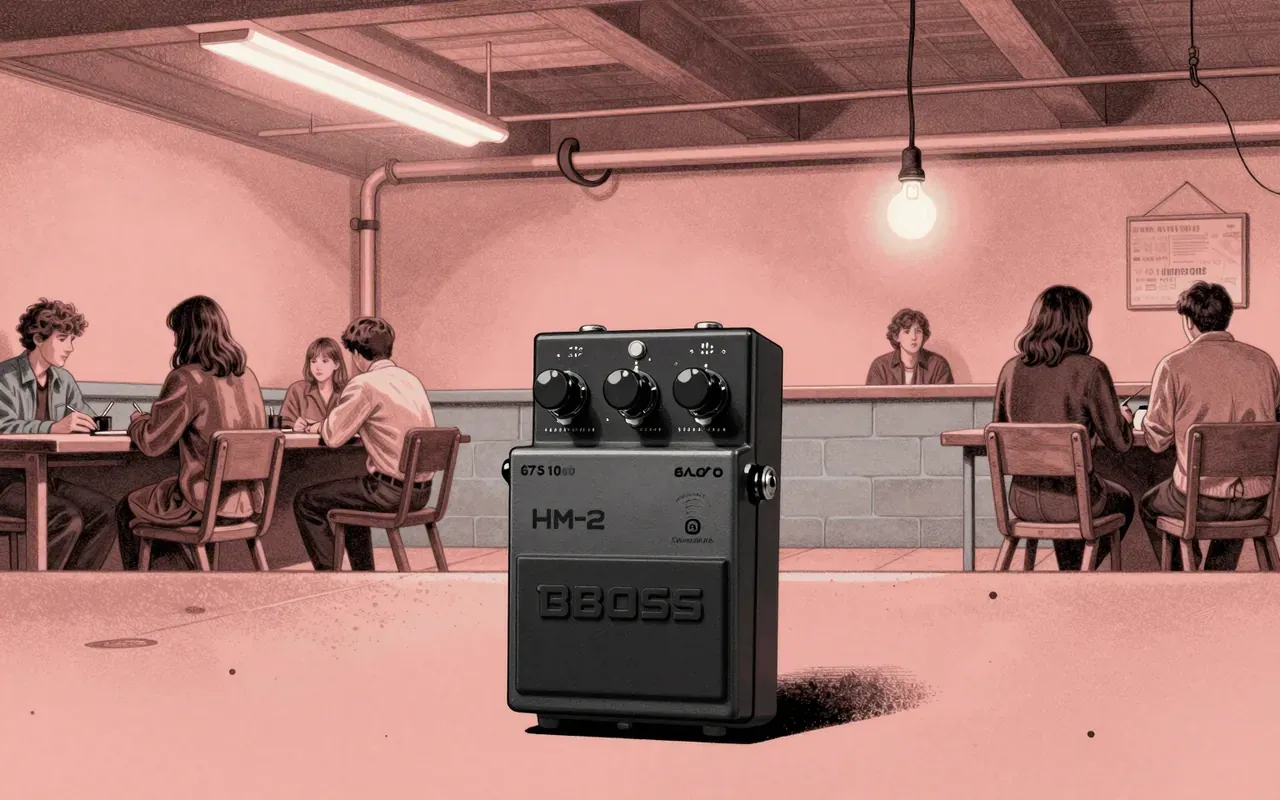
Boss HM-2Boss · 1983The Boss HM-2 is a distortion pedal introduced in October 1983. It was designed to emulate the mid-range response of a Marshall stack and is based on the Boss DS-1. Its defining feature is the radically versatile Low and High ‘Color Mix’ EQ controls, each offering 20 dB of boost or cut.
9:23
Boss FZ-2 Hyper FuzzBossThe Boss FZ-2 Hyper Fuzz is a discontinued analog fuzz pedal with three selectable modes and five physical controls. It lacks true bypass. It was succeeded by the FZ-5.
9:58
Boss PH-2 Super PhaserBossThe Boss PH-2 Super Phaser is a discontinued analog guitar stompbox pedal built from 1984 to 2001. It adds a rate knob and two-mode switch to the PH-1 lineage. Mode 1 uses 10-step phasing. Mode 2 uses 12-step phasing. Controls are Rate, Depth, Res, and a 2-way Mode switch. LFO speed ranges from 100 ms to 14 s. Input impedance is 1 Mohm (FET). Residual noise is -80 dBm (IHF-A). Current draw is 20 mA at 9 V DC. Early Incubus used it for its distinctive ‘in-your-face’ phase character—especially in mode 2.
Up next in Audio

Boss DD-3 Digital Delay

Boss · 9:56

The DD-3 doesn’t shape sound—it transmits it, sharply and stubbornly, until the battery dies.

9:56