audiobriefs
9:45in productionCh. 1 · What it is/ 9:45 · ceiling 15 min
Effects & pedals

Boss HM-2

It doesn’t sound like a Marshall — it sounds like a Marshall filtered through a 1983 Boss engineer’s idea of what ‘heavy’ should feel like.

The Boss HM-2 is a distortion pedal introduced in October 1983. It was designed to emulate the mid-range response of a Marshall stack and is based on the Boss DS-1. Its defining feature is the radically versatile Low and High ‘Color Mix’ EQ controls, each offering 20 dB of boost or cut.

Chapters & takeaways4
  1. 0:58
    What it is

    It is a distortion pedal — not overdrive, not fuzz, not saturation — and nothing else.

  2. 2:17
    How it thinks

    Its mid-range focus comes from deliberate design, not accident — and its roots are in the DS-1, not a tube amp bench.

  3. 4:15
    How it responds

    The Low and High ‘Color Mix’ controls give immediate, wide-range tonal control — but only within the pedal’s narrow harmonic window.

  4. 5:58
    Where it sits in the mix

    It carves midrange presence first, then lets you push lows and highs around it — not the other way round.

Worth your time?

Yes. Use the whole thing.

3.5/ 5
What works
  • carving midrange presence
  • cutting through dense mixes
  • shaping rhythm guitar tones for heavy music
What does not
  • deliver tight low-end control
  • offer high-frequency clarity at extreme settings
  • provide clean headroom
Use it if
  • players who want raw, mid-heavy distortion with tactile EQ
Skip it if
  • players who rely on precise gain staging
  • players who need extended top-end definition
The written brief1 min read

What it is and what it was built for

The Boss HM-2 is a distortion pedal introduced in October 1983. It was built to emulate the mid-range response of a Marshall stack.

How it works, in terms a player would use

It has two EQ knobs — Low and High ‘Color Mix’ — each offering 20 dB of boost or cut. The circuit is derived from the DS-1, with a focus on mid-range response like a Marshall stack.

What it does better than anything else

It delivers a thick, saturated mid-forward distortion that cuts through dense mixes better than most 1980s pedals — especially when the Low and High controls are used to carve space rather than boost.

What it does badly

It does not deliver tight low-end control or high-frequency clarity at extreme settings. The EQ interacts in ways that can muddy the signal when both bands are boosted heavily.

What people made with it

It was used to shape the core guitar tone of Swedish death metal in the late 1980s and early 1990s.

Who should use it, and who should not

Players who want a raw, mid-heavy distortion with tactile EQ for live or studio rhythm work should use it. Players who rely on precise gain staging, clean boosts, or extended top-end definition should not.

Is it worth your time

Yes, if you need aggressive, adjustable distortion with strong midrange character and hands-on EQ shaping. No, if you need transparency, clean headroom, or modern high-gain articulation.
Same bench · Effects & pedals4 of 18
9:46
Eventide EclipseEventideA professional-grade digital effects processor with dual independent effects blocks, nearly 100 algorithms—including 11 reverbs—and 24-bit/96kHz conversion. Supports true stereo reverb I/O and extensive looping (up to 20 seconds per block). Firmware updates require Compact Flash and strict version dependencies; bootloader corruption requires factory reprogramming.
8:54
Electro-Harmonix Memory ManElectro-HarmonixThe Electro-Harmonix Deluxe Memory Man is an analog delay pedal introduced in 2008, offering up to 550ms of delay, selectable chorus or vibrato modulation, true bypass switching, and mono audio I/O.
10:42
MXR Phase 90MXR · 1972The MXR Phase 90 is a phaser effects pedal introduced in 1972, the first pedal sold by MXR. It features one knob (Speed), an orange enclosure, and evolved logo designs (script then block). Production ceased in 1984 when MXR went bankrupt. Dunlop resumed production with added features: an LED and optional AC power supply. Pre-1981 units lacked LEDs, A/C adaptor jacks, and true-bypass switching. It was used on the first two Van Halen albums.
9:51
Eventide SpaceEventideThe Eventide Space is a reverb-and-delay pedal offering 12 algorithmic spatial effects—including Hall, Plate, Blackhole®, and Shimmer—controlled via 10 knobs, MIDI, expression pedal, or HotSwitch. It features 100 presets (some artist-designed), true analog bypass, tap tempo/MIDI clock sync, and mono/stereo I/O in a rugged metal pedal format. Software tools FactorLib and H9 Control manage presets; the SpaceTime algorithm combines modulation, two delays, and reverb.
Up next in Audio

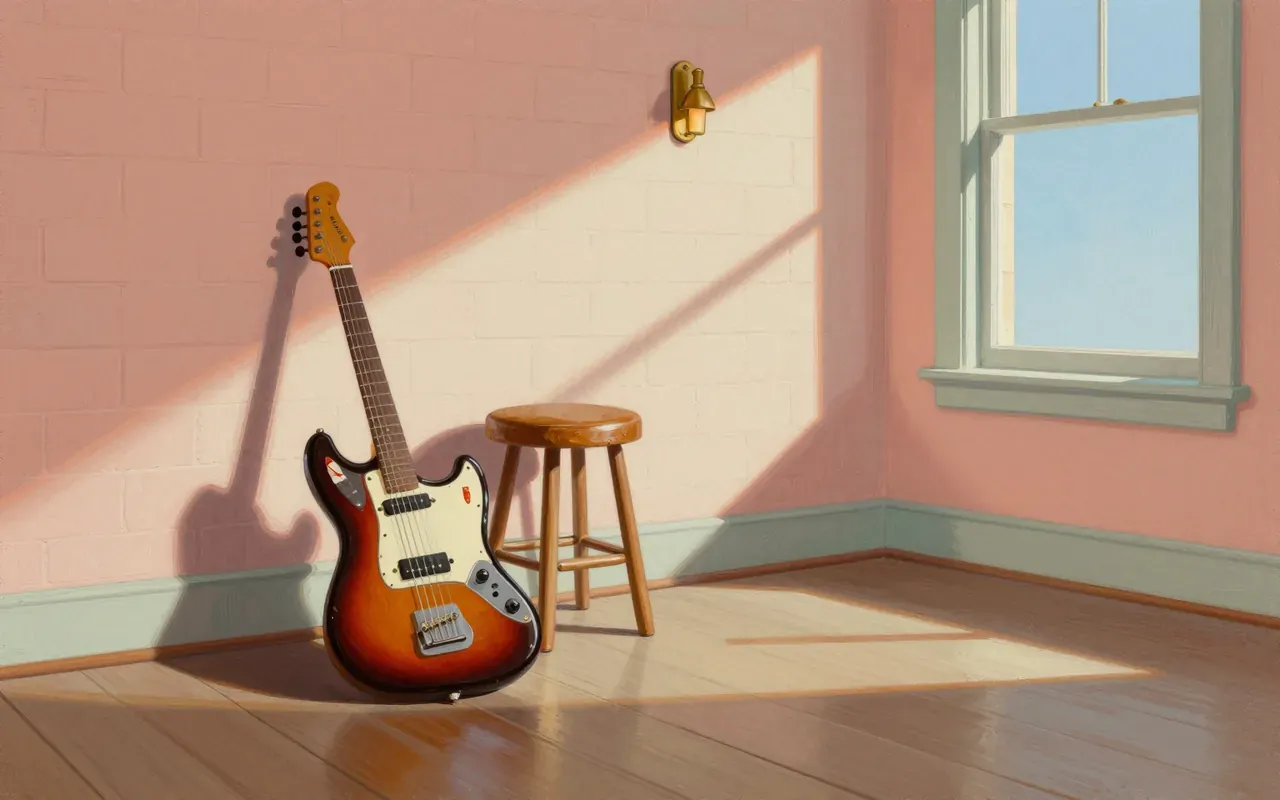
Fender Jaguar

Fender · 1962 · 8:57

A guitar built for rapid tonal whiplash—not versatility, but violent contrast.

8:57