audiobriefs
8:57in productionCh. 1 · Born in 1962/ 8:57 · ceiling 15 min
Guitars & amps

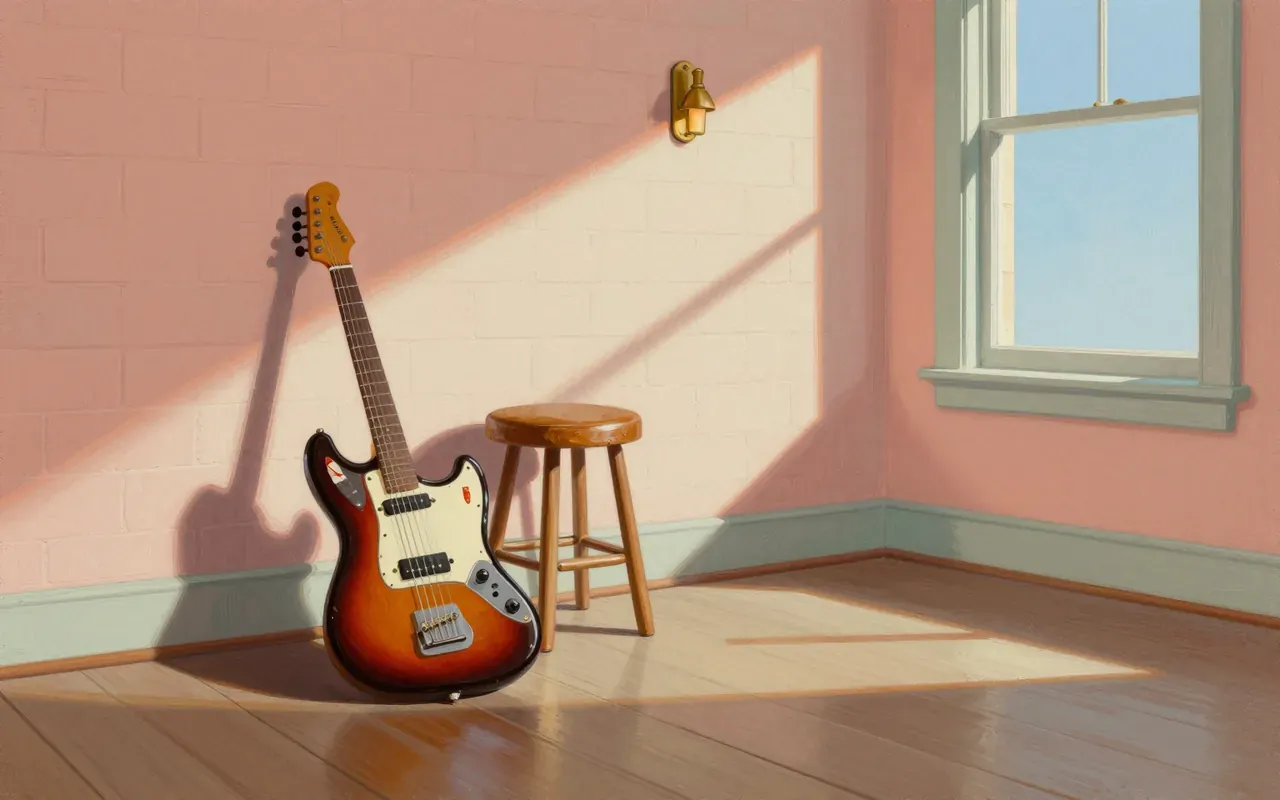
Fender Jaguar

A guitar built for rapid tonal whiplash—not versatility, but violent contrast.

The Fender Jaguar is a 1962 electric guitar with an offset-waist body, 24-inch scale, 22-fret neck, dual-circuit switching (lead/rhythm), smaller single-coil pickups with notched side plates for improved RF shielding, a spring-loaded string mute, and design lineage from the Jazzmaster.

Chapters & takeaways4
  1. 1:05
    Born in 1962

    It launched in 1962—not as a novelty, but as Fender’s deliberate answer to Jazzmaster-derived ergonomics and circuit logic.

  2. 2:28
    Body and Scale

    Its offset waist, 24-inch scale, and Jazzmaster lineage shape how it sits, balances, and feels under the hands.

  3. 4:04
    Dual Circuits

    Two separate circuits give you two complete tone worlds—one for lead, one for rhythm—with no overlap or blending.

  4. 5:36
    Switches, Not Knobs

    Three switches, two dials, and a mute lever force decisive choices—not fine control.

Worth your time?

Yes. Use the whole thing.

4/ 5
What works
  • rapid tonal switching
  • RF-resistant single-coils
  • short-scale offset body for easier chord voicings and barre shapes
What does not
  • offer pickup blending
  • allow tone sweeps
  • provide hum-cancelling
Use it if
  • players who value tactile circuit-switching
  • those who work within constraints like fixed pickup selection per circuit
  • anyone wanting a guitar whose design invites experimentation with silence, filtering, and decay
Skip it if
  • players who rely on smooth tone sweeps
  • those needing noise-free clean headroom at high gain
  • anyone requiring consistent sustain across all registers
The written brief2 min read

What it is and what it was built for

The Fender Jaguar is a 1962 electric guitar built for players who wanted distinct, switchable tonal personalities in one instrument—not just a new look, but a new workflow.

How it works, in terms a player would use

The Jaguar has two independent circuits: a lead circuit with three switches and two dials, and a rhythm circuit activated by an upper bout switch. The lead circuit lets you toggle neck and bridge pickups separately and engage a high-pass filter via the ‘strangle’ switch. The rhythm circuit gives neck-pickup-only tone with dedicated volume and tone rollers. A lever flips up a spring-loaded rubber string mute under the strings.

What it does better than anything else

It switches between preset lead and rhythm tones faster than any Fender of its era. Its smaller single-coil pickups with notched side plates reject RF interference better than Stratocasters or Telecasters. The 24-inch scale and offset waist make chord voicings and barre shapes physically easier on the left hand.

What it does badly

It does not offer pickup blending. The rhythm circuit locks you to the neck pickup only. The strangle switch cuts bass abruptly—no sweep, no nuance. The rubber mute is easily dislodged and dampens sustain unpredictably.

What people made with it

Players used its dual circuits to jump between bright, filtered leads and warm, bass-heavy rhythm parts mid-song. Its vibrato unit and short scale supported surf, garage, and post-punk textures where pitch wobble and percussive muting were central.

Who should use it, and who should not

Use it if you value tactile circuit-switching, enjoy working within constraints like fixed pickup selection per circuit, and want a guitar whose design invites experimentation with silence, filtering, and decay. Do not use it if you rely on smooth tone sweeps, noise-free clean headroom at high gain, or consistent sustain across all registers.

Is it worth your time

Yes—if you want rapid tonal switching, RF-resistant single-coils, and a short-scale offset body that invites rhythmic muting and surfy vibrato play. No—if you need simplicity, hum-cancelling pickups, or a longer scale for tight low-end articulation.
Same bench · Guitars & amps4 of 66
9:31
Gretsch Country ClubGretschNo verified source links the term 'Country Club' to any specific Gretsch instrument feature, specification, or design rationale beyond its model name and mid-1950s introduction alongside the 6120 Nashville, 6128 Duo Jet, and White Falcon. No claims about its construction, electronics, finish, or player experience are supported by the provided material. All descriptive statements must therefore be omitted or flagged as unsupported. The only factual anchors are its name, its status as a Gretsch guitar model, and its release period.
9:30
Gretsch TennesseanGretschThe Gretsch Tennessean is a hollow-body electric guitar built for vintage tone and playability. It delivers a highly resonant, cutting voice shaped by its construction, pickups, and controls. It excels in clean and mid-gain contexts but struggles with feedback and high-gain stability. Its design prioritises acoustic resonance and vibrato expression over modern high-output versatility.
10:06
Rickenbacker 325Rickenbacker · 1958The Rickenbacker 325 is a compact, bright, feedback-prone hollow-body guitar defined by its short scale, semi-hollow construction, and visual signature — the crescent moon cutaways and angled sound hole. It was designed for clarity and portability, not warmth or power.
9:15
Vox AC15VoxThe Vox AC15 is a foundational British guitar amplifier — simple, immediate, and sonically specific. It trades versatility for character. Its design choices are constraints, not oversights. It remains relevant not as a relic, but as a functional tool with an unrepeatable voice.
Up next in Audio

Fender Jazz Bass

Fender · 9:34

The Jazz Bass trades fundamental weight for midrange cut—and gives your left hand room to move.

9:34