audiobriefs
8:58in productionCh. 1 · Sold to jazz, stolen by surf/ 8:58 · ceiling 15 min
Guitars & amps

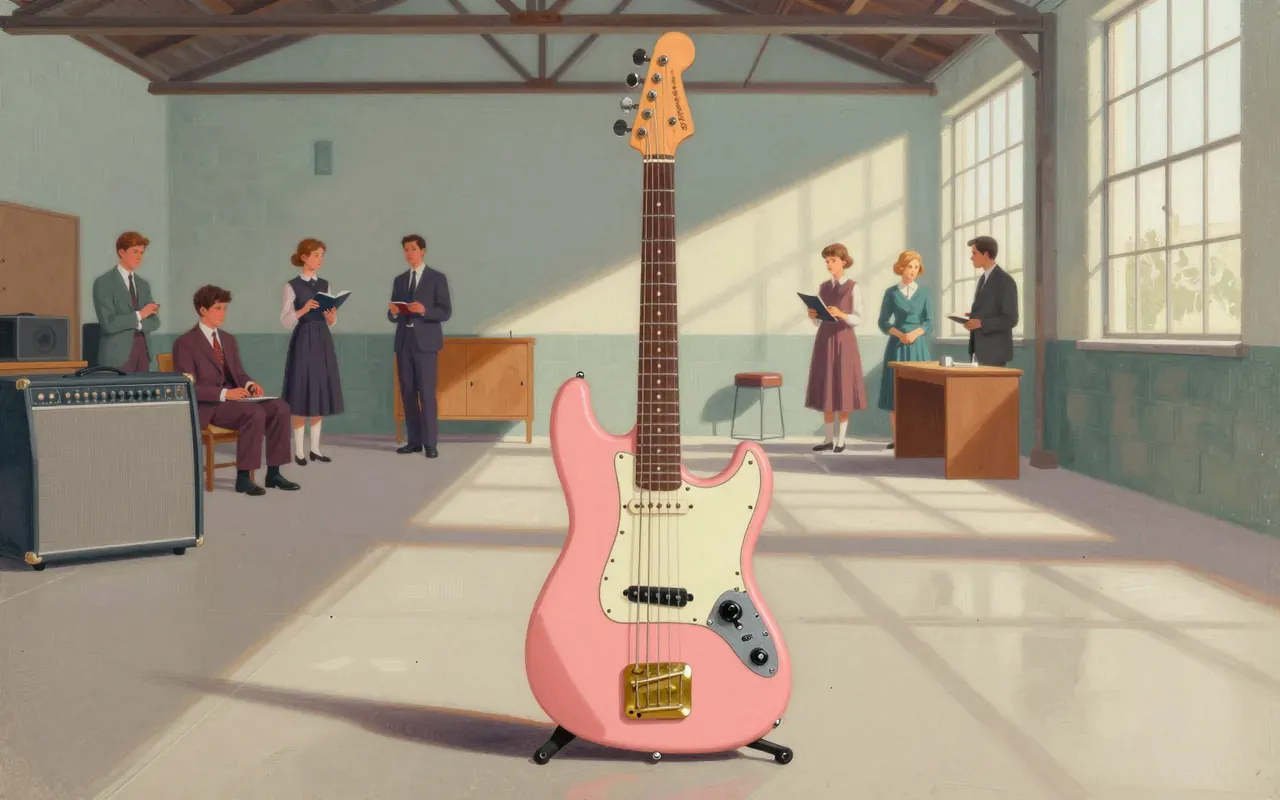
Fender Jazzmaster

It was sold to jazz players but loved by surf guitarists—because its instability is its voice.

Fender Jazzmaster (1958)

Chapters & takeaways4
  1. 0:59
    Sold to jazz, stolen by surf

    It was launched for jazz but claimed by surf.

  2. 2:36
    Built to sit in

    The offset waist puts comfort first—for seated players.

  3. 3:50
    Circuits, fulcrums, and the lock

    Two circuits, two bridges, one long arm—and a lock to stop chaos.

  4. 5:11
    Mellow resonance, no hum, less sustain

    Less sustain, wider pickups, no hum—mellow where others bite.

Worth your time?

Yes. Use the whole thing.

4/ 5
What works
  • as a seated jazz companion
  • as a surf-rock engine
  • as a dual-voice platform for texture-switching
What does not
  • deliver tight sustain
  • suit aggressive palm muting
  • offer Stratocaster-style vibrato stability
Use it if
  • players who value seated ergonomics
  • surfers of pitch and texture
  • builders of layered, vib-heavy tones
Skip it if
  • players reliant on high-gain sustain
  • those needing instant, stable vibrato response
  • users who prefer single-circuit simplicity
The written brief1 min read

What it is and what it was built for

A 1958 Fender electric guitar built for jazz players who sat while performing. It has a 25.5-inch scale, wide white ‘soapbar’ pickups, and a floating vibrato system unlike any other Fender at the time.

How it works, in terms a player would use

The Jazzmaster switches between lead and rhythm circuits using a slide switch. Each circuit has its own volume and tone controls, all roller thumbwheels. The vibrato arm moves the bridge back and forth on two fulcrum points. A manual vibrato lock holds the system in place if a string breaks.

What it does better than anything else

It offers unmatched seated playing comfort thanks to its offset-waist body. Its lead/rhythm circuit split gives two distinct tonal palettes under one hood—no need to swap guitars or pedals for rhythm texture versus lead cut.

What it does badly

It delivers less sustain than the Stratocaster due to its bridge and vibrato construction. The vibrato system detunes easily without the lock engaged. The long arm and floating bridge make palm muting and aggressive picking less precise.

What people made with it

Surf rock guitarists made it their own in the early 1960s—using its mellow, jazzier tone and extreme vibrato for reverb-drenched, wave-like lines. Jazz players did not adopt it widely despite the marketing.

Who should use it, and who should not

Players who prioritise tactile variety, vibrato expression and ergonomic seated play should use it. Players who rely on tight rhythmic precision, high-gain sustain or intuitive control layout should not.

Is it worth your time

Yes—if you want a guitar that leans into instability, invites surfy vibrato and seated comfort, and rejects Stratocaster conventions. No—if you need tight sustain, predictable tuning or fast access to standard switching logic.

Same bench · Guitars & amps4 of 66
9:31
Gretsch Country ClubGretschNo verified source links the term 'Country Club' to any specific Gretsch instrument feature, specification, or design rationale beyond its model name and mid-1950s introduction alongside the 6120 Nashville, 6128 Duo Jet, and White Falcon. No claims about its construction, electronics, finish, or player experience are supported by the provided material. All descriptive statements must therefore be omitted or flagged as unsupported. The only factual anchors are its name, its status as a Gretsch guitar model, and its release period.
9:30
Gretsch TennesseanGretschThe Gretsch Tennessean is a hollow-body electric guitar built for vintage tone and playability. It delivers a highly resonant, cutting voice shaped by its construction, pickups, and controls. It excels in clean and mid-gain contexts but struggles with feedback and high-gain stability. Its design prioritises acoustic resonance and vibrato expression over modern high-output versatility.
10:06
Rickenbacker 325Rickenbacker · 1958The Rickenbacker 325 is a compact, bright, feedback-prone hollow-body guitar defined by its short scale, semi-hollow construction, and visual signature — the crescent moon cutaways and angled sound hole. It was designed for clarity and portability, not warmth or power.
9:15
Vox AC15VoxThe Vox AC15 is a foundational British guitar amplifier — simple, immediate, and sonically specific. It trades versatility for character. Its design choices are constraints, not oversights. It remains relevant not as a relic, but as a functional tool with an unrepeatable voice.
Up next in Audio

Roland JD-990

Roland · 9:05

A 1993 PCM module that gives you vintage warmth and digital clarity—but only if you’re willing to program via keypad.

9:05