audiobriefs
9:23in productionCh. 1 · Gone from production/ 9:23 · ceiling 15 min
Effects & pedals

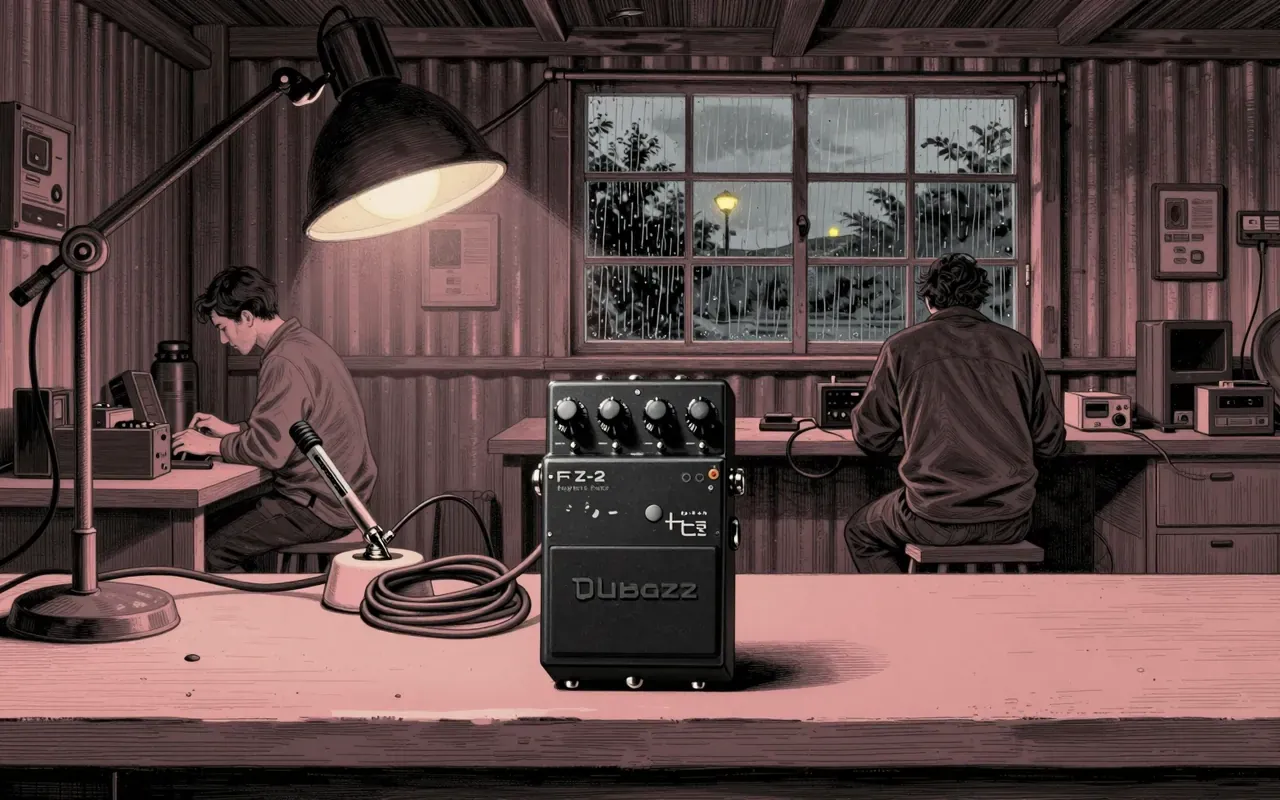
Boss FZ-2 Hyper Fuzz

Three fuzz modes in one box — but no true bypass, no new units, and no way to escape its compressed, unrelenting grind.

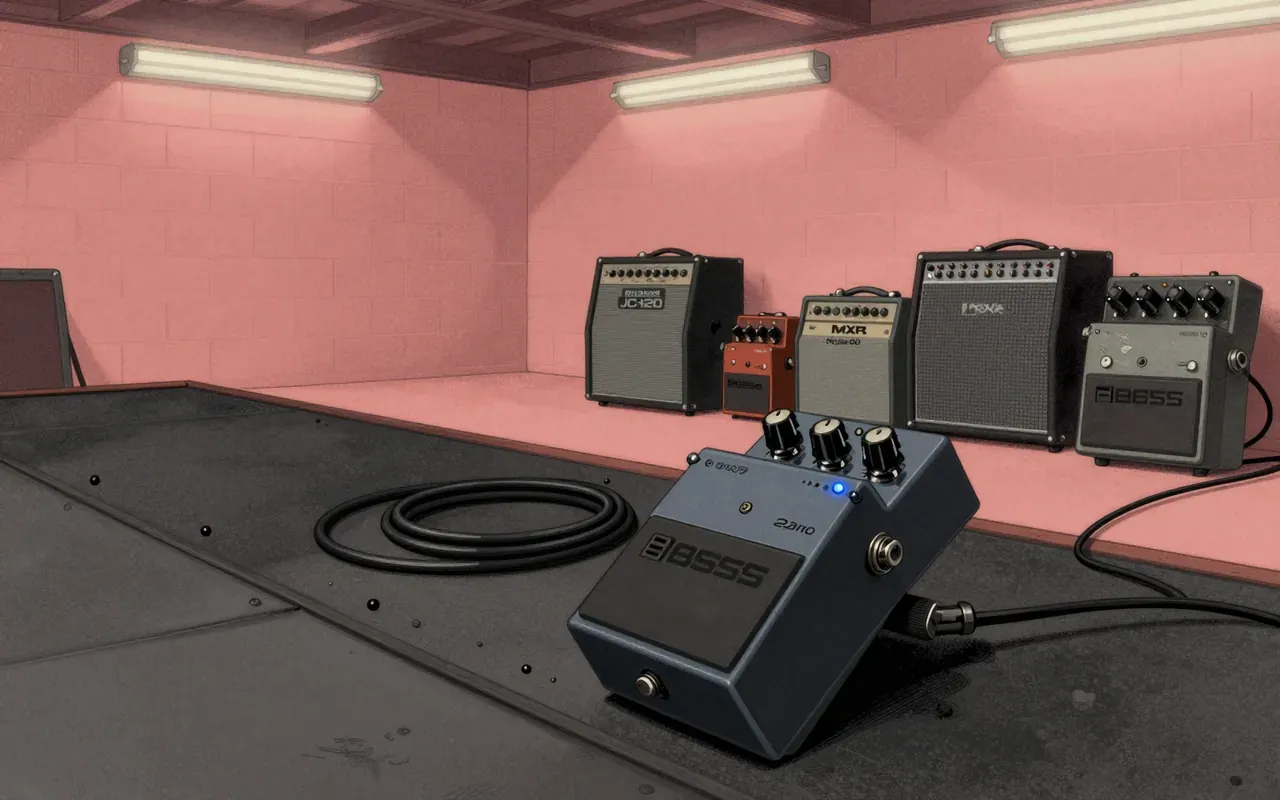
The Boss FZ-2 Hyper Fuzz is a discontinued analog fuzz pedal with three selectable modes and five physical controls. It lacks true bypass. It was succeeded by the FZ-5.

Chapters & takeaways4
  1. 1:01
    Gone from production

    It is discontinued and unavailable new.

  2. 2:27
    Succeeded by the FZ-5

    The FZ-5 replaced it in Boss's lineup.

  3. 4:15
    Five knobs, three modes

    Five physical controls define its hands-on workflow: Level, Tone, concentric cut/boost, Gain, and a 3-way rotary mode switch.

  4. 5:30
    Three distinct modes

    Fuzz I, Fuzz II, and Gain Boost are discrete sonic options — not variations on a theme.

Worth your time?

Yes. Use the whole thing.

3.5/ 5
What works
  • three distinct fuzz modes
  • concentric tone control for cut/boost
What does not
  • true bypass
Use it if
  • players seeking switchable fuzz aggression in a durable metal housing
Skip it if
  • players who require signal transparency when the pedal is off
The written brief1 min read

What it is and what it was built for

The Boss FZ-2 Hyper Fuzz is a discontinued analog guitar fuzz pedal built for aggressive, saturated distortion. It was designed for players who want switchable fuzz intensity and mid-forward grit without pedalboard bloat.

How it works, in terms a player would use

The pedal has four main controls: Level, Tone, Gain, and a 3-Way Mode Switch. A fifth control is a concentric knob — a smaller knob nested inside the Tone knob — for adjusting cut/boost frequencies. Players select between Fuzz I, Fuzz II, and Gain Boost using the rotary switch. It lacks true bypass.

What it does better than anything else

It delivers three distinct high-gain fuzz voicings in one enclosure — two fuzz modes with different saturation characters and a dedicated Gain Boost — more than most single-pedal fuzz units of its era.

What it does badly

It does not preserve signal integrity when off — no true bypass means tone suck and loading on the signal chain. It offers no fine-grained tonal shaping beyond the concentric Tone/cut-boost and broad Gain sweep.

What people made with it

No information is provided about what people made with it.

Who should use it, and who should not

Players who already own one, or who specifically want its three-mode switching and metal-enclosed durability should use it. Players who rely on true bypass, need consistent stock availability, or prefer transparent clean tones when the pedal is off should not.

Is it worth your time

It is not worth your time if you need true bypass, modern reliability, or current availability. It is worth your time only if you seek its specific aggressive fuzz textures and are prepared to source a used unit.
Same bench · Effects & pedals4 of 121
9:00
Boss DS-1Boss · 1978The Boss DS-1 is a 1978 distortion pedal built for tight, aggressive tones using hard-clipping circuitry. It uses input/output buffers, a transistor boost stage, an op-amp gain stage with hard clipping diodes, and a tone control. A JFET switching circuit engages or bypasses the effect via a momentary push button. It helped popularise distortion as a distinct pedal category and served as a template for later designs. The 1994 circuit redesign introduced volume loss and a fizzy or waspy edge—problems that spawned a community of modifiers. It remains Boss’s bestselling drive pedal.
9:06
Boss DC-2 Dimension CBossThe Boss DC-2 Dimension C is a fixed-preset stereo analog chorus pedal made from 1985 to 1989. It offers five distinct chorus tones — one automatic, four selected by buttons — with no user controls. It reproduces the Roland SDD-320 Dimension D’s spatial effect: thickness, depth and width for a 3D sound. Stereo outputs widen the effect. Built-in noise reduction lowers hiss. It cannot be adjusted mid-performance. It belongs in a rig where consistency matters more than flexibility.
9:11
Boss MT-2Boss · 1991The Boss MT-2 Metal Zone is a 1991 distortion pedal designed for heavy metal guitarists. It features high-gain capabilities, a thick and tight tone, and powerful semi-parametric EQ controls. Boss developed it as a more versatile successor to the HM-2, using a dual-stage gain circuit and seven pre- and post-distortion filters.
10:39
Lovetone Ring StingerLovetoneThe Lovetone Ring Stinger is an all-analog octave and ring modulator pedal with switchable LFO modulation. It delivers distinctive Hendrix- and Jeff Beck–style tones but requires its manual for calibration and stable power for consistent operation.
Up next in Audio

Grace Design m201

Grace Design · 9:00

A preamp that refuses to be anything else — and that is its entire point.

9:00