audiobriefs
9:43in productionCh. 1 · All Analog, All the Time/ 9:43 · ceiling 15 min
Effects & pedals · Sound design & sampling

Sennheiser Vocoder 2000

It doesn’t speak — it forces speech through analog grit, one knob at a time.

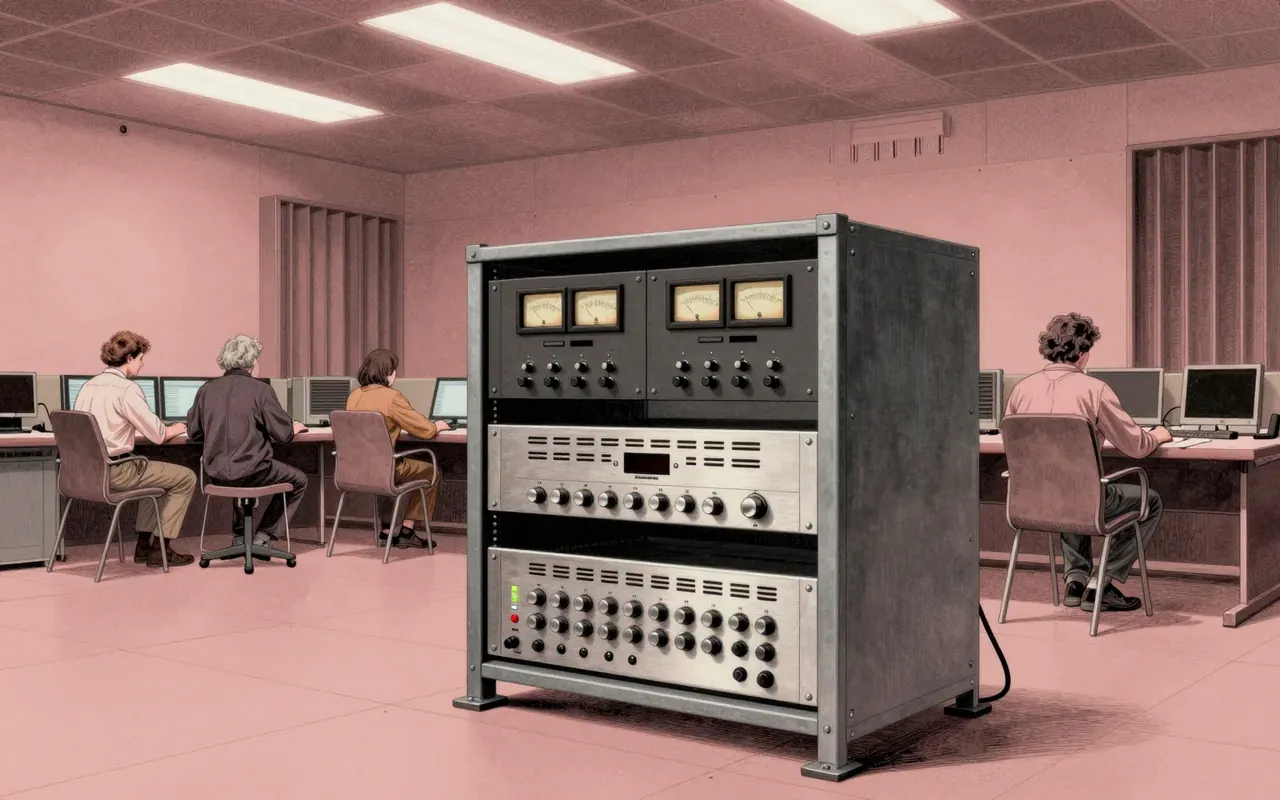
The Sennheiser Vocoder 2000 is a fully analog, rack-mount vocoder released around 2002. It uses discrete-component circuitry. It includes an internal oscillator with pitch modulation, an internal noise source, and a noise gate. It requires no external sound source. Both white-face and black-face versions share identical analog circuitry.

Chapters & takeaways4
  1. 1:02
    All Analog, All the Time

    Every version is 100% analog — no digital components, no firmware, no compromise.

  2. 2:24
    Rack-Mount Only

    It lives in a rack, not on a desk — built for fixed installations, not gig bags.

  3. 3:56
    Self-Contained Sound Source

    No external synth needed — oscillator and noise source are built in and voice-controllable.

  4. 5:57
    Voice-Locked Oscillator

    Pitch modulation ties synth tone directly to vocal pitch — no tracking delay, no quantisation.

Worth your time?

Yes. Use the whole thing.

4.5/ 5
What works
  • immediate tactile control
  • harmonically rich vowel shaping
  • voice-locked pitch modulation
  • zero-latency analog signal path
What does not
  • digital
  • portable
  • preset-based
  • MIDI-equipped
Use it if
  • studio engineers
  • modular performers
  • sound designers who reject digital interpolation
Skip it if
  • laptop producers
  • live performers needing quick recall
  • anyone without rack space
The written brief1 min read

What it is and what it was built for

The Sennheiser Vocoder 2000 is a fully analog, rack-mount vocoder built for studio vocal processing and live sound design. It was built to replace external synth sources with its own oscillator and noise generator.

How it works, in terms a player would use

It is a rack-mount unit with grey knobs and coloured lines. It uses internal analog circuitry only. It has an internal oscillator and noise source, so no external synth or drum machine is needed. Pitch modulation links the oscillator to voice input. A noise gate controls sibilance.

What it does better than anything else

It does better than any digital vocoder at delivering immediate, tactile, harmonically rich vowel shaping — because every stage is analog and discrete, and because the internal oscillator locks tightly to voice pitch without tracking lag.

What it does badly

It does badly at recall and repeatability. There are no presets, no save function, no CV or MIDI sync. Its noise gate is basic and cannot be finely tuned. It offers no visual feedback beyond LED indicators.

What people made with it

People made expressive, talk-box–adjacent lead lines and intelligible robotic vocals — using only voice and the unit’s internal sources — in electronic and experimental music contexts.

Who should use it, and who should not

A studio engineer or modular performer who values hands-on analog signal flow and owns space for a 19-inch rack unit should use it. Anyone needing portability, recall, or digital integration should not.

Is it worth your time

It is worth your time if you need hands-on, fully analog vocoding with no digital interpolation or latency. It is not worth your time if you need patch memory, MIDI control, or integration with DAWs.
Same bench · Effects & pedals4 of 121
10:39
Lovetone Ring StingerLovetoneThe Lovetone Ring Stinger is an all-analog octave and ring modulator pedal with switchable LFO modulation. It delivers distinctive Hendrix- and Jeff Beck–style tones but requires its manual for calibration and stable power for consistent operation.
10:08
MXR Distortion +MXRThe MXR Distortion + is a 1974 distortion pedal using a single op-amp and germanium diodes. It has Output and Distortion controls only. Increasing Distortion raises both clipping and treble. It was one of MXR’s earliest original pedals, released shortly after the Phase 90. It later appeared in the Series 2000 line in 1982.
9:06
Boss DC-2 Dimension CBossThe Boss DC-2 Dimension C is a fixed-preset stereo analog chorus pedal made from 1985 to 1989. It offers five distinct chorus tones — one automatic, four selected by buttons — with no user controls. It reproduces the Roland SDD-320 Dimension D’s spatial effect: thickness, depth and width for a 3D sound. Stereo outputs widen the effect. Built-in noise reduction lowers hiss. It cannot be adjusted mid-performance. It belongs in a rig where consistency matters more than flexibility.
8:47
Lovetone Big CheeseLovetoneThe Lovetone Big Cheese is a UK-made, all-analog fuzz pedal for electric guitar. It has four controls: 'Curds' (gain), 'Whey' (volume), a traditional tone knob, and a stepped tone switch with four positions including bypass. It uses 1/4" input/output jacks and a 1/8" 9V power jack. It is not rack-mountable. It produces high-gain, noisy, aggressive fuzz — but can also deliver subtle overdrive. It is expensive and regarded as top-notch.
Up next in Audio

EMS Vocoder 5000

EMS · 8:12

An effects processor with no specs is not a tool — it's a placeholder.

8:12