audiobriefs
8:35in productionCh. 1 · No manual needed/ 8:35 · ceiling 15 min
Synths & drum machines

Yamaha RX21

It doesn’t play drums—it stamps them out, flat and fast, like a factory press.

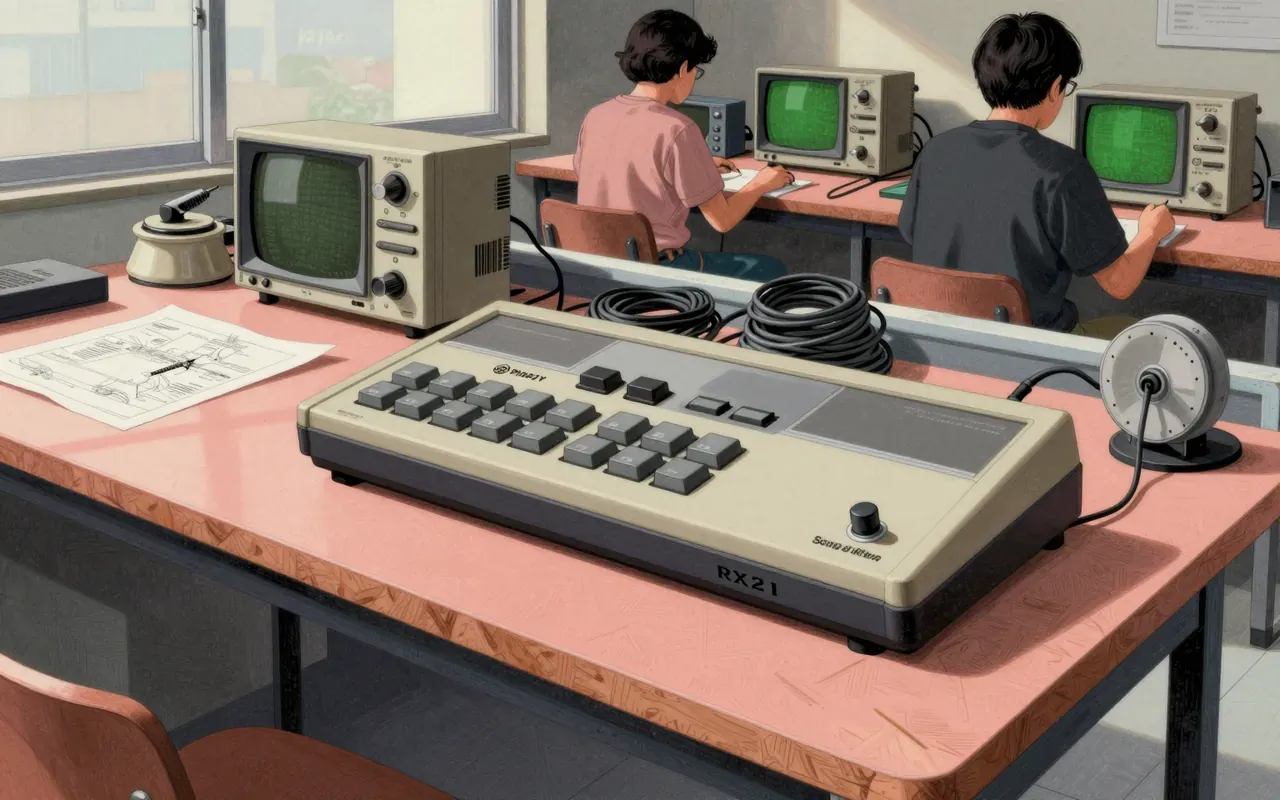
The Yamaha RX21 is a fixed-function drum machine. It plays 100 preset patterns and 5 song sequences. It has stereo and headset outputs, plus a footswitch input. Its operation is intuitive and manual-free. Its sound is basic, loop-based, and dynamically flat—characteristic of early 1980s beatboxes.

Chapters & takeaways4
  1. 0:49
    No manual needed

    You can operate it without opening the manual.

  2. 2:21
    100 patterns, 5 songs

    It holds 100 patterns and 5 songs—no loading, no saving.

  3. 3:38
    Flat, loop-based 80s sound

    Its drum sounds are basic, loop-based, and dynamically flat—pure 1980s beatbox character.

  4. 5:08
    Stereo, headset, footswitch only

    Outputs are traditional stereo and headset; a footswitch input handles start/stop.

Worth your time?

Yes. Use the whole thing.

3.5/ 5
What works
  • as a live rhythm anchor
  • for sketching simple backing tracks
  • in setups where simplicity trumps capability
What does not
  • offer dynamic control
  • allow sound editing
  • sync to external tempo
  • support user patterns
Use it if
  • performers needing instant beat recall
  • producers valuing immediacy over flexibility
Skip it if
  • sound designers
  • studio producers requiring nuance
The written brief1 min read

What it is and what it was built for

The Yamaha RX21 is a self-contained drum machine built for live performance and quick sketching of basic rhythmic backing. It was not designed for sound design, layering, or studio production.

How it works, in terms a player would use

It runs patterns and songs from memory. Press Play. Select a pattern with the number keys. Chain patterns into songs. Use the footswitch to start and stop. No programming required.

What it does better than anything else

It delivers immediate, uncluttered 1980s drum loops faster than any machine that requires sequencing or patching. Its simplicity means zero setup time.

What it does badly

It offers no dynamic range. Every hit sounds the same volume. It gives no way to adjust individual drum levels, tune sounds, or modify timing. It cannot sync to external clocks.

What people made with it

People used it to lay down foundational drum tracks in home recordings and live backing—especially where speed and reliability mattered more than nuance.

Who should use it, and who should not

A performer who needs instant, consistent 1980s-style beats on stage or in rehearsal. Not a producer seeking flexibility, dynamics, or modern connectivity.

Is it worth your time

Yes—if you want loop-based 1980s drum tracks without editing, routing or velocity control. No—if you need dynamics, variation, or integration with modern gear.
Same bench · Synths & drum machines4 of 243
Up next in Audio

Yamaha RX7

Yamaha · 7:59

It doesn’t emulate drums—it weaponises 12-bit compromise.

7:59