audiobriefs
8:11in productionCh. 1 · Built to Fill a Gap/ 8:11 · ceiling 15 min
Synths & drum machines

Synton Fenix

It wasn’t built to sell. It was built because every other synth failed its creators’ personal test.

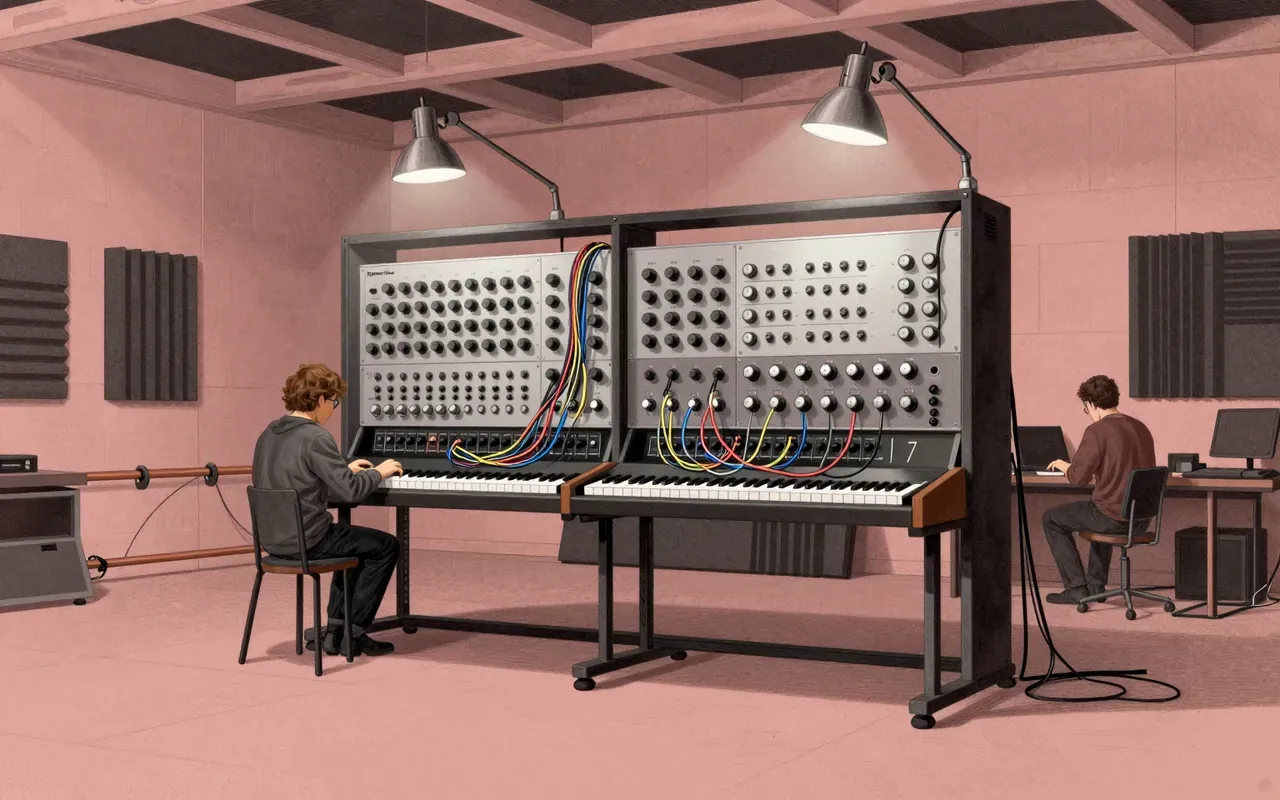
The Synton Fenix is a rare, handbuilt modular synthesizer from 1997 — 75 units total — designed by Marc Paping and Bert Vermeulen to include only the vintage-analogue features they personally valued, and nothing more.

Chapters & takeaways4
  1. 1:08
    Built to Fill a Gap

    It exists because commercial synths lacked the features its designers demanded.

  2. 2:33
    A Personal Synthesis Archive

    Its modules reflect decades of hands-on preference — not market research or trend forecasting.

  3. 3:52
    Two Batches, No Reissues

    Only 75 were ever made — 25 first, then 50 more — all handbuilt, all unique.

  4. 4:54
    Favourite, Not Famous

    Musicians cite its unique modules and distinctive sounds as why it’s their favourite gear.

Worth your time?

Yes. Use the whole thing.

3.5/ 5
What works
  • as-a-personal-synthesis-archive
  • as-a-distinctive-sound-source
What does not
  • scale
  • integrate
  • document
Use it if
  • designer
  • collector
Skip it if
  • performer
  • beginner
  • studio-tenant
The written brief1 min read

What it is and what it was built for

It is a handbuilt analogue modular synthesizer introduced in 1997. It was built to fill a gap: none of the commercial analog synthesizers on the market had the features its creators wanted.

How it works, in terms a player would use

It is a modular synthesizer with 31 differing modules. Players patch cables between them to route audio and control signals. Each module is analogue. The design follows vintage analog signal paths, not modern digital emulation.

What it does better than anything else

It does better than anything else at delivering the exact combination of vintage-analogue features that its designers personally favoured — features absent from commercial synths at the time.

What it does badly

It does badly at scalability and accessibility. Only 75 units exist. No two are identical in layout or component ageing. There is no service manual, no official schematics, and no replacement parts supply chain.

What people made with it

Musicians made distinctive sounds with it — sounds cited as reasons why it became their favourite piece of musical equipment.

Who should use it, and who should not

A working modular synth designer or collector who already owns and maintains other rare analogue systems should use it. Anyone needing reliability, documentation, or expandability should not.

Is it worth your time

It is worth your time only if you need a rare, handbuilt modular system whose specific feature set cannot be replicated elsewhere — and you can source, maintain, and afford one.

Same bench · Synths & drum machines4 of 119
8:29
Novation Digital Music SystemsNovation · 1992The MM10 is a 1992 portable keyboard controller made by Novation Digital Music Systems. It was built to operate with the Yamaha QY10. It has no sound engine. It runs on batteries. It has full-sized keys. It forms, with the QY10, the first completely portable modern music workstation.
8:19
Mutable Instruments BraidsMutable InstrumentsBraids delivers radical timbral variety in minimal space—but with no internal editing, no tuning stability guarantees, and no analogue circuitry. It is a selector, not a synthesizer.
8:40
Mutable Instruments CloudsMutable InstrumentsClouds is a granular audio processor for Eurorack that transforms live input into dense, overlapping grains. It records continuously into a short, variable buffer (up to 8 seconds), allows freezing that buffer to isolate a sonic space, and provides hands-on control over grain position, size, pitch, density, timing distribution, and envelope shape. A diffuser blurs transients using all-pass filters. It supports 40–60 concurrent grains and operates in stereo with extensive CV control, dry/wet blending, feedback, and reverb-like effects during freeze mode. It does not store or recall samples, nor does it support offline processing or waveform editing.
10:15
Doepfer Dark EnergyDoepferA compact, monophonic, fully analog synthesizer released in 2010 as a stand-alone version of the Doepfer A-111-5 Eurorack module. It features dual LFOs capable of audio-rate FM (~5 kHz), a 24 dB/octave low-pass VCF, and a triangle-based VCO. The VCF can function as a sine oscillator when the VCO is disengaged and resonance is maxed. All sound generation and modulation are analog; only USB/MIDI contain digital components. It has no polyphony, no patch memory, no velocity or aftertouch, and no audio input. Superseded by the Dark Energy II in 2012.
Up next in Audio

Final Scratch

Stanton/Native Instruments · 9:05

It turned your laptop into a record player — but only if you accepted its latency, fragility, and lock-in.

9:05