audiobriefs
9:56in productionCh. 1 · LAS, not legacy/ 9:56 · ceiling 15 min
Synths & drum machines · Keyboards & organs

Roland D-20

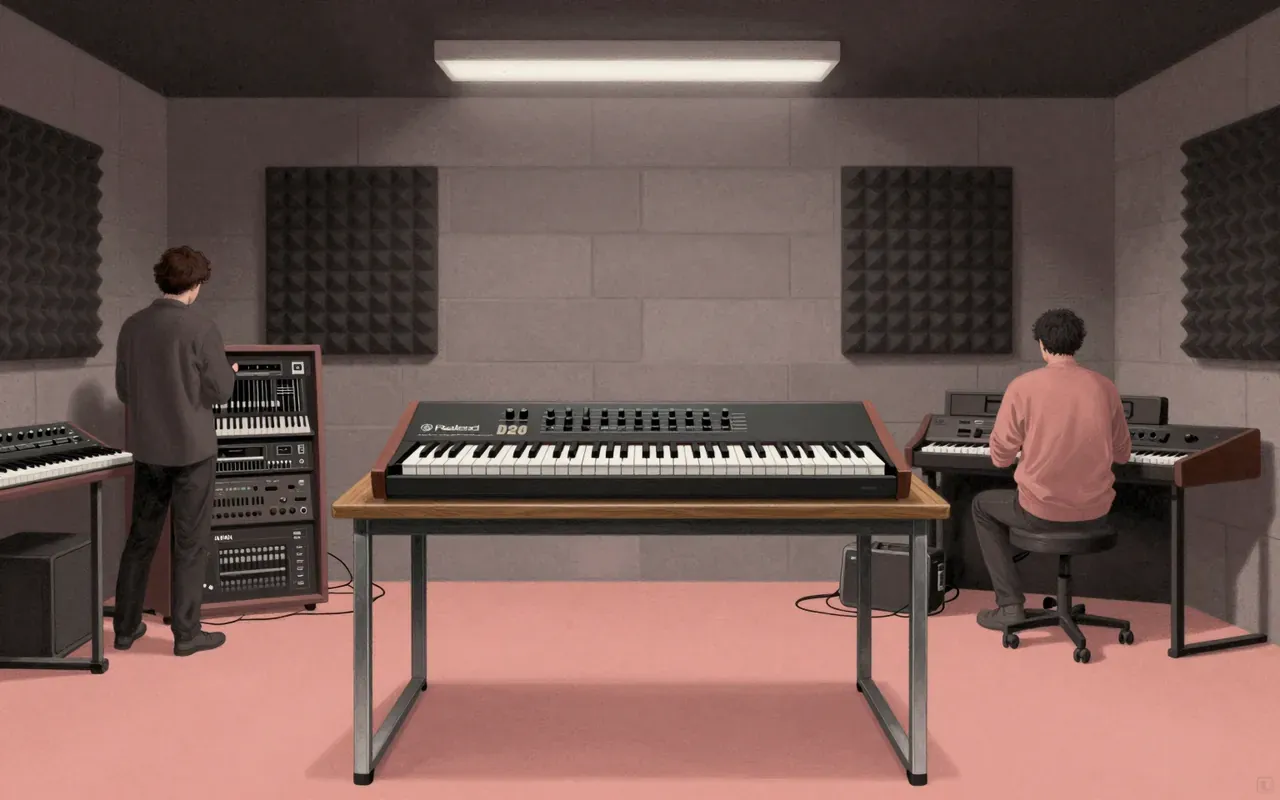
The D-20 is the D-50’s cheaper, slower, more stubborn sibling—and it earns its place by doing more with less.

The Roland D-20 is a 1988 digital synthesizer using Linear Arithmetic synthesis. It offers 32-voice polyphony, 8-part multitimbrality, a 61-key velocity-sensitive keyboard, an 8-voice sequencer with rhythm track, a built-in arpeggiator, reverb effects, and internal/external memory storage. LAS programming revolves around tones, partials, and timbres—a method that is difficult to learn but capable of unique results when mastered. It was produced from 1988 to 1992.

Chapters & takeaways4
  1. 0:58
    LAS, not legacy

    It runs Linear Arithmetic synthesis—not samples, not FM, not analogue.

  2. 2:19
    More voices, more parts

    32 voices and 8-part multitimbrality let it stack rhythms, bass, pads, and leads without layering hardware.

  3. 4:44
    Built-in beatbox

    Its 8-voice sequencer and arpeggiator make it a self-contained sketchpad—not just a tone generator.

  4. 6:28
    Tricky, not broken

    Tones, partials, and timbres are non-intuitive building blocks—but mastery unlocks unique textures.

Worth your time?

Yes. Use the whole thing.

3.5/ 5
What works
  • as a sequenced texture engine
  • as a multitimbral sketchpad
  • as a cost-conscious D-50 alternative
What does not
  • deliver immediate sonic gratification
  • support expressive real-time control
  • offer modern connectivity or workflow
Use it if
  • players familiar with LAS
  • producers needing layered sequencing in one box
  • collectors seeking functional D-series alternatives
Skip it if
  • beginners learning synthesis
  • performers requiring aftertouch or assignable controls
  • users expecting plug-and-play modern integration
The written brief1 min read

What it is and what it was built for

The Roland D-20 is a 1988 digital synthesizer built to bring Linear Arithmetic synthesis to performers and producers who needed more polyphony and sequencing than the D-10, but less expense and prestige than the D-50.

How it works, in terms a player would use

It uses linear arithmetic synthesis, built around tones, partials, and timbres. Programming demands layering these elements to shape sound. It has a 61-key velocity-sensitive keyboard, an 8-voice sequencer with rhythm track, a built-in arpeggiator, reverb effects, and internal/external memory storage.

What it does better than anything else

It delivers 32-voice polyphony and 8-part multitimbrality at a lower cost than the D-50—making layered, sequenced, rhythm-driven digital textures accessible in one box.

What it does badly

It falls short on immediacy: LAS editing is opaque and slow. There is no aftertouch, no assignable knobs for live filter or envelope tweaks, and no patch morphing or real-time parameter smoothing.

What people made with it

No verified examples of specific recordings, albums, or artists are given in the sources.

Who should use it, and who should not

A player who already understands LAS and wants a dedicated, sequencer-equipped D-10/D-110 sibling. Not for beginners learning synthesis, or for those who rely on tactile, real-time sound shaping.

Is it worth your time

Yes—if you want hands-on LAS programming without D-50 price or complexity. No—if you need intuitive real-time control, deep analogue warmth, or modern workflow integration.
Same bench · Synths & drum machines4 of 243
8:59
Roland Jupiter-6RolandThe Jupiter-6 delivers focused, hands-on bitimbral control and waveform stacking unavailable on the Jupiter-8 — but locks you into rigid voice splits and omits expressive dimensions like aftertouch.
10:36
Roland MKS-80RolandThe Roland MKS-80 is an 8-voice, rack-mount, fully analog subtractive synthesizer made from 1984 to 1987. It is the only MKS-series unit with voltage-controlled oscillators—not digitally-controlled ones. Its voice architecture mirrors the Jupiter-6 but adds an HPF, a low boost circuit in the second VCA, and a DC supply current boost. A February 1985 revision introduced updated VCOs, VCAs, and a filter later shared with the JX-8P, JX-10, and MKS-70. Each voice uses two Curtis CEM3340 VCOs. It has no keyboard, no sequencer, and minimal front-panel editing—requiring SysEx tools for deep programming.
8:02
Roland Juno-2 / Alpha Juno-2RolandThe Roland Juno-2 (Alpha Juno-2) is an 80s hybrid synth: analog filters and voice path, digital control over oscillators, envelopes, LFO, PWM, and chorus. It has 64 factory and 64 user patches, a velocity-sensitive 61-key keyboard, and a single digital wheel for editing. It lacks computer update capability and rack-mounting. Real-time sound switching is slow. It was built for studio use — not live performance.
8:32
Roland MKS-70 Super JXRolandThe Roland MKS-70 is a 1986 2U rack-mount analog synthesizer module. It combines two JX-8P engines for 12-voice polyphony and dual-tone layering. It stores 100 patches, each built from two of 64 tones. Chorus has only off/slow/fast settings. Chase-play enables delayed voice repeats. Front-panel editing is cumbersome and tedious. Full SysEx control and PC editing require firmware v1.08. It has three stereo outputs: one per tone and one mix. It lacks arpeggiator, sequencer and keyboard.
Up next in Audio

Fostex D-80

Fostex · 9:20

It’s not a classic — it’s a crunchy, second-hand relic that sounds like the 1980s because it couldn’t do better.

9:20