audiobriefs
9:02in productionCh. 1 · Not Analog. Not Emulation./ 9:02 · ceiling 15 min
Synths & drum machines

Access Virus

It doesn’t emulate analog—it replaces it with something sharper, faster, and less forgiving.

The Access Virus is a series of DSP-based virtual analog synthesizers introduced in 1997 and updated through the TI series. It offers subtractive, phase distortion, and FM synthesis—with wavetable added from the TI generation onward. Formats include rack modules (Virus B, C, TI Snow), keyboard versions (Virus KB, TI Keyboard, TI Polar), and fixed control layouts. It prioritises polyphonic stability, real-time editing, and aggressive tonal character over tactile expressivity or modern integration.

Chapters & takeaways4
  1. 1:03
    Not Analog. Not Emulation.

    A DSP-native virtual analog line—designed from 1997 onward to outperform analog in stability and polyphony.

  2. 2:34
    Form Follows Function

    Three physical formats: rack module, keyboard, and compact desktop—each with fixed form and function.

  3. 4:28
    Wavetable Was an Upgrade, Not a Foundation

    Synthesis expanded with each revision—wavetable arrived only with TI, not earlier models.

  4. 5:27
    Four Synthesis Types, One Engine

    It combines subtractive, phase distortion, FM—and later wavetable—in one signal path.

Worth your time?

Yes. Use the whole thing.

4/ 5
What works
  • aggressive filter response
  • tight oscillator sync
  • layered modulation within fixed architecture
  • consistent DSP character across revisions
What does not
  • support sample import
  • include aftertouch on most keyboards
  • offer deep MIDI learn per parameter
  • feature USB audio
Use it if
  • producers needing stable, high-headroom hardware leads and basses
  • performers who rely on immediate knob access and preset recall
  • sound designers drawn to phase distortion and wavetable scanning
Skip it if
  • those requiring expressive keybeds or MPE
  • users dependent on DAW-integrated patch management
  • anyone expecting analog-style warmth or saturation
The written brief1 min read

What it is and what it was built for

It is a series of DSP-based virtual analog synthesizers built for studio and stage use. It was built for producers and performers who needed polyphonic, stable, programmable hardware with expanding synthesis options across revisions.

How it works, in terms a player would use

It runs on DSP chips. It uses subtractive, phase distortion, and FM synthesis. From the TI series onward, it adds wavetable synthesis. You edit sounds with knobs and menus on its front panel. It has no built-in sequencer or arpeggiator.

What it does better than anything else

It delivers aggressive, high-headroom digital-analog hybrid tones with tight filter response and punchy oscillators. Its phase distortion and FM layers give sharp, cutting leads and metallic basses that cut through dense mixes. The TI series’ wavetable scanning adds motion without LFO dependency.

What it does badly

It offers no built-in effects beyond basic reverb and chorus. It lacks aftertouch on most keyboard versions. Its menu-diving workflow slows sound design compared to fully knob-per-function synths. It does not support sample import or granular synthesis.

What people made with it

Producers used it for trance leads, techno basslines, and film-score textures. Its Virus TI variants powered mid-2000s electronic pop and club tracks where bright, precise timbres were required.

Who should use it, and who should not

A producer or performer who values hardware immediacy, wants a dedicated rack or keyboard synth with consistent DSP character, and works in genres that benefit from its aggressive filter and layered modulation. Not for someone who relies on deep MIDI mapping, touch-sensitive controls, or integrated sampling.

Is it worth your time

Yes—if you need a hardware virtual analog synth with deep real-time control and evolving architecture across generations. No—if you need hands-on modulation routing, tactile feedback beyond knobs, or modern connectivity like USB audio or MPE.
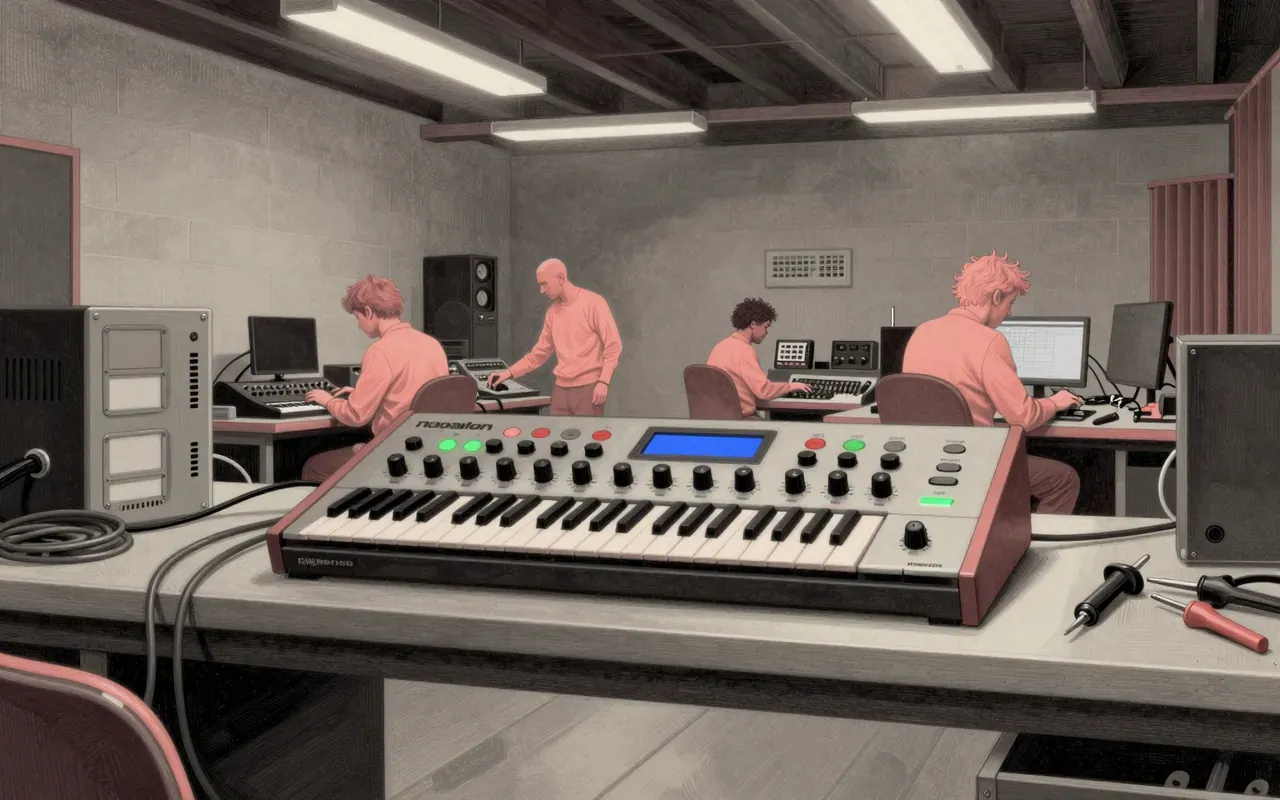
Same bench · Synths & drum machines4 of 40
9:20
ARP 2600ARPThe ARP 2600 is a foundational analog synthesizer designed for education. Its semimodular architecture, front-panel signal graphics, and duophonic voice count reflect its classroom purpose—not stage use. Its original filter was replaced after a patent dispute. It teaches synthesis more directly than any contemporaneous instrument, but offers no polyphony, no presets, and unstable tuning.
8:47
Roland CR-78RolandThe CR-78 is historically singular: the first microprocessor-based drum machine and the first to allow user-programmable pattern creation. Its analog synthesis yields 14 fixed drum sounds. Its four-note polyphony defines its rhythmic ceiling. It does not offer sound editing, velocity layers, or sample playback. It belongs in rooms where constraint is compositional strategy—not a flaw to be patched.
8:36
Yamaha CS-80Yamaha · 1976The Yamaha CS-80 is an analog synthesizer introduced in 1977. It supports true 8-voice polyphony, with two independent synthesizer layers per voice each with its own set of front panel controls. It has a layered keyboard that is both velocity-sensitive and pressure-sensitive, with polyphonic aftertouch and a ribbon controller for polyphonic pitch-bends and glissandos. Production of the instrument ceased in 1980.
9:20
Casio CZ synthesizersCasioThe Casio CZ series is a line of low-cost, digitally implemented phase distortion synthesizers introduced by Casio in 1984. They simulate analog filter behaviour without physical filters, using digital phase distortion instead. Each oscillator plays waveforms in series—not parallel—enabling sub-harmonics but restricting waveform pairing. Polyphony drops from eight to four voices when using two oscillators per voice. They were built for amateur musicians, prioritising affordability and portability over expressive control or sonic flexibility.
Up next in Audio

DigiTech Whammy

DigiTech · 1989 · 9:26

It doesn’t tune your guitar—it hijacks your pitch, one wobbly note at a time.

9:26