audiobriefs
9:51in productionCh. 1 · When it existed/ 9:51 · ceiling 15 min
Keyboards & organs · Synths & drum machines

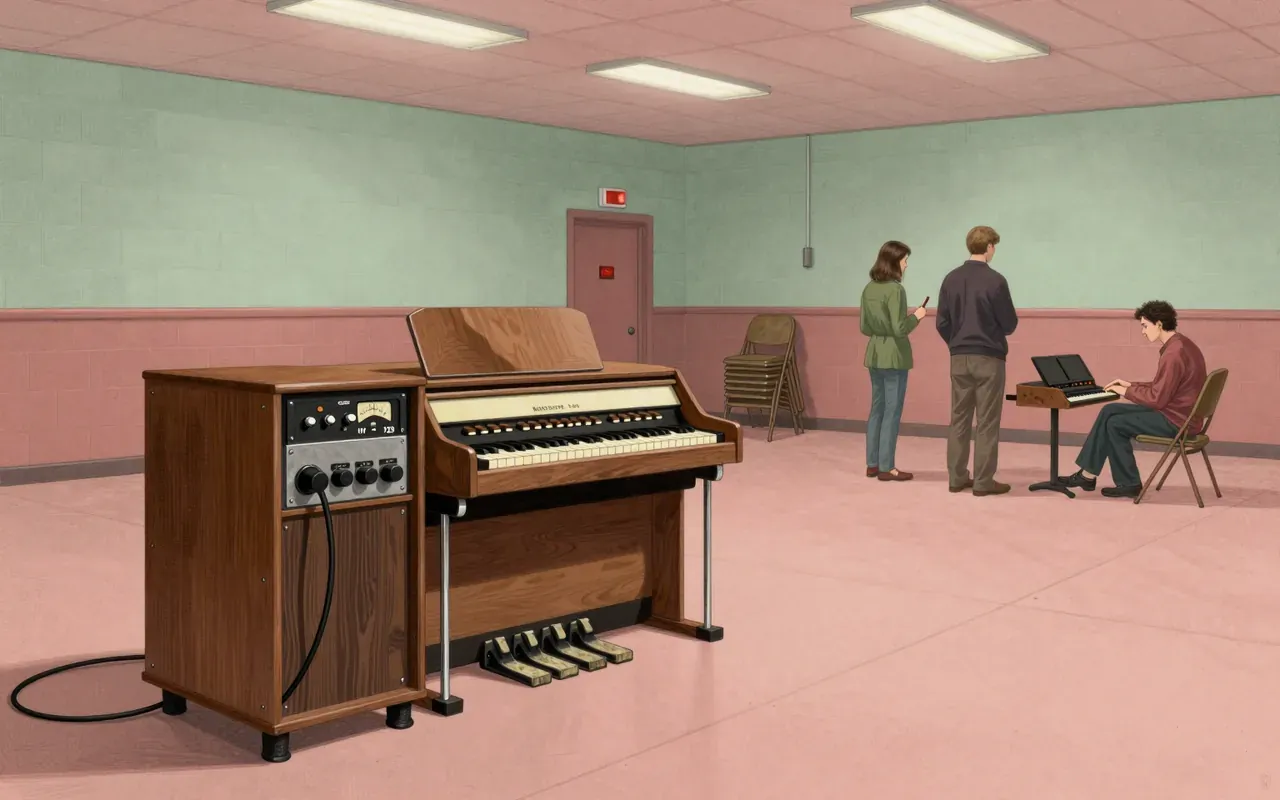
Yamaha YC-45D

It bends notes sideways — and everything else about it is a compromise to fit that trick into a single 1970s chassis.

The Yamaha YC-45D is a 1976–1980 hybrid organ-synthesizer. It combines drawbar organ, transistor organ, piano, harpsichord, distortion and a 3-octave ribbon synth. Its lateral per-note vibrato/bend is unmatched for its time. Its preset system is rudimentary. Its ribbon lacks visual pitch reference. Its emulations are shallow. It belongs in a room where articulation matters more than fidelity.

Chapters & takeaways4
  1. 1:02
    When it existed

    It was sold from 1976 to 1980 — a late-70s hybrid built before digital synthesis matured.

  2. 2:49
    What voices it gives you

    It mixes drawbars, transistor organ, piano, harpsichord and distortion — all switchable but not layerable.

  3. 4:21
    How it plays synth

    Its 3-octave ribbon controller is a direct precursor to the CS80’s expression — but without velocity or visual feedback.

  4. 6:10
    What it does uniquely

    Its lateral vibrato/bend effect works per note — a rare, physical articulation no other organ of its era offered.

Worth your time?

Yes. Use the whole thing.

3.5/ 5
What works
  • lateral vibrato/bend per note
  • drawbar-to-transistor voice switching
  • ribbon-triggered monophonic synth lines
  • distortion applied across all voices
What does not
  • deliver stable tuning
  • support layered voices
  • offer programmable presets
  • provide velocity sensitivity
Use it if
  • players who prioritise physical articulation over sonic depth
  • collectors seeking pre-CS80 Yamaha synth lineage
  • performers needing one-box versatility in 1970s-style contexts
Skip it if
  • studio producers requiring clean samples or stable intonation
  • players reliant on modern patch recall or MIDI integration
  • anyone expecting deep piano or harpsichord modelling
The written brief1 min read

What it is and what it was built for

The Yamaha YC-45D is a hybrid organ-synthesizer built between 1976 and 1980. It was built for performers needing one instrument to cover church, lounge, rock and experimental settings.

How it works, in terms a player would use

It layers drawbar organ, transistor organ, piano, harpsichord and synth voices. It uses physical drawbars for tonewheel emulation. It applies vibrato individually per note with a lateral bend effect. It triggers the synth section via a 3-octave touch-sensitive ribbon controller. It adds distortion to any voice.

What it does better than anything else

It delivers lateral vibrato/bend per note better than any contemporaneous organ or synth. It integrates Hammond-style drawbars with transistor organ and synth in one chassis more completely than any 1976–1980 competitor.

What it does badly

It does not sustain notes cleanly across the keyboard. Its piano and harpsichord emulations are shallow. Its presets are rudimentary. Its ribbon controller offers no visual pitch feedback. Its distortion is fixed-intensity and cannot be modulated.

What people made with it

People made Jon Lord–style distorted organ leads, Lucy-in-the-Sky–style harpsichord textures, and early synth lines using its ribbon — though no specific recordings or artists are documented in the source material.

Who should use it, and who should not

A player who values tactile, immediate control over tonal depth should use it. A player who needs stable intonation, layered patches or modern workflow integration should not.

Is it worth your time

It is worth your time if you need a single vintage instrument that covers organ, party-organ, plucked, percussive and early synth textures — but only if you accept its limited polyphony, untempered tuning and lack of presets beyond basic switches.

Same bench · Keyboards & organs4 of 28
10:14
Korg M1KorgThe Korg M1 is a 1988 sampling-based music workstation with 16-note polyphony, 16-bit PCM sample playback, built-in effects including reverb, delay, chorus, tremolo, EQ, distortion and Leslie simulation, and an eight-track MIDI sequencer. It uses sampled attack transients, loops, sustained waveforms and percussive samples. It was the bestselling synthesizer ever at that time, selling over 250,000 units. None of its features was unique, but their integration was unprecedented.
9:27
Hammond M3HammondThe Korg M3 88 is a workstation belonging to the M3 series. It features a dynamic 88-note RH3 keyboard with aftertouch. It supports expansion via an EXB-Radias card to reach nearly 1700 sounds across HD-1, EDS, and optional MMT synthesis. KARMA functions as a highly sophisticated and flexible live arpeggiator. A Kaos Pad is accessible via the touchscreen. The onboard sampler is size-limited despite memory expansion. The instrument is modular: the module can be separated from the keyboard or added to a RADIAS rack. Its six pads are less accurate than those on an MPC.
7:54
Leslie Leslie 122LeslieThe Leslie 122 is a rotating speaker cabinet designed for organs—not a preamp, not an effects unit, not a standalone amplifier. Its entire function depends on connection to a compatible organ like the Hammond M3. It offers no user controls. Its effect is purely mechanical: rotation creates tremolo and vibrato through air displacement. It cannot be used without modification for guitar or other instruments. It belongs only where an organ lives—and nowhere else.
8:38
Wurlitzer 200AWurlitzerThe Wurlitzer 200A is a 73-key electro-mechanical electric piano with built-in speakers, output jacks, a sustain pedal, carrying handles, and two knobs — one for volume, one for tremolo speed. Its keyboard action is tactile and easy to play. Its tone is uniquely recognizable. It is a newer model than earlier Wurlitzer electric pianos. It offers more tonal range than those earlier models only via dedicated tremolo and volume controls.
Up next in Audio

Tiptop Audio Z-DSP

Tiptop Audio · 8:49

It is not a synth, a pedal, or a DAW plugin — it is an effects module that only works inside a modular synth.

8:49