audiobriefs
9:12in productionCh. 1 · Built for Belgrade/ 9:12 · ceiling 15 min
Synths & drum machines

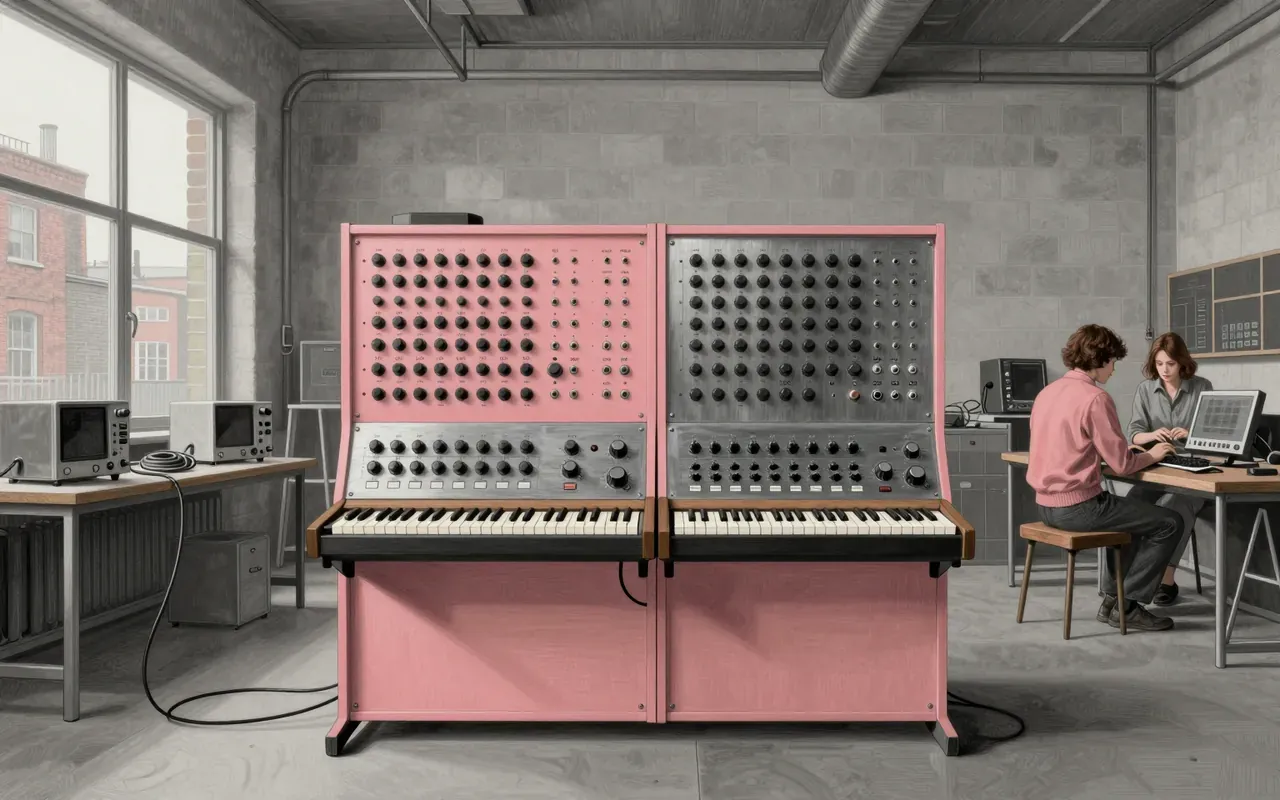
EMS Synthi 100

A microtonal sequencer fortress built for Radio Belgrade—not for your desk.

The EMS Synthi 100 is a large analogue/digital hybrid synthesizer commissioned by Radio Belgrade, designed by David Cockerell and documented in 1971. It developed from a concept of three VCS3 systems but contains analogue modules equivalent to six VCS3s. It features 12 voltage-controlled oscillators and eight voltage-controlled filters. Two monophonic keyboards produce four control voltages and two triggers. Its digital sequencer has three duophonic layers and 256 duophonic note events. Two 60×60 matrices connect modules via patch pins. Keyboard spread adjusts for equal temperament or microtonal tunings up to 61 divisions per semitone.

Chapters & takeaways4
  1. 1:00
    Built for Belgrade

    It began as a bespoke commission—not a product line.

  2. 2:26
    Analogue Density, Digital Layers

    Twelve oscillators, eight filters, four CVs, two triggers, and 256 duophonic note events—not polyphony.

  3. 4:17
    Pins Over Ports

    Two 60×60 matrices mean routing is tactile, visible, and slow.

  4. 5:50
    Microtonal by Design

    61 divisions per semitone isn’t theoretical—it’s dialled in on the keyboard.

Worth your time?

Yes. Use the whole thing.

3.5/ 5
What works
  • microtonal keyboard tuning up to 61 divisions per semitone
  • duophonic sequencing across three layers
  • large-scale voltage routing via dual matrices
  • integration of digital sequencing with analogue synthesis
What does not
  • support polyphony
  • save patches
  • integrate with modern DAWs
  • fit on a standard desk
Use it if
  • composers building custom electronic studios
  • researchers studying 1970s Eastern European electronic music infrastructure
Skip it if
  • live performers needing quick recall
  • producers working in stereo stems or plugin chains
  • anyone without dedicated floor space and technical staff
The written brief1 min read

What it is and what it was built for

It is a large analogue/digital hybrid synthesizer commissioned by Radio Belgrade. It was designed by David Cockerell and documented in 1971. It grew from a concept of three VCS3s but contains analogue modules equivalent to six VCS3s.

How it works, in terms a player would use

Two monophonic keyboards produce four control voltages and two triggers. Patching happens across two 60×60 matrices using pins. The 256-step digital sequencer runs three duophonic layers. Keyboard spread adjusts for equal temperament or microtonal tunings up to 61 divisions per semitone.

What it does better than anything else

It does microtonal keyboard tuning better than any contemporaneous British synth—up to 61 divisions per semitone—and integrates digital sequencing with analogue synthesis at scale unmatched by the VCS3 or early Buchla.

What it does badly

It does not support polyphony. Its monophonic keyboards and analogue architecture force sequential note entry. The patch matrix is slow to reconfigure mid-session. No built-in memory saves patch states.

What people made with it

Radio Belgrade used it to build their Electronic Studio. Composers there made works requiring layered duophonic sequencing, precise microtonal pitch control, and complex voltage routing across two independent matrices.

Who should use it, and who should not

A studio committed to Radio Belgrade–style electroacoustic composition should use it. Anyone needing MIDI, USB, preset recall, or under-20kg portability should not.

Is it worth your time

It is worth your time only if you need a physically patchable, microtonally flexible, multi-layered sequencer-driven system that occupies floor space and demands daily negotiation—not if you want immediacy, portability or stability.
Same bench · Synths & drum machines4 of 119
8:29
Novation Digital Music SystemsNovation · 1992The MM10 is a 1992 portable keyboard controller made by Novation Digital Music Systems. It was built to operate with the Yamaha QY10. It has no sound engine. It runs on batteries. It has full-sized keys. It forms, with the QY10, the first completely portable modern music workstation.
8:19
Mutable Instruments BraidsMutable InstrumentsBraids delivers radical timbral variety in minimal space—but with no internal editing, no tuning stability guarantees, and no analogue circuitry. It is a selector, not a synthesizer.
8:40
Mutable Instruments CloudsMutable InstrumentsClouds is a granular audio processor for Eurorack that transforms live input into dense, overlapping grains. It records continuously into a short, variable buffer (up to 8 seconds), allows freezing that buffer to isolate a sonic space, and provides hands-on control over grain position, size, pitch, density, timing distribution, and envelope shape. A diffuser blurs transients using all-pass filters. It supports 40–60 concurrent grains and operates in stereo with extensive CV control, dry/wet blending, feedback, and reverb-like effects during freeze mode. It does not store or recall samples, nor does it support offline processing or waveform editing.
10:15
Doepfer Dark EnergyDoepferA compact, monophonic, fully analog synthesizer released in 2010 as a stand-alone version of the Doepfer A-111-5 Eurorack module. It features dual LFOs capable of audio-rate FM (~5 kHz), a 24 dB/octave low-pass VCF, and a triangle-based VCO. The VCF can function as a sine oscillator when the VCO is disengaged and resonance is maxed. All sound generation and modulation are analog; only USB/MIDI contain digital components. It has no polyphony, no patch memory, no velocity or aftertouch, and no audio input. Superseded by the Dark Energy II in 2012.
Up next in Audio

EMS Synthi AKS

EMS · 1972 · 10:43

A portable noise machine that trades stability for spontaneity—and never apologises for it.

10:43