audiobriefs
10:43in productionCh. 1 · Built for movement/ 10:43 · ceiling 15 min
Synths & drum machines

EMS Synthi AKS

A portable noise machine that trades stability for spontaneity—and never apologises for it.

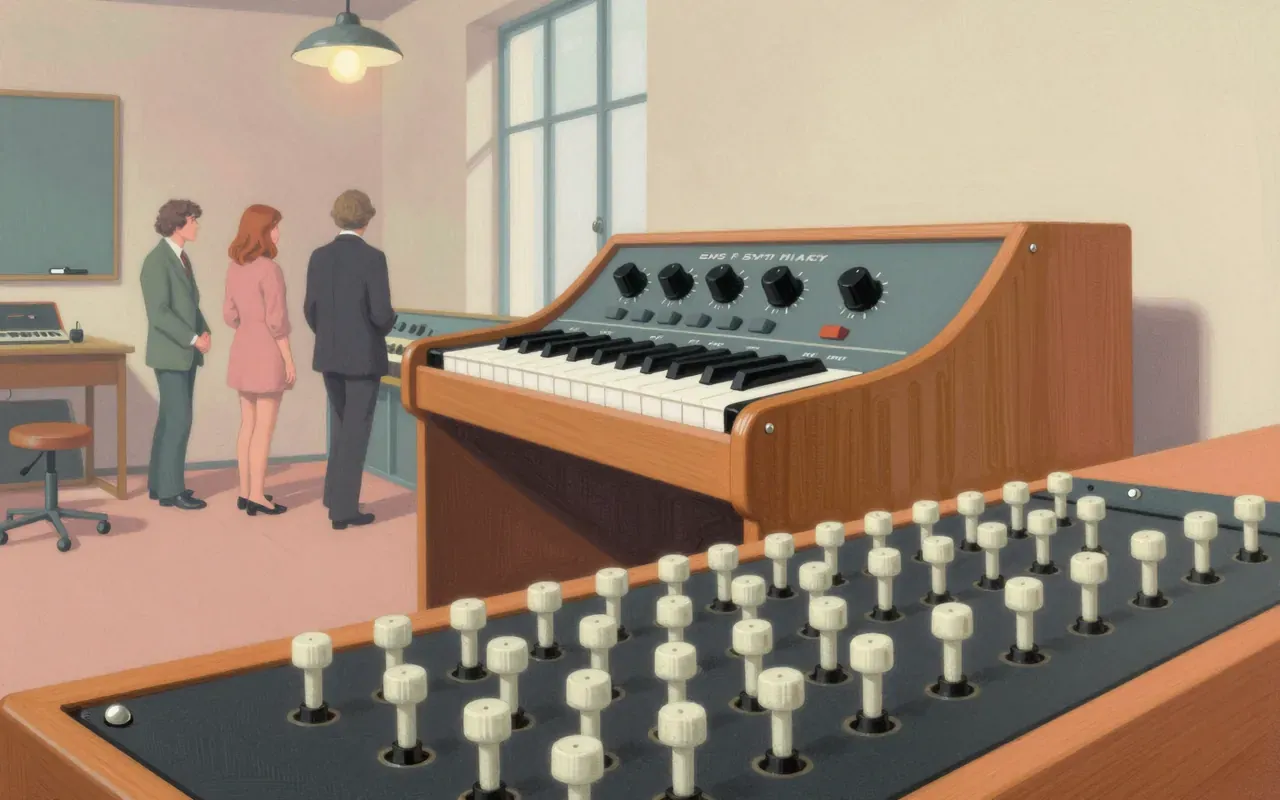
The EMS Synthi AKS is a portable modular analog synthesiser introduced in March 1972. It features a built-in keyboard and sequencer, a patch pin matrix, and shares design DNA with the VCS 3. Its sequencer creates eight-note repeating patterns. Users have described it as a 'noise machine'. One full album—Music from the SYNTHI—was made using only this instrument.

Chapters & takeaways4
  1. 1:04
    Built for movement

    It is a self-contained, portable analog synth with keyboard and sequencer built in from day one.

  2. 2:38
    Patch by pin, play by pulse

    Its pin matrix and eight-note sequencer make pattern-building physical, not programmatic.

  3. 4:44
    Noise is the interface

    It was called a 'noise machine'—not as insult, but as job description.

  4. 6:23
    All you need

    One album was made using only this instrument—proof it can carry a full sonic world.

Worth your time?

Yes. Use the whole thing.

4/ 5
What works
  • generating hypnotic sequences
  • processing vocals and guitars
  • creating noise textures
  • working portably
What does not
  • hold tune
  • store patches
  • sync to modern clocks
  • play chords
Use it if
  • sound designers
  • experimental composers
  • live performers who prioritise gesture over grid
Skip it if
  • producers reliant on recall
  • MIDI-based workflows
  • studio engineers needing stable tracking
The written brief1 min read

What it is and what it was built for

A portable modular analog synthesiser built in 1972. It was built for live experimentation: sequencing, processing external sources, and generating raw electronic sound in studio or on stage.

How it works, in terms a player would use

It uses a patch pin matrix to route signals between oscillators, filters and envelope generators. The built-in keyboard and sequencer are fixed parts of the signal path. You set notes with pins on the sequencer grid. You hear sound only when pins are placed and the sequencer is running.

What it does better than anything else

It generates unpredictable, evolving textures faster than any other instrument of its era. Its sequencer locks into hypnotic eight-note loops without quantisation drift. Its patch matrix forces immediate, tactile decisions—no menus, no layers, no undo.

What it does badly

It cannot hold pitch reliably over time. It offers no memory for patches or sequences. There is no MIDI, no USB, no CV/Gate output beyond its own internal bus. The keyboard is monophonic and non-velocity-sensitive.

What people made with it

David Gilmour used it to create the repeating eight-note sequence on Pink Floyd’s ‘On the Run’. Depeche Mode used it as a ‘noise machine’ during Music for the Masses. Yoshio Machida made an entire album—Music from the SYNTHI—using only the Synthi AKS.

Who should use it, and who should not

Experimental composers, sound designers and performers who value immediacy over precision. Not for producers who rely on recall, sync or repeatability.

Is it worth your time

Yes—if you want a portable, hands-on tool for generative noise, looping sequences and vocal or guitar processing. No—if you need stable tuning, polyphony, recallable patches or integration with modern gear.

Same bench · Synths & drum machines4 of 119
8:29
Novation Digital Music SystemsNovation · 1992The MM10 is a 1992 portable keyboard controller made by Novation Digital Music Systems. It was built to operate with the Yamaha QY10. It has no sound engine. It runs on batteries. It has full-sized keys. It forms, with the QY10, the first completely portable modern music workstation.
8:19
Mutable Instruments BraidsMutable InstrumentsBraids delivers radical timbral variety in minimal space—but with no internal editing, no tuning stability guarantees, and no analogue circuitry. It is a selector, not a synthesizer.
8:40
Mutable Instruments CloudsMutable InstrumentsClouds is a granular audio processor for Eurorack that transforms live input into dense, overlapping grains. It records continuously into a short, variable buffer (up to 8 seconds), allows freezing that buffer to isolate a sonic space, and provides hands-on control over grain position, size, pitch, density, timing distribution, and envelope shape. A diffuser blurs transients using all-pass filters. It supports 40–60 concurrent grains and operates in stereo with extensive CV control, dry/wet blending, feedback, and reverb-like effects during freeze mode. It does not store or recall samples, nor does it support offline processing or waveform editing.
10:15
Doepfer Dark EnergyDoepferA compact, monophonic, fully analog synthesizer released in 2010 as a stand-alone version of the Doepfer A-111-5 Eurorack module. It features dual LFOs capable of audio-rate FM (~5 kHz), a 24 dB/octave low-pass VCF, and a triangle-based VCO. The VCF can function as a sine oscillator when the VCO is disengaged and resonance is maxed. All sound generation and modulation are analog; only USB/MIDI contain digital components. It has no polyphony, no patch memory, no velocity or aftertouch, and no audio input. Superseded by the Dark Energy II in 2012.
Up next in Audio

Roland System 700

Roland · 1976 · 9:00

A monophonic modular system built for professionals — not for playing live, not for learning, not for saving space.

9:00