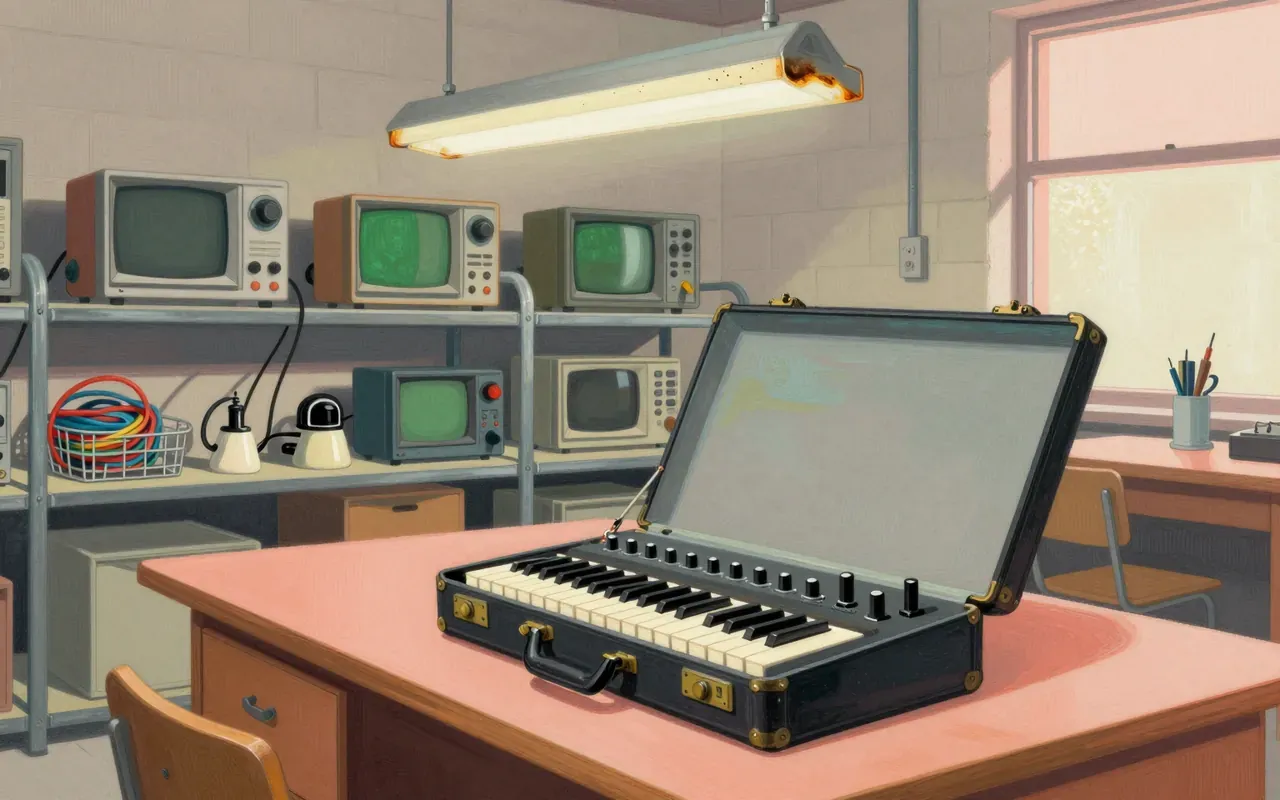
The only Moog that folds — and the only Moog that folds *because* it was built for the classroom, not the studio.
The Moog Sonic Six is a duophonic analog synthesizer introduced in 1972. It was built for portability and education after Bill Waytena acquired R.A. Moog Inc. and rebranded the Sonic V as the Sonic Six. Its folding control panel is unique in Moog’s history. It was widely used for lectures and educational purposes, often by Bob Moog himself. It delivers weak sound compared to the MiniMoog and suffers from reliability issues. Its single contour generator is shared between VCA and VCF, limiting independent envelope shaping. It is worth your time only if you need a portable, self-contained analog synth for live lecture demos or classroom use — not for studio depth, reliability, or sonic authority.
It is duophonic, not monophonic — and it is Moog Music’s rebranded version of the Sonic V.
2:28
The only Moog that folds
Its folding control panel is unique in Moog’s history — no other model has it.
3:46
Built for the classroom
It was designed for mobility and teaching — Bob Moog used it himself in lectures.
5:01
Weak sound, strong portability
It sounds thin and unreliable next to the MiniMoog — but it plays anywhere with no external gear.
Worth your time?
Yes. Use the whole thing.
2.5/ 5
What works
mobile-teaching
self-contained-demos
What does not
studio-recording
live-performance
sound-design
Use it if
educators
lecture-demonstrators
Skip it if
studio-producers
gigging-performers
collectors-seeking-sonic-variety
The written brief1 min read
What it is and what it was built for
A duophonic analog synthesizer introduced in 1972. Built for portability and education after Bill Waytena acquired R.A. Moog Inc. and rebranded the Sonic V as the Sonic Six.
How it works, in terms a player would use
Two VCOs feed into a diode-ladder (later transistor) filter. A single contour generator shapes both VCA and VCF. Dual LFOs and a ring modulator add modulation. The pitch bend wheel is horizontal and spring-loaded. The control panel folds over the keyboard for transport.
What it does better than anything else
It folds. No other Moog product has a folding control panel. Its built-in speaker and briefcase format make it uniquely suited for mobile educational demonstration.
What it does badly
It delivers weak sound compared to the MiniMoog. It suffers from reliability issues. It shares one contour generator between VCA and VCF, limiting independent envelope shaping.
What people made with it
Bob Moog used it for lectures. It was widely used for educational purposes — not for recording albums or stage performance.
Who should use it, and who should not
Educators demonstrating synthesis live should use it. Studio producers, gigging performers, or collectors seeking sonic versatility should not.
Is it worth your time
It is worth your time only if you need a portable, self-contained analog synth for live lecture demos or classroom use — not for studio depth, reliability, or sonic authority.