audiobriefs
7:42in productionCh. 1 · Built for bite, not breadth/ 7:42 · ceiling 15 min
Synths & drum machines

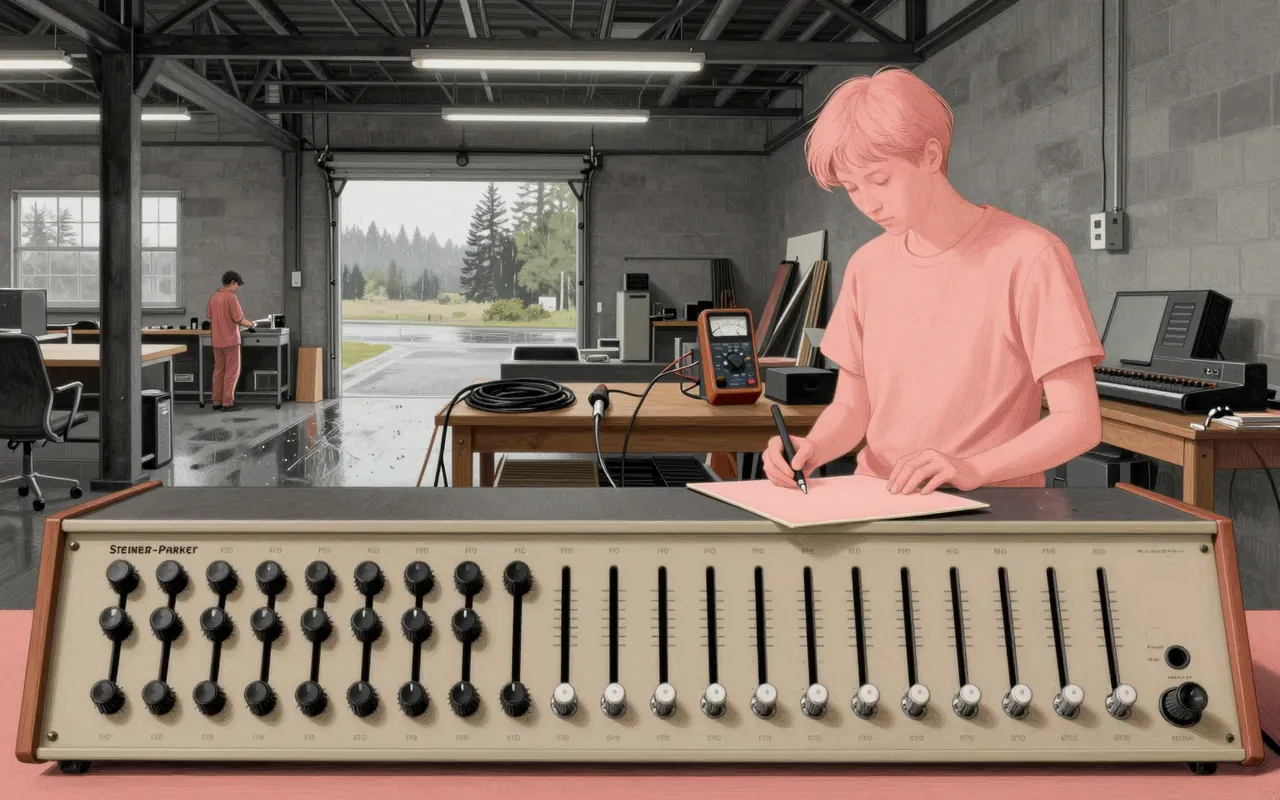
Steiner-Parker Synthacon

The Synthacon’s filter doesn’t choke when you crank resonance—so it sings where others gasp.

The Steiner-Parker Synthacon is a monophonic analog synthesizer released in 1975. Its defining feature is Nyle Steiner’s 12dB/octave multimode filter, which self-oscillates and sustains full amplitude at all resonance settings—a deliberate departure from the Minimoog and ARP Odyssey. Several hundred units were made. It has no polyphony, no LFO, no patch memory, and tuning stability is not documented. Its value lies in its singular filter behaviour, not versatility or convenience.

Chapters & takeaways4
  1. 0:49
    Built for bite, not breadth

    Monophonic analog, launched in 1975 as a cheaper alternative to the Minimoog and ARP Odyssey.

  2. 1:54
    Resonance that doesn’t fade

    Its 12dB/octave multimode filter self-oscillates—and stays loud at any resonance.

  3. 3:23
    One man, one filter, one voice

    Nyle Steiner designed the filter. It’s the core of the instrument—not an add-on.

  4. 4:38
    Scarce by design, not legend

    Several hundred units were made. Rarity isn’t romantic—it means no spares, no manuals, no certainty.

Worth your time?

Yes. Use the whole thing.

3.5/ 5
What works
  • as a lead voice with singing, resonant filter sweeps
  • as a source for aggressive, self-oscillating tones
  • as a foundational reference for later Steiner-derived filters
What does not
  • support polyphony
  • include an LFO
  • retain stable tuning across sessions
  • offer preset storage
Use it if
  • players who prioritise expressive filter control over reliability
  • builders and modders interested in the Steiner filter topology
  • sound designers seeking unattenuated resonance
Skip it if
  • performers needing live stability
  • composers requiring polyphonic textures
  • users dependent on recallable patches
The written brief1 min read

What it is and what it was built for

A monophonic analog synthesizer released in 1975. Built in Salt Lake City to compete with the Minimoog and ARP Odyssey on price and character—not features or stability.

How it works, in terms a player would use

It is monophonic. It has a 12dB/octave multimode filter with low-pass, high-pass and band-pass modes. The filter self-oscillates. Resonance increases without cutting output volume, thanks to positive feedback.

What it does better than anything else

Its filter maintains amplitude at all resonance levels. That makes it uniquely suited for sustained, singing leads and aggressive, unattenuated filter sweeps—something the Minimoog and ARP Odyssey cannot do without external compensation.

What it does badly

It offers no voltage-controlled envelope for the filter. It lacks a dedicated LFO. It has no built-in sequencer or patch memory. Tuning drifts. Only several hundred were made, so service and parts are scarce.

What people made with it

The document does not state what people made with it.

Who should use it, and who should not

Use it if you value hands-on, immediate filter control and accept its limitations: monophony, tuning instability, and no modulation routing beyond the basic VCA and VCF envelopes. Avoid it if you rely on reliability, polyphony, or modern workflow integration.

Is it worth your time

Yes—if you want a raw, resonant, monophonic analog voice that behaves unlike the Minimoog or ARP Odyssey. No—if you need polyphony, presets, or stable tuning over long sessions.
Same bench · Synths & drum machines4 of 119
8:29
Novation Digital Music SystemsNovation · 1992The MM10 is a 1992 portable keyboard controller made by Novation Digital Music Systems. It was built to operate with the Yamaha QY10. It has no sound engine. It runs on batteries. It has full-sized keys. It forms, with the QY10, the first completely portable modern music workstation.
8:19
Mutable Instruments BraidsMutable InstrumentsBraids delivers radical timbral variety in minimal space—but with no internal editing, no tuning stability guarantees, and no analogue circuitry. It is a selector, not a synthesizer.
8:40
Mutable Instruments CloudsMutable InstrumentsClouds is a granular audio processor for Eurorack that transforms live input into dense, overlapping grains. It records continuously into a short, variable buffer (up to 8 seconds), allows freezing that buffer to isolate a sonic space, and provides hands-on control over grain position, size, pitch, density, timing distribution, and envelope shape. A diffuser blurs transients using all-pass filters. It supports 40–60 concurrent grains and operates in stereo with extensive CV control, dry/wet blending, feedback, and reverb-like effects during freeze mode. It does not store or recall samples, nor does it support offline processing or waveform editing.
10:15
Doepfer Dark EnergyDoepferA compact, monophonic, fully analog synthesizer released in 2010 as a stand-alone version of the Doepfer A-111-5 Eurorack module. It features dual LFOs capable of audio-rate FM (~5 kHz), a 24 dB/octave low-pass VCF, and a triangle-based VCO. The VCF can function as a sine oscillator when the VCO is disengaged and resonance is maxed. All sound generation and modulation are analog; only USB/MIDI contain digital components. It has no polyphony, no patch memory, no velocity or aftertouch, and no audio input. Superseded by the Dark Energy II in 2012.
Up next in Audio

Elka Synthex

Elka · 8:42

The only 1980s Italian synth that lets you sequence four monophonic lines while cross-modulating pulse width across eight analog voices.

8:42