audiobriefs
10:22in productionCh. 1 · The First Boss Overdrive/ 10:22 · ceiling 15 min
Effects & pedals

Boss OD-1 OverDrive

It doesn’t sound like an amp—it sounds like your amp breaking up earlier, warmer, and messier.

The Boss OD-1 is a 1977–1985 overdrive pedal with Level and Overdrive knobs only. It uses a FET boost circuit that degrades the dry signal when bypassed. It delivers low-gain saturation by pushing an already overdriven amp’s front end—not by distorting on its own. It lacks tone control. It preceded the SD-1. It performs best in that narrow context—and nowhere else.

Chapters & takeaways4
  1. 0:51
    The First Boss Overdrive

    It was Boss’s first overdrive—and a deliberate pivot from fuzz to amp-friendly saturation.

  2. 2:17
    No Tone Knob, No Excuses

    Two knobs. No tone. No compromise. You dial in drive and volume—or nothing.

  3. 3:41
    Bypass Is Broken. Use It That Way.

    It leaks and dulls your signal when off—and works best only when your amp is already singing.

  4. 5:24
    Front-End Breakup, Not Pedal Distortion

    It doesn’t replace your amp’s distortion—it coaxes more of it out, earlier and softer.

Worth your time?

Yes. Use the whole thing.

3.5/ 5
What works
  • as a low-gain front-end saturator
  • when placed before an overdriven tube amp
  • as a period-correct texture layer
What does not
  • sound like a modern overdrive
  • work well with solid-state amps
  • preserve signal integrity when off
Use it if
  • players using tube amps already on the edge of breakup
  • collectors seeking original 1970s Boss design language
  • engineers tracking how early FET circuits shaped pedal tone
Skip it if
  • players needing silent true-bypass
  • those relying on pedal EQ to shape tone
  • anyone expecting clean boost capability
The written brief1 min read

What it is and what it was built for

The Boss OD-1 is a 1977 overdrive pedal built as a low-gain alternative to fuzz boxes. It was designed to push an amplifier’s input stage into breakup—not to distort on its own.

How it works, in terms a player would use

It has only two knobs: Level and Overdrive. No tone control. It uses a FET boost circuit. When bypassed, it leaks signal and sucks tone.

What it does better than anything else

It breaks up the front end of an already overdriven amp more naturally than later Boss overdrives—delivering a specific low-gain saturation that sits close to amp distortion, not pedal distortion.

What it does badly

It fails at transparency. The FET circuit degrades the dry signal when off. It offers no tone adjustment. It cannot drive an amp cleanly from clean.

What people made with it

Players used it in front of already overdriven amps to thicken and compress their core amp tone without adding high-gain fizz or artificial mid-scoop.

Who should use it, and who should not

Players chasing vintage low-gain warmth who own an overdriven tube amp and tolerate compromised bypass. Not for players needing silent switching, EQ control, or clean boost.

Is it worth your time

Yes—if you want low-gain amp breakup and accept its limitations. No—if you need transparency, tone shaping, or clean bypass.
Same bench · Effects & pedals4 of 121
7:59
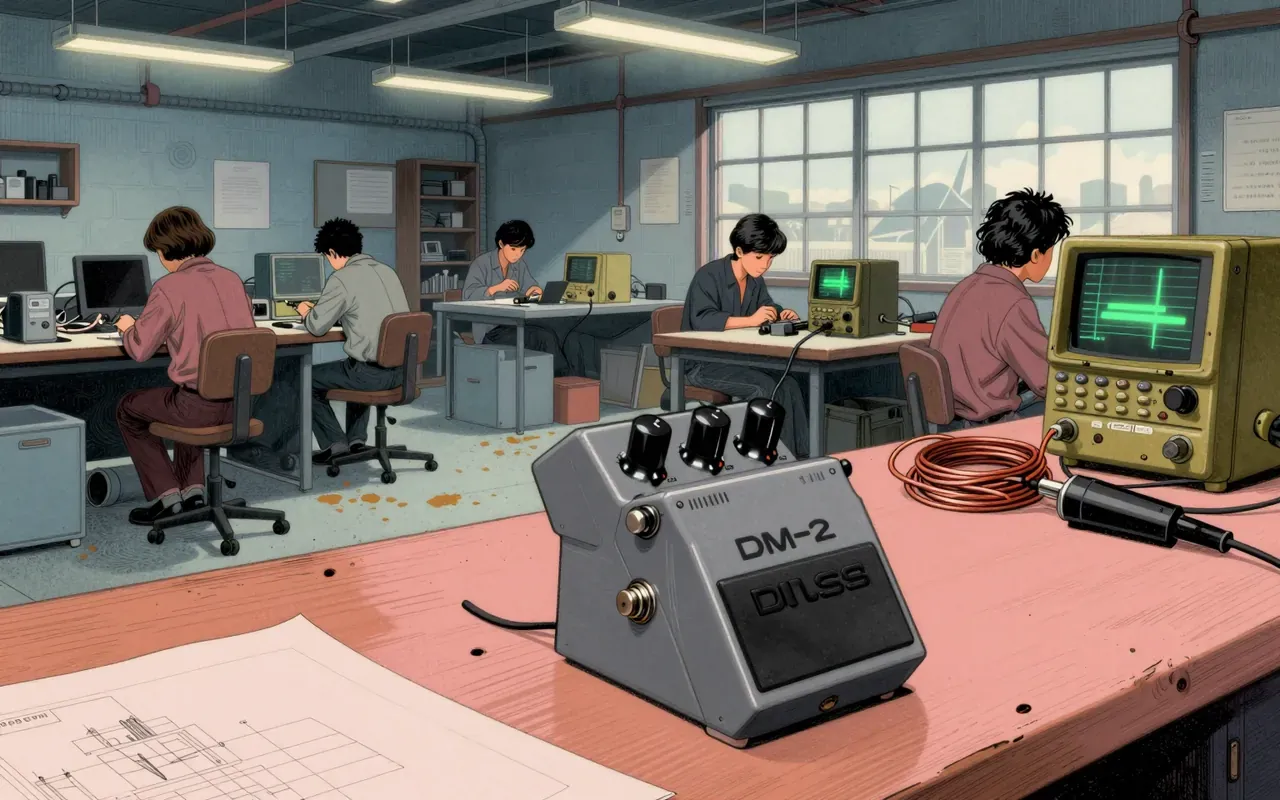
Boss DM-2 DelayBossThe Boss DM-2 is a Japanese-made analog delay pedal released in 1981. It delivers warm, tone-enhancing repeats from 20ms to 300ms using three knobs: Repeat Rate, Echo, and Intensity. It has no MIDI, no computer control, and is not rackable. It was built for guitar and other electronic instruments. It thickens tone rather than cutting with precision.
9:00
Boss DS-1Boss · 1978The Boss DS-1 is a 1978 distortion pedal built for tight, aggressive tones using hard-clipping circuitry. It uses input/output buffers, a transistor boost stage, an op-amp gain stage with hard clipping diodes, and a tone control. A JFET switching circuit engages or bypasses the effect via a momentary push button. It helped popularise distortion as a distinct pedal category and served as a template for later designs. The 1994 circuit redesign introduced volume loss and a fizzy or waspy edge—problems that spawned a community of modifiers. It remains Boss’s bestselling drive pedal.
8:41
Pro Co RATPro CoThe Pro Co RAT is a distortion pedal for electric guitar, first prototyped in 1977 or 1978 and entering full production in 1979. Its distinctive aggressive distortion stems from an accidental 47 ohm resistor substitution that increased op-amp gain, combined with diode-based hard-clipping. It uses an op-amp to amplify and diodes to limit the signal.
9:12
List of distortion pedalsMarshallDistortion pedals are foot-operated clipping devices for guitar and bass. They are not amplifiers, not processors, not tone-shapers—just signal clippers. Their value lies in repeatability, placement, and type: fuzz, distortion, or overdrive. Nothing more.
Up next in Audio

Boss PH-1 Phaser

Boss · 7:15

A Leslie speaker in a box — no more, no less.

7:15